

High deductible health plan education for employees is the set of materials, sessions, and follow-up support an employer gives so workers understand deductibles, out-of-pocket maximums, and health savings accounts before they pick a plan. Done well, it turns a plan people tolerate into a plan they can actually choose on purpose.
This guide is for HR teams, benefits managers, and the brokers who support them. It covers what to explain, how to explain it in plain language, and where the line sits between educating your workforce and giving someone individualized financial or medical advice. Plan documents and current IRS rules always control the specifics.
If your enrollment push is running on a single email and a benefits fair, you are probably leaving the harder questions unanswered. The how to get employees to participate in wellness programs piece covers the participation side of the same problem.
Table of Contents
- What Is a High Deductible Health Plan?
- Why High Deductible Health Plan Education Matters
- What Should Employees Understand About the Plan?
- How to Explain Deductibles, Copays, and Coinsurance
- How Do HSA and FSA Contributions Affect Plan Decisions?
- What Should an Employee Education Session Cover?
- How Can Employers Make the Education Easy to Access?
- High Deductible Health Plan Education for Employees: What to Say
- Frequently Asked Questions
- How does an HSA work for employees?
- What are the requirements to qualify for a high deductible health plan and HSA?
- What are the drawbacks of a high deductible health plan?
- Why do companies push HDHPs?
- What questions should I ask HR about my health insurance?
- Does an HDHP with an HSA cost less than a PPO?
- Conclusion: Start With One Clear Benefits Conversation
What Is a High Deductible Health Plan?
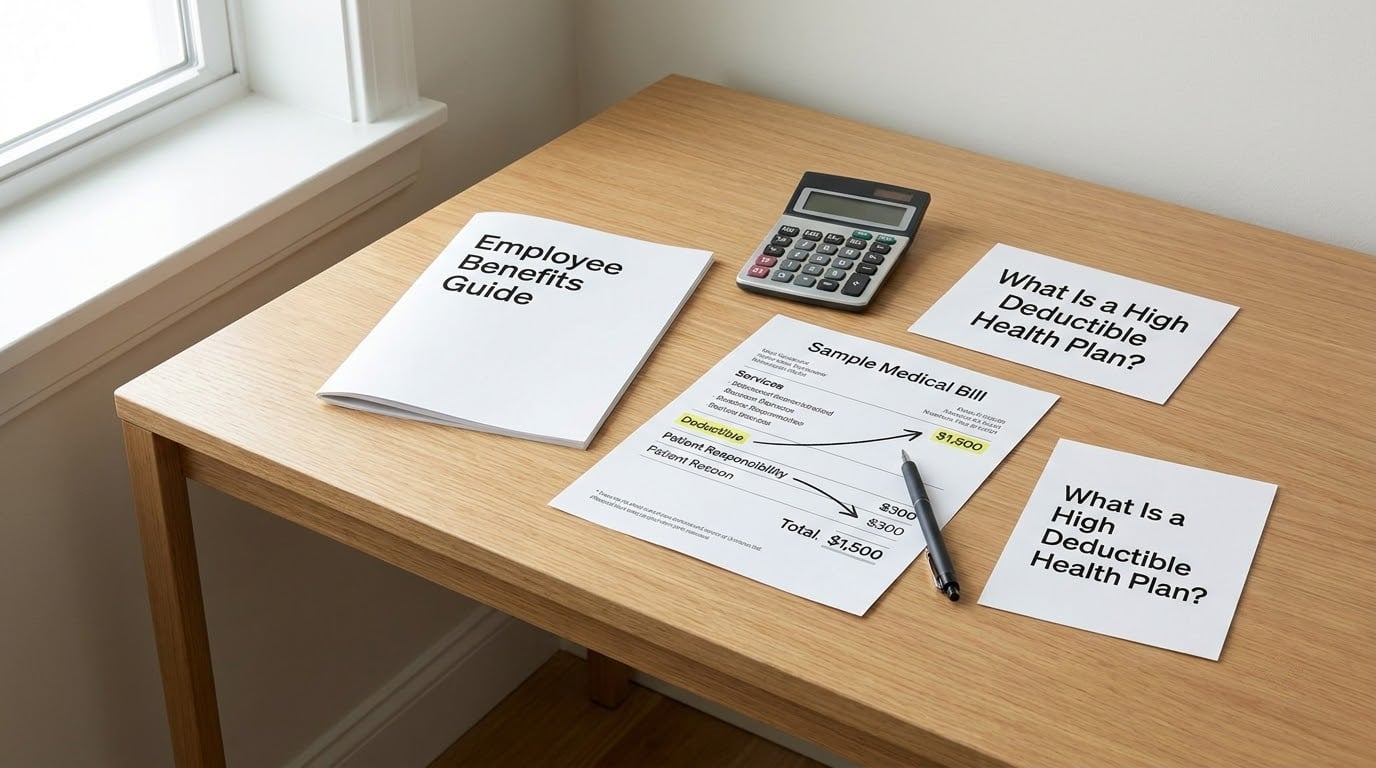
A high deductible health plan is a medical plan whose deductible is higher than the minimum set by law, and whose out-of-pocket maximum caps what you can spend on covered in-network care in a plan year. It pairs with a health savings account, which is the account that makes the higher deductible tolerable.
Five cost terms get mixed up constantly, and separating them is the single most useful thing an employer can do in a benefits meeting.
- Premium is what you pay to keep coverage, usually taken from payroll every pay period regardless of whether you use care.
- Deductible is the amount you pay for covered services before the plan starts sharing the bill.
- Copay is a flat amount for a specific service, such as an office visit, and it often applies before you finish the deductible.
- Coinsurance is a percentage of the allowed amount that you pay after the deductible is met.
- Out-of-pocket maximum is the ceiling on what you pay for in-network covered services in one year, including your deductible, copays, and coinsurance.
Here is the piece most employees get wrong. Suppose a plan has a deductible, and someone has a specialist visit early in the year without having met any of it. If the plan has no copay for that visit, the employee may pay the plan’s full allowed amount for it. Nothing kicks in until the deductible is satisfied.
Employers offer this design because the per-paycheck premium is lower, and because pairing it with an HSA shifts some of the spending decision to the employee. Both are reasonable goals, and neither one settles the question of whether the plan fits a given household. Employees who want support getting into the program consistently show up in open enrollment questions, and the incentives that actually motivate employees playbook covers that side too.
Why High Deductible Health Plan Education Matters

Employees who do not understand their plan change their behavior in ways employers rarely see coming. They postpone a screening, they pick a cheaper appointment they do not need, or they never fund the HSA at all and lose the account’s main advantage.
The cost shows up in research that benefits providers keep citing, where a little over half of patients on a high deductible plan reported delaying or skipping care because they could not tell what it would cost. That is a plan design outcome and an information problem at the same time, and education can only fix the second half of it.
The other half of the problem is the HSA. Research from the Employee Benefit Research Institute found that roughly a third of HSA holders withdraw more from their accounts than they put in. An account that behaves like a checking account is not delivering the tax advantages that justified the deductible in the first place.
There is a limit to what education can fix, and knowing it protects you. An employer can explain how a deductible works, what a qualified medical expense is, and what the network rules say. It cannot tell a specific employee which plan fits their health and their household budget. Say that out loud in the session, because employees assume the difference is being deliberately vague.
What Should Employees Understand About the Plan?
Any education session worth the calendar slot covers the same core list. If one of these is missing, employees will be guessing during open enrollment and phoning HR in February instead.
- The annual deductible, and whether it is embedded or aggregated for family coverage
- Individual and family deductible amounts, which are not always the same number
- In-network versus out-of-network care, and the fact that the out-of-pocket maximum usually does not protect against out-of-network charges
- Coinsurance percentages and the copays that apply to specific services
- Preventive services, which many plans cover before the deductible is met
- Prescription coverage, including tiers, generics, and mail-order options
- The out-of-pocket maximum and what it does and does not count
- Where the official plan document lives and who to call when this guide disagrees with it
One more habit pays off more than any other: have employees read the plan’s Summary of Benefits and Coverage. It is short, standardized, and it settles most arguments about what a visit actually costs.
How to Explain Deductibles, Copays, and Coinsurance
Definitions on a slide are not education. The best version of this conversation walks through one real claim from start to finish, in a fixed order, so the employee sees where each piece lands.
Take a claim. First, the plan pays its share and the employee pays the allowed amount until the deductible is met. Second, once the deductible is met, the employee pays the plan’s coinsurance share on each claim. Third, a copay replaces coinsurance for services where the plan lists one, such as a primary care visit. Fourth, everything the employee pays on covered in-network claims accumulates toward the out-of-pocket maximum.
Then say the part people resist hearing: the amount owed for any one service is not fixed in advance. Two employees on the identical plan can owe very different amounts for the same procedure, because their deductibles are at different points and their plans handle copays differently.
Give employees a formula they can reuse. Expected annual cost is roughly your premiums, plus what you expect to spend between the deductible and the out-of-pocket maximum, plus anything your plan charges outside that cap. Compare that figure across plans, then repeat it for a good year and a bad year. Most employees have never made that comparison, which is why a single afternoon can change their enrollment.
How Do HSA and FSA Contributions Affect Plan Decisions?
A health savings account and a flexible spending account both help employees pay for care, and they behave very differently. Mixing them up is the most expensive mistake an employee can make during enrollment, so this section deserves real time.
An HSA is an account the employee owns. Contributions usually come through a Section 125 cafeteria plan on a pre-tax payroll deduction, growth is tax-free, and qualified medical withdrawals are tax-free. The balance rolls over year to year with nothing to lose, and it stays with the employee if they change jobs or leave the workforce. Contributions are limited annually, and catch-up contributions are available to eligible older employees. Check the current limits, since they are set each year, in IRS Publication 969 and the annual Revenue Procedure.
An FSA is different in the ways that matter. It is usually employer-run, it is funded through payroll, and many designs run on a use-it-or-lose-it basis with a short carryover grace period. The critical rule for this topic is that an employee generally cannot contribute to an HSA while covered by a general-purpose health FSA, because that combination is disqualifying coverage.
| Feature | HDHP | HSA | General-purpose FSA | HRA |
|---|---|---|---|---|
| What it is | Medical insurance plan | Employee-owned savings account | Employer-run reimbursement account | Employer-funded reimbursement account |
| Who owns it | Insurer and plan sponsor | The employee | The employer | The employer |
| Balance carries over | Not applicable | Yes, with no use-it-or-lose-it | Often limited by plan terms | Depends on plan terms |
| Follows the employee to a new job | No | Yes | No | No |
| Eligible for investment options | Not applicable | Yes, once the balance allows | No | No |
| Funded by payroll deduction | Premium | Yes, pre-tax | Yes, pre-tax | No, employer-funded |
The HSA-to-FSA mistake is worth calling out by name. An employee who has a flexible spending account and wants to switch to an HDHP with an HSA usually has to wait until the next open enrollment period, and sometimes until a qualifying life event, because the accounts can overlap only briefly. General-purpose FSAs cannot be paired with HSA contributions at all; limited-purpose dental and vision accounts generally can. That timing question is exactly the kind of thing HR should answer before enrollment week rather than after.
What Should an Employee Education Session Cover?
A single 45-minute session can carry a lot if it is sequenced. Here is an agenda that works for an audience with no benefits background.
- The five cost terms, defined in ordinary words, with one worked example
- What the deductible does and does not cover, including preventive services
- How to check whether a provider and a prescription are in network before the visit
- HSA and FSA basics, contribution limits, and the disqualifying coverage rule
- What the employer contributes, when it lands, and how payroll deduction works
- How to read an Explanation of Benefits, submit a claim, and file an appeal
- When open enrollment happens, what changes mid-year, and where the plan document lives
Leave the last ten minutes for questions, and collect the ones you cannot answer in writing afterward. Employees are far more willing to ask in a group than they are one-to-one, and the questions a room asks out loud tell you exactly where your materials are failing.
Encourage employees to bring their own questions to HR or the plan administrator. Useful ones include: does preventive care apply before the deductible, is this provider in network, what happens if I switch from an FSA to an HSA mid-year, what is the deadline to change my HSA contribution after enrollment, and who do I contact about a claim I think was processed wrong.
How Can Employers Make the Education Easy to Access?
Format matters more than polish. A benefits guide nobody opens loses to a twelve-minute recording somebody watches on a break.
- One plain-language page that defines the cost terms, printed and posted, plus the same content in the benefits portal
- A short recorded walkthrough with captions and a transcript, so shift and night staff can watch on their own schedule
- A live session with a Q&A, recorded and re-shared to anyone who missed it
- Translated and accessible formats where your workforce needs them, which matters most in large frontline and multilingual operations
- One named benefits contact with published response times, so a question never dies in a shared inbox
Test whether any of it worked by asking for anonymous questions before and after, or running a short knowledge check with three or four questions about plan mechanics. Both tell you whether employees understand the plan, and neither requires you to collect anything about anyone’s health. Writing the standards down also fits naturally into a broader workplace health and safety policy if your program already has one.
High Deductible Health Plan Education for Employees: What to Say
Neutral wording protects everyone. Here is language that works in a meeting, on a slide, or in an email.
This plan has a higher deductible and a lower premium than our other options. You pay the first part of covered in-network care yourself until you reach the deductible, then you share the cost with us up to your out-of-pocket maximum. If you pair it with an HSA, you can set aside money on a pre-tax basis to pay for qualified expenses, and that money is yours to keep.
A short checklist works alongside it. Confirm that the slide defines premium, deductible, copay, coinsurance, and out-of-pocket maximum. Make sure the HSA section points to IRS Publication 969 for current rules instead of quoting limits that go stale every January. Name the specific administrator employees call about a claim, and say plainly that the plan document governs any disagreement. Close by telling employees to check their own situation, documents, and applicable tax guidance before they decide.
One more sentence matters more than the rest, because ERISA sets the boundary. Education describes plan mechanics for everyone; individualized advice recommends a course of action to one person. The Department of Labor addressed exactly this line in Field Assistance Bulletin 2018-02, which explains that communications about plan terms are not advice about an employee’s individual situation. When in doubt, describe what the plan does and let the employee decide what it means for them. Bring your broker or counsel in for the edge cases.
Frequently Asked Questions
How does an HSA work for employees?
An HSA is an account the employee owns, usually funded through a pre-tax payroll deduction under a Section 125 cafeteria plan. Contributions, growth, and qualified medical withdrawals are tax-free, the balance rolls over with nothing to lose, and the account follows the employee when they change jobs. Annual contribution limits and catch-up rules are set by the IRS and change over time, so check IRS Publication 969 for the current figures.
What are the requirements to qualify for a high deductible health plan and HSA?
A plan qualifies as an HDHP when its deductible meets the annual minimum the IRS sets for self-only or family coverage, with the out-of-pocket maximum meeting its own limit. To contribute to an HSA, an employee generally must be enrolled in a qualifying HDHP, be eligible for Medicare if over 65, and not be covered by disqualifying coverage, which includes a general-purpose health FSA. Your plan administrator confirms all three.
What are the drawbacks of a high deductible health plan?
The honest answer is that the plan asks you to pay more up front. You cover the full allowed amount for covered care until you meet the deductible, which can feel risky if you cannot fund it. The out-of-pocket maximum usually does not apply to out-of-network care. An HDHP also makes little sense if you never fund the HSA, because you are paying the higher deductible without the tax advantages that make it worthwhile.
Why do companies push HDHPs?
Mostly for cost reasons. The premium an employer pays per employee is lower, and the design moves more spending decisions to the employee, which helps employers hold total costs down. Some employers also like pairing it with an HSA because the account is portable and stays with the worker. None of that settles whether the plan fits a given household, which is why good education matters.
What questions should I ask HR about my health insurance?
Ask whether preventive care is covered before the deductible, whether your regular providers and prescriptions are in network, what happens if you switch from an FSA to an HSA, when you can change your HSA contribution after enrollment, and who to contact about a claim you think was processed wrong. Bring your real situation to the plan administrator rather than asking HR to pick a plan for you.
Does an HDHP with an HSA cost less than a PPO?
It depends entirely on how much care you use in a year. Low use tends to favor the HDHP, because the premium is lower and you may never reach the deductible. High or chronic care tends to favor a richer plan, even though you would stop at the out-of-pocket maximum. Run the same expected cost through both plans for a light year and a heavy year, then compare the totals.
Conclusion: Start With One Clear Benefits Conversation
You do not need a benefits communication overhaul to improve this. Start with four things: send the official plan documents and the Summary of Benefits and Coverage, explain the five cost terms in plain words, walk one claim through end to end, and open a private channel for the questions you could not answer in the room.
Keep describing mechanics rather than recommending choices, and point employees to the current IRS rules instead of repeating figures that will be out of date by open enrollment. Plan terms vary by plan and change over time, so treat every number in any benefits material as something to verify before you send it.