

Implementation science basics for workplace programs boil down to one uncomfortable fact: a program that worked in a study rarely lands the same way in a real employer setting. Research tells you an intervention can help. Implementation science deals with the harder half — adoption, delivery, participation, cost, and whether anyone is still running it in year three. This guide is for HR, benefits, occupational health, and safety leads planning a program or trying to rescue one, and it was reviewed against current practice for 2026.
Table of Contents
- What Is Implementation Science?
- How Does Implementation Science Guide Workplace Programs?
- What Should a Workplace Team Do Before Launching a Program?
- How Do You Map Workplace Context, Barriers, and Supporters?
- How Do You Choose Implementation Strategies?
- How Do You Pilot and Adapt a Workplace Program?
- How Do You Measure Implementation and Program Outcomes?
- What Metrics Show Whether a Workplace Program Is Working?
- How Can Organizations Sustain an Effective Program?
- Frequently Asked Questions
- What is the difference between workplace health research and implementation science?
- Do workplace programs have to follow the original research protocol exactly?
- How can a small workplace evaluate a health or safety program?
- Why is employee participation often low in workplace wellness programs?
- What are the four stages of implementation science?
- Conclusion
What Is Implementation Science?
Implementation science is the study of how evidence-based interventions move into everyday practice — how they get adopted, delivered as intended, measured, and sustained in a specific setting. Effectiveness research asks whether an intervention works. Implementation science asks why it works, for whom, in which workplace, and under what conditions.
The gap between what research says should happen and what an organization actually does is usually called the evidence-to-practice or quality gap. A fatigue management program may show real reductions in reported exhaustion in a trial, then reach 4% of a 900-person workforce because it was announced in an all-hands meeting and left there.
What makes implementation science a science rather than a checklist is that it produces generalizable knowledge. A team that learns which barriers mattered and which strategies cleared them can repeat that work in the next department, plant, or clinic. Without that, every rollout is a fresh guess.
Two terms come up constantly and are worth separating early. Effectiveness outcomes are what the program is meant to change — injuries, sick days, blood pressure, turnover. Implementation outcomes are how well it was delivered — reach, adoption, fidelity, cost, acceptability. A program can improve health and still be an implementation failure, or improve nothing and be delivered beautifully. You need both sets of numbers.
How Does Implementation Science Guide Workplace Programs?
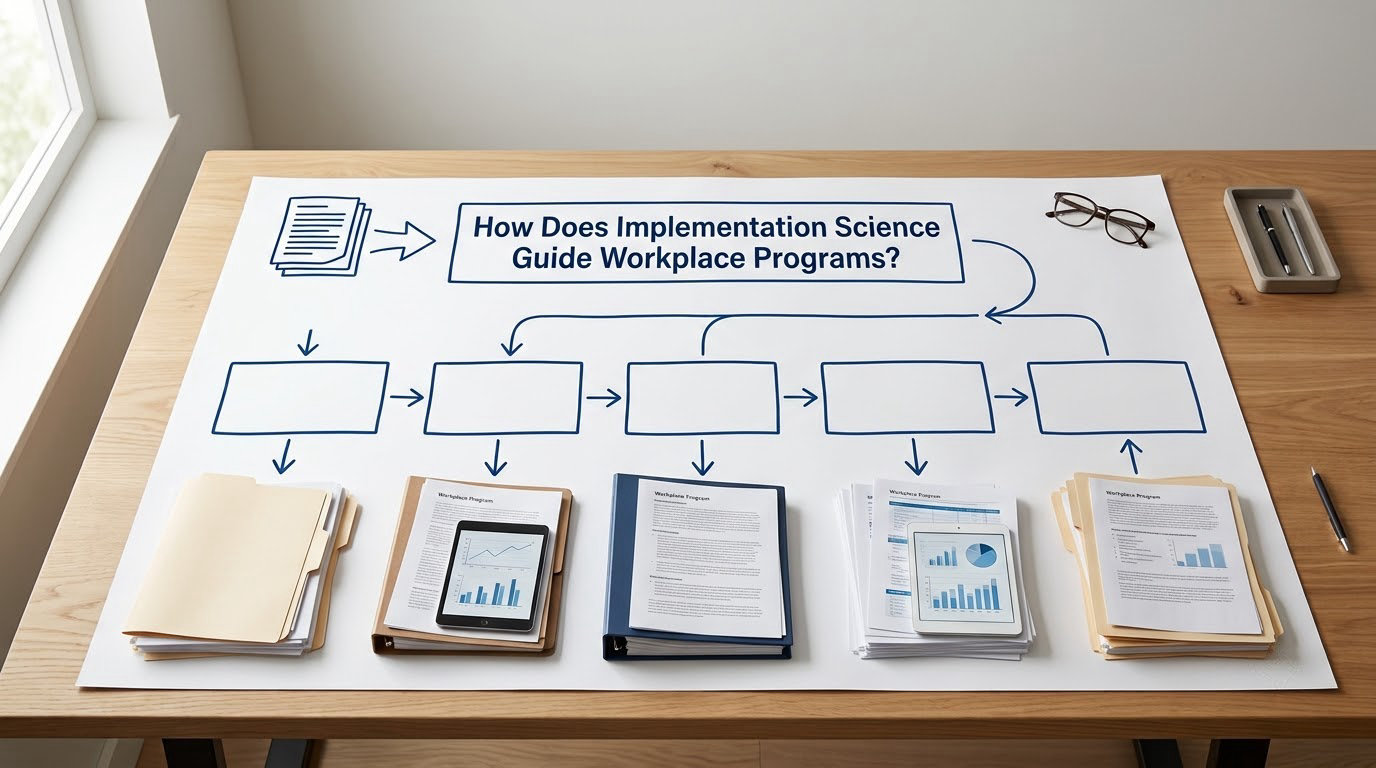
Implementation science guides a workplace program through five connected moves: find the evidence, read the context, choose strategies deliberately, watch how employees actually experience the program, and feed what you learn back into the next version. Skip any one of them and the loop breaks.
- Evidence. Start with the research or the standard, but treat it as a starting point rather than a finished product. Note which components the original program depended on.
- Context. Examine the organization before designing delivery: leadership posture, manager readiness, staffing, shift patterns, existing policies, budget, and the norms around health talk in your workforce.
- Strategies. Match a specific response to each specific barrier. “Increase awareness” is not a strategy. A manager prompt in the weekly ops meeting is.
- Experience. Collect structured feedback from the people taking part, and separately from the people who declined or dropped out. The second group explains most participation problems.
- Evaluation. Track implementation and outcomes together on a fixed schedule, then decide deliberately whether to adapt, scale, pause, or stop.
The order matters less than the loop. Most workplace programs do steps one and two, declare victory at step three, and never look at step four again. That is why they quietly end after eighteen months.
What Should a Workplace Team Do Before Launching a Program?
A team that spends four weeks on preparation usually saves six months of drift. These implementation science basics for workplace programs come first, in this order.
- Name the problem precisely. “Wellness” is not a problem statement. Reduced musculoskeletal injury on the night shift is. If the issue is physical risk, start with a how to conduct a workplace hazard assessment before you pick an intervention.
- Define the target population. Include contractors, temporary staff, and night shift in scope from day one, or plan for how you will serve them later.
- Gather employee input. Short interviews or a five-question survey before design beats a launch survey after. You are testing assumptions, not validating a finished plan.
- Review evidence and constraints together. Read the research and the operations calendar in the same sitting. A program needing daily lunch-hour delivery in a plant with rotating crews has a real constraint, not a bad excuse.
- Establish ownership. One named senior leader, one named manager in each participating area, and one person accountable for the data.
- Set objectives in advance. Write down what you expect to see at 60, 90, and 180 days, including the implementation numbers, not just the health ones.
- Choose a realistic delivery method. Decide now whether sessions happen during paid work time, on a digital platform, in print, or in person — and confirm who absorbs the cost in labor time.
If your team cannot fill in items five and six, pause the launch. Everything downstream gets harder to fix later.
How Do You Map Workplace Context, Barriers, and Supporters?
Workplace context is the set of conditions that will decide whether your program runs or dies, and most of it is visible before you launch if someone goes looking. Look at leadership support, manager readiness, employee needs, available time, budget, existing policies, workflow interruptions, workplace culture, access barriers, and programs already competing for attention.
Four methods work well together:
- Interviews with senior leaders, middle managers, and a handful of employees who did not sign up. Ten to fifteen conversations of twenty minutes beats a survey with a 3% response rate.
- Observation. Watch an actual shift or an actual meeting. Time lost to a lift-assist program shows up in seconds of work-arounds that nobody reports.
- Short surveys on awareness, intended participation, and the barriers people expect. Keep it under five questions.
- Administrative data you already hold — claims, incident reports, absence records, overtime, turnover — reviewed in aggregate and de-identified.
Sort what you find into barriers and supporters. Barriers come in two flavors: something that is missing (training, protected time, a manager’s attention) and something that is in the way (stigma about mental health, a production deadline every Friday, a privacy rumor that spreads by email). Those two need different responses, which is why lumping them together wastes the mapping effort.
Prioritize. A barrier that blocks 80% of your target population outranks ten that block nobody.
How Do You Choose Implementation Strategies?
Choose strategies by matching them to the barrier you actually found. If the barrier is enrollment friction, simplify enrollment or move it to a single existing workflow employees already use. If it is manager indifference, assign workplace champions and give managers a two-minute prompt with something to say.
Common responses that hold up in employer settings include scheduling activities during work time, offering language and accessibility support, providing a non-digital participation route for people who will not log in, sending manager reminders, coaching delivery staff, and running short feedback loops between departments.
How Do Implementation Science Basics Shape Strategy Selection?
The core implementation science basics turn strategy choice into a six-step decision instead of a list of good intentions. Run it once per barrier and the reasoning becomes auditable later, which matters when someone asks why you spent the budget there.
- Name the barrier in one observable sentence: “Two-thirds of eligible staff did not activate the screening portal.”
- Identify its cause. Is it unclear value, too much effort, a schedule conflict, an access issue, or distrust? Different causes need different responses.
- Select a matching response from the strategy menu and write down why you expect it to work.
- Assign responsibility to one named person with the authority to fix it.
- Set a time frame — typically 30 to 90 days for a workplace barrier to respond.
- Define an indicator that will show whether the response worked, and record the value before you start.
If a strategy has no owner, a date, and a before-and-after number, it is a hope, not a strategy.
How Do You Pilot and Adapt a Workplace Program?
Pilot small, pilot with intent. Run the program in two or three departments or one site with a team willing to give honest feedback, and keep everything else — staffing, timing, escalation — as close to the real rollout as you can manage. A pilot that runs on a volunteer task force tells you very little about a company-wide rollout.
During the pilot, watch delivery as closely as participation. Were sessions delivered as designed? Did managers actually do their part? How many people dropped out, and when? Talk to people who left, not only people who stayed; their reasons are the adaptation data you need.
Then adapt deliberately rather than reactively. A useful discipline is core components versus surface delivery. Surface delivery — the specific platform, the room, the timing — may change freely. Core components — the elements shown to produce the effect — should only change with a stated reason and a plan for measuring whether the change held the benefit.
Document every adaptation in a running log: what changed, why, who approved it, and what you expect to happen. Six months later that log is the difference between a program that learned something and a program that drifted.
Pilot end means a decision, not a pause. Expand, hold and iterate again, hand to operations, or stop. If the same barrier has survived two full cycles with two different strategies, stop and re-examine the problem definition.
How Do You Measure Implementation and Program Outcomes?
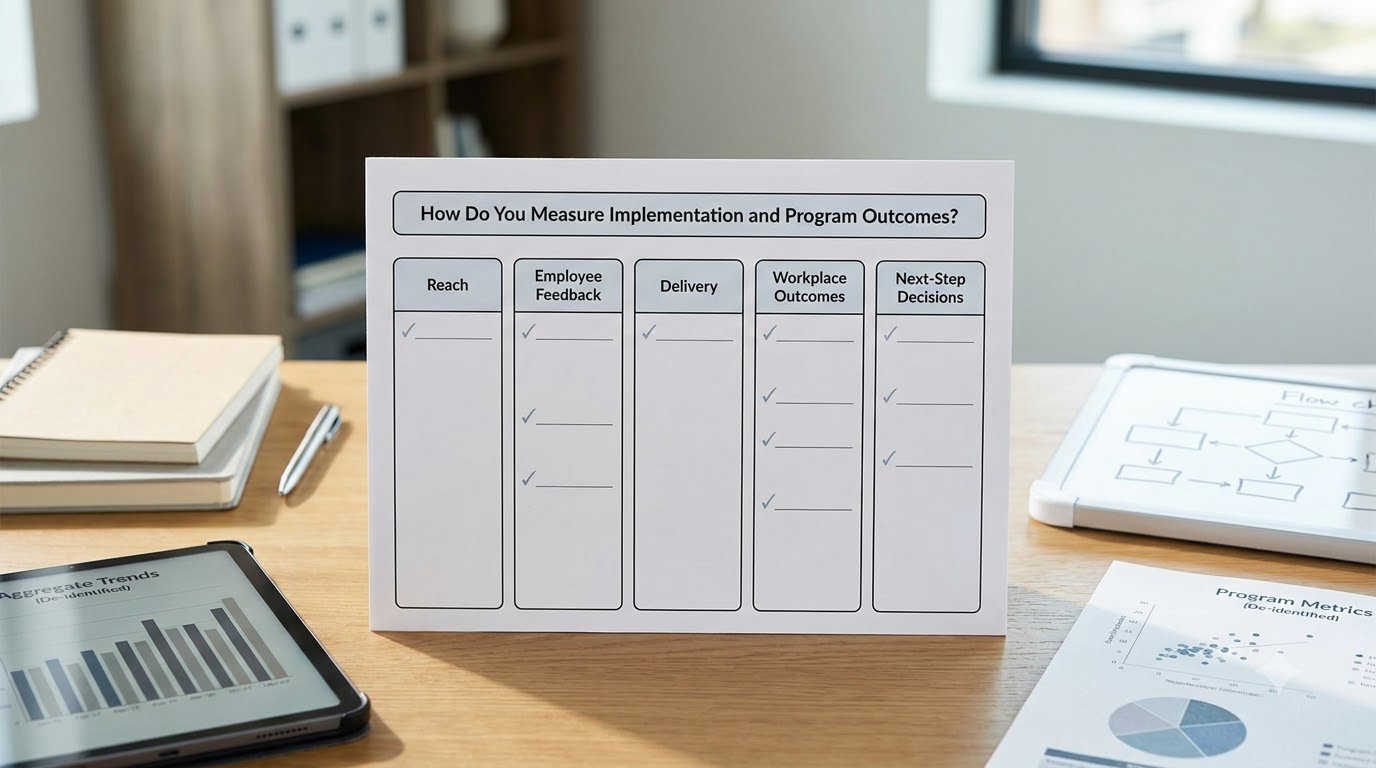
Measure two things in parallel and never let one stand in for the other: how well the program was implemented, and what changed as a result. Workplace programs fail on measurement in one of two directions — they track only satisfaction and call it success, or they track only health outcomes and never learn why nothing moved.
Implementation science basics point to a standard set of implementation outcomes: acceptability, adoption, appropriateness, feasibility, fidelity, cost, penetration, reach, and sustainability. You do not need all nine on day one. Pick three you can collect reliably in the first quarter and add the rest once the reporting habit exists.
A few rules keep the data usable. Report in aggregate, never at a level where an individual could be identified. Use the same definitions each wave so numbers stay comparable. Collect outcome data on a schedule tied to something real, like a benefits renewal or an annual safety cycle, not to a launch anniversary.
Feasibility matters more than most teams expect. If data collection itself takes 20 hours of manager time per wave, it will stop the first quarter a manager gets busy. Pilot the measurement process as carefully as the program.
What Metrics Show Whether a Workplace Program Is Working?
The table below maps the question you are actually asking to the metric that answers it. Most workplace teams need the left column more than the right.
| Question you are asking | What to measure | Workplace example indicator |
|---|---|---|
| Did employees hear about it? | Reach | Percentage of eligible employees aware of the program |
| Did they start? | Participation and penetration | Enrollment rate and share of each department enrolled |
| Did each site or unit take it up? | Adoption | Number of departments delivering the program, out of those expected to |
| Was it run as designed? | Fidelity and dose | Percentage of sessions delivered with required components; average sessions attended |
| Did it fit the way people work? | Acceptability and appropriateness | Short pulse ratings and reported reasons for non-participation |
| Could it be delivered at all? | Feasibility | Staff hours per participant and manager hours per wave |
| What did it cost? | Cost | Total and per-participant cost including staff time, not just vendor fees |
| Is it still running? | Sustainability | Program still delivered and funded 12 months after launch |
| Did anything change? | Intervention outcomes | Aggregate changes in the relevant safety, absence, or health measure |
Report implementation and outcome numbers in the same review meeting. Separated, they produce two arguments instead of one decision.
How Can Organizations Sustain an Effective Program?
A program survives when it stops depending on the person who launched it. That takes leadership ownership, a policy that names it, stable funding line, defined manager roles, and a refresh cycle rather than a permanent launch push.
Ownership and policy. Put the program in a written policy so it has a home beyond one person’s enthusiasm. Our guide to how to write a workplace health and safety policy covers the structure, and the program should appear inside one.
Funding. Budget the full cost, including manager and staff time. Programs that survive budget conversations are the ones whose true cost was visible from the start.
Manager roles. Give managers a small, specific, repeatable task rather than a general request to support the program. Two minutes in a standing meeting is realistic; championing a cause is not.
Employee participation. Participation decays without fresh reasons to join. Our piece on how to get employees to participate in wellness programs covers the tactics; the implementation rule is to test one change at a time so you know which one moved the number.
Refresher cycles. New hires, shift changes, and reorganizations all erode delivery. Schedule a short refresher and re-run your readiness check after each one.
Equitable access. Check who is not participating and why, by shift, location, employment type, and remote status. A participation rate that averages 60% can hide a warehouse at 12%.
Plans to scale or stop. Decide the expansion criteria and the stopping criteria in advance. A program that has run three cycles with flat implementation outcomes and no leadership owner is not a success story, and continuing it costs more than ending it cleanly.
Frequently Asked Questions
What is the difference between workplace health research and implementation science?
Workplace health research asks whether an intervention can change health, safety, or well-being, usually under study conditions. Implementation science asks why that intervention succeeds or fails in a specific organization: who adopts it, how faithfully it is delivered, what it costs, and whether it lasts. Both matter, and most workplace programs only plan for the first question.
Do workplace programs have to follow the original research protocol exactly?
No. Programs should protect the core components shown to produce the benefit while adapting surface delivery to employee needs, culture, staffing, and regulations. Record each adaptation with the reason it was made and one indicator that will show whether the change held. Adaptations that are never written down turn into drift nobody can evaluate later.
How can a small workplace evaluate a health or safety program?
A small workplace can track a handful of practical measures: enrollment, participation, manager support, completed activities, training completion, and reported barriers, plus one outcome measure relevant to the goal. Report them in aggregate, on a fixed schedule, and review them in the same meeting as your program decisions. Consistency over a year beats an elaborate study you abandon in month three.
Why is employee participation often low in workplace wellness programs?
Participation usually drops when employees see the program as irrelevant, distrust its purpose, hit scheduling barriers, lack accessible options, or cannot tell what they get for joining. Interview people who declined rather than only those who enrolled. If a program needs an opt-out explanation to a skeptical workforce, say plainly who sees the data and who does not.
What are the four stages of implementation science?
The most widely used staged model has four phases: exploration, preparation, implementation, and sustainment. Some versions split exploration in two or add a generalization stage for spreading a program across sites. The practical value is the shape of the timeline — you learn and plan first, you deliver with support next, then you decide what stays after the initial push fades.
Conclusion
Pick one well-defined program goal, map the two or three barriers most likely to sink it, and match each one to a strategy with a named owner and a number to watch. Do that before launch and the implementation science basics take care of themselves afterwards — because you will be measuring delivery and outcomes from the first month rather than explaining a dropout in month twelve.