
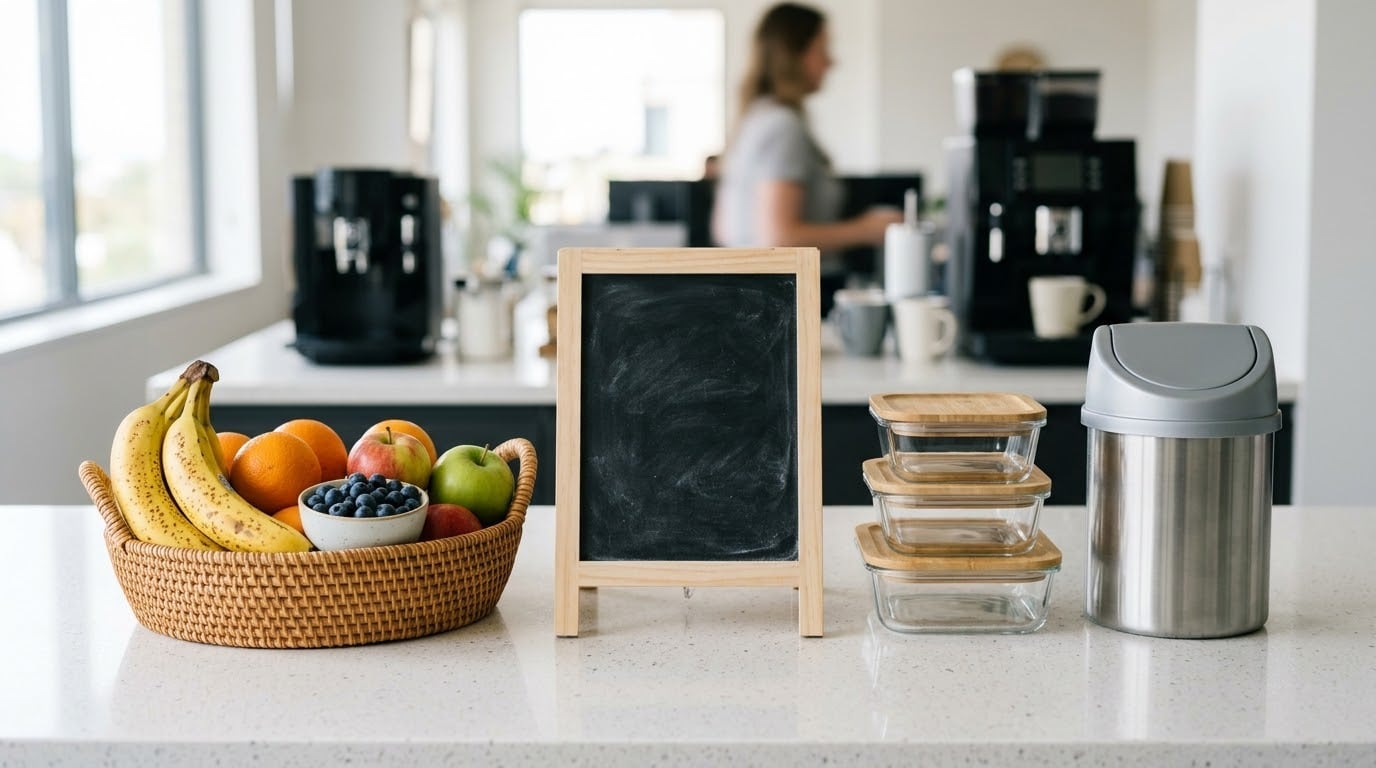
A free fruit at work program is an employer-funded benefit that puts fresh fruit in a shared, visible place on site so staff can grab a piece without leaving their desk or paying for it. Starting one takes about six steps: set the purpose, check demand, pick locations, choose fruit and a supplier, set the budget and food-safety routine, then launch and measure. Most first attempts fail on logistics, not on fruit.
This guide is for HR and people teams, office and facilities managers, wellness coordinators, and small-business owners who want a low-cost perk people actually use. It is general information, not medical advice; anyone with specific dietary or health questions should talk to a doctor, pharmacist, or registered dietitian.
Table of Contents
- What You Need
- Step-by-Step: How to Start a Free Fruit at Work Program
- Common Mistakes
- Frequently Asked Questions
- How much does a free fruit at work program cost?
- Should a free fruit at work program be available to all employees?
- What fruit is easiest and safest to provide at work?
- How can employers make a fruit program accessible to employees on different shifts?
- How do we know whether a free fruit at work program is working?
- Conclusion
What You Need
You can run a fruit program with far less than most companies assume. Before you commit money, work through seven decisions.
- A sponsor. One named person who owns the program. If it belongs to everyone, it belongs to no one.
- A budget line. Recurring money, not a one-off experiment, plus a small startup amount for baskets and storage.
- Locations. At least one spot that people pass daily, with a surface that can be wiped clean.
- Storage. A cool, dry place for the week’s supply. Refrigeration only if you plan to cut fruit.
- A supply plan. Either a managed delivery service or a named person who buys and restocks on a schedule.
- A food-safety procedure. Rotation rules, cleaning frequency, and a plan for damaged or spoiled pieces.
- A feedback channel. One link, QR code, or comment box so people can say what they want without hunting someone down.
If the program sits inside a wider wellbeing effort, it helps to read our guide to how to start an employee wellness program first, so fruit becomes one component rather than a stand-alone gesture.
Step-by-Step: How to Start a Free Fruit at Work Program
The sequence below moves from the decision to start through to the first review. Work through it in order, and do not skip step two just because demand seems obvious.
1. Define the Program’s Purpose and Scope
Write one sentence on why the program exists. Convenience at the 3pm slump, part of a nutrition goal, or a recruiting and retention message for a tight labor market — pick one primary reason, because it determines what you measure later.
Then decide who it covers. A universal program is simpler to run and easier to explain. A targeted one, for example only at sites with 50 or more staff, cuts cost but needs a clear rule about who qualifies.
Set two or three measures of success now, before launch. Participation and waste are the two most useful early signals; health outcomes are not something a fruit basket can prove in a quarter.
Keep the framing honest. Free fruit is a complement to fair pay and good working conditions, never a substitute for either. Where employees discuss perks, the suspicion that food is used to distract from compensation comes up repeatedly, and a program framed as a health and convenience investment gets far less friction than one framed as compensation.
2. Check Demand and Choose the Right Locations
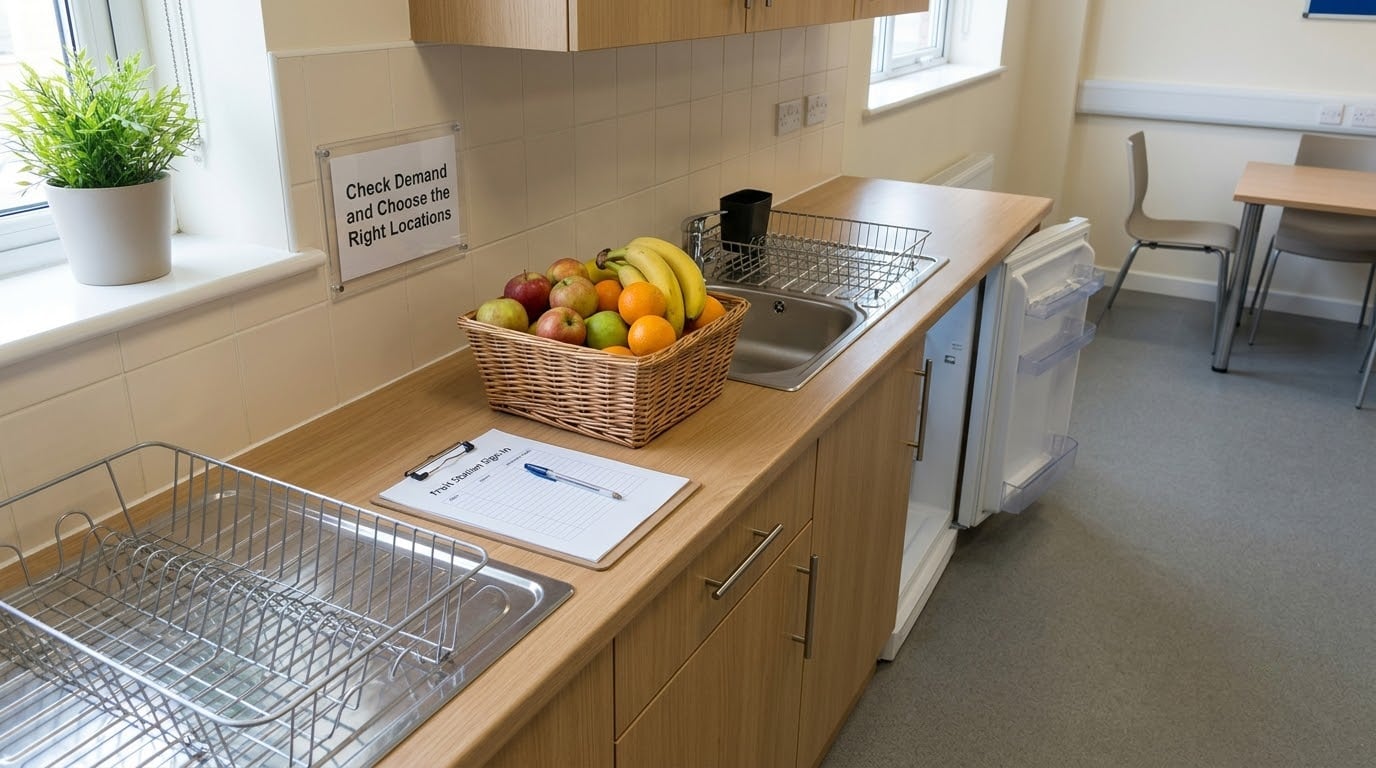
Ask before you build. A short survey with three questions — which fruit, which location, which days — takes under a minute per person and gives you an assortment most people will actually eat. If you already run an office pantry or vending service, its consumption data is a decent proxy.
Location tends to matter more than selection. The best-performing spots are usually near the coffee machine, outside meeting rooms, and by the main entrance; the worst is the deepest corner of a kitchen nobody enters.
Watch for practical conflicts before you commit: fridge space taken from lunches, cleaning routines disrupted by an open basket, and security or production rules at warehouses, plants, and clinical sites.
3. Select Fruit and a Reliable Supply Plan
Bananas, oranges, clementines, apples, blueberries, and baby carrots are the fruit and produce items most often chosen in offices. Start there and let your own survey override the list. Assortment matters to staff — variety and dietary inclusivity show up as consistently as anything in employee feedback.
Whole fruit beats pre-cut for a workplace program. Pre-cut looks appealing but needs refrigeration, has a much shorter shelf life, and turns a simple perk into a food-safety project with your facilities team.
Frozen and shelf-stable options are worth keeping as a backup rather than the default. They remove the spoilage problem entirely and work at sites with no kitchen at all.
For suppliers, ask what happens when a delivery is short or an item is out of season. A service that substitutes without asking tends to create complaint volume later. Sustainable packaging and compostable liners are cheap to request now and awkward to retrofit later.
Pair the program with water rather than treating it as the hydration story on its own. Our piece on why water access at work matters covers the access side, which people consistently rate higher when it is free and visible.
4. Set the Budget, Roles, and Food-Safety Procedures
Budget per employee per week, not per delivery. Supplier pricing scales with headcount, so a single large order costs proportionally less than several small ones, and a weekly figure keeps the conversation with finance simple.
Our guide to how to budget for an employee wellness program covers the wider numbers, including how to defend the line item when budgets tighten.
Split the work: replenishment, cleaning, waste bin emptying, and supplier contact should each have an owner. In a small office one person can hold all four. In a larger site, facilities usually owns cleaning and the wellness lead owns the rest.
On safety, write three rules down and post them. Inspect on arrival and remove anything damaged or moldy, check whole fruit daily and discard anything past its use, and wash hands and wipe surfaces before refilling. If you serve anything pre-cut, treat it as time-controlled food and confirm the temperature requirements with your own food-safety lead.
Label allergens plainly on anything that has been cut or packaged. Whole uncut fruit is the simplest option for offices with severe nut or latex sensitivities in the room.
5. Launch the Program and Communicate It Clearly
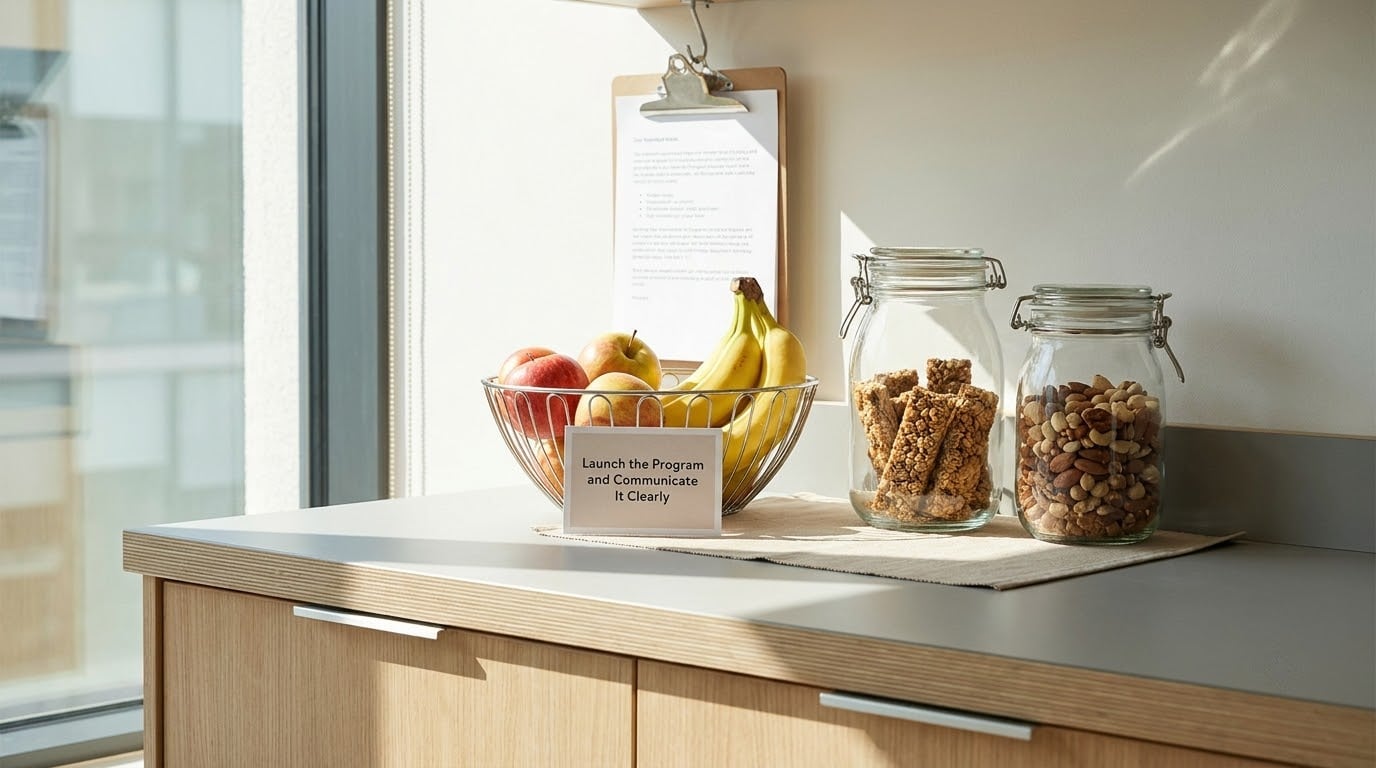
Pilot before you scale. Run one site, one building, or one floor for a month with a small order, learn the rhythm, then expand. Suppliers will often include a trial basket so staff can sample the assortment before you commit to a schedule.
The launch notice should be short: where the fruit is, which days it arrives, who to contact, and one sentence about what it is for. Put it on the intranet, in the chat channel people already read, and as a sign at the fruit station itself.
Make it usable for everyone. Remote and hybrid staff get excluded from an office-only bowl by default, which is a common source of fairness complaints. A quarterly credit, a meeting-hamper allowance, or shipping a box to a handful of fully remote employees all close part of that gap.
Do not position the program as a reason to work through lunch. Employees read that as pressure, and goodwill reverses fast.
6. Review Results and Improve the Program
Check in at 30, 60, and 90 days. Track four things: how often the basket is emptied and refilled, roughly how much is thrown away, the feedback comments, and the operational problems that annoyed staff.
Waste is the most honest signal you have. A pile of untouched bananas means the assortment or the timing is wrong, not that employees lack discipline. Cut the item, change the delivery day, or move the station before you add more variety.
Then adjust one thing at a time — fruit mix, delivery frequency, locations, or eligibility. Keep what people eat, drop what they walk past.
Common Mistakes
- Ordering too much too fast. Start at roughly one to two portions per employee per day and adjust after two weeks. Over-ordering is the fastest way to end up with a bin of spoiled fruit.
- Putting fruit somewhere quiet. A tidy kitchen cupboard signals that the program is optional. Visibility usually decides uptake more than variety does.
- Ignoring dietary needs. Ask about restrictions in the survey, label anything cut or packaged, and keep at least one option suitable for common allergies.
- Skipping the cleaning routine. Assign cleaning and waste removal to a named person with the same weight as the ordering.
- Launching without asking anyone. Employees can tell when an assortment was picked by a vendor rather than by the people eating it, and participation drops.
- Treating it as the whole wellness strategy. Fruit fits alongside movement, sleep, mental health, and safe working conditions. It cannot carry those on its own.
- Never measuring. Without a number and a date for review, the program quietly disappears when someone leaves or budgets tighten.
Frequently Asked Questions
How much does a free fruit at work program cost?
Cost depends mostly on headcount and delivery frequency. Suppliers usually price per employee per week, and larger headcounts get a lower rate because one delivery replaces many small ones. Add a small one-off amount for baskets, signage, and storage, then plan a monthly figure for the supplier. Ask for a written quote per week and per employee so you can adjust the scope without renegotiating from scratch.
Should a free fruit at work program be available to all employees?
Open to everyone is simpler to run, easier to explain, and avoids eligibility disputes. Targeted programs cost less and suit smaller employers, but they need a written rule about who qualifies. Whichever you choose, say plainly how it is funded and who pays for it, since transparency removes a lot of suspicion. Employees generally value free, easy-to-use benefits far more than the monetary value of the perk.
What fruit is easiest and safest to provide at work?
Whole, uncut fruit such as bananas, oranges, clementines, and apples is the easiest option. It needs no refrigeration, has a longer shelf life, and avoids most allergen labeling problems. Pre-cut fruit looks convenient but requires refrigeration, closer temperature control, and a much shorter window before it has to be discarded. Keep frozen or shelf-stable fruit as a backup for sites without a kitchen.
How can employers make a fruit program accessible to employees on different shifts?
Deliver two or three times a week instead of once, so fresh fruit is present on every shift rather than disappearing by mid-afternoon on delivery day. Place a station in more than one area, including near where night and warehouse staff actually break. For fully remote employees, a periodic credit or a shipped box avoids the fairness complaints that come with an office-only benefit.
How do we know whether a free fruit at work program is working?
Track four practical measures: how often the basket is emptied and refilled, how much fruit is thrown away, what employees say in short feedback surveys, and which operational problems come up. Review them at 30, 60, and 90 days. Low waste with high refills means uptake is healthy. A basket that keeps filling up with untouched fruit points to a timing, location, or variety problem rather than an interest problem.
Conclusion
Start small and be honest about the goal. Ask employees what fruit and where, pilot one visible location for a month, write down a weekly budget per person plus the cleaning and replenishment owners, and set a review date before you launch rather than after.
If the basket empties and the waste stays low, widen to more locations and more delivery days. If fruit piles up untouched, fix timing and placement before ordering more. That is the whole program, and it works because the details get handled, not because the fruit is exotic.