
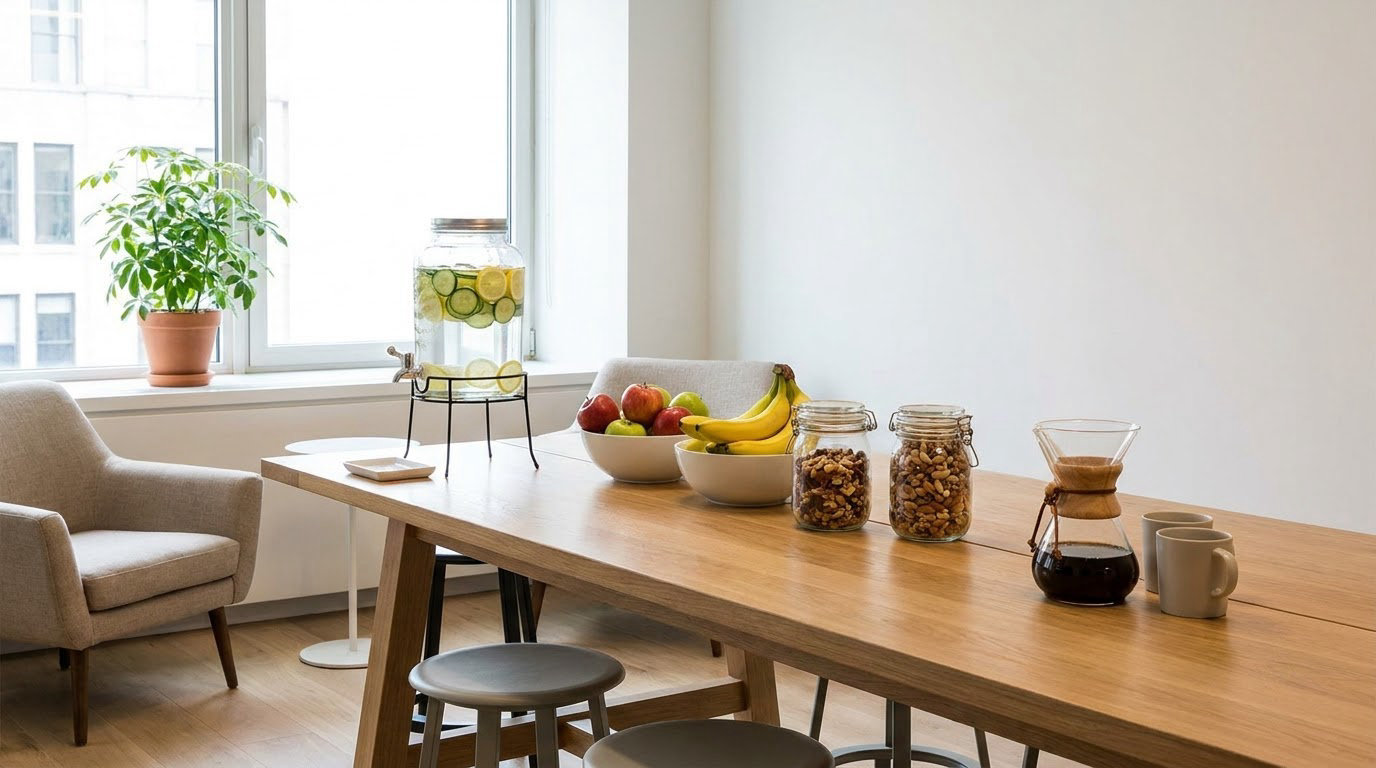
If you want to know how to make break rooms healthier, start with the room itself: measure the air, clear out the shared fridge and microwave, fix the seating and the walk path, and set a cleaning routine with a named owner. Most break rooms get into trouble through neglect rather than bad design, and the changes that matter most are unglamorous.
This guide is written for the people who actually own the space: office managers, HR leads, facilities managers, and the wellness champion who keeps getting asked why the microwave smells like last week’s soup. You can work through it in a weekend, and most of the steps cost nothing but attention.
A healthy break room is a shared space that restores people instead of exposing them. It offers food people can eat without worry, water, seating that suits different bodies, air that does not smell like the last person who heated a fish, and enough quiet for someone who does not want to make small talk at 3pm.
One CMM article on maintaining a healthy breakroom cited a Staples survey in which 44% of employees had caught the flu and 45% believed they picked it up from a coworker. That is the case for caring about a room most people spend fifteen minutes in twice a day.
Table of Contents
- What You Need Before You Make Break Rooms Healthier
- Step-by-Step: Six Changes That Make Break Rooms Healthier
- Common Mistakes That Make Break Rooms Less Healthy
- Frequently Asked Questions
- What is the quickest way to make a break room healthier?
- Which break-room changes improve worker wellbeing the most?
- How can an employer improve poor air quality in a break room?
- Should break rooms have separate areas for food, drinks, and waste?
- How often should a workplace break room be cleaned and inspected?
- How can employees help make the break room healthier?
- Conclusion: Where to Start This Week
What You Need Before You Make Break Rooms Healthier
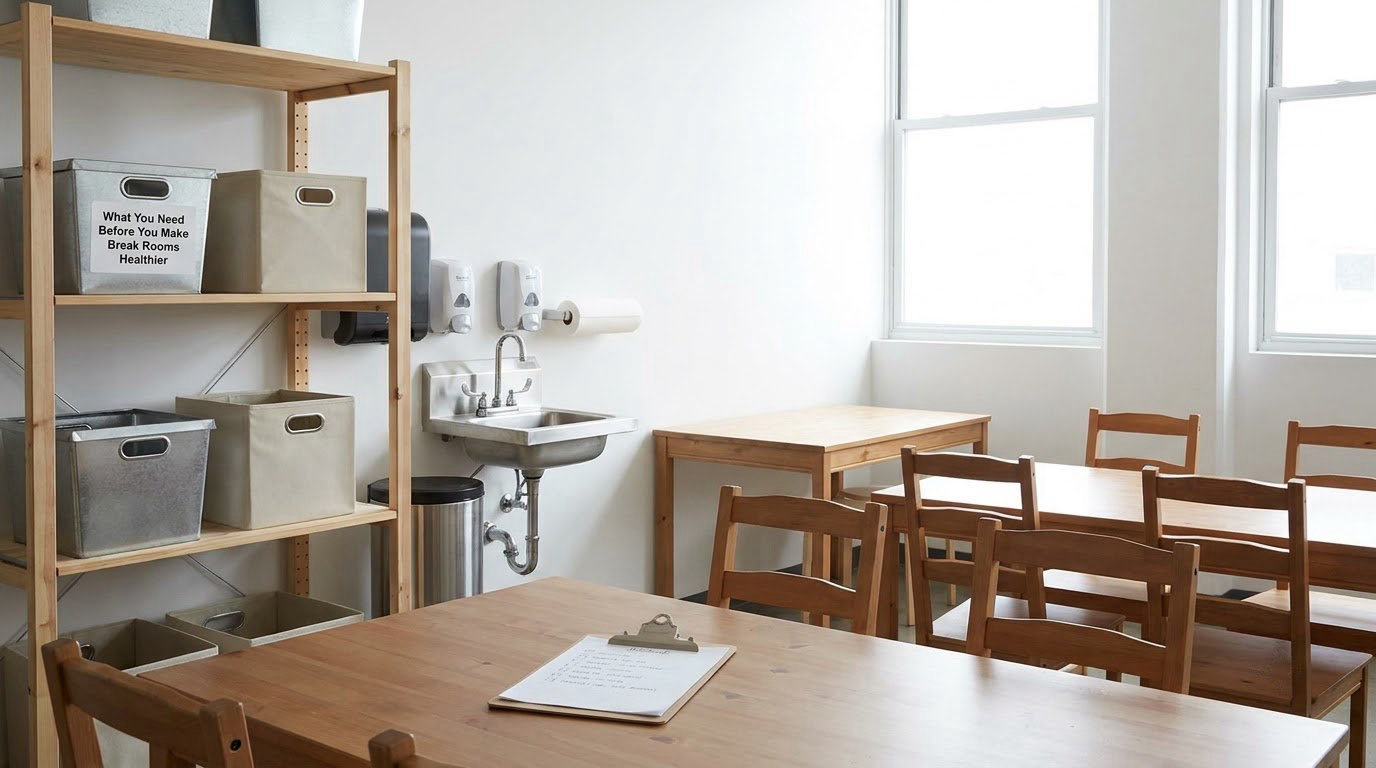
You need less than most people expect. The list is short because the work is mostly decision-making, not procurement.
- A person who owns the room. One named coordinator, usually the office or facilities manager, with authority to order supplies and post a schedule.
- Thirty minutes for a walk-through at two different times of day. Morning rush and mid-afternoon are different rooms, and you need to see both.
- Basic cleaning supplies and a disinfectant with a printed contact time, plus wipes that stay wet for the time the label actually states.
- An air reading. A cheap carbon dioxide monitor and, if the room has windows, a note on whether they are ever opened.
- Storage hardware: labeled bins, shelf risers, a dedicated leftovers shelf, and a food-waste bin with a foot pedal.
- Employee feedback collected somewhere anonymous, plus a way to report a problem that does not require walking up to the boss.
Keep the walk-through phone photos. Before-and-after shots of the same fridge shelf do more for a budget conversation than any proposal you will write.
Step-by-Step: Six Changes That Make Break Rooms Healthier
How to assess the current break room
Walk in with a checklist and photograph everything. Air: read the carbon dioxide monitor in the morning and again at peak, and note odors. Light: stand where people wait, not at the window. Noise: note whether you can hold a conversation without raising your voice. Cleanliness: look at the underside of the microwave door, the fridge shelf edges, the handle of the kettle, and the bin lids.
Then note crowding. Count seats against headcount per shift, and measure the clear path from the door to the sink. A route narrower than about 36 inches is a problem for anyone using a wheelchair, a walker, or a cart, and the US Access Board gives minimum clearances for exactly this.
Finish with the unglamorous survey: what food is left untouched, what gets thrown away, where people store things, and which surfaces your team wipes anyway because nobody else does. Write the top five problems on one page. If you only fix those, you will have improved the room more than most renovation projects manage.
How to improve ventilation and air quality
Break rooms are usually the worst-ventilated room on the floor, because they sit on the interior of a floor plate and get whatever leftover air the system delivers. Fixing that is the single highest-impact change available to you, and none of the three leading articles I reviewed even mention it.
Start with the free moves. Open exterior windows and doors during breaks and breaks in the weather allow. Run the HVAC fan rather than relying on the thermostat alone, because fans move air without cooling it. Confirm that return grilles and supply diffusers in the room are not blocked by a storage shelf someone added in a hurry, and check that the exhaust over the sink or any cooktop is actually running.
Then look at filtration. Ask the facilities team which filter the unit is using and whether it is MERV 13 or higher, and whether the filters are being changed on schedule. A clogged filter defeats the whole system. If the air is stale and the unit cannot be upgraded quickly, a portable HEPA air cleaner sized to the room is a reasonable stopgap, and it is the one purchase most worth making out of a small wellness budget.
For readers new to this, carbon dioxide is a useful proxy: outdoor air sits near 400 parts per million, and a room that climbs past roughly 1,000 ppm is telling you fresh air is not arriving fast enough. None of this is a diagnosis of anyone in the room; it is a ventilation readout. ASHRAE Standard 62.2 is the reference a facilities manager will use for outdoor air rates, and quoting it by name makes the request much harder to wave off.
Watch what you bring in with the air. Aerosol air fresheners and heavily fragranced cleaners are a recurring complaint in staff discussions, and in a small room with limited ventilation the scent lingers long after the spray. Choose unscented products and let ventilation do the work.
How to make food storage and eating cleaner
The fridge, microwave and sink are where hygiene plans go to die, and they are the exact hardware people complain about online. Assign ownership: one person empties and wipes the fridge and microwave on a named day, and that name goes on the door. Rotation labels dated in marker are the cheapest fix there is, and anything undated goes into a bin for the owner to claim or discard.
Give food rules that fit a shared room. Everything open is covered and dated, raw meat does not go in a break room fridge at all, and leftovers come home after three days. Put a designated allergy-aware shelf on the top or the bottom, label it, and keep it stocked with food people can actually eat. An employee lounge that only offers things one group can eat quietly excludes everyone else.
Keep perishable food out for no more than two hours at room temperature, and if the room sits warm, less than that. If food arrives hot, keep it at 140°F or above; if it is meant to stay cold, keep it at 40°F or below. Have a refrigerator thermometer on the top shelf, not in a door pocket, and check it as part of the weekly round. When you reheat leftovers, bring them to 165°F before serving.
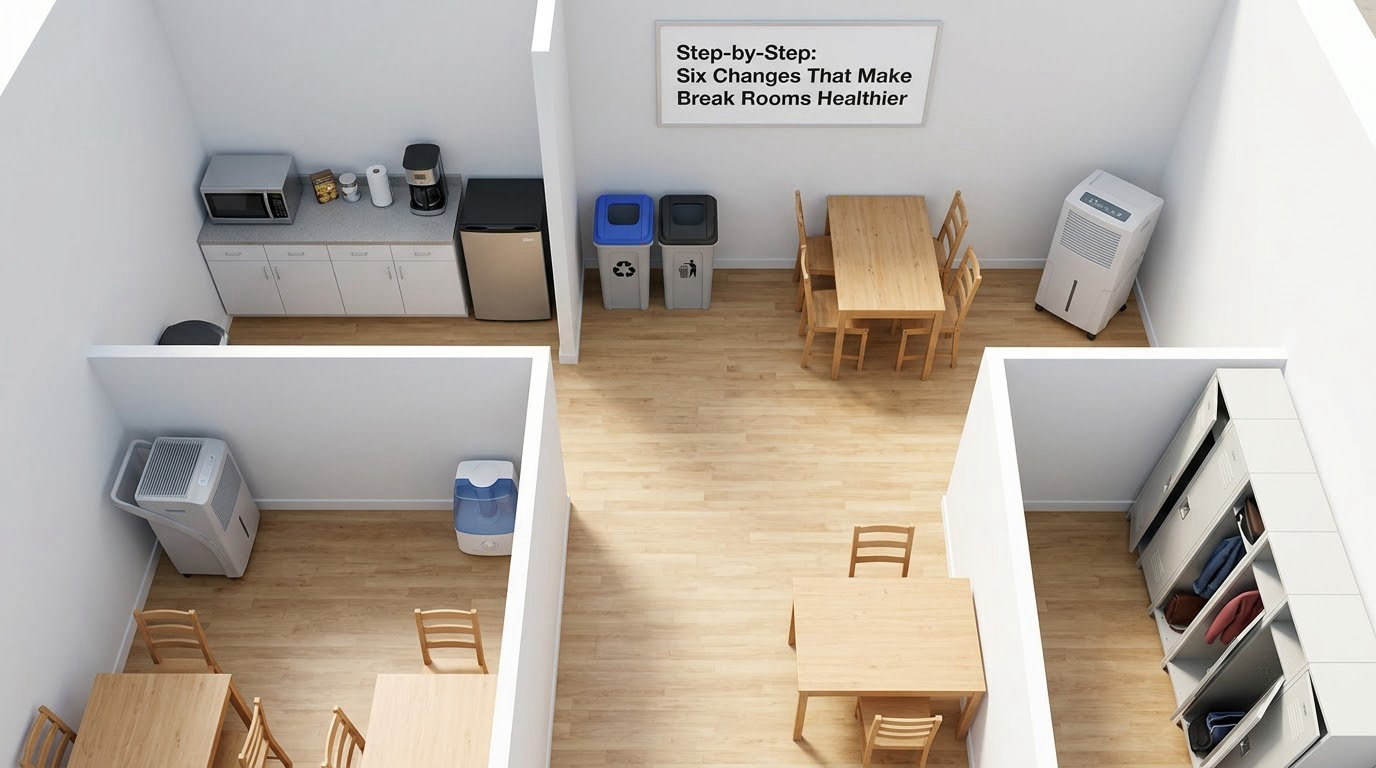
Split the room into clean zones. Food on one side, waste on the other, with the sink in the middle and a clear working gap between raw prep and anything ready to eat. A single wipe-down does not survive a full lunch service, so wipe stations at 11am and 2pm instead of one nightly clean, and put the wipes where people will actually use them rather than locked in a janitor closet.
Do not spray cleaner near open food or food containers, a problem that keeps coming up in employee threads. Apply to a cloth, or use a wipe.
How to improve seating, movement, and accessibility
People use a break room three different ways: to eat and talk, to sit alone and reset, and to step away from a screen. One chair for all three jobs fails at least two of them.
Offer a spread. Two or three seats with backs and armrests, a high table or counter for a quick standing break, and somewhere out of the traffic line for a person who wants lunch without an audience. Round or small tables beat one long table for small offices, because nobody has to sit opposite a manager to get a sandwich.
Check the ergonomics of what you already own. Seats with backs at a height where feet rest flat, tables that clear the knees, and a counter high enough to stand at comfortably. A chair that rolls and a person who uses it should not be stuck behind a fixed table, so allow clearance and keep the path from door to seat free of boxes.
Accessibility is a floor, not an upgrade. Clear routes to the sink, refrigerator, and restroom, reachable counter sections and a refrigerator low enough to reach, a waste bin reachable without stretching, and a room that accommodates mobility devices rather than merely tolerating them. Signage that uses a clear step-free route from the entrance helps everyone, including the person carrying a tray and looking for the microwave.
Light matters more than most plans budget for. Task lighting over the food area, dimmable or indirect light in the seating corner, and daylight from a window if you have one. On lighting and acoustics specifically, requesters in hospital staff forums asked for natural light, plants, and a place to nap, and those same requests show up in ordinary office threads.
If the room doubles as a wellness or quiet room, split it. Part social, part quiet, divided by a soft screen or a partial wall, so the person who needs a sensory break does not have to sit inside a conversation. A small lamp, a blanket basket, and one chair with no screen nearby costs very little and is the most requested item in most feedback sets I have seen.
How to reduce waste and improve hygiene
Waste is a hygiene problem before it is an environmental one. An overfull bin becomes a breeding ground, and an unopened bin invites people to walk past it and drop their rubbish somewhere else. A foot-pedal bin near the exit, emptied before it is full, solves the majority of complaints I hear about the room.
Sort what you can: landfill, recycling, and food waste. Label each with a sign big enough to read from across the room, because an unlabeled bin gets contaminated. Empty the food-waste bin daily in summer, every other day otherwise.
Keep the clean-up kit visible and complete. Wipes, a spray bottle, a roll of paper towel, a small brush for crumbs, and spare liners all belong near the sink in a single caddy. Restock it when it runs low, and put a small box of gloves next to the bins so people do not have to touch a full bag.
For the high-touch list, keep it short and written on the inside of a cabinet door: refrigerator handles and shelves, microwave door and keypad, sink taps and soap dispenser, bin lids, table edges, chair backs, drawer handles, coffee machine parts, and the kettle. Then match the product to the job and respect its contact time. Facilities coverage of disinfectant selection makes the point well: quat-based products typically need around ten minutes of wet contact before they are wiped away, which nobody is going to honor in a working break room, while hydrogen-peroxide-based products work in one to five minutes. Pick the one your team will actually use, and follow its label.
That is the real lesson from the hygiene angle. A protocol that requires an hour of someone standing next to a counter gets skipped by week three.
How to make break rooms healthier month to month, with employee feedback
Hand the room over to a routine before you hand it to a committee. A weekly round that takes ten minutes: check the monitor reading, confirm the thermometer in the fridge, restock the caddy, empty bins, and wipe the high-touch list. A monthly round that takes longer: walk the assessment again, photograph the same spots, and compare.
Feedback has to be easy and safe. An anonymous form with four questions beats a suggestion box every time: what do you use this room for, what would you change, which one thing is broken, and how clean was it this week. Add a QR code on the table and a paper version for people who will not scan one. Report back on what you did with the answers, because a survey with no visible response teaches people that surveys do not matter.
Then track four numbers and no more. How many people used the room on a sample day, the carbon dioxide peak at midday, the number of cleaning issues found in the weekly round, and the answers to the cleanliness question. Sick-day rates are tempting but move too slowly to tell you anything about a break room in a quarter.
Sequencing helps. In week one, do the free fixes: clear the fridge, label the shelves, empty the bin, add a second caddy, post the high-touch list. In month one, buy the filtration or the thermostat that lets people control the room, and run the first feedback form. In the first quarter, decide on the larger layout change, such as splitting a quiet corner, based on what the data and the forms told you.
Common Mistakes That Make Break Rooms Less Healthy
Ten problems come up repeatedly, and each has a straight fix.
Buying equipment without changing the routine. A new air purifier sitting next to a dirty sink is decoration. Every purchase should come with a name attached and a schedule.
Fragrancing a poorly ventilated room. Scent sprays mask odors and add volatile compounds to air that is not moving. Unfragranced cleaner and open air solve the same problem honestly.
Cleaning once at night. A room that is busy from 8am to 6pm needs a midday touch-up of tables, sinks, and handles. Save the deep clean for after hours.
Ignoring contact time. People spray, wipe immediately, and move on. Use a fast-acting product so the label is easy to follow.
Adding seats to a room that is already crowded. Fix circulation before capacity. More chairs in a jammed room makes noise, spills, and access worse for everyone.
Treating feedback as a one-time survey. A survey in January tells you about January. Ask four questions quarterly and keep the results somewhere people can read.
Forgetting shared-food rules. Uncovered food and unlabeled containers are the two complaints facilities teams hear most. Write both rules on the fridge door and enforce them without moralizing.
Dropping accessibility as a later phase. A path that cannot be traversed, a counter you cannot reach, or a bin you cannot open makes the room worse for the whole workforce, not just one person. Fix the clearances now.
Two more worth naming. Do not remove basic shared items to save money; forks, spoons, and paper towels are a visible signal about how the company treats small comforts, and the reaction in staff forums is out of proportion to the saving. And do not stock only food one group can eat. Dietary restrictions in a shared office are a routine fact, and a top shelf for allergen-aware items is a two-line policy.
Frequently Asked Questions
What is the quickest way to make a break room healthier?
Clear and clean the shared fridge, empty the bin, and post a high-touch cleaning list with a named owner. Those three things take under an hour, need no budget, and address the complaints employees raise most often: leftovers, odors, and sticky handles. After that, open the window and check the carbon dioxide reading during a busy hour.
Which break-room changes improve worker wellbeing the most?
Fresh air first, then cleanliness, then seating and quiet. A CMM article cited a Staples survey where 44% of employees had the flu and 45% believed they caught it from a coworker, so hygiene is the baseline. After that, give people a genuine place to sit without talking, which the quiet-room requests in staff forums consistently point to.
How can an employer improve poor air quality in a break room?
Start by opening exterior windows and running the HVAC fan so air moves even when it is not cooled. Verify the filters are the type the unit is rated for and that they are changed on schedule, and confirm supply and return grilles in the room are not blocked. A portable HEPA cleaner is a reasonable interim step, and ASHRAE Standard 62.2 gives your facilities team the outdoor air rate to quote back to you.
Should break rooms have separate areas for food, drinks, and waste?
Yes, and it costs nothing. Keeping food prep and eating away from the waste bin, and the sink between the two, cuts odors and cross-contamination while making the room easier to reset. A bin near the exit and a fridge inside the room keeps people from walking back and forth across the food zone carrying rubbish.
How often should a workplace break room be cleaned and inspected?
Wipe high-touch surfaces such as handles, the microwave keypad, the sink, and bin lids at midday, then do a deeper clean after hours, and empty food waste daily in warm weather. Run a ten-minute weekly inspection covering the fridge temperature, the air reading, and supply levels. If you want to know how to make break rooms healthier on a schedule that survives staff turnover, the weekly inspection is the piece most worth keeping.
How can employees help make the break room healthier?
Cover and date your food, take leftovers home within three days, and never put raw meat in a shared office fridge. Wipe the microwave after use and report a broken dispenser or empty soap through the anonymous form rather than hoping someone else does. Small habits matter here because the room is touched by everyone and cleaned by almost no one.
Conclusion: Where to Start This Week
Take five steps, in this order. Do the walk-through and write down the top five problems. Fix the fridge, the bins, and the labeling, which costs nothing and takes an afternoon. Move the food zone away from the waste zone and clear the path to the sink. Post a high-touch cleaning list with a named owner and a midday touch-up. Then ask four questions anonymously and report back on what you changed.
Air quality and the larger layout change can follow, once the basics hold. If you take only one thing from this guide, take the high-touch list with a name next to it, because that is the difference between a break room that looks clean at 8am and one that is still usable at 3pm.