
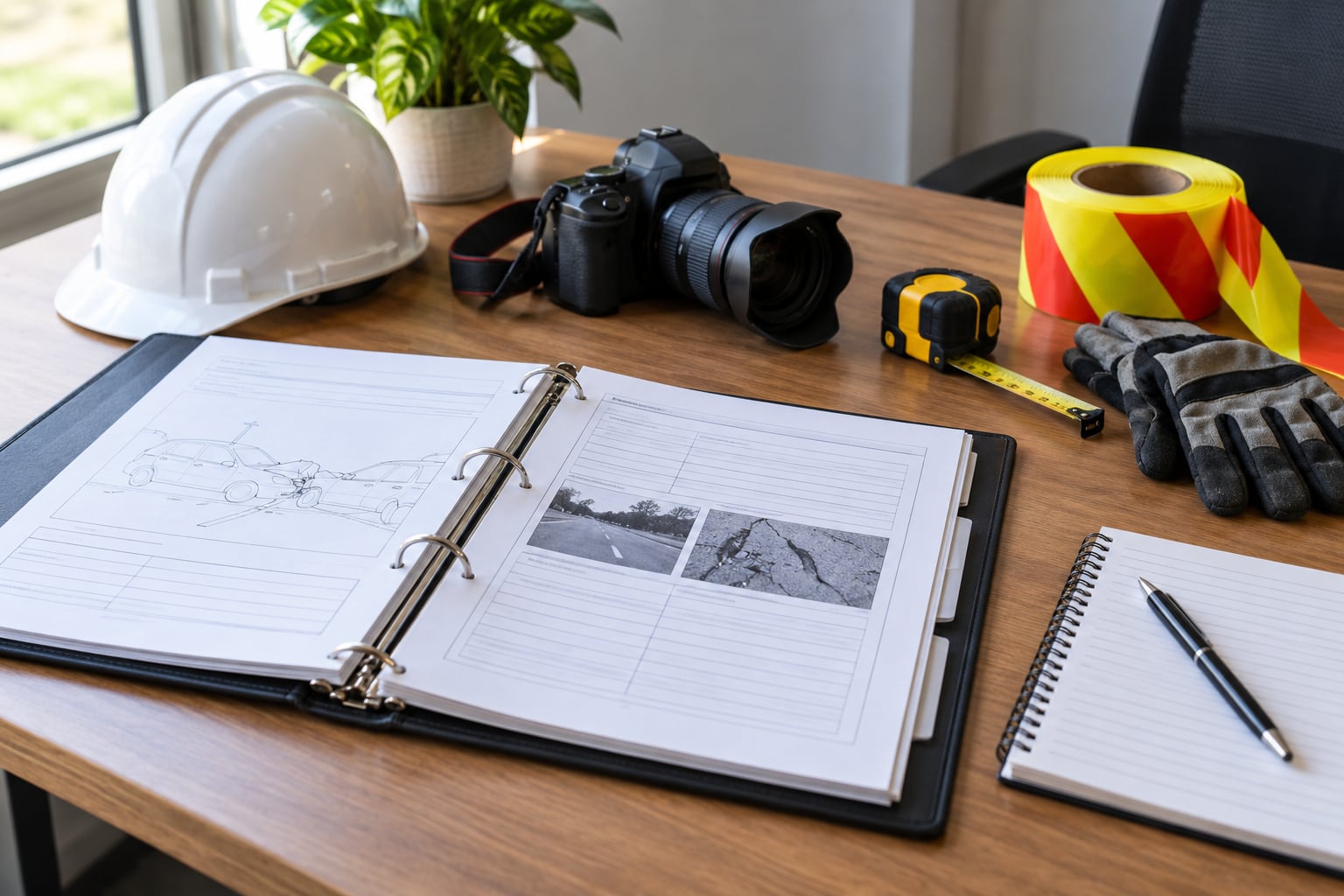
To investigate a workplace accident properly, follow nine steps: secure the scene and care for the person hurt, notify the right people, preserve evidence, take separate witness accounts, rebuild the timeline, find the root causes, check whether your existing safety controls actually worked, assign corrective actions with owners and deadlines, then document and close the case. Most investigations that go wrong skip one of those steps, and it is nearly always the evidence or the root-cause stage.
A good investigation usually takes a few days to two weeks. The immediate response starts within minutes; the written closeout should not take longer than 30 days, and faster if the hazard is still present. The work is less demanding than most people expect, as long as someone is named to lead it and the paperwork starts the same day.
One distinction matters early. An accident caused injury, illness or property damage. An incident happened but caused no harm. A near miss could have caused serious harm but did not. All three deserve the same investigation approach, because near misses are the cheapest warning you will ever get. If you have not done this before, the what to do after a workplace injury guide covers the first hour; this article covers everything after that.
Table of Contents
- What You Need Before You Start
- Step-by-Step Workplace Accident Investigation
- 1. Secure the scene and provide emergency care
- 2. Notify the right people and check reporting duties
- 3. Gather preliminary facts and witness accounts
- 4. Preserve evidence and document conditions
- 5. Reconstruct the accident sequence
- 6. Identify immediate, underlying, and contributing causes
- 7. Evaluate the existing risk controls
- 8. Recommend and implement corrective actions
- 9. Document findings, share lessons, and close the investigation
- Common Mistakes in Workplace Accident Investigations
- Frequently Asked Questions
- Conclusion
What You Need Before You Start
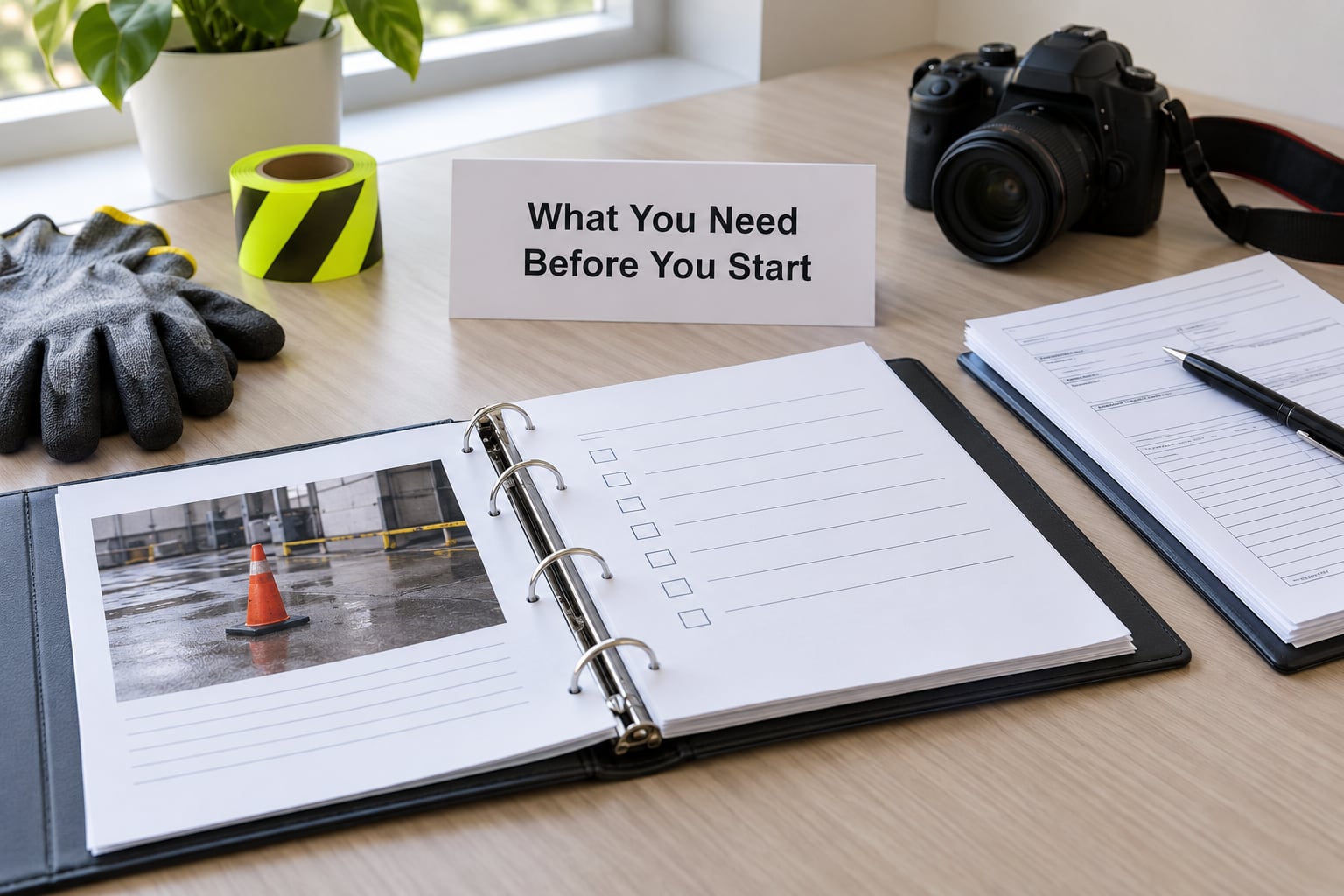
You need a lead investigator, the injured person’s supervisor, someone from safety or HR, and at least one person who works that area day to day. A frontline worker on the team is not optional decoration. They know which shortcuts people take when the line gets backed up, and they know which of your procedures are fiction.
Before anyone walks the scene, put these in place.
- Forms and templates. An incident report form, a witness statement form, a scene sketch sheet and a corrective action log. If you build these once and reuse them, the ninth step takes an afternoon instead of a fortnight.
- Records access. Training records for everyone involved, the written procedure for the task, maintenance and inspection logs for the equipment, the shift rota, and any CCTV or vehicle telematics covering the area.
- Equipment. A camera or phone with a timestamp, a tape measure, a flashlight, cones or barrier tape, cut-resistant gloves, and a notebook that does not autofill from a previous report.
- Authority. Written authority to stop work in that area, to pull records, and to interview staff. Investigators without that authority get half-truths.
- Time. Block out several hours for the scene walk and interviews before the shift fills with production pressure.
One rule covers all of it: do not disturb the scene unless disturbing it protects a person or prevents more damage. Moving a spilled chemical container, switching off a stuck conveyor or shutting a leaking valve all count as justified. Tidying up, straightening a stack or taking a photo out of frame do not.
Step-by-Step Workplace Accident Investigation
The nine steps below run in order because each one depends on the last. Skipping ahead is how organisations end up with a report that describes the wrong cause and a corrective action that changes nothing.
1. Secure the scene and provide emergency care
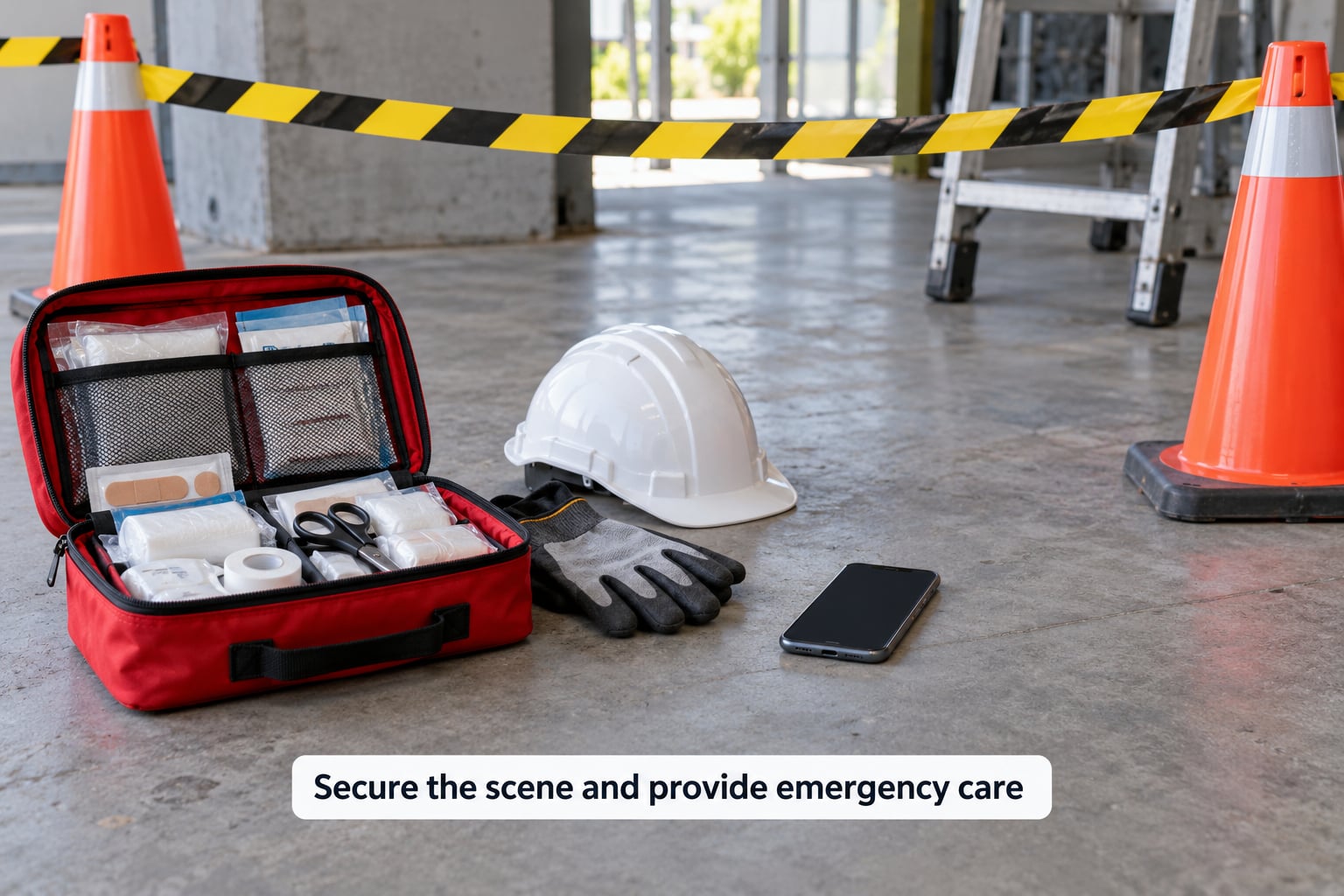
People first, then the area. Stop the task, stop the machine, and stop anyone walking through a scene with an unstable load, live energy, or a chemical release. Then call emergency services and give first aid within what you are trained to do.
Nobody enters the area until the hazard is controlled. If you cannot say what the hazard is, treat it as live. Barricade generously; over-excluding people for an hour costs far less than a second injury at the same spot.
How do you know the step is complete? The injured person is with someone competent, emergency services have the scene, the hazard is isolated, and a boundary is in place. Time the boundary: what time was it placed, and who placed it? Write that down.
2. Notify the right people and check reporting duties
Notification happens fast and it is not only the supervisor. In a typical US employer, the chain runs to the supervisor, the safety lead, HR and the owner or plant manager, plus the workers’ compensation carrier once an injury is reported. In the UK, the reporting duty sits with the employer under RIDDOR and works differently, so use your local rules rather than a US checklist.
Regulatory reporting has real time limits and different triggers. In the US, a fatality must be reported to OSHA within 8 hours, an inpatient hospitalization, amputation or loss of an eye within 24 hours, and recordable cases are entered on the OSHA 300 log within seven calendar days of learning of the injury. Those thresholds are why many small employers report late: they assume “no overnight hospital stay” means nothing to report.
Keep medical details out of the investigation file. Record what the person was doing and what they were exposed to, and route diagnoses, treatment notes and prognosis to HR and the carrier only. An investigator holding medical records creates a confidentiality problem that outlives the report.
How do you know the step is complete? You can name every person notified, the time of each notification, and the specific reporting decision you made with the reason for it.
3. Gather preliminary facts and witness accounts
Find the witnesses while memory is fresh. Anyone who saw anything, anyone who noticed an unusual noise, smell or behaviour beforehand, and anyone who was in the area minutes earlier all count, even if they say they saw nothing. Nobody has to have been looking directly at the injured person to be useful.
Interview them separately and away from the group. Safety professionals describe this as the single biggest source of contaminated statements: once witnesses compare notes, they converge on one version that is less accurate than any single memory. Take a written statement in their own words before any group discussion.
Ask open questions. “Walk me through what you saw, starting from the beginning” gets you a sequence. “Do you think he was careless” gets you a verdict, and it ends the interview. Follow with “What were you thinking about at that moment” and “What would you change about the job if you ran it”. Note the time of each interview and who was present.
How do you know the step is complete? Every witness has a signed statement, and no two statements were taken in the same room.
4. Preserve evidence and document conditions
Photograph the scene before moving anything, then again after. Wide shots for context, mid-range for the equipment involved, close-ups for the failure point. Take a continuous walk-through shot so the layout is reconstructable. Put a scale or a familiar object next to close-ups so size is not guesswork later.
Record conditions that will not wait: lighting levels, wet or greasy floors, temperature, ventilation state, which guards were fitted and which were missing, what setting a switch, dial or valve was on. Write it as a plain list of observations, not conclusions.
Label and bag physical evidence: the failed fitting, the frayed strap, the trip hazard, the drug test sample if it exists. Record who handled it, when, and where it went. That chain of custody is what lets an insurer or a lawyer use the item six months later instead of discarding it as unattributable.
How do you know the step is complete? Another investigator could reconstruct the scene from your photos and notes without asking you a question.
5. Reconstruct the accident sequence
Build one chronological timeline from every source: witness statements, CCTV, equipment logs, the maintenance record, shift handover notes, the written procedure, and the sequence of events on a machine control system. Put them side by side and mark where they agree and where they disagree.
Then separate what is verified from what is unresolved. “The guard was off at 06:14 and the log shows no inspection since Friday” is verified. “The supervisor removed it” is not. Unresolved items get an owner and a deadline inside the investigation, not a conclusion written in as fact. This is the step where sloppy reports are born, because a plausible story gets written down and then treated as established.
How do you know the step is complete? Your timeline has no gaps between the last safe state and the injury, or every gap has a named open question.
6. Identify immediate, underlying, and contributing causes
The immediate cause is the event that produced the injury: the unguarded blade, the wet floor, the released load. The underlying cause is why that condition existed. Contributing factors are everything that made the outcome more or less likely: staffing, lighting, fatigue, production pressure, equipment age, previous near misses, unclear signage.
Use a structured method rather than intuition, and pick the one that fits the problem.
- 5 Whys. Fast, best for a single clear chain, weakest at stopping early because it invites the team to settle on the first plausible answer. Push past “human error” every time.
- Fishbone or Ishikawa diagram. Best when several families of cause converge, for example equipment, method, people, environment, materials and management on one chart. Ideal for a first investigation and for showing a team what it was missing.
- Fault Tree Analysis. Best for high-consequence events where you need to know every combination of failures that produces the outcome. Slower, and it needs people who have used it.
- Pareto analysis. Not a cause-finding tool but a targeting tool: use your last year of incident data to see whether a small number of event types carries most of the risk.
Two questions settle most arguments in this step. Why was the error possible, and why was the condition normal? If the answer is that a known hazard had been tolerated for months, the cause sits with the management system that accepted it, not with the person at the machine.
How do you know the step is complete? Every action and condition you identified has a plausible reason attached to it, and at least one cause sits above the individual worker.
7. Evaluate the existing risk controls
Take each control your organisation claims to have and test it: was the hazard assessment done, and did it list this hazard; was the person trained, and can they show competence rather than attendance; did the written procedure match the task; were engineering controls present and actually used; was the PPE right for the exposure; were inspections happening on schedule; did the near-miss reporting system work.
Most investigations find a gap in at least one. A procedure that says “isolate before maintenance” is not a control if the isolation point is unmarked and nobody can find it in under two minutes.
How do you know the step is complete? Every control is marked present, absent, present but ineffective, or unknown, with evidence for the mark.
8. Recommend and implement corrective actions
Rank actions by how much risk they remove, not by how cheap they are. Eliminating the task or the hazard beats an engineering control, which beats a procedure change, which beats a warning sign, which beats retraining and PPE. A sign does not stop a hand getting caught.
Split them three ways. Immediate actions go in the same week and usually mean stopping the task or isolating the equipment. Interim actions protect people while a bigger fix is designed. Long-term actions change equipment, layout, procurement or policy, and they take budget and a named sponsor.
Write each one so it can be audited: what will change, who owns it, by what date, how you will confirm it is done, and what interim protection applies meanwhile. Give it an owner with authority to spend, not a committee.
How do you know the step is complete? Every recommended action has an owner and a date, and the immediate ones are already verified as done.
9. Document findings, share lessons, and close the investigation
The report should be readable by a manager who was not there and by the worker involved, and it should survive legal review. Include a factual description, the timeline, the evidence, the root causes, the control evaluation, the corrective actions with owners and dates, and a list of what remains unknown.
Strip out blame. Naming an individual as “the cause” tells the workforce what not to say next time, and the next witness statement gets worse. Say “the isolation procedure did not specify a lock location” instead of “the technician failed to lock out”. Protect personnel and medical details; share the lessons widely with those details removed.
Set a follow-up review date for the long-term actions, and do not close the case until verification is done. If a policy is the fix, check that the policy was actually updated and communicated rather than just written.
How do you know the step is complete? The report is signed, distributed and stored, actions have owners and dates, and follow-up is on the calendar.
Common Mistakes in Workplace Accident Investigations
Most of these are fixable habits, not competence gaps.
- Arriving late. The scene is cleaned, guards are refitted and the evidence is gone within an hour. Fix: assign a specific person to hold the scene and record the time the boundary went up.
- Stopping at human error. “Operator failed to follow procedure” ends the thinking and changes nothing. Fix: keep asking why the error was possible on that shift, with that workload, on that equipment.
- Leading the witness. Suggesting what happened or correcting a statement produces a version that matches your conclusion. Fix: ask open questions, record answers verbatim, never hold a group session.
- Letting witnesses talk first. Accounts merge and converge. Fix: separate interviews within the same shift, ideally on the day.
- Skipping the paperwork. Forms pile up and distract from analysis, so the analysis never happens. Fix: a short standard form filled in properly beats three pages nobody completes.
- Ignoring near misses. The no-harm mindset kills free lessons. Fix: investigate them with the same rigour, at a fraction of the cost.
- Defaulting to retraining. It is the cheapest line on a budget and the least effective. Fix: retrain only when knowledge or skill was actually the gap, and pair it with an engineering or procedural fix.
- Never verifying the fix. The report closes, the bin gets a new sign, the same hazard reappears. Fix: verification is a dated task with a named owner like any other action.
Two habits fix most of these at once. Put a frontline worker on the team and give them a real vote on the findings, and share anonymised lessons from every investigation, including the ugly ones. People report what they believe will be received well.
Frequently Asked Questions
Who should lead a workplace accident investigation?
The lead should be someone impartial to the event and trained to investigate, not the supervisor whose area it happened in. A safety manager, HR lead or an outside investigator usually fills the role for serious cases. The team should also include the injured person’s supervisor, a frontline worker from that area, and someone who can read the equipment records. Keep legal counsel out of the fact-finding stage so the investigation is not shaped as a defence.
What should I do if there was no injury and no damage?
Investigate it anyway. An incident with no harm is a near miss, and near misses show you the same conditions that produce injuries, only with a better outcome and less cost. Run the same process in compressed form: record what happened, identify the conditions, decide whether the hazard is still there, and fix it while the equipment and the memory are fresh. What you skip is the regulatory reporting, not the analysis.
When do I involve OSHA or workers’ compensation?
In the US, report to OSHA within 8 hours of a fatality and within 24 hours of an inpatient hospitalization, amputation or loss of an eye. Notify your workers’ compensation carrier as soon as an injury is reported so treatment and wage replacement are not delayed. If your operation is outside the US, the rules differ: UK employers report under RIDDOR, and other countries have their own schemes. Confirm your exact obligations with your compliance adviser rather than copying a checklist from another jurisdiction.
How long should a workplace accident report take?
Take written statements and secure the scene the same day. Aim to have the factual investigation, timeline and evidence gathered within seven days, and the full report with corrective actions within 30 days. Anything with an ongoing hazard moves faster. If an investigation will take longer, tell the injured person, the family and the regulator why, and give a date. A late but well-documented report beats a rushed one that blames the wrong cause.
Can a workplace accident investigation stay confidential?
The findings can be shared widely. What must be limited is medical information, workers’ compensation details, personal identifiers and anything that would expose a witness to retaliation. Publish anonymised lessons with those parts removed. What cannot happen is a closed loop where employees never hear the outcome, because that teaches them that reporting an incident is pointless. The investigation team may keep working notes private, and in pending litigation your legal adviser will tell you what to hold back.
Conclusion
The first priority in any investigation is people and preservation: make the area safe, get care to the injured worker, put a boundary around the scene and start writing down what you see before anything moves. Everything after that is sequence, evidence and honest cause-finding.
Do it in that order, and the report you end up with is one your insurer, your regulator and your own workers can all read. If your hazard assessment and written procedures have not been reviewed against what actually happens on the floor, that is the gap to close first, and the workplace hazard assessment guide walks through it step by step. Whatever you decide, record it in a health and safety policy people can find and read.