

Commuting is stressful mostly because of three things: unpredictability, time pressure, and lack of control. A trip you can plan for is far easier to sit through than the same distance with no say over the route, the mode, or the clock. Reduce the load by attacking those three levers first, then manage what is left with preparation, safe in-travel techniques, and a short recovery ritual on the other side.
That definition matters because distance alone explains very little. A forty-minute ride on a train that arrives on time is a different experience from a twenty-five-minute drive where every light is red, even though the second one is shorter. If your strategy targets the wrong trigger, it will feel like a lot of effort for no change.
Commuters argue about the tolerable limit constantly, usually without much evidence, and there is no agreed number. What the research and the lived experience agree on is that predictability and perceived control do more for how a trip feels than the minutes on the clock. One commuter described a twenty-minute stop-and-go drive as more corrosive than a ninety-minute train ride, which tracks with the forum pattern: loss of control over time and route gets cited far more often than distance.
Below is a routine in eight steps. It takes about two weeks to set up honestly, works whether you drive, ride transit, cycle, walk, or split the week between an office and a kitchen table, and costs nothing to try. Last reviewed for 2026.
Table of Contents
- Step-by-Step: How to Reduce Commute Stress
- 1. Identify Your Main Stress Triggers
- 2. Build a 10-Minute Pre-Commute Routine
- 3. Add Time and Schedule Flexibility
- 4. Make the Trip Itself Easier to Manage
- 5. Use Safe, In-Travel Stress Techniques
- 6. Set a Boundary Between Work and Commute
- 7. Create a Simple Recovery Ritual
- 8. Review What Worked and Adjust
- Common Mistakes That Can Make Commuting Stressful
- Frequently Asked Questions
- Conclusion: Start With One Small Commute Change
Step-by-Step: How to Reduce Commute Stress
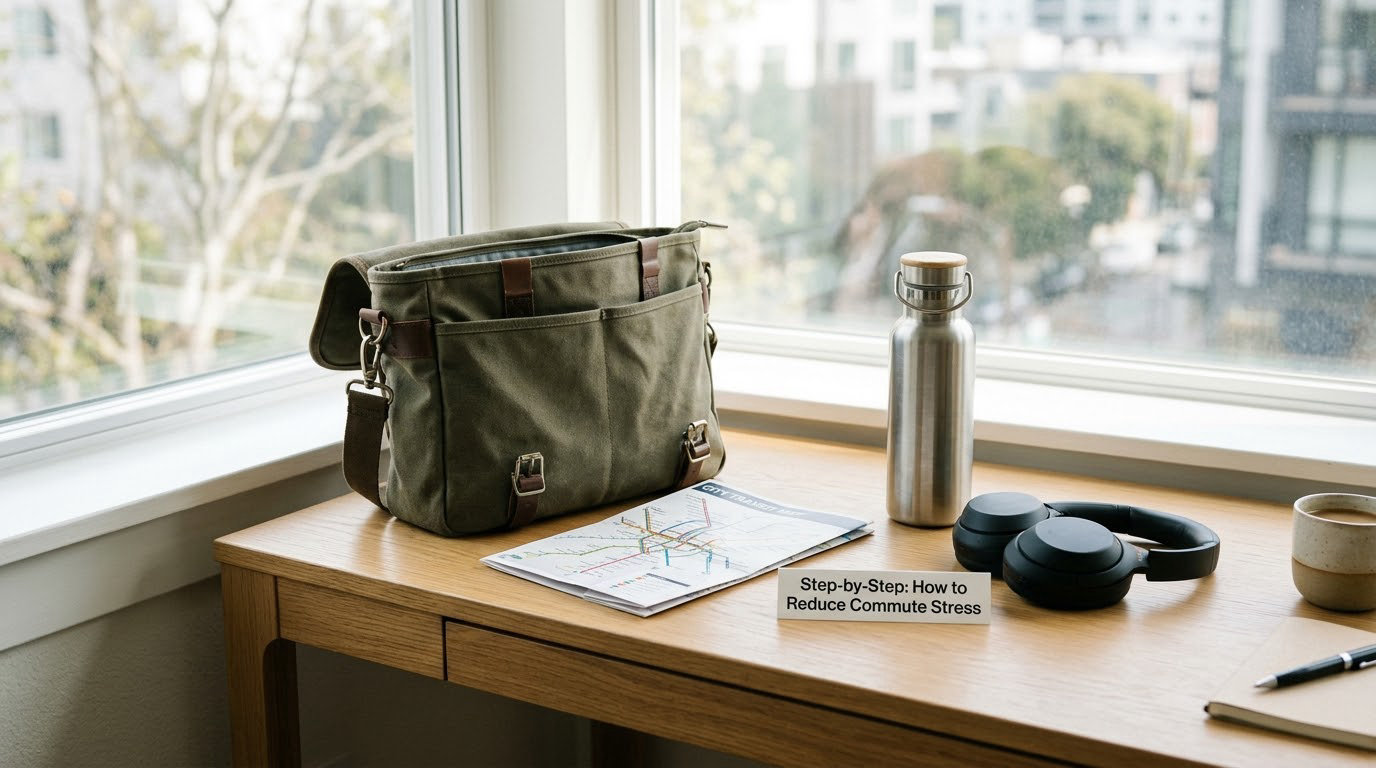
The steps run in order because they compound. Preparation makes the trip manageable, in-travel techniques handle whatever the trip throws at you, and a recovery ritual keeps the day from starting or ending inside the car. Skip ahead to whichever step matches your actual problem if you already know what it is.
1. Identify Your Main Stress Triggers
Write down the specific thing that tightens your shoulders. Not “traffic” in general, but the twenty-minute block where the road stops moving, or the platform announcement that your train is eight minutes late. Specific triggers can be worked on; vague ones just get absorbed.
Most commuters fall into one of these buckets:
- Unpredictability — delays, cancelled services, roadworks, weather. The trip itself is fine; the not-knowing is not.
- Time pressure — leaving late, missing a connection, arriving to a meeting already out of breath.
- Lack of control — no alternative route, no choice of seat or carriage, no say over the schedule.
- Crowding and noise — packed carriages, standing room only, engines and chatter with no volume control.
- Isolation — one to two hours a day with no human contact, which regular solo drivers mention more than anything else.
- Cost — fares, fuel and parking stacking up quietly until they register as the reason you feel heavy every morning.
- No decompression — work following you through the front door before you have said a word to anyone.
One commuter thread after another makes the same point: loss of control over time and route gets cited more often than distance. Someone whose day is ruined by an eight-minute delay has an unpredictability problem, and breathing exercises will not fix it. Someone who arrives tense after ninety minutes of silence has a decompression problem, and a better podcast will not either.
2. Build a 10-Minute Pre-Commute Routine
The morning rush is where most commutes are lost. Ten minutes of preparation removes the fiddly decisions — where are my keys, did I charge the headphones, which pass do I need — that otherwise run all the way to the station car park.
- Pack the night before (2 minutes). Bag, water bottle, headphones, badge, whatever the next day needs. Do it at the kitchen counter, not in a dark hallway at 6:40am.
- Drink a glass of water (1 minute). Dehydration and low blood sugar read as irritability, and people routinely mistake one for the other.
- Three rounds of box breathing (2 minutes). Inhale for four counts, hold four, exhale four, hold four. Four rounds is enough to shift a racing pulse.
- One thing that isn’t work (3 minutes). A podcast episode, a few pages, a song. It marks the boundary between work mode and travel mode.
- Check the route once (2 minutes). Look at delays, set the route, put the phone down. Checking again in twenty minutes will not change the traffic.
Attach the routine to something you already do — locking the door, starting the car, tapping your transit pass. Existing habits carry new ones better than willpower does.
3. Add Time and Schedule Flexibility
This is the lever with the largest effect and the one most people never pull, because it requires asking for something. Every commuter discussion I have read puts flexible or staggered start times at the top of the list of changes that helped, above any technique done in the car.
Options, roughly in order of how much they change your day:
- Shift twenty to thirty minutes either way. Leaving before the rush or after it is usually the single biggest win available to a driver, and it costs nothing but an earlier or later start.
- Stagger your hours formally. Ask for a 7:30 start instead of 9:00, or an 11:00 start instead of 9:00, when your role allows it. Put it in writing; informal flex usually collapses the first time someone needs you early.
- Keep an alternative route. Test it on a Saturday so you know the junctions. Back roads with more turns can feel worse than a highway, so pick for predictability rather than novelty.
- Ask for a remote day or two. Framing it as a scheduling question rather than a wellbeing plea tends to get further.
- Change the mode for one leg. Park and ride, or drive to a station and take the train for the middle of the trip when parking is the stressful part.
A realistic buffer beats a tight plan. People who budget fifteen spare minutes describe a completely different trip from people who budget zero, because one bad variable does not flatten the whole morning.
4. Make the Trip Itself Easier to Manage
Small friction removals matter more than they sound. Most travel stress is a pile of tiny unresolved tasks, not one big problem.
Keep fares or passes loaded and ready to scan, so a dead phone does not become a queue at the barrier. Check service alerts once before you leave rather than every four minutes while you travel — repeated checking works like a slot machine, and each refresh costs you more attention than the delay does.
For riders, choose the carriage or seat before you board if the route allows it. The last car is usually emptiest; the one before a busy interchange fills fastest. Standing on a moving train with a coffee is a poor combination, and boarding the car where you can sit is a reasonable five-minute habit.
For drivers, having one playlist, one podcast or one book loaded and ready means you are never choosing mid-jam, which is when the frustration usually lands. Keep something in the car that is not a screen: a book, a puzzle, a hard-felt pen for sketching. For cyclists, run your route and your audio before setting off, and keep one hand free and your bag off the handlebars.
5. Use Safe, In-Travel Stress Techniques
These are for the moment the frustration spikes. Most people need one reliable method, not a menu, so pick the one you will actually remember when you are stopped at a red light for the fourth time.
- Paced breathing. Box breathing at 4-4-4-4, or 4-7-8 if you prefer a longer exhale, keeps the nervous system from stacking adrenaline on top of frustration.
- Attention shifting. Name five things you can see, four you can hear, three you can feel. It interrupts the loop where you replay the same annoyed thought.
- Music or audio. Noise-cancelling headphones with brown noise or a calm playlist come up more than anything else in commuter forums. Keep news and self-help off the commute; both tend to leave people wired rather than settled.
- Mindful observation. Take the local road instead of the highway and stay present on it. Some commuters report this works precisely because there is nothing to zone out to.
- Brief human contact. A short call to someone who makes you laugh, a voice note, or a few words with a regular on the platform. This matters most for people who drive alone for hours.
Safety limits, and they are not optional. Never use any technique that takes your eyes off the road or your hands off the wheel. Eyes-closed breathing, reading, checking messages, and any eye-closed meditation are driving-unsafe and cycling-unsafe. Set audio before you move, then drive the way you would drive with an empty car. If you want to use a structured practice, do it in the ten minutes before departure or after you arrive.
6. Set a Boundary Between Work and Commute
Many commuters report arriving home already irritated, with the day still running in the background. That usually means the workday never actually ended — it just changed location.
Mark the end of it somewhere physical. Silence work notifications the moment you leave the building, not when you get home. Do one neutral, low-demand thing for the length of the trip: a podcast, a music album, a walk from the station, a call to a friend. Neutral matters; scrolling a feed or reading work messages is not a transition, it is a second shift.
On the way back, resist reopening the laptop and the inbox. If something genuinely cannot wait, write it down and deal with it at a fixed time tomorrow. A single named exception is fine; a habit is not.
7. Create a Simple Recovery Ritual
The transition problem is the one nobody addresses and the one that wrecks the evening. There is no gap between work headspace and home, so work follows you through the door and the people you live with get the leftover version of you.
A workable ritual takes five minutes. Change out of work clothes first, before you sit down, because sitting down is the signal that you are done. Walk for five minutes if the trip was seated, or stretch your shoulders and hips if it was not. Eat something proper rather than grazing over the sink. Then take two quiet minutes before you touch messages.
Pick two or three of those and do them every time. Consistency is what tells your nervous system the day has ended, not the specific activity you chose.
8. Review What Worked and Adjust
Treat this like any other change worth measuring. For one or two weeks, keep a note on three things: how stressed you felt at the start of the trip, how much energy you had when you arrived, and how many problems the trip threw at you.
Then change one thing. The most common mistake is trying all eight at once, which makes it impossible to tell which one worked and which one you abandoned on day four.
After a couple of weeks you will usually find that two levers carry most of the load for you: one structural (a later start, a different route, a remote day) and one in-the-moment (breathing, audio, the recovery ritual). Keep those, drop the rest, and let the routine settle to something you would still do on a bad-tuesday-in-February morning.
Common Mistakes That Can Make Commuting Stressful
Most people do not struggle with commute stress because they lack tips. They struggle with a handful of habits that reliably make an ordinary trip worse.
- Packing at the last minute. It turns the first ten minutes into a search for keys, wallet and charger, so you leave home already behind. Fix: pack the night before at the kitchen counter. Two minutes, every evening.
- Refreshing transit or traffic updates repeatedly. Each refresh hands you a fresh small problem to worry about, and the information almost never changes your route. Fix: check once before leaving, set the route, then put the phone down.
- Headphones loud enough to drown out thought. High volume raises arousal instead of lowering it, and you arrive at work with your hearing and your attention both frayed. Fix: comfortable volume, noise cancelling or brown noise, audio chosen the night before.
- Skipping meals because the commute runs long. Low blood sugar and dehydration get read as stress, and irritability follows you into the office. Fix: eat before you leave or bring something for the middle of the trip, and drink water.
- Expecting every trip to feel the same. When one in five days is worse, it reads as a personal failure rather than weather, construction and other traffic. Fix: judge the routine on a two-week average, not on the day that went badly.
- Working or scrolling the whole way. You arrive at the other end still in work mode, and the trip becomes more work rather than a break. Fix: reserve one leg of the trip for audio, reading or nothing at all.
A quick tip: if you only adopt one habit this week, make it the ten minutes before departure. Everything else in this routine works better once the morning stop feeling like a fire drill.
Frequently Asked Questions
How do I stop feeling stressed in traffic every day?
Traffic stress comes mostly from unpredictability and from other drivers, not from the road itself. Shift your departure by twenty to thirty minutes to miss the worst of the rush, choose a route you have driven before so it stays boring, and set audio up before you move. Keep a realistic buffer so one slow junction does not ruin the morning. Long drives alone are also isolating, so a call or a podcast does more good than people expect.
How can I relax on a crowded public transit commute?
Crowding is harder to control than delay, so plan around the parts you can influence. Travel outside peak hours where your schedule allows, board at a less crowded carriage or the last car, and have your pass ready so you are not fumbling at the barrier. Noise-cancelling headphones and a calm playlist reduce the sensory load. Try to sit rather than stand, and give your attention one specific task instead of watching the clock.
How to deal with a long commute to work?
Start with structure rather than endurance. Add a realistic buffer, shift your start time if you can, and pick one reliable in-travel activity instead of improvising each day. Set a hard boundary at the end of the workday so work does not ride home with you, and build a five-minute recovery ritual when you arrive. If the length itself is the problem, remote days, a shorter route or a different role are the real fix.
How do hybrid workers manage commute stress on office days?
Mixed weeks tend to be harder than fully remote or fully office weeks, because the commuting days are unpredictable on top of everything else. Try to fix your office days in the calendar at the start of each week, keep the same departure time on those days, and leave the office at a fixed hour so evenings stay predictable. The commute also changes your workday, so treat office days as a distinct schedule rather than a normal day with extra travel.
When does commute stress become a problem I should get help with?
Commute stress is worth raising with a professional when it is affecting your sleep, your relationships, or your work consistently for weeks, or when it comes with panic, low mood, or physical symptoms. A doctor or a mental health professional can help you work out what is going on, and workplace support or an employee assistance programme may cover the practical side. None of the steps here replace that conversation, and nobody has to wait until it is severe to make it.
Conclusion: Start With One Small Commute Change
Knowing how to reduce commute stress comes down to three levers and one habit. Unpredictability, time pressure and lack of control cause most of it, so fix what you can about timing, route, mode and schedule before trying to relax your way through a trip you have no control over.
Start with the trigger, then pick one lever. Write down what actually tightens your shoulders, add fifteen minutes of buffer or a five-minute recovery ritual, and give it two weeks. That is usually enough to know whether you are dealing with a schedule problem or a state problem, and the two need completely different fixes.
If you manage people, the commute sits inside your retention and wellbeing picture whether you call it that or not. Predictable office hours, staggered starts and access to mental health support cost very little and remove the complaint before it reaches you.