

To write a standard operating procedure for safety, you define one specific task, identify its hazards and the controls that reduce them, then write the steps in plain imperative language under a fixed set of headings. Add who is responsible, what records prove the work was done safely, and what happens when conditions are unsafe. Then test it with the people who will actually use it before anyone signs off.
A first SOP takes most of a day if the task is well understood. The hard part is not the writing; it is getting the steps to match what really happens on the floor. Budget time for two walkthroughs and expect to rewrite a third of your draft.
One note before we start: OSHA and most state plans require certain written procedures in narrow, specific circumstances, such as lockout/tagout, respiratory protection and permissible exposure sampling. An SOP is not a legal document on its own, but where a written procedure is required, your SOP is usually how you satisfy it.
Table of Contents
What You Need
Most drafts go wrong because the author started with a blank page instead of with the task. Gather these six things before you type a word.
1. The task, defined narrowly. “Machine operation” is not a task. “Clearing a jam from the infeed conveyor without opening the guard” is. If you cannot describe the start and end points in one sentence, the task is too big for one SOP.
2. The rules that apply. For a US workplace that usually means the relevant OSHA standard plus your state plan, plus manufacturer instructions for any equipment involved. If you operate under ISO 45001 or a food safety scheme like BRCGS or SQF, the scheme’s clause on documented information is the anchor. Write down which sources informed the procedure; auditors ask.
3. Hazard information. Existing risk assessments, near miss reports, incident records and inspection findings. If none exist, do a walkthrough with the operators who do the task and write down what can hurt, what could break, and what has already gone wrong.
4. The people who know the work. At least two operators, the supervisor who assigns it, and whoever maintains the equipment. A document written only by a safety professional tends to describe a task nobody performs.
5. The controls and equipment involved. Engineering controls in place, guarding and interlocks, required personal protective equipment, tools, and any permits or isolation steps. Note the hierarchy rather than jumping straight to PPE.
6. Evidence of safe completion. Decide now what records will prove the work was done correctly: a checklist, a log entry, a permit, a test reading. If you cannot name the record, you cannot verify anything later.
Step-by-Step: How to Write a Standard Operating Procedure for Safety
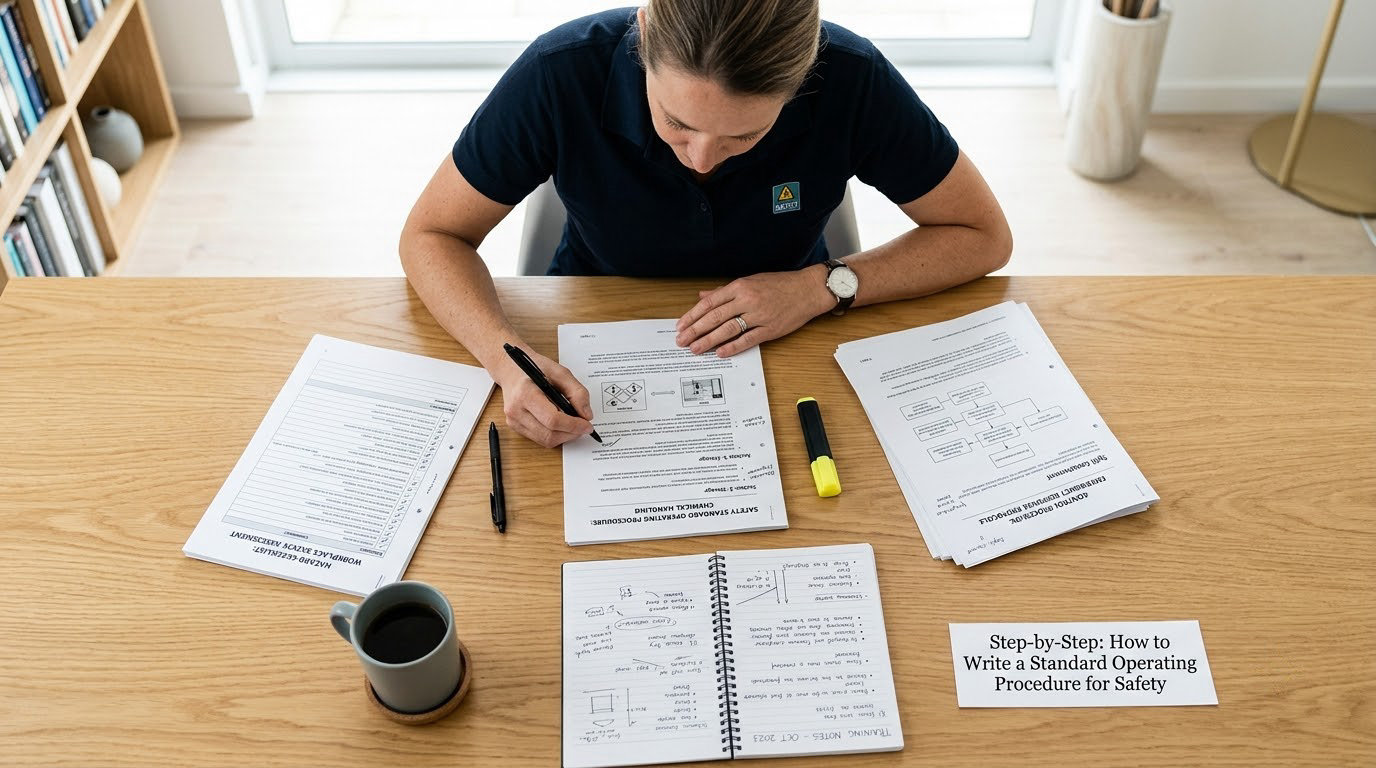
Eight steps, in this order. Skipping ahead is how you end up with a document nobody can follow at 2am.
1. Define the Task and the Safety Problem
Write a one-sentence scope statement: who does what, where, under what conditions, and why it matters. Name the trigger that starts the work and the point at which it is finished.
Then name the harm that could occur and who it lands on. “Operator’s hand is caught between the conveyor and the drive roller during a jam clear” is a safety problem. “Improves efficiency” is not. If you can trace the sentence back to an incident report, a near miss or a failed inspection, the SOP has a reason to exist that an auditor will accept.
Test the scope by asking whether a reader could tell, from this one sentence, whether a situation falls inside or outside the procedure. If not, the boundary is still fuzzy.
2. Gather Requirements and Input
Collect the applicable requirements and the operational reality, and keep them separate. Requirements come from regulations, standards and manufacturer instructions. Reality comes from watching the task being performed and asking the operator where the instructions always get vague.
Talk to at least two people who do the job. Ask them what they would tell a new hire standing next to them. Those are your steps. Anything you wrote at a desk that nobody said is a guess.
Record the sources in a references section at the end of the document. Manufacturer instructions deserve special care: reference the manual rather than copying its contents, because a copied paragraph goes out of date the moment the manual is revised.
3. Write Clear, Actionable Steps
Write every step as one action, starting with a verb: “Disconnect the power”, “Verify zero energy”, “Tag the isolator”. Avoid the passive voice entirely. “The guard should be checked” tells nobody who is holding it.
Sequence the work from preparation through cleanup. Keep sentences short, one idea per line. Put the action in the line and the reason in a following line only when the reason is not obvious.
Mark hold points clearly, as their own numbered step: a verification that must pass before the next stage begins. Number every step so a supervisor can say “stop at step 12” and everyone knows what that means. If a step needs two actions, it is two steps.
4. Assign Roles and Emergency Actions
Name the person or role at every step where it matters. In practice that usually covers four functions: who authorizes the work, who performs it, who supervises or checks it, and who responds when something fails.
Use roles and job titles, not individual names, so the document survives staff turnover. Then add the emergency section, which is the block most often left out: what constitutes a stop-work condition, who has the authority to stop it, what first aid or evacuation applies, and who gets called.
Where people work at height, in confined spaces, or around hazardous energy, the stop-work authority should be explicit and belong to any worker, with no penalty for using it.
5. Add Controls, Records, and Acceptance Criteria
This is where a safety SOP differs most from a general business procedure. Three sections are not optional.
Monitoring says how you will know the procedure is being followed: inspections, observations, record reviews, or sampling. Give it a frequency and a named owner.
Corrective action says what happens when monitoring finds a deviation: who is told, how it is contained, and how it is closed out.
Verification and record keeping says what proves each task was completed safely, who signs it, and how long the record is kept.
A short filled-in example, using the heading sequence that practitioners on the IFSQN food safety forum actually post in real documents, looks like this:
PURPOSE: Define the method for cleaning the dough mixer between production runs to prevent allergen cross-contact. SCOPE: All shifts, Mixer Bay 2. INSTRUCTIONS: 1. Switch off and isolate the mixer. 2. Remove the bowl and scraper. 3. Wash with the approved food-grade detergent. 4. Rinse with potable water. 5. Inspect the seal and shaft for residue. 6. Reassemble and record on the cleaning log. MONITORING: Line supervisor verifies the cleaning log daily. CORRECTIVE ACTION: Stop production, re-clean, record the deviation and notify QA. VERIFICATION AND RECORD KEEPING: Cleaning log signed each run, retained 12 months.
That example is deliberately short. Real operations differ, and one experienced food safety moderator on that forum put it plainly: the requirement is that the SOP describes what you are actually doing, and examples only suggest a format because the details will not match your site.
6. Review and Test the SOP
Send the draft to two audiences. The subject-matter reviewer checks the controls and the regulatory references. The person who will actually perform the task checks whether the steps work.
Then do a dry run. Walk the task with an operator who has not read the document, using only what is written. Watch where they stop and ask questions. Every hesitation is a gap in your SOP, not a gap in the operator.
Rewrite anything that caused a question, then run it a second time with a different person. This step catches more real problems than any other, and it is the step most often skipped because the author is confident the document is clear. It rarely is.
7. Approve, Publish, and Train
Approval is a documented act, not a verbal one. The approver is usually the process owner or manager, sometimes with a safety or quality sign-off for safety-critical procedures. Capture the name, role and date.
Assign a document number, a version and a next review date on the cover. Store the current version in one controlled location and withdraw superseded copies, including anything printed and pinned up in a workshop. An out-of-date laminated copy on a wall is worse than no copy.
Train every affected worker on the released version and record competency before anyone works to it independently. Training delivered against draft 3 is not training on the SOP you issued.
8. Monitor and Review the SOP
Watch the indicators that tell you the procedure is failing: near miss reports involving the task, inspection results, deviation records, training completion, and feedback from the people doing the work.
Set a scheduled review cycle, commonly annually for stable processes and more often for high-risk ones, and also set triggers for immediate revision after any change in equipment, process, personnel, materials or regulatory requirement.
Record every revision in a revision history table with the change, the reason and the approver. When an incident happens, the revision history is usually the first thing asked for.
Common Mistakes
Writing an SOP for a task that has not been defined. If the scope covers “production”, split it. One task per SOP keeps it testable and keeps the training conversation short.
Steps that describe intentions rather than actions. “Ensure the area is safe” is an intention. “Walk the aisle, confirm the floor is dry and the exit is clear” is an action. One action per step, in imperative voice.
Copying the regulation into the body text. A paragraph of regulatory language helps nobody at the machine. Quote the requirement in the references section and write plain instructions in the procedure.
Copying manufacturer instructions instead of referencing them. It reads thorough and creates a version-drift problem the next time the manual changes. Reference by manual number and section.
No emergency section. If the document does not say what to do when a control fails, the reader will improvise. That is the moment you were writing the SOP to prevent.
Approving without a walkthrough. Peer review by the intended reader catches what expert review misses. Treat every question during the dry run as a defect to fix.
Too much detail, or the wrong kind. One experienced practitioner on that forum warned against over-complicating an SOP; another argued for one SOP per product, per step, per machine. Both are defensible, and the resolution is usually the same: match granularity to how variable the work actually is, and put equipment operation in its own instruction that the SOP points to.
Three practical tips from working through this. Number your documents with a scheme that shows area and version, for example a site code, sequence number and revision, so an auditor can ask for one and find it in seconds. Keep the procedure section free of background narrative; move rationale to a short note under the step. And budget an hour for the walkthrough for every hour you spend drafting. That ratio has never worked against me.
Frequently Asked Questions
What should a safety SOP include?
A safety SOP should include purpose, scope, definitions, roles and responsibilities, the step-by-step procedure, required controls and PPE, emergency and stop-work actions, monitoring, corrective action, verification and record keeping, references, and a revision history with an approval signature. If a section is missing, an auditor will usually treat the whole document as incomplete.
How long should a standard operating procedure be?
Long enough to cover the task completely and nothing more. For a single repetitive task, one to three pages is typical. If you are producing ten pages, you may have written a training manual or a work instruction rather than an SOP. Length is a poor measure of quality; a reader should be able to find any step in seconds and act on it without context.
Does every workplace need a written SOP?
Not every task needs a formal SOP, and no US rule requires one in general. Written procedures are specifically required in defined situations, including hazardous energy control, respiratory protection and certain exposure monitoring. Beyond those, the driver is usually risk, insurance, customer or accreditation requirements. Document the highest-risk and most variable tasks first.
How often should a safety SOP be reviewed?
Annually for stable, lower-risk tasks, and every six months for high-risk or rapidly changing processes. Set a scheduled date on the document itself rather than relying on memory. Also trigger an immediate review after any change in equipment, materials, process, personnel or legal requirements, and after any incident or near miss involving the task.
What is the difference between an SOP and a risk assessment?
A risk assessment identifies hazards, estimates how likely and how serious the harm is, and decides which controls are needed. An SOP then documents the accepted controls as a repeatable sequence of steps. The assessment informs the procedure; the procedure is the evidence that the assessment was acted on. Most mature systems require both, kept separate but linked.
Can the same safety SOP be used at multiple worksites?
The structure and content travel well, but the site-specific details cannot be reused unchanged. Update the equipment and energy isolation specifics, emergency contacts, muster points, permit references and the applicable local rules for each location. Publish a site-specific version rather than a shared generic one, so nobody follows a document that names the wrong fire alarm or the wrong isolation point.
Conclusion
Pick the highest-risk task your team repeats, document it today, and bring the two people who do that job to the review before you approve anything. Every control and every acceptance criterion in that document should be one you watched someone actually perform.