
A workplace hydration challenge works best when it treats water as a routine rather than a race. The ideas below give HR leads, office managers and team leads 12 formats you can run in a week, a month or a quarter, whether your people sit at desks, work a warehouse floor, or are fully remote. Each one is designed to reward consistency, not volume, and every employee can opt out without explaining why. This is general workplace wellness guidance, not individual medical advice, and anyone with a fluid restriction should follow their clinician’s instructions instead of any challenge.
Before you pick a format, fix the plumbing. If the nearest refill point is a corridor away, no challenge will survive the first busy Tuesday. Our piece on why water access matters for worker health covers the infrastructure side in more detail, including refill proximity and equipment that works for different body sizes.
Table of Contents
- Hydration Challenge Ideas for Work at a Glance
- 1. Daily Water Check-In Challenge
- 2. Water Bottle Labeling Challenge
- 3. Team Refill Reminder Challenge
- 4. Hydration Habit Streak Challenge
- 5. Water-Side Meeting Challenge
- 6. Hydration Station Design Challenge
- 7. Flavor Inspiration Challenge
- 8. Hydration Break Bingo Challenge
- 9. Department Water-Walk Challenge
- 10. Hydration Knowledge Scavenger Hunt
- 11. Bring Your Own Bottle Challenge
- 12. Month-End Hydration Celebration
- How to choose between these hydration challenge ideas for work
- Safety guardrails to put in writing before you launch
- Frequently Asked Questions
- How much water should I drink during a workday?
- What is the 10 gulp rule?
- What happens if someone drinks a large amount of water very quickly?
- How do we keep a hydration challenge going after the first week?
- How can remote and shift-based employees join a hydration challenge?
- What if an employee has a medical fluid restriction?
- Conclusion
Hydration Challenge Ideas for Work at a Glance
The table below lists all 12 ideas with the setting each one suits, the benefit it delivers, and how people take part. Use it to match a format to your workplace before you read the detail.
| Challenge idea | Best workplace setting | Main benefit | How participation works |
|---|---|---|---|
| Daily water check-in | Office, hybrid, remote | Turns a forgotten habit into a visible one | Tick a card or send one emoji each day |
| Water bottle labeling | Anywhere | Personalisation plus a refill cue | Decorate a bottle and add reminder marks |
| Team refill reminders | Desk-based teams | Peer nudges that cost nothing | Pairs prompt each other at set times |
| Hydration habit streak | Anywhere | Builds routine without measuring fluid | Mark days you drank at natural breaks |
| Water-side meeting | Office and hybrid | Movement paired with a drink | Walk or stand for a break near water |
| Station design challenge | Office, warehouse, clinic | Fixes access problems first | Team proposes and tests an improvement |
| Flavor inspiration | Shared kitchen or break room | Makes plain water more appealing | Contribute an infusion recipe to try |
| Hydration break bingo | Office and remote | Lowest-pressure gamification | Complete squares built from real actions |
| Department water walk | Any setting, adapted per team | Adds movement to a desk-bound day | Short walked break between tasks |
| Knowledge scavenger hunt | Large sites, campuses, depots | Maps water access around the building | Answer questions, no intake recorded |
| Bring your own bottle | Anywhere, including remote | Shifts habits toward reusable bottles | Use your own container and log the switch |
| Month-end celebration | Whole company or department | Recognises participation, not volume | Team acknowledgement and a small prize |
1. Daily Water Check-In Challenge
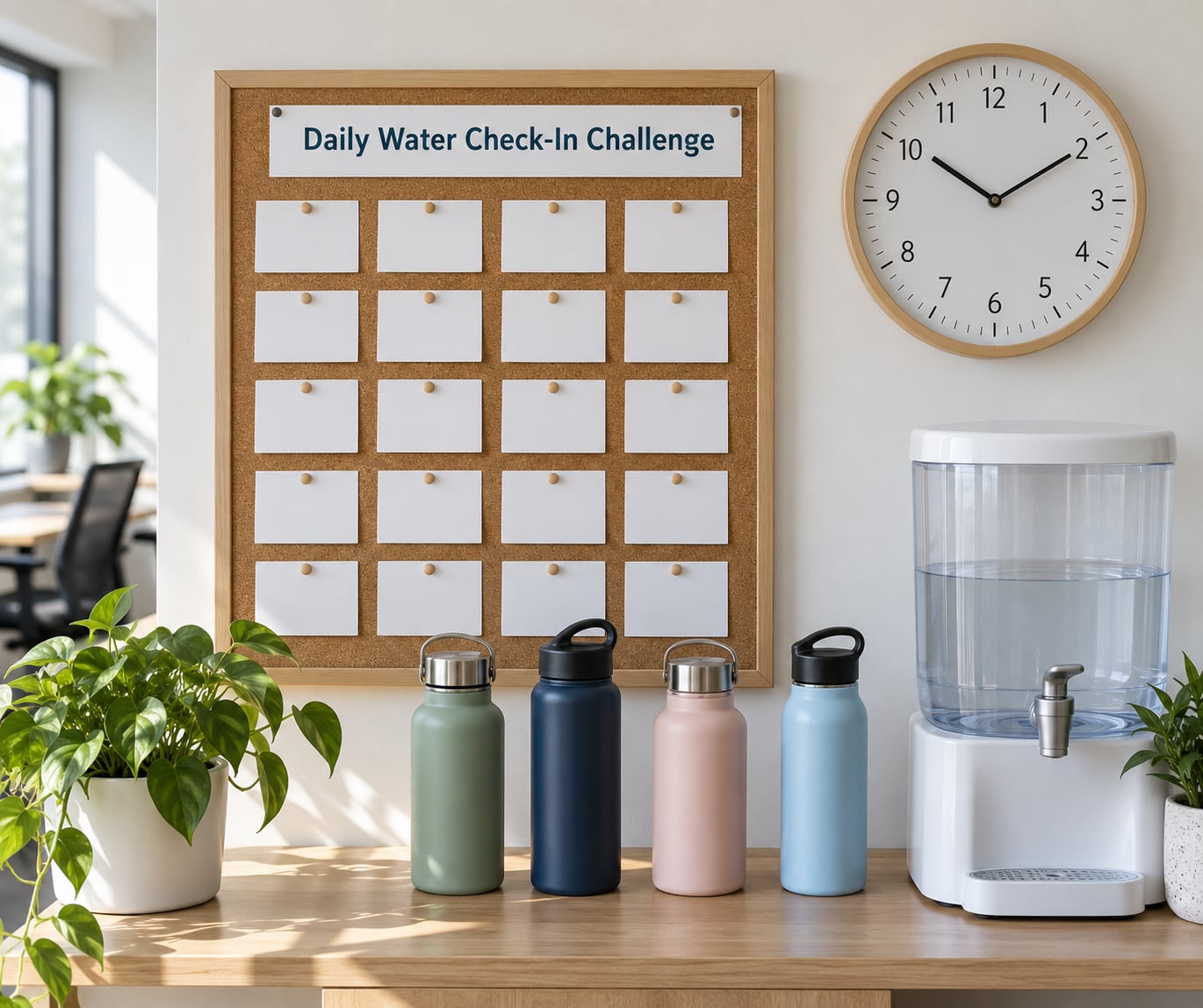
The daily check-in is the simplest format on this list and the one I suggest starting with. Nobody records a volume, nobody compares numbers, and the whole thing takes about five seconds per person per day.
Put a small board by the water point, or a pinned message in your team channel, with a grid of names and days. Each person marks the day they drank water at their normal break opportunities. If your team is remote, the same grid works as a shared document or a channel tab where people post a single check mark.
Run it for two weeks, not a month. Two weeks is long enough to see whether people actually visit the water point and short enough that nobody resents it. A 40-person office usually gets half its people participating in the first week, and participation climbs once people see names appear.
2. Water Bottle Labeling Challenge
This one works because it asks almost nothing. Employees take whatever bottle or cup they already carry and make it recognisably theirs, then add simple refill cues like marks or stickers at intervals.
The practical part is the cue. A small mark or a strip of coloured tape at the halfway point of a bottle is a prompt most people read without thinking. Some teams label bottles with an office name so refill points are easy to identify and stray bottles get returned to the right team.
Keep it optional and keep it out of shared display space unless people volunteer their bottle for a photo. Some staff use a mug, a glass jar or a cup, and the point is a visible cue rather than a specific container.
3. Team Refill Reminder Challenge
Pair up teammates and have them send each other a nudge at two or three agreed times a day. The message can be as plain as a water emoji, a standing desk reminder, or a knock on the door if you are on site.
Build in a clear opt-out. Some people have heart or kidney conditions, are recovering from medical procedures, or are simply not interested, and a reminder system with no opt-out becomes a problem rather than a nudge. Say in the launch message that anyone can leave the pair list at any time without explanation.
Refill reminders are also the easiest format to run for night and shift teams, because the times can match the shift rather than the office day.
4. Hydration Habit Streak Challenge
A streak challenge tracks routine, not fluid. Each person picks their own reasonable goal, such as drinking water at three natural opportunities in the workday, and marks the day when that happened.
The personal goal matters. A 45-minute meeting block and a warehouse shift have completely different shapes, and a shared target punishes people whose work does not allow frequent breaks. Flexible personal goals also sidestep prescribing amounts, which is not something a workplace programme should be doing.
Treat a missed day as neutral. If a skipped day costs a streak, people quit within two weeks, which is the single most common failure mode I see with this format.
5. Water-Side Meeting Challenge
This one pairs a drink with movement. Instead of a 60-minute block, try a 10-minute walk with water at the end of a 50-minute slot. How to run a fitness challenge at work covers the planning side if you want a wider programme rather than a single format.
Scale it to the meeting. Short calls get a glass of water at the end. Thirty-minute meetings get a two-minute stand and refill. Long sessions get a proper walk, and the walk is the point, not a token.
It is one of the better formats for hybrid teams because remote colleagues can step away from the desk for the same break, and nobody is singled out as the person who left the meeting.
6. Hydration Station Design Challenge
Skip the behaviour change and fix the setup first. Ask teams to spend a week auditing and improving one water point: where it sits, how easy it is to reach, whether the tap height suits everyone, whether cups are where people need them.
Then let them act on it. A team might add a second cup rack near the printer, relocate a dispenser closer to a break area, or request a unit with a lower spout. Facilities teams are usually happy to back a proposal that arrives with a written reason and two photos.
Evaluate the proposals the same way you would any small workplace improvement: a short anonymous survey before and after, and a count of station use if the equipment has it. Improvements that win are usually about location and cups, not about the water itself.
7. Flavor Inspiration Challenge
Plain water is a habit for some people and a chore for others. This format invites everyone to contribute one combination they actually enjoy, so the office ends up with a small menu instead of one jug nobody touches.
Reliable combinations are simple: citrus slices, cucumber, a few mint leaves, a splash of sparkling water, or ice with a little fruit. Keep everything unsweetened and let people label containers so nobody mistakes an infusion for a shared drink.
Two practical rules. Check workplace food allergy policies before offering anything, and do not build a challenge that requires a shared pitcher of anything. Some staff avoid certain ingredients for religious or medical reasons, and a communal jug is a poor way to run a team activity.
8. Hydration Break Bingo Challenge
A bingo card built from realistic workplace actions avoids any consumption target entirely. Squares include refilling a bottle, taking a scheduled break, visiting the water point between two meetings, and noticing a coworker’s bottle is empty.
Because actions vary by role, let people build their own card from a common pool of squares. A warehouse supervisor, a night-shift nurse and a remote designer will all complete different sets, and nobody needs a fixed target to compare against.
Bingo suits a one-week window and works well as a table filler in a break room or a card in a channel tab.
9. Department Water-Walk Challenge
Add a short walked break to the working day and put water at the end of it. For desk-based staff, two or three minutes after a long block is plenty. Our list of workplace step challenge ideas for teams has more formats if you want the movement element to carry the programme.
Adapt it per team rather than one rule for everyone. Warehouse and manufacturing staff often need a supervisor sign-off to leave a work area. Mobile and field staff need a check-in option that works without a fixed location. Night and shift teams need breaks timed to their shift, not to the office day.
For remote staff, the same challenge is a phone call made while walking, or a standing break between calls.
10. Hydration Knowledge Scavenger Hunt
On large sites, campuses, depots and hospitals, plenty of people genuinely do not know where the water points are. This activity turns that into a short quiz: find every refill point on the floor, identify the refill policy, and name the station nearest the shift change room.
It works well during onboarding, and it produces a useful artefact. The finished answer sheet is a simple map of water access that facilities can share and update, and it often reveals gaps, like a point that is behind a locked door at shift change.
Keep it factual. There is no health claim in a scavenger hunt, which makes it the safest format to run in a workplace with medical staff and strict wellness policies.
11. Bring Your Own Bottle Challenge
This is a switch challenge rather than a drinking challenge. Employees who normally use a disposable cup bring a reusable bottle instead, and the goal is fewer single-use containers in the bin.
Offer alternatives for people who cannot do it. Some staff share equipment, lose bottles constantly, work in environments where bottles are not permitted near machinery, or simply prefer a cup. Participation is tracked as a switch, not as a purchase, so nobody needs to spend money to take part.
Pair it with a short survey of which sizes and lid types people actually use. The answer is usually a wider range of bottle diameters than an office stocked by default, and that is a fixable detail with real impact.
12. Month-End Hydration Celebration
Close the month by recognising participation and consistency. Department acknowledgements in a team message, a shared lunch for the winning participation rate, and small practical prizes work better than anything based on volume consumed.
Never reward the largest intake total. That rewards people who chug, and it rewards the people whose bodies need less, and it discourages everyone else. Reward the highest participation rate, and consider a second category for the most improved refill-point access, which usually goes to the team that fixed a location problem.
Finish with a five-minute review: what people found useful, what got in the way, and whether anyone wants to keep something running. Teams at wellness programmes that run beyond one month usually keep the small formats and drop the scoring.
How to choose between these hydration challenge ideas for work
Pick the format that matches the constraints you already have, not the one that sounds most fun in a planning meeting. The constraint that decides most cases is time.
If you have one week, run the check-in, the bottle labeling or the bingo card. If you have a month, run the habit streak and close with the celebration. If your people never meet in person, use the check-in, the bingo card and the bring-your-own-bottle switch, since none of them require shared space.
Second constraint is the size of the team. Under about 15 people, a shared board beats a platform. Over 100 people, a simple digital tally with anonymised results beats a physical board nobody updates.
Third constraint is what you can honestly support. A challenge that fails on water access, water taste or dispenser maintenance will be over within a fortnight, no matter how good the mechanic is. Our water access guide is worth reading before you launch anything.
Safety guardrails to put in writing before you launch
Never set a maximum-intake goal, and never praise the biggest number on the board. Excessive water intake in a short window can cause hyponatremia, where sodium levels in the blood fall too low, and training communities have raised this risk repeatedly. The National Academies of Sciences, Engineering, and Medicine publish adequate intake reference figures of about 15.5 cups of fluid a day for adult men and 11.5 cups for adult women, but those are population references, not a workplace target for an individual employee.
Add four lines to your challenge brief. Participation is optional and can stop at any time. No specific fluid amount is required or measured. Anyone with a medical condition or a fluid restriction follows their clinician’s advice instead of the challenge. And individual intake data is never collected, shared or reported to managers.
Do not count litres in a visible public place either. If you track team totals, keep them coarse and let people contribute to a shared number rather than an individual one.
Frequently Asked Questions
How much water should I drink during a workday?
Public health bodies publish rough reference ranges rather than a workplace target: the National Academies of Sciences, Engineering, and Medicine give adequate intake figures of about 15.5 cups of fluid a day for adult men and 11.5 cups for adult women, counting all drinks and water-rich foods. Individual needs vary with heat, activity, pregnancy and health conditions. A workplace challenge should not prescribe an amount, so set participation goals around routine instead.
What is the 10 gulp rule?
The 10 gulp rule is a simple memory aid rather than medical guidance: imagine swallowing about ten small sips of water, which is roughly 250 millilitres, spread across a working hour or so. The idea is to create a repeatable prompt you can attach to an existing habit, like the start of a meeting. Treat it as a nudge, not a quota, and stop if you feel full or unwell.
What happens if someone drinks a large amount of water very quickly?
Drinking a large volume of water in a short window can dilute sodium in the blood and cause hyponatremia, which brings headache, nausea, confusion and in severe cases seizures. This is why a workplace challenge should never reward speed or maximum volume. Posters in training communities such as WAHOX and StrongFirst repeatedly raise the overhydration risk for exactly this reason, and anyone concerned should ask a clinician.
How do we keep a hydration challenge going after the first week?
Novelty carries the first seven to ten days, and participation usually drops after that. What sustains a programme is infrastructure, not novelty: refill points within a few minutes of desks, water people actually like drinking, and a break schedule that makes drinking possible. Cut the scoring, keep the smallest format that people liked, and review at 30 and 90 days to see whether the habit survives the challenge.
How can remote and shift-based employees join a hydration challenge?
Use formats that do not need shared space. A daily check-in grid, a bingo card built from personal actions, and a bring-your-own-bottle switch all work remotely, and time your prompts to the shift rather than the office day. Night and warehouse teams need breaks timed and supervised in a way that matches their roster, and mobile staff need a check-in option that does not depend on a fixed location.
What if an employee has a medical fluid restriction?
Make the opt-out automatic and private, and publish it in the challenge brief from the start rather than treating it as an exception. Employees with heart or kidney conditions, recent procedures or clinician-set fluid limits should follow their clinician’s advice, not the challenge, and they should never be asked to explain. Also avoid any format built on public volume counts, since those formats pressure exactly the people who need to opt out.
Conclusion
Start with the daily water check-in for two weeks, state plainly that participation is optional, and make the nearest water point a short walk rather than a corridor. After the first run, ask three questions: how many people joined, what got in the way, and whether anyone kept the habit afterwards. Then pick the next idea from the list based on that answer rather than on what sounded best at the planning meeting. Updated for 2026, and written as general wellness guidance rather than medical advice.