
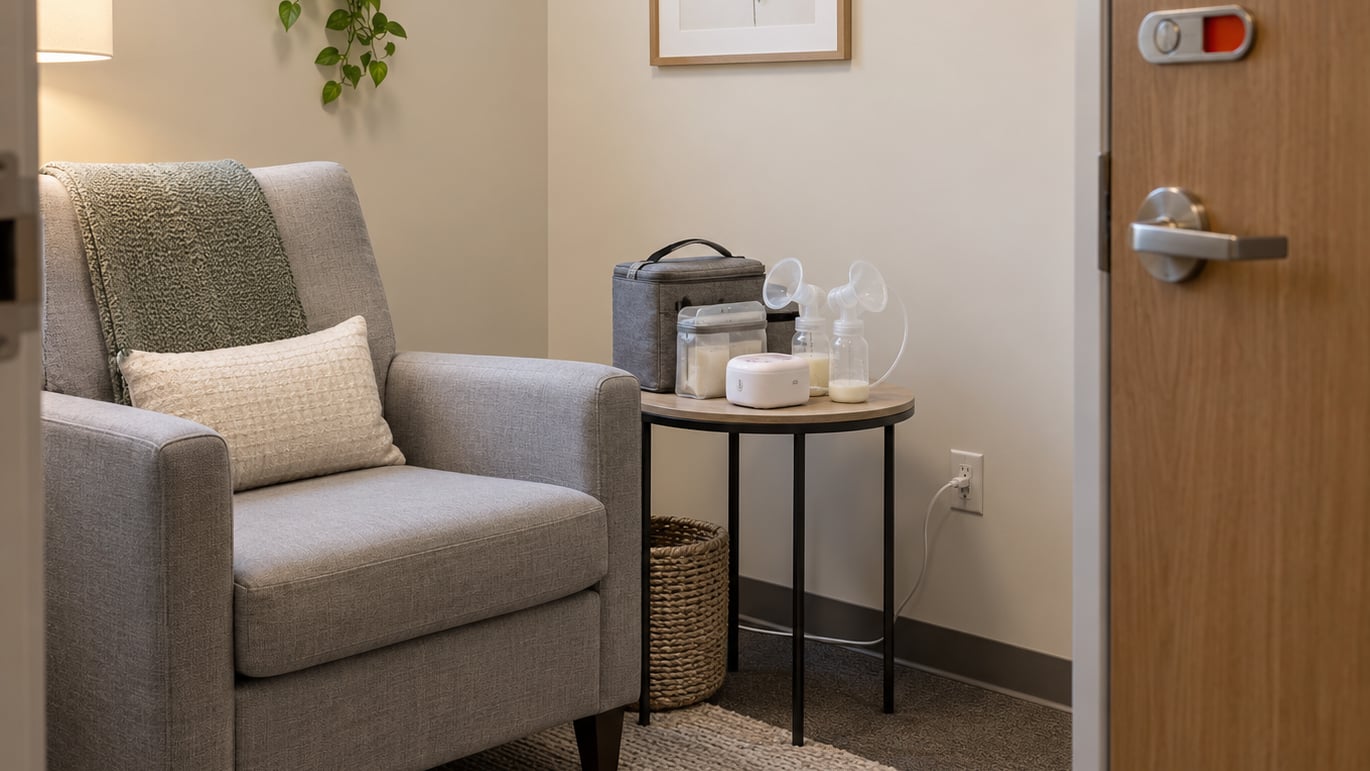
If you are an employer in the United States, the short answer is this: you must give covered employees reasonable break time and a private place other than a bathroom to pump or express breast milk, and that space has to be shielded from view, free from intrusion, and close to the work area where the employee actually works. Under the Fair Labor Standards Act, Section 7(r), as expanded by the Providing Urgent Maternal Protections for Nursing Mothers Act (PUMP Act) in 2022, that protection lasts for one year after the birth of a child. This guide covers what the federal rule says, what state law adds, what a usable room looks like in practice, and the checklist most HR and facilities teams need. It is written for 2026 and reviewed as workplace rules change.
Table of Contents
- Lactation Room Requirements for Employers at a Glance
- What Does the Federal PUMP Act Require?
- How Much Space Must a Lactation Room Have?
- What Features Should an Employer Provide?
- Do State and Local Laws Add More Requirements?
- Who Is Covered and What About Exempt Employees?
- How Can Employers Make the Space Usable and Private?
- Lactation Room Requirements for Employers: A Compliance Checklist
- Frequently Asked Questions
- Do employers have to provide a refrigerator for breast milk?
- Are companies required to have a mother’s room?
- How many pumping breaks can an employee take in a day?
- Can a shared break room with a curtain count as a lactation room?
- Are pumping breaks paid in every state?
- What should we do when no suitable room exists at our location?
- Conclusion
Lactation Room Requirements for Employers at a Glance
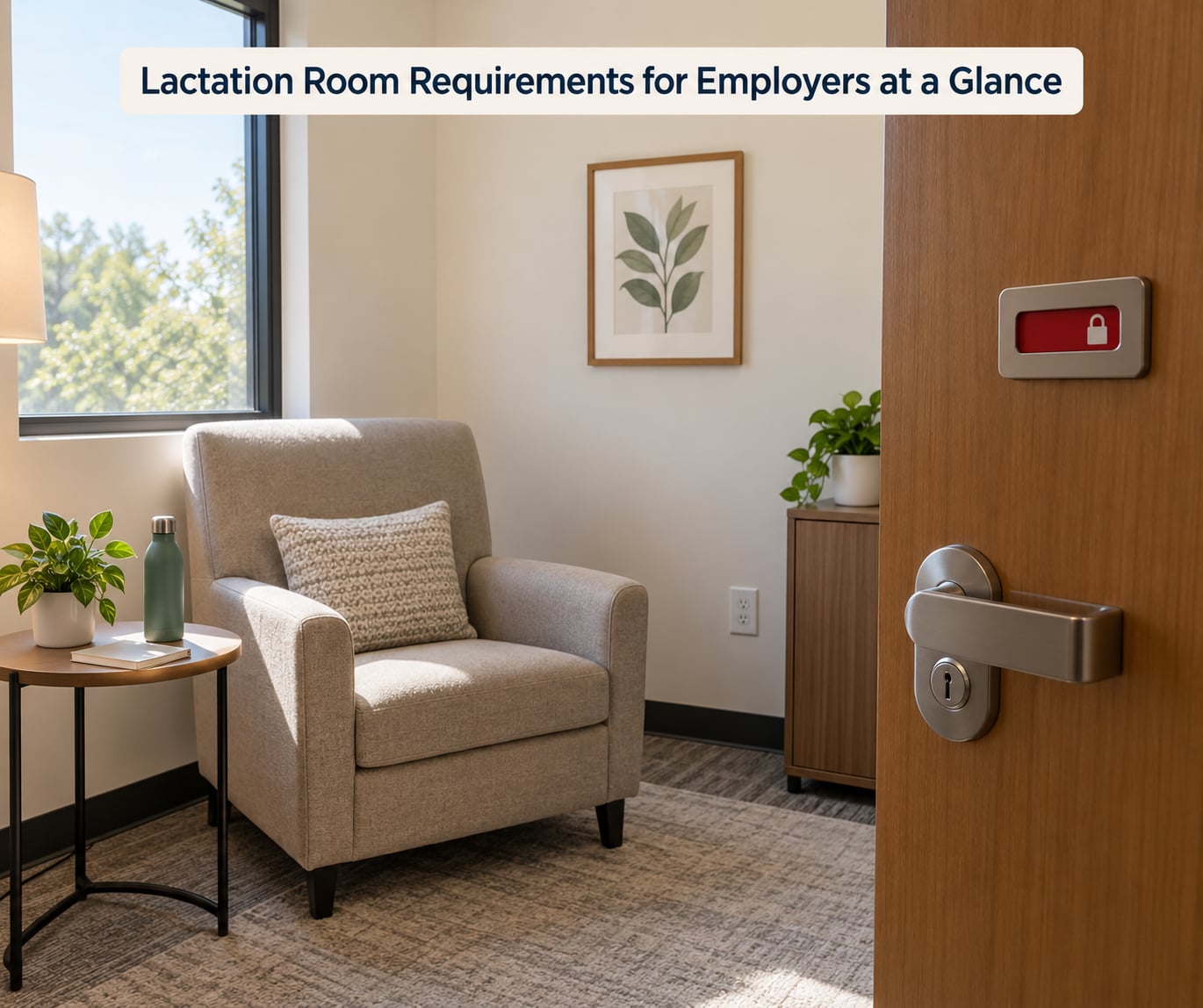
Here is the federal baseline in plain language. Employers must give covered employees a reasonable amount of break time to express breast milk for up to one year after the birth of a child, and a place to do it that is shielded from view, free from intrusion, available when needed, and functional for pumping. That place cannot be a bathroom, and it should be in close proximity to the employee’s work area. Break time must be counted as time worked for pay purposes, not deducted as an unpaid break.
In practice, that baseline turns into about a dozen checkable items:
- Break time: a reasonable amount of time, on a reasonable schedule, for up to one year after birth.
- Pay treatment: pumping time counts as time worked, so it is not taken from an unpaid lunch break.
- Not a bathroom: a bathroom, closet, or first-aid room does not satisfy the federal rule.
- Shielded from view: no windows, glass panels, or open doorways that expose the person pumping.
- Free from intrusion: no coworkers, managers, or the public entering during use.
- Functional for pumping: space where a person can sit with a pump and belongings without it being a storage closet.
- Available when needed: present and usable, not a room that exists on paper but is permanently padlocked or booked by someone else.
- Close proximity: a walk of a couple of minutes at most, ideally down the hall or on the same floor.
- No retaliation: employees cannot be fired, demoted, or disciplined for pumping or for asking about pumping space.
- State law may go further: several states add paid-break rules, space-size standards, or penalties on top of the federal floor.
Two things are worth saying up front because they come up constantly. The law does not specify a room size, and it does not require a refrigerator, a sink, or even a chair. Those are expectations people hold strongly, and some states or local rules do add requirements, but they are not federal mandates.
What Does the Federal PUMP Act Require?
The legal chain is short, and once you follow it the requirement is easier to apply than most employers expect.
The Fair Labor Standards Act, the federal wage-and-hour law that already governs minimum wage and overtime, was amended in 2010 by the Break Time for Nursing Mothers Act. That amendment added Section 7(r) of the FLSA, which is codified at 29 U.S.C. 207(r). It told covered employers to provide reasonable break time and a private, non-bathroom place for pumping.
The 2022 PUMP Act, the Providing Urgent Maternal Protections for Nursing Mothers Act, changed who was covered. Before it, protections largely reached only employees at companies with 50 or more employees. After it, the 50-employee threshold applies to the undue hardship defense rather than to basic coverage, so employers of all sizes fall under the baseline requirement, with limited exceptions for categories such as airline flight crewmembers and certain rail carrier and motorcoach operations.
Break time, frequency and duration
The law says a reasonable amount of break time, with frequency and duration that make sense for the individual’s needs. The Department of Labor’s guidance treats the first break of the day as generally adequate and describes additional breaks as needed as an employee grows, or as needed for pumping two children at once. In practice, that usually lands on roughly two to three breaks of 15 to 20 minutes across a shift, scheduled with the same flexibility that applies to any other permitted break.
Break time is compensated. It counts as time worked, so it is deducted from the FLSA workweek in calculating minimum wage and overtime. It is not, however, always required to be paid at the full contractual rate in every state, and several state laws expressly require paid pumping breaks. That distinction is where a lot of payroll trouble starts.
Duration and who the rule covers
Protections apply for up to one year following the birth of a child, and they apply based on the need to express milk, not on gender. A pregnant or lactating employee of any gender who needs to express breast milk is covered. The Pregnant Workers Fairness Act, effective in 2023, adds a separate and broader reasonable-accommodation duty for known limitations related to pregnancy, childbirth, or related conditions, which can reach beyond pumping to things like carrying limits, sitting, and lifting.
What happens if an employer falls short
Non-compliance is not a private conversation. An employee can file a complaint with the Department of Labor’s Wage and Hour Division, which can investigate and seek back wages and remedies. Under the PUMP Act, employees also gained a limited private right of action to sue for monetary damages, including money for the emotional harm of not having a place to pump. Before filing that lawsuit over an inadequate or missing space, an employee generally must give the employer 10 days’ advance written notice and an opportunity to fix the problem. Retaliation against an employee for pumping or for complaining about pumping is unlawful on its own.
Because this is a legal topic with real exposure, treat the summary above as orientation rather than advice. For a contested situation, an unfamiliar state, or a threatened claim, get a lawyer involved.
How Much Space Must a Lactation Room Have?
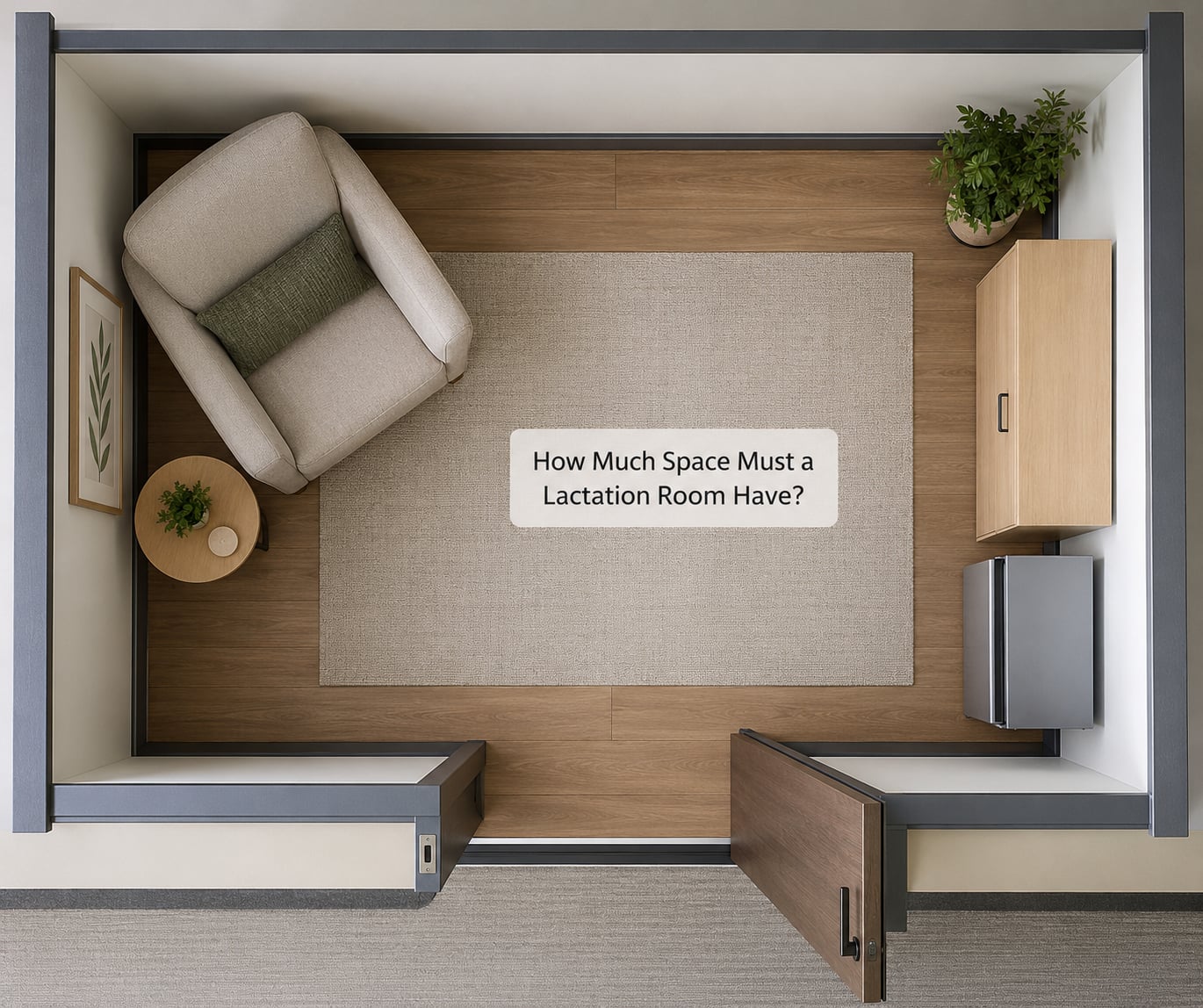
The federal PUMP Act does not set a square-foot minimum for a lactation room. There is no federal number, no minimum width, and no required clear floor area. What the statute does require is a space that is functional for pumping milk, shielded from view, free from intrusion, and available when needed. Usability, not dimensions, is the test. Some state and local rules do specify minimum square footage, so check the law for the location before you size a room.
The practical standard most employers settle on is a room sized so a seated employee can fit comfortably with a chair, a place to set a pump and bags, and enough clearance to open the door and move in and out without touching anything. Most rooms in use today fall in the 50 to 80 square foot range, which comfortably holds a chair, a small table, a single-person fridge or a shelf, and walking clearance. Some state rules and some industry programs set explicit minimums, often starting around 100 square feet for a dedicated single-user room.
For planning purposes, use this table as a guide, not as a legal standard:
| Room type | Typical usable area | Fits | Notes for employers |
|---|---|---|---|
| Dedicated single-user room | About 50 to 80 sq ft | One employee, pump, bags, small table, chair | Easiest federal compliance story, best privacy |
| Dedicated multi-user room | About 80 to 150 sq ft | Two or more seats with privacy screening between | Needed when several employees pump on overlapping breaks |
| Converted closet or former supply room | About 25 to 50 sq ft | Minimal: a chair and a shelf | Only defensible if it is truly enclosed, ventilated, and lockable; a closet with a deadbolt that never works is a recurring failure |
| Portable lactation pod | Varies by model | One or two users, seated | Can satisfy the federal rule when the space is shielded, private, and available when needed; verify state and local rules first |
Close proximity matters as much as size. The federal standard asks for a space in close proximity to the work area of the employee using it, which in practice means same floor, short walk, no separate stairwell, no crossing a public lobby, and no pass through a space where visitors or customers can see inside.
What Features Should an Employer Provide?
Most confusion comes from blending what the law requires with what employees expect. The table below separates them. Treat the required column as non-negotiable and the recommended column as the difference between a compliant room on paper and one employees are willing to actually use.
| Feature | Federal status | Practical guidance |
|---|---|---|
| Not a bathroom | Required | No bathroom, closet, or storage space may be offered as the pumping space |
| Shielded from view and free from intrusion | Required | Solid door that closes and latches, no window or glass panel, no shared open area |
| Available when needed | Required | The room cannot be routinely booked by others or left locked with no access |
| Functional for pumping | Required | Room to sit, set the pump, and store bags, not an unused closet |
| Grounded electrical outlet | Not federally required, but effectively necessary | Most pumps need power. Provide a grounded outlet and safe cord routing |
| Chair and small table or shelf | Not federally required | Employees treat both as baseline. A folding chair is a minimum; a supportive chair is better |
| Refrigerator for expressed milk | Not federally required | Frequently requested and cheap to add. Where you cannot install one, allow a personal cooler in the room and tell employees about it |
| Sink with running water | Not federally required | Useful for hand hygiene, though most staff use a sink just outside |
| Lock or occupied indicator | Not federally required, strongly recommended | The single feature that most reliably protects privacy and prevents misuse |
| Lighting, ventilation, and windowless finish | Not federally required | Needed for comfort; a hot, unventilated room gets used reluctantly |
| Signage and privacy etiquette rules | Not federally required | States clearly who may use the room and that it is not a nap room or phone booth |
| Hygiene and trash supplies | Not federally required | Wipes, hand sanitizer, a covered waste bin, and a cleaning checklist |
Ask employees what would make the space usable for them, and take the answer seriously. Forum discussions among pumping employees are consistent on one point: a sink, a fridge, and an outlet are treated as the minimum, and a room whose door does not lock undermines the whole accommodation no matter how well it is built out.
Do State and Local Laws Add More Requirements?
Yes, and they vary a great deal. Federal law is the floor. State law can add paid break time, larger minimum space, mandatory signage, written policy requirements, private-sector coverage that reaches further than the federal rule, or extra penalties for violations.
The pattern is consistent enough to describe even though the details change often. Verify every item against your state or city’s current code before relying on it.
- Pay treatment: several states and cities require pumping breaks to be paid, sometimes for the full duration of reasonable break time rather than a set number of minutes.
- Space standards: some state and local rules set a minimum square-foot figure or require a dedicated, permanent space rather than a shared or temporary one.
- Written policy requirements: a number of states require employers to post or distribute a written breastfeeding or lactation policy.
- Small employer thresholds: a few state laws apply only to employers above a certain headcount, so coverage differs between a 20-person and a 200-person company.
- Penalties and private rights of action: several states allow employees to sue directly and recover compensation or penalties on top of the federal damages.
- Specific workplace rules: some states set extra requirements for particular settings, such as courthouses, schools, or public buildings.
A practical rule for multi-state employers
Build your requirement to the strictest standard among the states where your pumping employees work, not the federal baseline. For most employers that means: paid pumping breaks, a dedicated non-shared room, a written policy, and a published way to request the space. A single national policy that meets the strictest rule is simpler to administer than fifty variations.
Two cautions. State agencies change their guidance pages often, so pull the current version rather than relying on an older summary. And for local rules, city and county ordinances can be stricter than the state, especially in large metropolitan areas where a local paid-break or space ordinance has been in place for years.
Who Is Covered and What About Exempt Employees?
Coverage under the PUMP Act is broader than most employers expect and narrower than some employees hope. Here is how to sort it.
Covered employers
Before 2022, protections mostly reached employers with 50 or more employees. The PUMP Act moved the 50-employee line so that employers of all sizes must generally provide reasonable break time and a suitable space to covered employees. Under the FLSA, employers of all sizes remain subject to the minimum wage and overtime provisions that give employees the right to the break in the first place.
Covered employees
The right attaches to employees, and it applies based on the need to express breast milk rather than on gender, pregnancy appearance, or whether someone has told HR in advance. It reaches hourly staff, salaried staff, and part-timers alike. It also reaches trans and non-binary employees who need to express milk, and employees who are not visibly pregnant, which is a common source of manager confusion when no accommodation paperwork is on file.
The airline flight crewmember gap
Airline flight crewmembers are excluded from the federal break-time and space provision. That exclusion is specific to crewmembers, not to all airline employees, so ground staff, baggage handlers, and customer service teams at an airline are not excluded on that basis. It is one of the most common mistakes in workplace lactation guidance, and it leaves a real gap for crewmembers who fall back on state law or on airline policy.
Exempt status does not mean unprotected
Being exempt from overtime is not the same as losing pumping protections. Many lactation situations involve exempt or salaried employees, and the PUMP Act right still applies. Separate industry-specific rules exist for rail carriers and motorcoach operators, and those categories have their own phase-in dates and conditions.
The under-50-employee defense
Employers with fewer than 50 employees can assert an undue hardship defense for the space requirement if they prove that providing it would cause a significant expense or burden compared with the overall resources and size of the business. The bar is set deliberately high, and documented attempts to find or create a compliant space tend to weaken the defense rather than strengthen it. Renting a portable pod for a few hundred dollars a year or converting an unused space rarely looks like a significant burden to an employer. If you are considering this defense, get counsel before relying on it.
The broader pregnancy accommodation duty
Beyond pumping, the Pregnant Workers Fairness Act requires covered employers to provide reasonable accommodations for known limitations related to pregnancy, childbirth, and related conditions. An employee who cannot carry a pump to a remote storage room may need a different accommodation than a nearby dedicated room, and PWFA may apply where the PUMP Act does not.
How Can Employers Make the Space Usable and Private?
A compliant room that employees avoid is a compliance problem in slow motion. Availability and privacy are doing most of the work in practice, and both are operational decisions rather than construction ones.
Location and access
Place the room on the same floor as the employees who will use it, away from restrooms so the association is obvious to visitors, and not in a spot that requires passing a reception desk or a glass wall. Confirm there is no second lock, or a lock the facilities team can open from outside in an emergency. Employees have reported being assigned spaces whose locks facilities never fixed, which is a privacy failure regardless of intent.
Access control and scheduling
Use one of three mechanisms and be consistent about it: a lock with a key or keypad given to pumping employees, an occupied indicator outside the room, or a booking system on the door or a shared calendar. For employers with several pumping employees, a simple booking system is the most reliable way to keep a single-user room genuinely available when needed.
Signage that prevents misuse
Non-lactating staff taking lactation rooms for calls or naps is one of the most common complaints from pumping employees, and it is one of the easiest problems to fix. Post clear signage at the door that names the room’s purpose, limits use to pumping and nursing, and points anyone else to book a meeting room instead. Include the rule in your lactation policy and in onboarding material, and tell managers to enforce it without exceptions.
Etiquette guidance typically reads: use the room only for pumping, leave it as you found it, dispose of milk in the sink or bin provided, wipe surfaces, and return any milk or personal items to the shared refrigerator promptly.
Cleaning, maintenance and supplies
Set a cleaning schedule with a named owner, keep wipes, hand sanitizer, and a covered waste bin available, and log reported problems with a response time. A room that smells or has no supplies gets used less, and a room nobody maintains gets abandoned.
A clear path to report problems
Give employees a named contact and a simple way to report a room that is locked, occupied, unclean, or missing supplies, and tell them that reports will not be treated as an attendance problem. Nothing suppresses use of a lactation room faster than the belief that complaining about it will be held against you.
Lactation Room Requirements for Employers: A Compliance Checklist
Hand this list to HR and facilities. It is written to be signed off item by item rather than read once.
- Identify every employee at your locations who may need to express milk, including part-time, exempt, and remote workers.
- Review your state and local lactation rules for each work location, and note anything stricter than the federal baseline.
- Confirm a space exists that is not a bathroom, closet, or storage area.
- Confirm the space has a door that closes and latches, with no window, glass panel, or gap that exposes the user.
- Confirm the space is in close proximity to the work area of the employees who will use it.
- Provide a grounded electrical outlet, a chair, and a surface for a pump and belongings.
- Provide a refrigerator for expressed milk, or a written alternative such as a personal cooler stored in the room.
- Decide the access control method and install the lock, indicator, or booking system.
- Post signage limiting the room to pumping and nursing, and add the etiquette rules to your lactation policy.
- Write a short lactation policy covering break scheduling, paid or unpaid treatment, how to request the room, and whom to contact about problems.
- Train managers and supervisors on the room’s purpose, the non-interruption rule, and the anti-retaliation protection.
- Code pumping time in payroll as compensated time worked, not as an unpaid break and not as PTO.
- Assign a named owner for cleaning, supply restocking, and maintenance requests.
- Set up a reporting channel for inadequate or unavailable space and communicate it to employees.
- Review the arrangement every six months: usage, complaints, wear and tear, and any change in staffing or law.
If item 3 fails anywhere, treat it as urgent. Employers have been told there is no space available, and employees have ended up in supply closets and first-aid rooms. That is not a compliant fallback under federal law, and it is the kind of fact pattern that turns into a complaint.
Frequently Asked Questions
Do employers have to provide a refrigerator for breast milk?
No. Federal law under the FLSA Section 7(r) and the PUMP Act does not require a refrigerator, a sink, or a chair. Those are expected amenities and several states add their own requirements. Because the question comes up so often and answers vary, give pumping employees either a dedicated refrigerator in the room or a written alternative, such as a personal cooler kept there. Employees should not have to store milk in an office refrigerator full of food.
Are companies required to have a mother’s room?
Covered employers must provide a suitable space for covered employees to express breast milk for up to one year after birth. The space must be shielded from view, free from intrusion, available when needed, functional for pumping, and other than a bathroom. You do not need a room built and dedicated to that single purpose, but the space you designate has to meet those conditions and be close to the employee’s work area.
How many pumping breaks can an employee take in a day?
The law requires a reasonable amount of break time, with frequency and duration based on what the individual needs. Department of Labor guidance treats one break per day as generally adequate and additional breaks as needed for pumping more than one child or later in the day. Most workplace policies settle on two to three breaks of roughly 15 to 20 minutes. Scheduling should carry the same flexibility as any other permitted break.
Can a shared break room with a curtain count as a lactation room?
Usually not. Federal law requires a place shielded from view and free from intrusion, and a curtained corner of a shared break room leaves the person visible and open to interruption. Employers have been found short of the requirement when the only option was a shared space. If your building cannot support a dedicated room, look at a portable pod, a converted but properly enclosed room, or a temporary compliant space while a permanent one is arranged.
Are pumping breaks paid in every state?
Not at the federal level, which is where many employers get it wrong. Under the FLSA, pumping time counts as time worked for minimum wage and overtime purposes, but not every state requires it to be paid at the full contractual rate. A growing number of states and cities require paid pumping breaks, some for a set number of minutes. Check the rule for the state where the employee works and code the time as paid rather than as unpaid break time or PTO.
What should we do when no suitable room exists at our location?
Act quickly and in writing. Identify a temporary compliant space now: an enclosed, lockable room, or a properly set up portable pod, that is not a bathroom or closet. Tell affected employees what is available and when a permanent space will be in place. Then document the search, the options you priced, and the reason the final choice was made, since that record is what an undue hardship defense would rest on and what an auditor will ask to see.
Conclusion
Start by mapping the requirement to your workforce: identify who may need to pump, check the federal baseline, then check the state and local rules for every location where those employees work. Build to the strictest rule you find rather than the federal minimum. Then make sure the space is private, lockable, close by, and actually available, add the amenities employees expect, and tell people how to request it and how to report a problem. If you are weighing whether a space meets the standard, or you are considering an undue hardship defense, talk to counsel rather than deciding it internally. Related reading on the site covers wellness program data privacy considerations for employers, telehealth for occupational injuries, and airline crew health challenges.