

Critical incident stress debriefing is a short, facilitator-led group discussion, usually held one to three days after a traumatic workplace event, where colleagues who were there talk through what happened, learn that their reactions are normal, and find out where to get more help. It is a support session, not therapy, and it is not a substitute for professional mental health care.
Most organisations only think about it after a serious accident, a fatality, or an act of workplace violence. That is often too late to plan properly, because the decisions that make a debriefing useful — who facilitates it, whether attendance is voluntary, what happens to what people say — are all made before the session, not during it.
This guide explains what critical incident stress debriefing involves, what the research actually supports, and how to set one up without forcing people to relive a hard experience in front of colleagues. It is written for employers, HR leads and safety professionals. If you are an individual dealing with distress after a workplace incident, talk to your doctor or a qualified mental health professional for advice specific to you.
Table of Contents
- Critical Incident Stress Debriefing: What It Is
- What Is the Purpose of Critical Incident Stress Debriefing?
- How Does Critical Incident Stress Debriefing Work?
- What Does the Evidence Say About Critical Incident Stress Debriefing?
- How to Use Critical Incident Stress Debriefing in the Workplace
- What Are the Risks and Common Mistakes?
- What Support Works When Debriefing May Not Be Appropriate?
- Who Should Facilitate a Workplace Critical Incident Debriefing?
- How Do You Measure Whether Debriefing Helped?
- Frequently Asked Questions
- Conclusion
Critical Incident Stress Debriefing: What It Is
Critical incident stress debriefing (CISD) is a structured group process in which people who shared the same distressing event meet with trained facilitators to review what happened, talk about how they reacted, and hear how common those reactions are.
The model most employers mean is the one developed by Dr. Jeffrey T. Mitchell, a firefighter-paramedic who noticed in the 1970s that fellow responders needed a space to talk after a bad call. His seven-phase protocol is now published by the International Critical Incident Stress Foundation (ICISF) and used by fire services, police forces, hospitals, the military and a growing number of ordinary workplaces.
It is not a routine team meeting. A normal meeting reviews decisions and assigns actions; a debriefing session is about reactions, and the facilitator is not there to assign blame. It is also not one-to-one counselling — nobody receives individual therapy inside a CISD session. What it is, in practical terms, is a structured peer support conversation with a mental health professional in the room.
Organisations commonly consider it after a fatality or serious injury on site, workplace violence or an active threat, a serious near miss, a natural disaster or mass casualty response, the sudden death of a colleague, or a traumatic call handled by dispatch, security, HR or clinical staff who were not physically on the scene but were part of the response.
What Is the Purpose of Critical Incident Stress Debriefing?
The purpose is to support people in the days immediately after an incident, not to prevent a mental health condition months later. Mitchell set out three official goals, and they are worth keeping in view because most disappointment with debriefing comes from expecting more than that.
- Mitigate the negative impact of the incident on those involved.
- Normalise the reactions people are having, so nobody thinks they are the only one struggling.
- Restore the group’s sense of effectiveness and readiness to return to work.
In practice that means reducing isolation, letting colleagues hear that racing thoughts, poor sleep, irritability and physical exhaustion after a bad event are common rather than a personal failing, and identifying early who needs more support than a group room can provide.
That last part is the one employers underrate. A debriefing works best as a gateway: the people who need clinical care are identified during the session and referred onwards, rather than waiting for a performance dip or a grievance three months later.
How Does Critical Incident Stress Debriefing Work?

A CISD session runs for one to three hours, ideally within 24 to 72 hours of the incident, and it is deliberately small — usually a group of people who shared the same experience, with roughly one facilitator for every five to seven participants.
The facilitator works through seven phases in order:
- Introduction — the facilitator names the purpose, sets ground rules and confirms that anyone can leave or stay quiet at any point.
- Fact — participants tell the story in sequence, filling in what actually happened and where the timeline broke down.
- Thought — each person identifies the worst moment for them personally, which often differs from the agreed worst moment of the group.
- Reaction — participants describe how the event affected them, and the facilitator labels the common patterns out loud.
- Symptom — the facilitator teaches the expected physical, cognitive, emotional and behavioural stress responses, often using a handout.
- Teaching — time for questions, coping discussion, and the explicit statement that distress lasting beyond a few weeks is worth raising with a clinician.
- Reentry — the facilitator closes the session, explains what support is available next, and confirms that contact details for follow-up have been given out.
Two facilitators is the norm: one peer facilitator who was there or has comparable experience, and one licensed mental health professional who can recognise severe distress and make a referral in the room rather than a week later.
Participants can tell their story, listen, or say nothing at all. A session where one person talks for twenty minutes while the rest sit in silence is not a CISD, and good facilitators interrupt that pattern deliberately.
What Does the Evidence Say About Critical Incident Stress Debriefing?
The honest answer is that the evidence for CISD is mixed, and anyone claiming otherwise is selling you something. Reviews of debriefing research have found that mandatory, single-session psychological debriefing delivered shortly after a traumatic event does not reliably prevent post-traumatic stress disorder, and for some participants it increases distress rather than reducing it.
That finding applies to a specific design: compulsory attendance, immediate timing, and a session focused on retelling the event in detail. What the research supports more consistently is voluntary support, practical help with everyday functioning, and clear access to professional mental health care. Organisations that offer all three do better than organisations that offer a one-hour mandatory session and nothing after it.
So the useful conclusion is not that debriefing is pointless. It is that debriefing works as early, voluntary, psychoeducational support with a referral pathway attached — and fails when it is treated as a substitute for care. A good review of team-level stress load, including how to avoid absorbing your team’s stress as your own, is in our guide to preventing secondary traumatic stress at work.
How does critical incident stress debriefing compare with psychological debriefing?
The two terms get used interchangeably, but they are not the same thing. Critical incident stress debriefing is the Mitchell protocol — a workplace and responder support model built around peer support, normalisation and a referral to further services, typically run by a mental health professional and a peer facilitator together.
Psychological debriefing is a clinical intervention. It is a structured conversation about memory and meaning, closer to therapy in method, and it should only be delivered by a suitably qualified clinician following current clinical guidelines. Handing a workgroup of non-clinical employees the label “psychological debrief” and asking them to process trauma on the spot is the practice behind most of the documented harm.
There is a third thing that causes real confusion: operational or technical debriefing, where a team reviews how a task went and what to change next time. Useful, but it is a work review, not psychological support, and running it without support for a distressed team is how incidents get compounded.
How to Use Critical Incident Stress Debriefing in the Workplace
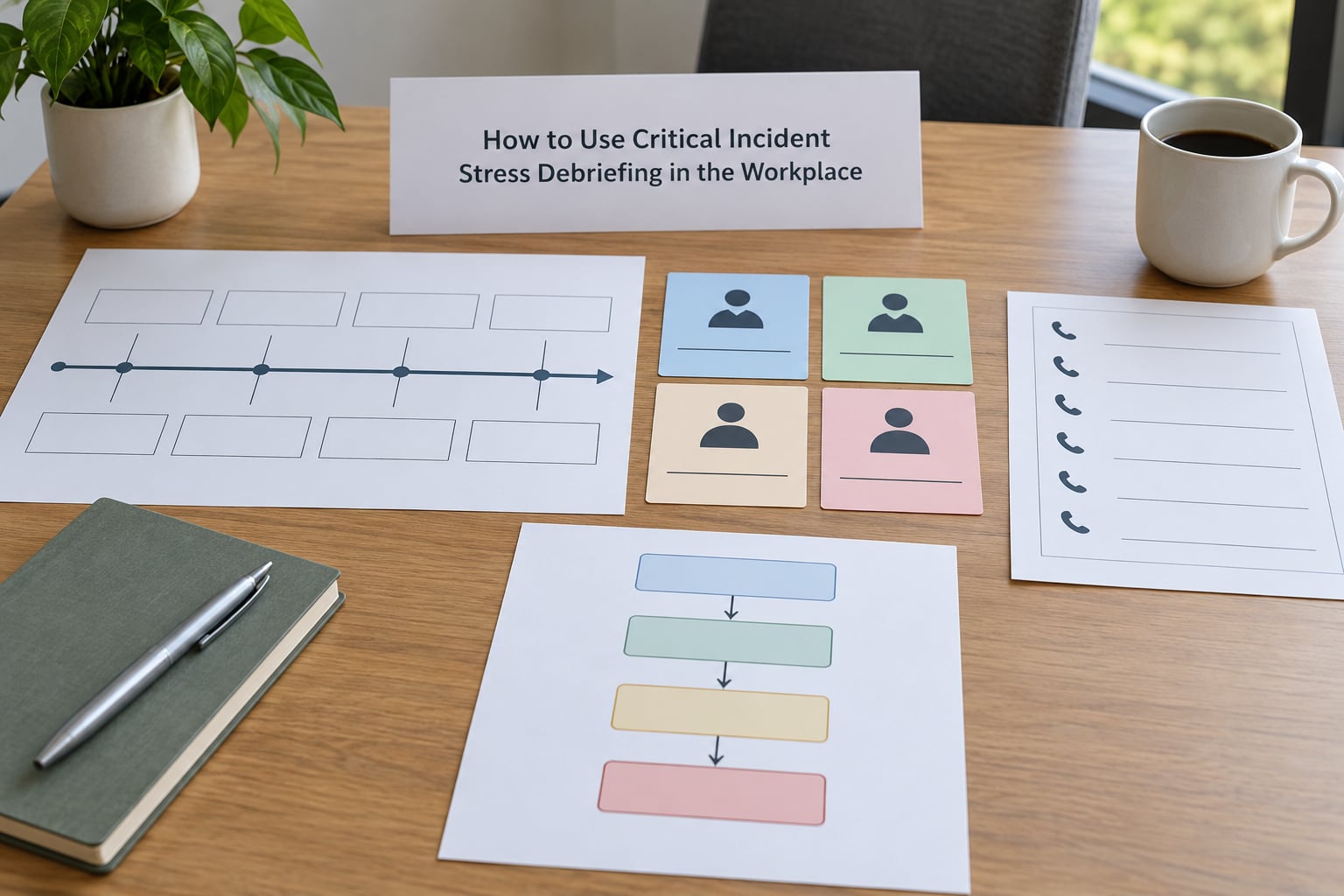
Set the plan up before you need it, because the useful decisions all happen in advance. Here is a framework that works in most organisations.
Define eligibility in advance. Write down which events trigger a debrief and which roles count. Support staff, dispatchers, security, HR and on-call managers are regularly left out of these sessions and then wonder why they feel worse a month later.
Make participation voluntary, and say so in writing. Attendance records are often the only record that a session happened, and a mandatory session is where consent quietly disappears. Offer a parallel route for anyone who cannot or will not attend, so opting out has a real alternative attached to it rather than a stigma.
Book the right facilitators. Two people, at least one a licensed mental health professional, plus a peer with shared experience. Ask for their credentials and for the size of groups they have run before.
Agree ground rules in advance. Confidentiality within the room, no blame, no questions about other people’s decisions, no gossip afterwards, and a stated end time. Confidentiality has limits and you must name them: disclosures of harm to self or others, safeguarding concerns, and anything legally required will be passed on.
Do not create a culture of retelling. Tell people in advance that nobody has to describe the event in detail. A workplace version of a critical incident stress debriefing should stay a support conversation, not an oral history of the worst thing that happened.
Have a referral route ready before the session. Know your employee assistance contact, your occupational health provider and how a self-referral to a clinician works, including whether it needs a manager note. The incident report covers the factual side of the event; the referral route covers the human side.
Document attendance, not content. Record who attended and which follow-up options were offered. Do not write down what individuals disclosed in the room.
What Are the Risks and Common Mistakes?
Most harm from workplace debriefing comes from implementation errors rather than from the model itself. These are the ones worth naming out loud before someone proposes a session.
- Mandatory attendance. If the only way to take part is to sit in a room, the session is not voluntary and consent is not real.
- Arguing about fault. A fact review must stay factual. The moment it becomes an investigation, people stop describing reactions and start defending themselves.
- Pressuring people to recount the event. Detail-forcing is the mechanism most associated with worse outcomes after debriefing.
- Promising confidentiality you cannot keep. Say plainly what stays in the room and what does not, before anything is shared.
- Skipping follow-up. Without a named contact and a time limit for check-ins, a debriefing is a single event, and single events rarely carry anyone through a difficult month.
- Treating it as clinical care. A group session cannot diagnose or treat. Anyone whose distress persists needs a clinician, not another session.
- Timing it badly. Straight after a shift ends, before anyone has slept, is often the worst possible slot. Rostering is the single most common reason a debrief arrives days after the event and feels disconnected from it.
What Support Works When Debriefing May Not Be Appropriate?
Some people should not be in a group session at all, and building alternatives is not optional. Start with psychological first aid: practical help in the days after the event — a quiet space, a shift swap, food, a ride home, clear information about what happens next — without asking anyone to process anything.
Then offer confidential channels that do not pass through the person’s manager: an employee assistance programme, an occupational health referral, or a self-referral to their own clinician. For teams carrying ongoing exposure, structured workplace stress management techniques for teams belong in the plan alongside incident-specific support.
Peer support works too, provided peers are trained, supervised and clear that they are not therapists. And the incident itself still needs fixing — investigating causes, correcting the hazards or processes that allowed it, and telling people what changed.
Some signs need qualified help quickly rather than a referral form. Anyone describing thoughts of harming themselves, hearing voices, feeling unable to stay safe, or showing confusion or memory loss after a head injury should be offered same-day clinical contact. Emergency services or the local crisis line are the right route when safety is in doubt.
Who Should Facilitate a Workplace Critical Incident Debriefing?
Before booking anyone, ask what training they actually hold and how they would handle a distressed participant. The credentials that matter are trauma-informed communication, group facilitation experience, the ability to recognise severe distress in front of a group, cultural competence, and current referral contacts in your region.
Ideally one facilitator is a licensed mental health professional and the other is a peer with comparable lived experience, which is the standard pairing in the CISM model. Facilitators should know their own limits and not offer clinical advice, diagnosis or counselling inside a workplace session.
Ask to see what happens when someone starts to fall apart mid-session. If the answer is “we would take a break”, keep asking. If the answer involves a named clinical contact and a clear handover, you have found the right person.
How Do You Measure Whether Debriefing Helped?
Measure the things you control, and be careful what you promise. CISD is not a treatment, so you cannot claim it prevented PTSD or reduced sickness absence on the strength of a feedback form.
Useful indicators are simple: whether employees understood what support was available, how many took up a referral, whether anyone attended a follow-up check-in, whether the people who needed clinical help were identified, and whether the process changed after the session based on what staff raised. Anonymised participation counts, not opinions on a five-point scale, tell you more.
Avoid screening employees for mental health conditions in the session itself. If you want to know whether your organisation’s overall stress picture needs attention, that is a separate, properly resourced piece of work with a mental health professional, not an add-on to an incident debrief.
Frequently Asked Questions
Should employees attend critical incident stress debriefing?
Attendance should be voluntary, and employees should be told that in writing before the session is offered. Forcing people to attend removes consent and is the feature most associated with poor outcomes. Give anyone who declines a real alternative, such as confidential employee assistance or a self-referral to a clinician, so opting out does not mark them out. Support staff and peripheral colleagues should be offered the session too, not only the direct team.
When should a workplace critical incident debriefing happen?
The usual window is 24 to 72 hours after the event, once people are calm enough to talk but before the experience has been buried under roster changes and rumination. A single session runs one to three hours. Where shift work makes that impossible, a later session is still worthwhile as long as it happens at all, and you can pair it with practical support in the gap.
Is critical incident stress debriefing confidential?
Participants are asked to keep what they hear in the room, and that agreement is what makes honest talk possible. But confidentiality has limits, and you must state them before anything is shared: risk to self or others, safeguarding concerns and anything legally required will be passed on to the appropriate service. Anonymised attendance records are kept, not notes on what an individual disclosed.
Can critical incident stress debriefing cause more stress?
Yes, in some circumstances. Research reviews have found that mandatory, single-session debriefing that pushes people to describe the event in detail does not prevent post-traumatic stress and can leave some participants more distressed afterwards. The safeguards are known: voluntary attendance, no pressure to recount, a small homogeneous group, a trained clinician present, and a referral route offered in the room rather than weeks later.
Is critical incident stress debriefing the same as counselling?
No. A CISD session is a single facilitated group discussion focused on normalising reactions and signposting support. Counselling is a course of individual or group therapy with a qualified clinician, addressing longer-term problems, and it runs over multiple appointments with clinical goals and confidentiality boundaries. If someone has persistent distress, poor sleep or intrusive symptoms beyond a few weeks, they need clinical care rather than another group session.
Conclusion
Prepare a voluntary, trauma-informed support plan now, while you have time to get the facilitators and the referral route right. Keep clinical treatment separate from the group session, state the limits of confidentiality before anything is shared, and make sure anyone whose distress is severe or lasting more than a few weeks can reach a qualified professional quickly. That is the difference between debriefing that helps and debriefing that simply happens.