
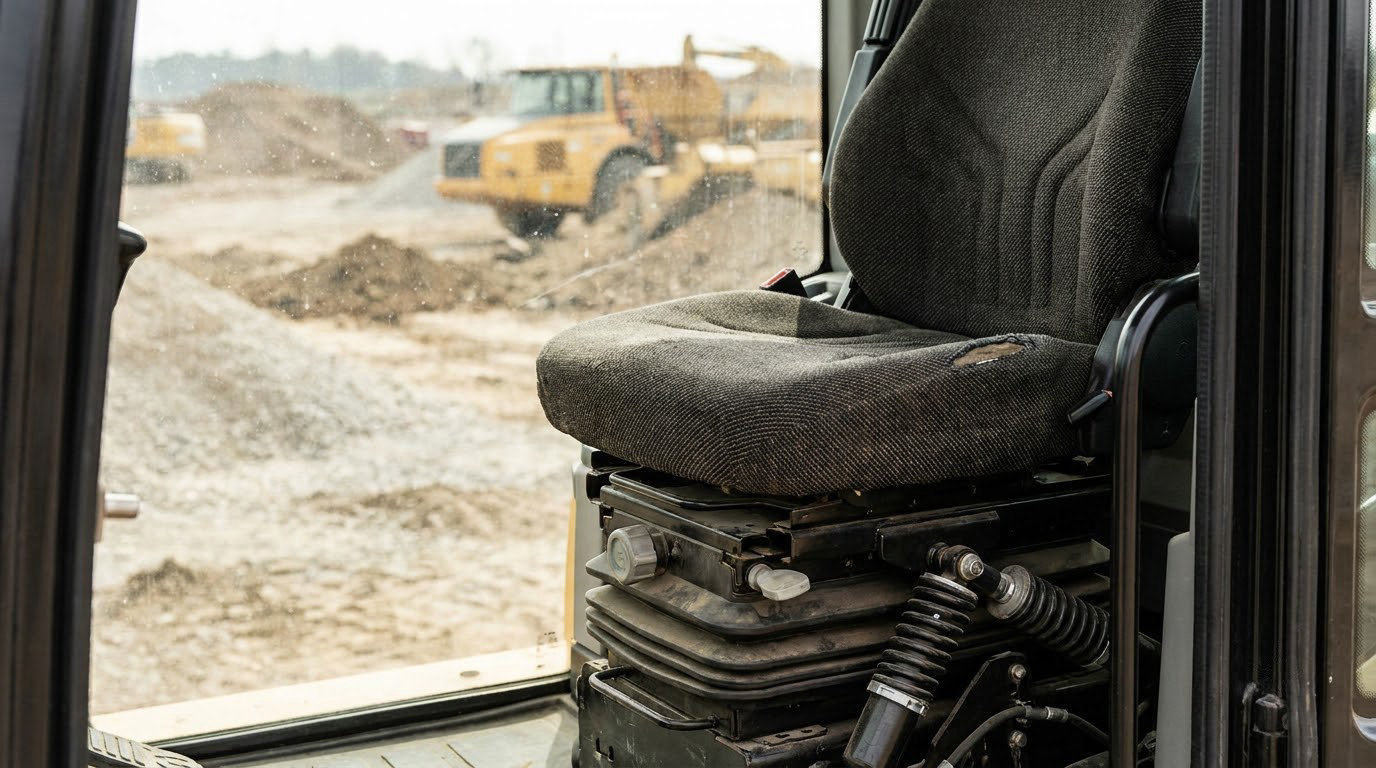
Whole body vibration for equipment operators is the shaking a person absorbs through the seat, pedals and floor while driving plant such as forklifts, dozers, haul trucks, loaders and tractors. It is a regulated hazard, it is measured against clear limits, and there is no personal protective equipment made for it. That means exposure has to be cut at the source: the machine, the seat, the road and the shift pattern.
This guide is written for two readers at once. If you operate plant, you will find the symptom guide and the reporting path. If you manage a fleet or a site, you will find the measurement method, the legal action values and the control hierarchy.
One note before we start. Searching this topic turns up consumer “whole body vibration” machines, the vibration plates sold for fitness. Those are a different thing entirely and have nothing to do with occupational safety. This article is about workplace vibration exposure from machinery.
Table of Contents
- What Is Whole Body Vibration for Equipment Operators?
- How Does Whole Body Vibration Affect the Body?
- What Is the Difference Between Whole Body and Hand-Arm Vibration?
- How Is Whole Body Vibration Exposure Measured?
- What Factors Increase Operator Vibration Risk?
- How Can Employers Reduce Whole Body Vibration?
- What Should Equipment Operators and Employers Monitor?
- What Should an Operator Do When Symptoms Appear?
- Frequently Asked Questions
- What kind of machinery can cause a whole body vibration?
- How can whole body vibration be prevented?
- What are the symptoms of whole body vibration, and when should I see a doctor?
- Is HAVs a legal requirement, and is whole body vibration regulated the same way?
- Can a suspension seat stop vibration reaching the operator?
- Conclusion
What Is Whole Body Vibration for Equipment Operators?
Whole body vibration, usually shortened to WBV, is mechanical vibration transmitted from a machine or vehicle to the person sitting in it, through the seat cushion, seat back and floor. The operator’s body acts as the receiver, and the vibration enters at the pelvis and lower back rather than the hands.
Any machine that a person sits in while it moves or works can produce it. The usual sources are:
- Forklift trucks and reach trucks moving loads across yard surfaces
- Dozers, wheel loaders and excavators working on rough ground
- Haul trucks and dump trucks on haul roads, in quarries and on mine sites
- Telehandlers and rough-terrain forklifts working at height or on platforms
- Agricultural tractors and combines during fieldwork
- Airport ground support equipment and refuse collection vehicles
- Rail and tram operators in some configurations
The severity does not follow machine size. A small forklift crossing an unmade yard with ruts can out-expose a much larger machine driven slowly on a sealed surface. It is the combination of shaking, shock and time that matters.
How Does Whole Body Vibration Affect the Body?
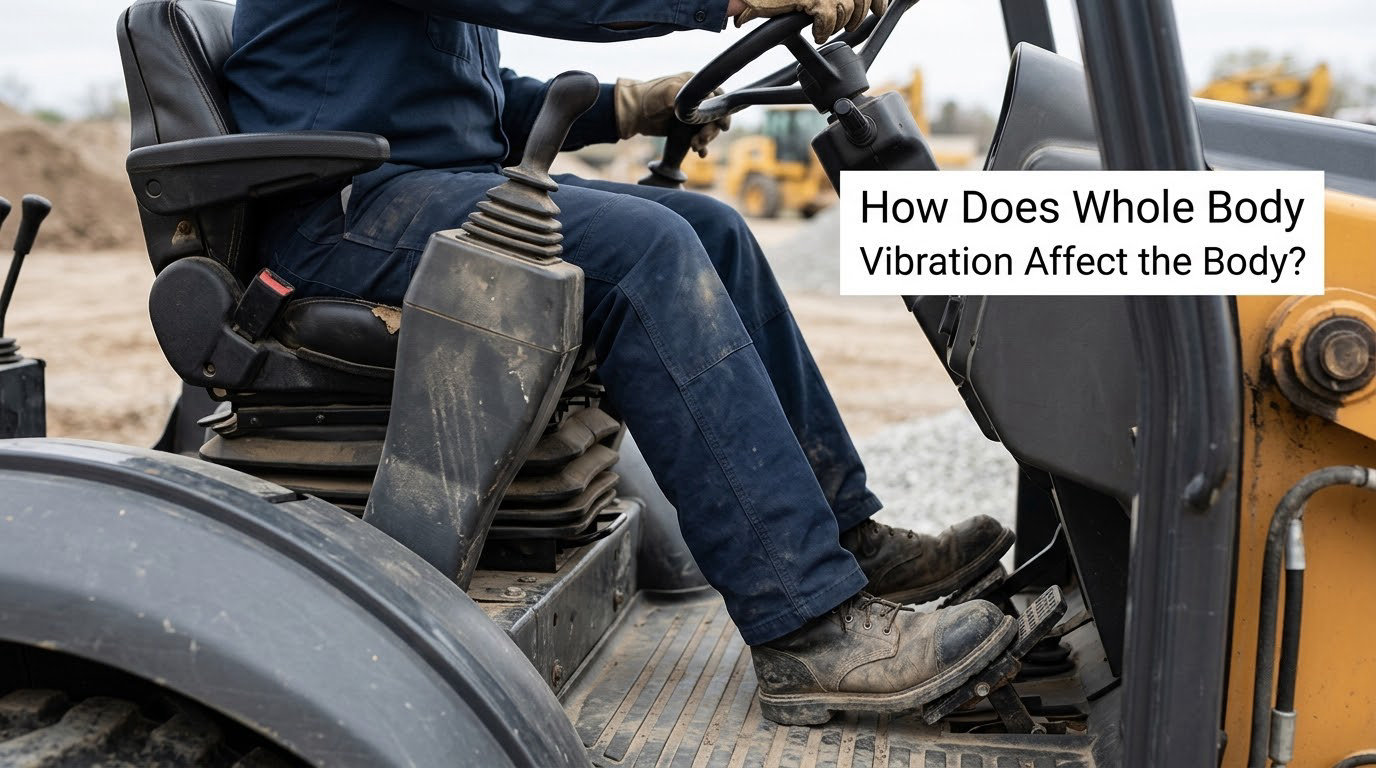
Harm happens because the body amplifies vibration at its own natural frequencies. The lumbar spine resonates somewhere around 4 to 8 Hz, which is exactly the range most wheel and seat systems produce. Below that the body moves with the machine; at resonance the spine takes a disproportionate share of the energy.
Short-term or acute effects usually show up as discomfort rather than injury. Common ones include:
- Lower back ache that builds through a shift and eases overnight
- Fatigue, poor concentration and reduced control of the machine
- Headache, shakiness and a sense of imbalance after long exposure
- Postural fatigue, because the muscles hold the torso still against the shaking
- Grip and handling accuracy dropping, which matters when placing a load
Repeated daily exposure over years is the real concern. Occupational health research links sustained WBV with low back pain, accelerated degeneration of the lumbar discs, and herniated or prolapsed discs. Reduced bowel and bladder function and circulation complaints appear in the clinical literature too, usually alongside spinal findings.
Why frequency and duration matter more than the machine name
Two operators on the same model can absorb very different amounts. The one on a poor road surface, in a worn seat, for ten hours a day carries the higher dose. Dose in vibration work is magnitude multiplied by time, which is why a badly maintained machine can be a bigger problem than a newer one driven carefully on a good surface.
Cold and damp conditions matter as well. Stiff muscles and cold joints tolerate repeated shock less well, and symptoms that are mild in summer are more noticeable in a wet winter shift. Operators with a pre-existing back condition, or a recent back injury, are more likely to be affected at the same exposure level.
When to get it checked
Do not diagnose yourself. Book an appointment with your GP or occupational health service if back pain persists for more than a few weeks, wakes you at night, is accompanied by numbness, tingling or weakness in a leg, or is getting worse over months. Say plainly that you drive heavy plant, because the work pattern changes how a clinician assesses the cause. Nothing on this page is medical advice, and nothing here replaces a proper clinical assessment.
What Is the Difference Between Whole Body and Hand-Arm Vibration?
Whole body vibration goes through the seat into the spine. Hand-arm vibration, often called HAV, goes through the hands into the fingers and wrist. They are separate hazards with separate health effects, and confusing them leads to the wrong controls.
| Point of difference | Whole body vibration (WBV) | Hand-arm vibration (HAV) |
|---|---|---|
| How it enters the body | Through the seat, seat back and floor | Through the hands and fingers |
| Usual machines | Forklifts, dozers, loaders, haul trucks, tractors | Angle grinders, jackhammers, pneumatic drills, chainsaws, vibro tools |
| Body part affected | Lumbar spine, hips, internal organs | Fingers, hands, wrist, forearm |
| Main health outcome | Low back pain, disc degeneration and prolapse | Hand-arm vibration syndrome, with numbness and circulation loss |
| Control focus | Seat, suspension, road surface, drive time | Tool selection, maintenance, grip and exposure time |
| Legal framework | Covered by the vibration at work rules with its own limits | Also covered, with its own limits and reporting duties |
On the question that comes up constantly, yes, hand-arm vibration exposure is regulated in its own right under the Control of Vibration at Work Regulations 2005 in Great Britain and Directive 2002/44/EC in the EU. That directive is where the 0.5 and 1.15 m/s² figures come from. In the United States, NIOSH and the CDC publish research and recommendations rather than enforceable limits, and states may run their own programmes.
How Is Whole Body Vibration Exposure Measured?
Exposure is measured as frequency-weighted acceleration, normalised to a standard eight-hour working day, and written as A(8) in metres per second squared. The measurement standard is ISO 2631-1. In plain terms, A(8) answers this question: if someone did this job’s vibration pattern for a full eight hours, how big would the shaking be?
Because it is normalised, you can compare a 30-minute rough-road exposure with a full shift. A rough hour on unmade ground can push a day’s equivalent figure well above what an easy eight hours would produce, and industry examples show limits being exceeded in as little as two hours of intense exposure.
What the two legal figures trigger
The figures below are the European and UK values. Check your own jurisdiction’s rules if you are outside that area.
| Measured A(8) | What it is called | What the employer must do |
|---|---|---|
| Below 0.5 m/s² A(8) | Below the exposure action value | Keep monitoring and keep controls in place |
| 0.5 m/s² A(8) or above | Exposure action value (EAV) reached | Introduce controls. Provide training and information. Make a plan with named responsibilities and dates |
| 1.15 m/s² A(8) or above | Exposure limit value (ELV) reached | Reduce exposure so it is below the limit. Design the work so the limit is not exceeded |
Weekly averaging is allowed in limited situations, for example a vehicle used for long-distance travel on average under ten hours a week. It is not a general workaround, and it does not cover typical site plant operated day after day.
How the measurement is actually done
A small triaxial accelerometer sits on the seat pan or on a pad where the operator’s thighs rest, and records acceleration on the vertical, lateral and rotational axes. Software applies the weighting curve and calculates A(8). Measurements are normally taken during real work rather than on a test track, because the surfaces and speeds an operator sees on shift are the exposure that matters.
Not every operation needs a full survey. A reasonable screening approach compares the machine against known higher-vibration designs, records hours per week and the surfaces involved, and reserves instrumented measurement for the fleet members closest to the action value. If you are ever unsure whether an assessment is warranted, an occupational hygienist will tell you within a short call.
What Factors Increase Operator Vibration Risk?
Risk rises and falls with a specific set of factors, and most of them sit with the employer rather than the operator.
- Machine condition. Worn shocks, worn bushes, degraded anti-vibration mounts and out-of-balance wheels all raise transmitted vibration.
- Seat condition. A collapsed or bottomed-out suspension seat transmits more than a working one. A fixed seat on rough ground is worse still.
- Ground conditions. Potholes, unmade roads, loose stone, mud, kerbs and steep ramps generate shocks far beyond steady-state vibration.
- Speed. Vibration climbs steeply with speed on uneven ground, even on the same machine.
- Load and machine setup. Overloading, uneven load distribution and poor tyre pressure change the machine’s response.
- Duration. Hours per shift and days per week multiply everything else into the A(8) figure.
- Operator position and posture. Reaching over-arm for controls and twisting to look behind put extra load on an already loaded lower back.
- Age and health of the operator. A less resilient body tolerates the same dose less well.
- Second exposures. Lifting heavy objects at the end of a long driving shift, when the back is already fatigued, compounds the risk.
Organisational factors sit behind all of these. Tight production schedules that reward speed over ground condition, shared machines with one worn seat, and no maintenance time in the plan all push exposure up quietly.
How Can Employers Reduce Whole Body Vibration?
Work through the hierarchy of controls in order. Skipping to the bottom rung first is the most common mistake, and it is the least effective.
- Eliminate the exposure where you can. Where a machine only moves loads across a yard, remote-controlled or ground-level equipment may remove the operator from the cab entirely. Repositioning transfer points can cut the distance driven more cheaply.
- Select lower-vibration equipment. When procuring, ask suppliers for vibration data under ISO 2631-1 rather than relying on brochures. Match seat design to the operator, and check that the suspension range covers the operator’s weight.
- Optimise seating and the cab. A properly adjusted seat with working suspension, reach and lumbar support, plus footwell and step access in good condition, reduces what reaches the spine. A seat repaired properly is often the cheapest control available.
- Improve the route. Grading roads, filling potholes and rescheduling haulage away from temporary surfaces removes shocks rather than just reducing steady-state vibration.
- Maintain the machine. Put tyres, shock absorbers, mounts and seats on a scheduled inspection with a recorded sign-off.
- Limit exposure duration. Job rotation, shortened driving periods, remote operation during the worst ground conditions, and rest breaks before manual handling all cut the dose. This is an administrative control, so it should never be the only one.
- Train and inform operators. Teach pre-start checks, correct seat adjustment, speed reduction on uneven ground, and why reporting symptoms matters.
There is one thing that does not appear on this list, because it does not exist: no personal protective equipment protects against whole body vibration. Belts, gloves and supports do not reduce what the spine receives.
What Should Equipment Operators and Employers Monitor?
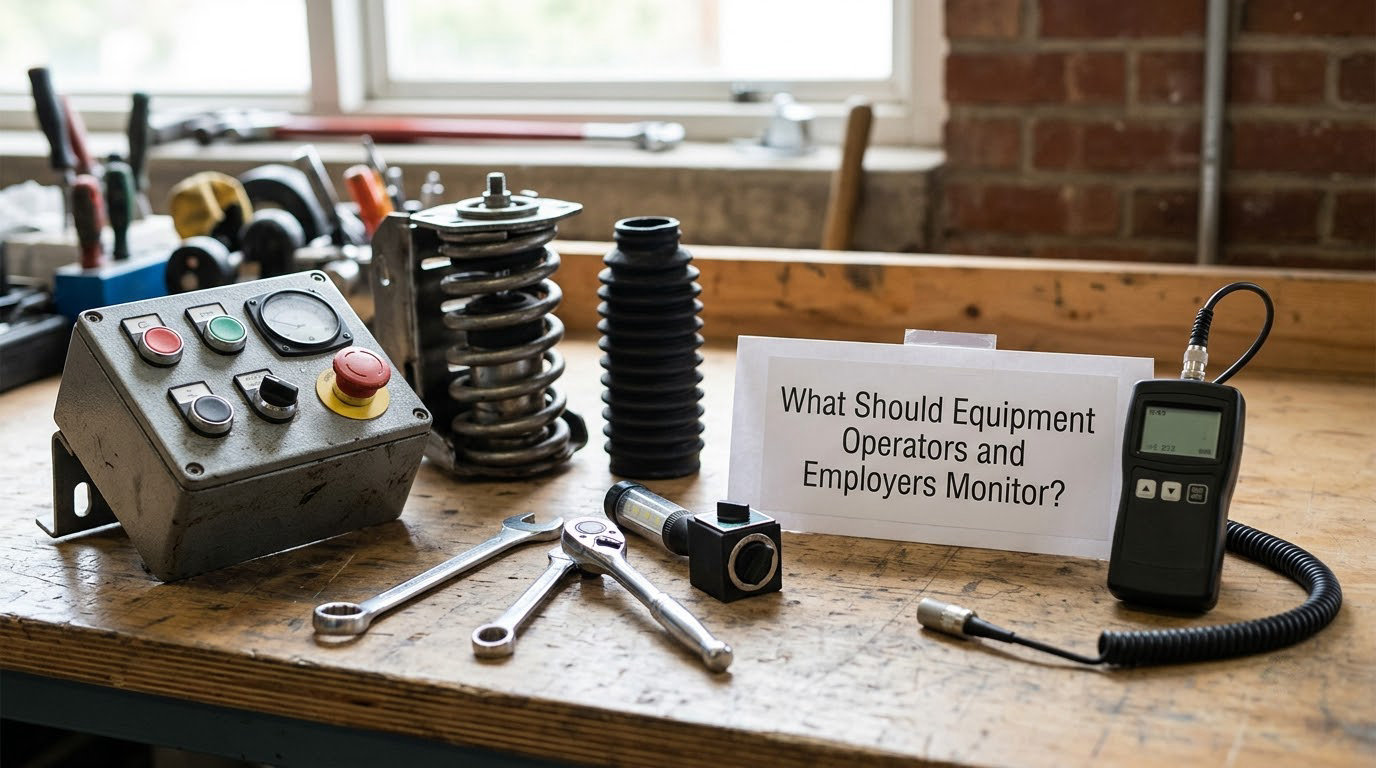
Monitoring is mostly routine observation rather than paperwork, and operators usually notice a change before an instrument does.
A per-shift machine and seat check
- Seat suspension settled or bottomed out when you sit down, or a visible tilt
- Loose or broken seat mounts, worn cushion, failed lumbar adjustment
- Cab mounts, floor plates and rubber seals showing wear or cracking
- Tyres at the specified pressure and undamaged
- New rattles, knocks or unevenness in the machine at the same point on the route
- Controls worn stiff or misaligned, forcing awkward postures
What employers should track
Keep a record of the plant on site, the hours each machine is used, the surfaces involved, the results of seat and suspension maintenance, and any measurement taken. On the people side, note changes in duties, new starters who have not had seat adjustment training, and any operator report of symptoms.
Bring in occupational health or a hygienist when a machine is near the action value, when several operators work the same high-vibration machine, when someone reports persistent symptoms, or when you are deciding how to reduce exposure and want measurement rather than opinion. Also bring them in before writing the control plan, because the measurement sets the priority order.
What Should an Operator Do When Symptoms Appear?
Do not wait for symptoms to settle on their own, and do not treat your own back with a plan you worked out alone.
Report it. Tell your supervisor or safety representative, in writing if you can, and record the machine you were on, your hours, the surfaces and anything that stood out about the seat. Ask whether that machine has been measured and whether the seat has been checked. If your employer says the machine is within limits and you still hurt, that gap is real and worth putting in writing, because it points to the maintenance, seat or schedule rather than to you.
Ask for an adjustment while it is being looked at, such as a different machine, a seat check, a rotation off high-vibration work, or a break between driving and heavy lifting. Those are reasonable adjustments and most supervisors can make them quickly.
Get medical advice for anything persistent or worrying, including pain that wakes you at night, travels down a leg, or brings numbness or weakness. Mention the machine and the hours. Keep your own copy of anything you report, along with dates and names, and keep your exposure records with the employer so your occupational health provider can use them.
Frequently Asked Questions
What kind of machinery can cause a whole body vibration?
Any machine a person sits in while it moves or works. In practice that covers forklift and reach trucks, dozers, wheel loaders and excavators, haul and dump trucks on site roads, telehandlers, agricultural tractors and combines, refuse vehicles, airport ground support equipment and some rail vehicles. Exposure depends far more on ground condition, speed and hours than on machine size.
How can whole body vibration be prevented?
Use the hierarchy of controls in order. Eliminate the exposure where possible, such as remote operation for yard work. Select lower-vibration equipment with measured data, fit and maintain a suspension seat matched to the operator, improve roads and routes, maintain tyres, shocks and mounts on a schedule, limit driving hours through rotation and rest breaks, and train operators. There is no personal protective equipment for whole body vibration.
What are the symptoms of whole body vibration, and when should I see a doctor?
Common early signs are lower back ache building through a shift, postural fatigue, headache, shakiness and reduced concentration. Long-term exposure is linked with low back pain, disc degeneration and prolapse. See your GP or occupational health service if pain persists for weeks, wakes you at night, spreads down a leg, or comes with numbness or weakness, and mention that you operate heavy plant.
Is HAVs a legal requirement, and is whole body vibration regulated the same way?
Both are regulated, through separate sets of exposure limits. In Great Britain the Control of Vibration at Work Regulations 2005 cover whole body vibration and hand-arm vibration, and EU Directive 2002/44/EC does the same across the EU, with action and limit values for each. The United States has no single federal limit; NIOSH and CDC issue research and recommendations, and individual states may regulate further.
Can a suspension seat stop vibration reaching the operator?
No seat removes whole body vibration, but a good one cuts it substantially. A suspension seat with a working, correctly adjusted damper lowers transmitted levels, especially on rough ground, and multi-axial suspension helps with lateral and rotational motion. It only works if it is matched to the operator’s weight, kept in adjustment and maintained, because a worn or bottomed-out seat transmits more than a sound one.
Conclusion
Start with the plant you use most, not the whole fleet. Identify the machines with the longest hours and the worst surfaces, look hard at the seats and suspension on those machines, and check whether anyone on them has reported back symptoms. Where exposure looks high, get it measured against the 0.5 and 1.15 m/s² A(8) figures, then work down the hierarchy of controls from elimination to shorter driving hours.
For operators: adjust your seat properly every time, slow down on rough ground, and write down any symptom and the machine it happened on. For employers: whole body vibration for equipment operators is only manageable when the evidence, the assessment and the plan sit in the same file.