

A safety data sheet is a standardized 16-section document, and knowing how to read a chemical safety data sheet takes about ten minutes once you know which sections matter. You do not read it front to back. You start at section 2 for the hazards, jump to section 4 for first aid, and check section 8 before anyone puts on gloves. That order is fixed under the Globally Harmonized System, so the information is always in the same place.
For US employers the document is required by the OSHA Hazard Communication Standard, 29 CFR 1910.1200, which also requires that workers can access it quickly, in a language and format they can understand. New lab and warehouse staff ask the same three questions every time: what is it, what will it do to me, and what do I wear. The seven steps below answer all three.
Table of Contents
- What You Need Before You Read a Chemical Safety Data Sheet
- Step-by-Step: How to Read a Chemical Safety Data Sheet
- 1. Confirm the Chemical and the Current SDS
- 2. Read Section 2: Hazard Identification and Label Information
- 3. Check Section 3: Composition and Ingredient Information
- 4. Review Section 4: First-Aid Measures and Emergency Response
- 5. Understand Section 8: Exposure Controls and Personal Protection
- 6. Check Sections 7 and 9: Handling, Storage, Stability and Physical Properties
- 7. Use Sections 10 to 16 to Make and Document a Workplace Decision
- Common Mistakes to Avoid When Reading an SDS
- Frequently Asked Questions
- Where can employees find the chemical safety data sheet for a workplace chemical?
- Does a chemical safety data sheet replace the product label?
- How often should an employer review or update SDS documents?
- Can an employee use an SDS to choose gloves or a respirator on their own?
- What should happen if a chemical exposure occurs while the SDS is not immediately available?
- Do all workplace chemicals have a safety data sheet in the same format?
What You Need Before You Read a Chemical Safety Data Sheet
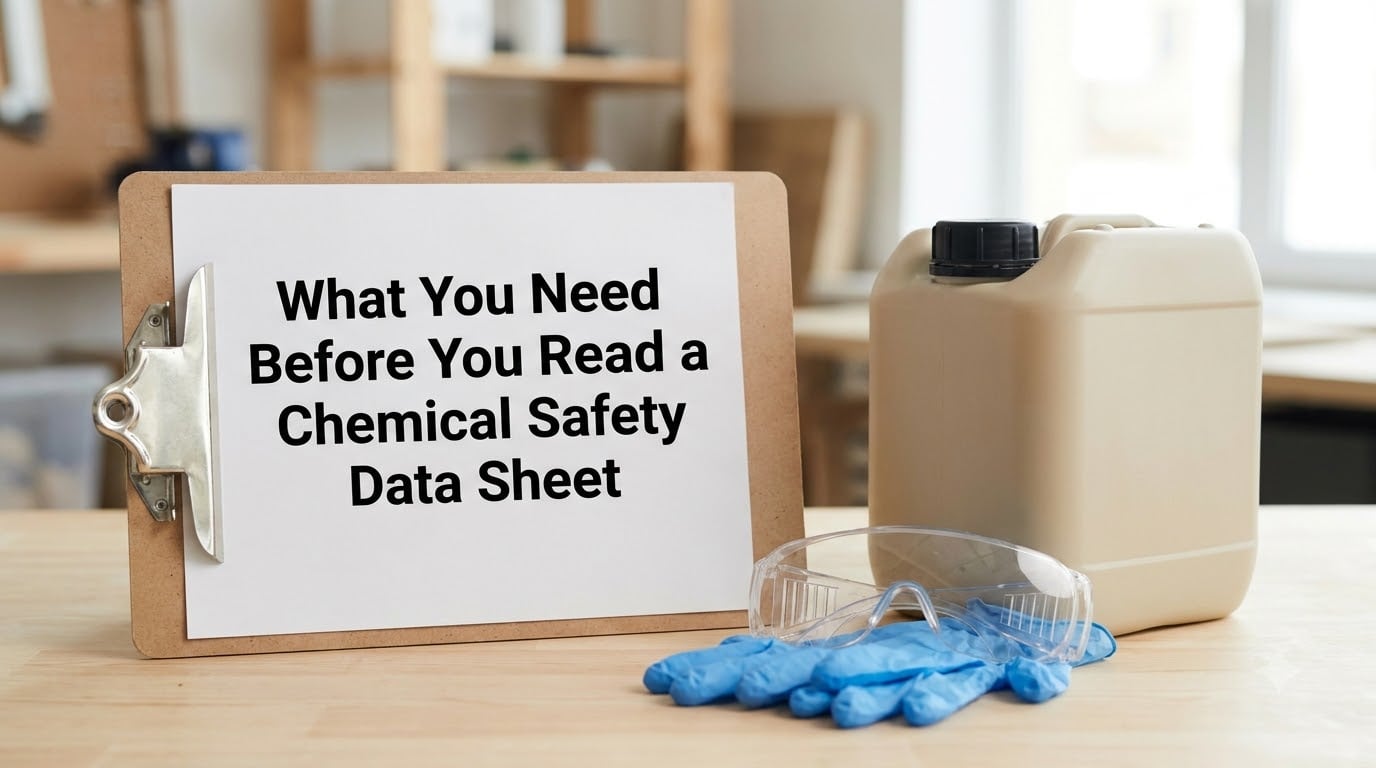
Gather these before you open the file. Missing one of them is why people end up with the wrong document for the wrong drum.
- The current SDS. The manufacturer-issued version with a revision date, not a copy someone printed six years ago. A binder handout is often a scanned MSDS from a supplier who has since been bought.
- The container label. The product name, product code, supplier and any hazard pictograms on the actual drum or bottle in front of you. This is what tells you whether the SDS you have open matches the material in the room.
- The CAS number. The unique registry number for the substance, found in section 3. It is the only reliable way to confirm you have the right chemical when trade names sound similar.
- Your workplace procedures. The spill plan, the eyewash and shower locations, the evacuation route, and who the emergency contact is. The SDS tells you what the chemical does; your procedure tells you who does what.
- A way to check numbers. The NIOSH Pocket Guide, PubChem and an occupational safety department contact. Section 8 limits are frequently decades old, and an outside source tells you whether a number is current.
- PPE you actually have on hand. If section 8 calls for a particular glove material and your site stocks only thin disposable nitrile, that gap has to close before the task starts, not after a spill.
Keep the printed label and the SDS together in the same folder. SDS data crosses teams constantly, from EHS to the lab to the control room, and hardcopy backups still matter when a search box fails during a spill.
Step-by-Step: How to Read a Chemical Safety Data Sheet
Work through the sections in this order rather than by page number from 1 to 16. Here is the fixed structure you will find in every GHS-aligned sheet, along with who actually needs to read each part.
| Section | Title | What it tells you | Primary reader |
|---|---|---|---|
| 1 | Identification | Product name, product code, supplier, emergency phone number | All |
| 2 | Hazard Identification | Signal word, pictograms, hazard and precautionary statements | All |
| 3 | Composition / Ingredients | Ingredient names, CAS numbers, concentration ranges, trade secrets | Safety managers |
| 4 | First-Aid Measures | Response by eye, skin, inhalation and ingestion route | All |
| 5 | Fire-Fighting Measures | Suitable extinguishing media, unsuitable media, specific hazards | Supervisors, fire team |
| 6 | Accidental Release Measures | Spill containment, cleanup, cleanup material, reporting | All, especially maintenance |
| 7 | Handling and Storage | Safe practices, incompatibilities, storage conditions | All |
| 8 | Exposure Controls / PPE | Exposure limits, engineering controls, respirator, gloves, eye protection | All, safety managers |
| 9 | Physical and Chemical Properties | Appearance, odor, flash point, boiling point, vapor pressure, solubility | Safety managers, process staff |
| 10 | Stability and Reactivity | Incompatible materials, conditions to avoid, decomposition products | Safety managers |
| 11 | Toxicological Information | Route-specific exposure data, LD50 and LC50, carcinogenicity | Safety managers, occupational health |
| 12 | Ecological Information | Fish, algae and invertebrate data, bioaccumulation | EHS, environmental |
| 13 | Disposal Considerations | Container and waste disposal guidance | EHS, environmental |
| 14 | Transport Information | UN number, proper shipping name, transport hazard class | Shipping, receiving |
| 15 | Regulatory Information | Component listings under other agencies such as EPA, TSCA, Prop 65, SARA | EHS, compliance |
| 16 | Other Information | Revision date, revision history, disclaimer, NFPA and HMIS ratings | All, document control |
1. Confirm the Chemical and the Current SDS
Match four things before you read a word of substance: the product name on the label, the product code, the manufacturer, and the SDS revision date in section 16. If any one of those disagrees, stop and get the right sheet.
Section 1 is the identity block. It carries the recommended trade name, the product code, the supplier’s name and address, and a 24-hour emergency telephone number you would call rather than search for a contact name. A chemical emergency line is a real phone number staffed by someone who can answer chemistry questions at 2 a.m. Write it on the lab door.
Check section 16 for the revision date. If the sheet has no date, treat it as unverified. GHS is now on its seventh revision and US adoption phases in over several years, so an older sheet is not automatically wrong, but it may not reflect a reformulated product.
This is also where you settle the MSDS versus SDS question. An MSDS is the older pre-2012 US format with a loose, manufacturer-specific layout. An SDS is the 16-section GHS format. If the document you are holding has a fixed numbered structure and the word SDS, it is current. If it says material safety data sheet and section 12 mentions toxicity, it predates the format and you should request the GHS version from your supplier. Old MSDS files still sitting in shared drives are one of the most common problems teams run into.
2. Read Section 2: Hazard Identification and Label Information
Section 2 is the most important section for a worker, and it is short. It tells you the signal word, the pictograms, the hazard statements and the precautionary statements.
The signal word is one of two words. Danger means a more severe hazard category; Warning means something less severe, but still not harmless. You will never see both on the same product.
The pictograms are the red diamond shapes. GHS uses nine of them: flame for flammables, flame over circle for oxidizers, skull and crossbones for acute toxicity, exclamation mark for irritants and less severe hazards, corrosion for skin and eye damage, gas cylinder for compressed gases, exploding bomb for explosives, flame over circle with a fish for environmental hazards, and the health hazard silhouette for carcinogens, organ toxicity and respiratory sensitization. Section 16 also usually carries NFPA or HMIS diamond ratings, which workers tend to find easier to scan than the pictograms, though the two are not identical systems.
Hazard statements are the H-codes: H319 means serious eye irritation, H314 means causes severe skin burns, H336 means may cause drowsiness or dizziness. Precautionary statements are the P-codes covering prevention, response, storage and disposal. P260 means do not breathe the dust, fume, gas or vapor, which is the statement that tells you a respirator or local exhaust ventilation is required.
When the label and the SDS disagree, treat the more protective of the two and tell your safety contact. That happens with old stock, relabeled containers and mixtures bought from a distributor. A container relabeled in the field by hand is a red flag: the workplace remains responsible for keeping the container properly labeled, which usually means reprinting a compliant label with the six required label elements rather than trusting a scrawled marker note.
3. Check Section 3: Composition and Ingredient Information
Section 3 tells you what is actually in the product: the chemical name, the CAS number and the concentration range, either as a percentage or as a range such as 1 to 5 percent.
The CAS number is the part to copy. It is a unique identifier that lets you pull authoritative data from PubChem or the NIOSH Pocket Guide and compare it with any other sheet for the same substance. Suppliers cannot refuse a CAS request for a substance that is not a trade secret.
When section 3 says a component is proprietary, that is a legitimate claim, and you are entitled to specific health and safety information about that ingredient without learning the formulation. The identifying information you should still receive includes the chemical name, the CAS number where one exists, the concentration range and any hazard information. If a supplier discloses nothing at all, escalate it and treat the product with more caution, not less.
A mixture whose hazardous ingredients are all hidden is a genuine problem for hazard assessment, and it is the point at which lab staff most often get stuck. The practical answer is to select a different product with full disclosure for the job, or ask the supplier in writing for the CAS numbers of the hazardous components.
4. Review Section 4: First-Aid Measures and Emergency Response
Section 4 is organized by route of exposure, in a fixed order: inhalation, skin contact, eye contact, ingestion, and then symptoms and effects that need medical attention or a poison center call.
Read the route that matches how people actually get hurt with this chemical. For solvents and vapors that is usually inhalation, for caustics it is eyes and skin, and for powders it is often inhalation followed by ingestion from hand-to-mouth contact.
Do exactly what section 4 says and nothing more. If it says to rinse for fifteen minutes, rinse for fifteen minutes. If it says to move the person to fresh air and call medical, do that before searching for the chemical. Never give anything by mouth to an unconscious person, and do not attempt neutralizing agents unless the sheet explicitly instructs it.
Sections 5 and 6 are the emergency response pair. Section 5 names the extinguishing media that work, such as alcohol-resistant foam, dry chemical, carbon dioxide or water spray, and it flags the media to avoid, such as plain water on a reactive metal. Section 6 gives the spill procedure: how to contain, whether cleanup is for large or small spills, what absorbent to use, whether the residue needs neutralizing or collecting, and when to report it. Ventilation guidance in section 6 matters even for small spills in a poorly ventilated room.
5. Understand Section 8: Exposure Controls and Personal Protection
Section 8 is where most compliance gaps live, and it is the section to read before the task rather than after. It has three parts: exposure limits, engineering controls, and personal protective equipment.
The exposure limits are published by three different bodies, and they are not interchangeable.
| Limit | Set by | Legal status in the US | When to use it |
|---|---|---|---|
| PEL (permissible exposure limit) | OSHA | Enforceable in the workplace | Compliance decisions, air monitoring programs |
| REL (recommended exposure limit) | NIOSH | Advisory, used as a reference | When the PEL is missing, old or scientifically outdated |
| TLV (threshold limit value) | ACGIH | Advisory; binding only if adopted by a state | Best available science, including carcinogenicity and sensitization |
The practical trap is that many OSHA PELs still date from the 1970s and were never updated for newer toxicology, while ACGIH TLVs are revised every year. When the three differ, most safety professionals use the more protective TLV, or the REL when there is no TLV. Confirm which limits your own state or program requires before you set a monitoring target.
Values usually appear in parts per million (ppm) for vapors and milligrams per cubic meter (mg/m3) for dusts and mists, and an eight-hour time-weighted average (TWA) alongside a short-term exposure limit (STEL) or ceiling. A value written as a ceiling should never be exceeded at any moment, even if the daily average looks fine.
Engineering controls come first because they protect everyone in the room. Section 8 names them: local exhaust ventilation, dilution ventilation, enclosure or a closed process. If the sheet specifies a control, the answer is not to skip it and wear more PPE.
Then the PPE, and this is where specificity matters. Gloves are listed by material and often thickness, and the sheet may reference a breakthrough time, which is how long the chemical permeates the glove before it reaches your hand. Nitrile works for many solvents and fails against others; butyl rubber and neoprene cover different ranges. Chemical splash goggles with side shields, or a face shield for splash and heat work, are usually specified separately from a respirator. When a respirator is listed, the type and often the cartridge or filter designation follow, and using a respirator at work requires a written program, a medical evaluation, fit testing and training. Reading a cartridge code off an SDS does not authorize you to strap one on.
6. Check Sections 7 and 9: Handling, Storage, Stability and Physical Properties
Section 7 covers handling and storage. Handling statements tell you about ventilation during transfer, grounding and bonding when transferring flammable liquids, and static control. Storage statements name incompatible materials to segregate, the temperature range, whether the product needs to be kept away from light, and whether it belongs in a flammable or corrosive cabinet.
Section 10 expands on reactivity. It lists materials to avoid, such as strong oxidizers with organics or acids with cyanides, and the hazardous decomposition products released by fire or reaction. This is the section that tells you a spill is not just a cleanup problem when the material is unstable.
Section 9 is the physical data block, and it is the easiest section to use badly. The numbers matter in specific ways. Flash point tells you the lowest temperature at which the vapor ignites, and it decides your storage cabinet and whether you need bonding during transfer. Vapor density above 1.0 means the vapor is heavier than air and collects in low spots and floor drains, which changes where you ventilate and where a spill actually goes. Boiling and melting points, solubility, pH and vapor pressure tell you how a release behaves, and the physical state and appearance line help you confirm the drum in front of you really is what the sheet describes. Solubility in section 9 also quietly limits your glove choices for immersion work, because a glove that holds water may swell in a polar solvent.
7. Use Sections 10 to 16 to Make and Document a Workplace Decision
The last sections turn reading into action. Section 11 gives route-specific toxicity data, including LD50 for ingestion and dermal exposure and LC50 for inhalation, plus any carcinogenicity classification from IARC, NTP or the EU. Section 12 covers ecological toxicity, and section 13 tells you how to dispose of the chemical and its container, which is often where a facility’s process conflicts with a generic label.
Section 14 gives the UN number, proper shipping name and hazard class for transport. If someone ships a sample to a lab or moves drums between buildings, this is the section that has to appear on the paperwork.
Section 15 lists component status under other agencies: TSCA inventory, CERCLA reportable quantities, SARA Title III categories, California Proposition 65 listings and state-specific rules. Section 16 is document control. It carries the issue date, revision date, revision history describing what changed, and the HMIS and NFPA ratings many workplaces print on the label.
Turn what you found into a documented decision. Write down the task, the chemical, the sections you used, the controls required, the PPE specified with material and thickness, who was trained and when, and the date. When a supplier reformulates, the revision date is how you find out. The transition is where mistakes happen, because a worker may still be following last year’s sheet while the new one sits in an inbox unread.
Common Mistakes to Avoid When Reading an SDS
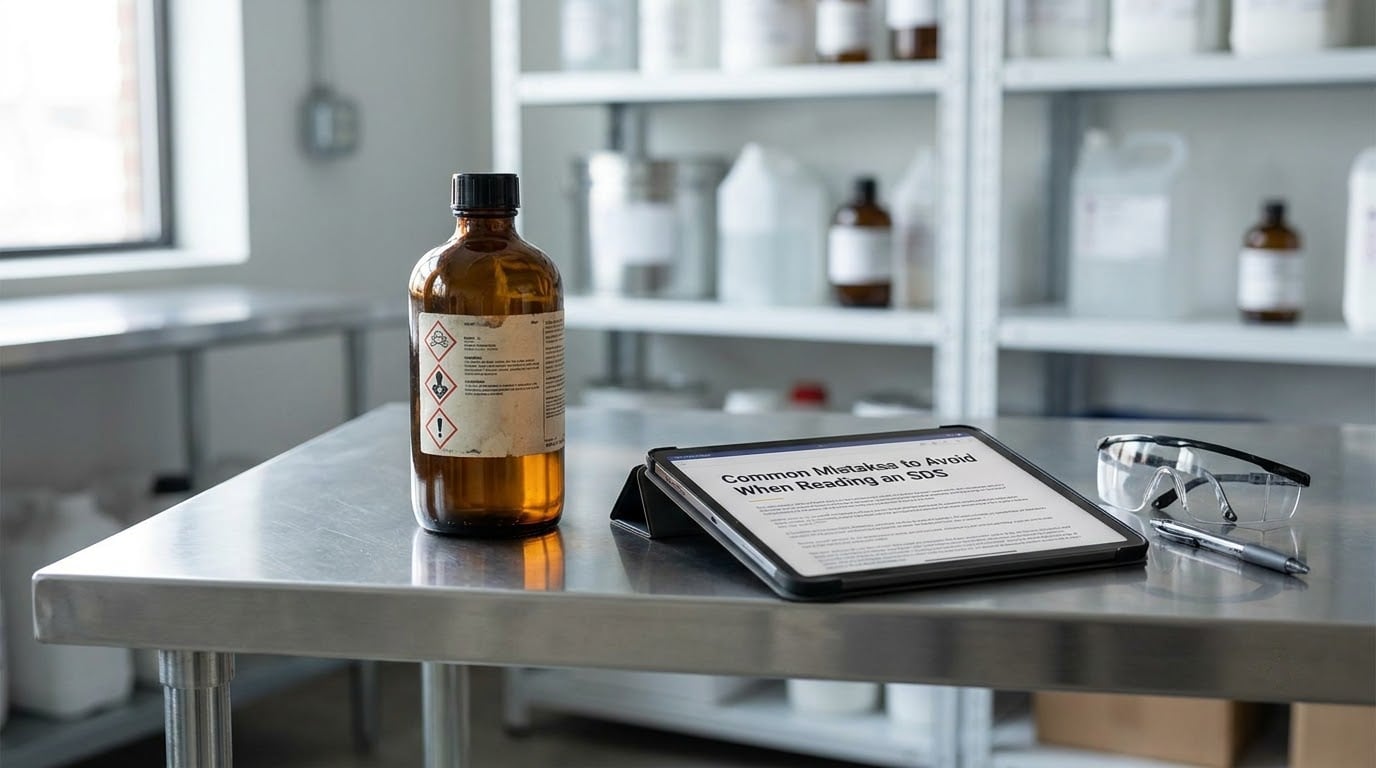
Using an outdated sheet. An MSDS-format document or a PDF with no revision date is a starting point at best. Ask the supplier for the current GHS version and log the date you received it.
Treating the SDS as a complete risk assessment. The sheet describes the chemical. It does not know your room volume, your ventilation, your shift length or the other drums stored next to it. You still need a task-specific assessment on top of it.
Accepting generic PPE advice. Wear gloves is not a specification. Advice without glove material, thickness or breakthrough time is useless, because a glove that fails in 10 minutes is worse than one that would have held.
Using odor as a warning. Odor threshold has nothing to do with an exposure limit. Some solvents are detectable far below their safe limit, and others, like carbon monoxide, are odorless entirely. If you smell something, treat it as an exposure event rather than a warning that more exposure is fine.
Ignoring proprietary ingredient listings. A missing disclosure is a reason to escalate or switch products, not a reason to assume the product is benign.
Sticking to the old OSHA PEL. When the PEL, REL and TLV disagree, say so in your documentation and use the more protective value while you confirm the requirement.
Reading once at onboarding and never again. Hands-on training works better with the real chemicals on the site. Pull the SDS for the three products the team uses most, spend twenty minutes on sections 2, 4, 6, 7 and 8, and have each person say the emergency phone number out loud.
Frequently Asked Questions
Where can employees find the chemical safety data sheet for a workplace chemical?
It has to be accessible where people handle the chemical, not only in an office. That means a printed binder at the station, a shared drive or SDS system with a search box, or a QR code on the container linking to the current sheet. The OSHA Hazard Communication Standard requires access in a language and format the worker can understand, and it must stay available during every shift. Keep a physical backup as well, because search systems fail exactly when a spill does.
Does a chemical safety data sheet replace the product label?
No. They are two different documents with different jobs. The label goes on the container and gives a quick hazard summary: product identity, signal word, pictograms, hazard statements and precautionary statements. The SDS is the full 16-section document. US rules let suppliers reduce label information when the SDS is available at the worksite, which is why the label may look thin. When the two disagree, follow the more protective information and report the mismatch to your safety contact.
How often should an employer review or update SDS documents?
Treat every purchase and every formulation change as a trigger to check the sheet. The SDS does not expire on a fixed schedule, but it must reflect the product as it is currently sold, and the revision date in section 16 is the only way to know whether you have the current version. Most teams set a calendar review for their whole library, then confirm the version at each reorder. If a supplier reformulates, notify everyone who used the previous version.
Can an employee use an SDS to choose gloves or a respirator on their own?
For gloves, the sheet usually gives you enough to start: material, thickness and sometimes a breakthrough time, which you can check against a permeation table for the named chemical. For respirators, no. Section 8 tells you whether a respirator is needed and which type, but using one at work requires a written program, medical clearance, fit testing and training. Choose your gloves from the sheet and respiratory protection from your safety program, not from the document alone.
What should happen if a chemical exposure occurs while the SDS is not immediately available?
Treat first aid as the priority, using general first-aid training while someone else retrieves the sheet. Get the person to fresh air for inhalation, start flushing eyes or skin for at least fifteen minutes, and call medical or the poison center. A 24-hour emergency number is printed in section 1 of the SDS and on most labels, so having it on the wall matters more than having the file open. Report the incident afterward and pull the SDS to plan prevention, not first aid.
Do all workplace chemicals have a safety data sheet in the same format?
Hazardous chemicals in the workplace should, and an old MSDS-format document is the exception rather than the rule. You will still find legacy MSDS files, some consumer products sold in small quantities, and non-hazardous materials that do not require a sheet at all. The key test is the fixed 16-section numbered structure with a revision date in section 16. If a document lacks it, request the current GHS version from the manufacturer before relying on it.
Start with the three products your team handles most. Pull the current SDS for each, read sections 2, 4, 6, 7 and 8, and write down the signal word, the glove material, and the emergency number on the same page. That single hour of work catches most of the exposure problems before they happen, and it turns how to read a chemical safety data sheet from a document review into a habit.