
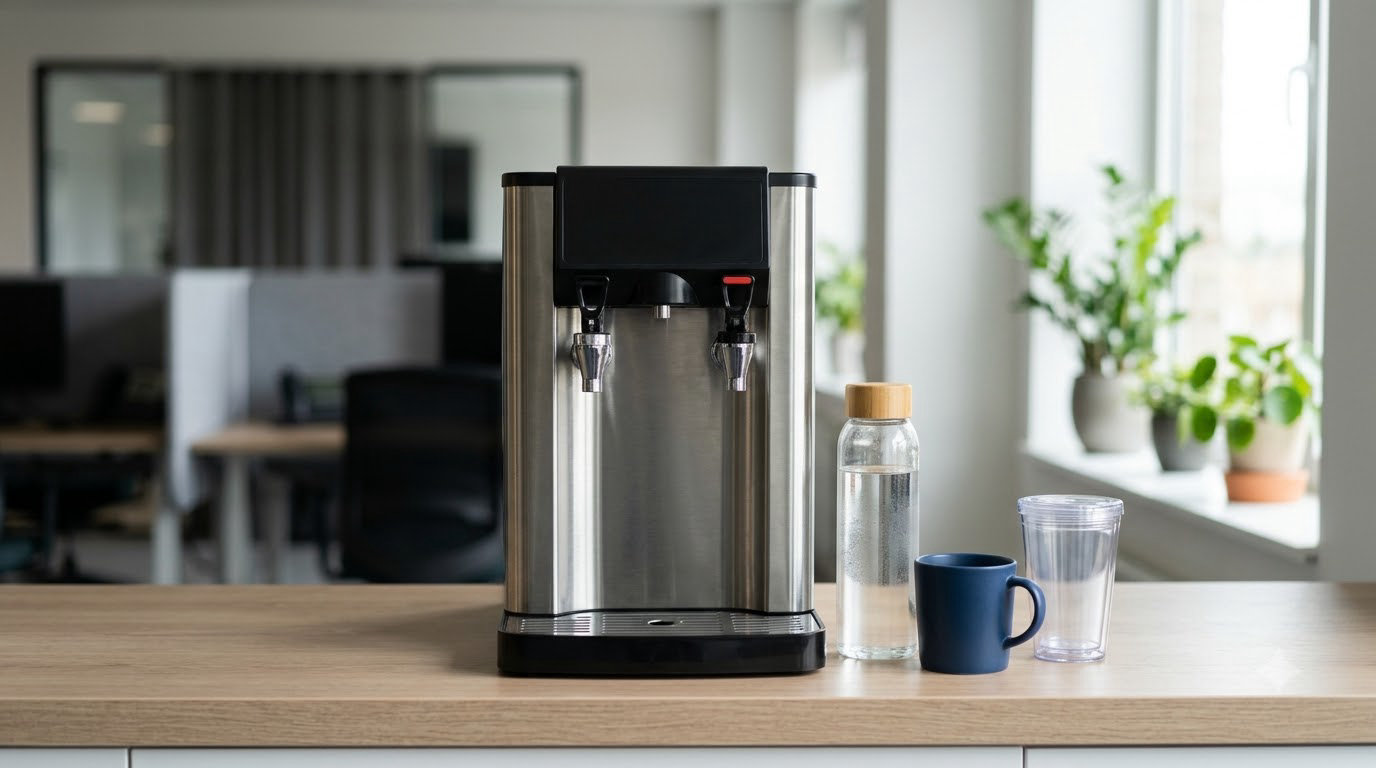
Water access at work matters because a worker who cannot reach cool drinking water quickly loses more fluid through sweat and breath than they replace, and the payback shows up as fatigue, slower thinking, small errors and, in hot work, heat illness. Employers who treat water as a perk rather than a control usually find out through a near miss instead of a survey.
Most of what follows comes from how safety and facilities teams describe the same recurring failures: a cooler two corridors from the work area, cups that ran out at two in the afternoon, an outdoor crew told to wait until the truck was unloaded. Those are not exotic problems, and they are all fixable.
Table of Contents
- Why Water Access at Work Matters
- How Much Water Do Workers Need During the Day?
- What Are the Main Workplace Barriers to Water?
- How Can Employers Improve Water Access?
- Why Water Access Is Especially Important in Hot Work
- What Should Employers Monitor and Document?
- Frequently Asked Questions
- Is an employer required to provide drinking water at work?
- How often should workplace water dispensers be serviced?
- Can employees be required to bring their own water bottles?
- How can employers support hydration for outdoor or warehouse workers?
- Is a water fountain enough to meet workplace hydration needs?
- When should a workplace health concern be referred to a medical professional?
- Conclusion: Start With Distance, Not Awareness
Why Water Access at Work Matters
Water access at work matters for four connected reasons: it prevents dehydration, it protects thinking and reaction time, it is the foundation of heat illness prevention, and in many states the employer is legally obliged to provide it. Remove any one of those and the same handful of workplace problems tends to follow.
- It replaces sweat losses before the body tells you it is behind. Thirst arrives late. By the time people feel thirsty, fluid loss is already measurable, and heat-exposed workers often push through before they feel anything.
- It protects concentration, working memory and reaction time. Mild fluid loss of roughly one to two percent of body mass has been linked in research to measurable slowing in attention and short-term memory, and reaction-time errors are exactly the kind that turn into near misses.
- It is the backbone of heat illness prevention. Water alone does not prevent heat stroke, but without it rest breaks in the shade do very little, because a body that cannot cool itself cannot recover.
- It is a duty, not a favour. OSHA expects potable drinking water to be available, and several states set specific quantity and timing rules that apply well beyond the minimum.
What counts as adequate water access at work
A sink in the break room is not water access. Adequate access means a supply of cool, potable water close enough to the work area that a worker can reach it within a minute or two of needing it, without asking permission and without losing productive time.
Work that expands that definition: quantity that lasts the whole shift, a temperature people will actually drink, cups or a refill point that fits reusable bottles, maintenance that keeps the unit running, and accessibility for people with mobility or vision needs.
The thinking and productivity case
The commercial argument is quieter than the safety argument but easier to measure. Workplace wellness research has repeatedly connected mild dehydration to lower output, and estimates of the productivity loss from dehydration at low fluid levels range widely depending on task and study design.
The honest summary is that the effect is real, consistent in direction, and larger in work that demands sustained attention than in work that does not. Treat it as a contributing factor, not a cure-all; no hydration programme fixes a badly designed process.
The legal case, in plain language
At the federal level, the expectation is straightforward: employees should have potable drinking water readily accessible, in sufficient quantity and at a suitable temperature. Where a hazard is recognised and not addressed, OSHA can act under the general duty clause.
State rules are where the specific numbers live. California requires enough fresh, pure and suitably cool water for outdoor employees to drink at least one quart per hour, and states including Washington, Colorado, Minnesota and Maryland have their own heat standards with water, shade and rest provisions. Requirements vary by state and change, so confirm the rule that applies to your site rather than assuming the federal baseline covers it.
How Much Water Do Workers Need During the Day?
Needs vary by person, workload, climate, diet, health status and shift length, so no single number works for everyone and no employer should set an individual quota or a fluid target for a specific employee. What an employer controls is access, timing and breaks.
The reference points most widely used in occupational guidance are generous by design: roughly one cup, 8 ounces, every 15 to 20 minutes in hot conditions, and on the order of a quart per hour for workers in the heat. Those figures assume access is continuous, because a body that cannot drink at that rate cannot catch up later.
| Work situation | What raises fluid needs | What access has to look like |
|---|---|---|
| Outdoor construction, utilities, landscaping | Heat, direct sun, heavy work, protective clothing, sweat rate | Shaded or cooled point within a few steps, frequent breaks, roughly a quart per hour available |
| Warehouse and manufacturing floor | Heat from equipment, forklifts, enclosed layout, long shifts | Refill points on the floor, more than one per area, cups that are restocked |
| Commercial kitchens | Standing all shift, heat near cooking equipment | Drinking water separate from hand-wash sinks, refills permitted during service |
| Delivery driving and transport | Long hours, no fixed break location, warm vehicle | Refill stops planned into the route, insulated containers |
| Office and desk-based work | Low sweat loss, but fewer cues to drink and long seated stretches | Filtered or cooled point near the floor, visible, usable without leaving a meeting |
| Remote and hybrid work | No water-cooler cues, unstructured day, screens all day | Employer supplies equipment or a stipend and tells people it is expected, not optional |
What Are the Main Workplace Barriers to Water?
Most sites have water. What they have is friction, and friction quietly lowers intake long before anyone feels thirsty. These are the barriers that come up again and again.
- Distance. A cooler in the far break room that requires crossing a production line or a car park is not accessible during the working hour.
- Queues and single points of failure. One dispenser serving two hundred people turns into a line, and a line becomes a reason to skip the drink.
- Breakdown and empty supplies. A broken unit with no service ticket is the most common complaint we hear, and the cups running out mid-shift is the one that construction managers single out.
- Water quality and temperature. Water that tastes of plastic or sits warm gets refused, and people switch to coffee or energy drinks instead.
- Permission problems. When a worker has to ask a supervisor, the request becomes a favour, and people stop asking. Restricting personal bottles removes the worker’s own backup supply.
- Confusing rules. Sanitary codes, break policies and health rules are often cited to limit beverages. Most workers have no idea which are real, so they comply and quietly drink less.
The pattern behind all of these is the same: access that is technically available but practically denied. Workers describe exactly that gap, and it is the reason a policy document on its own changes very little.
How Can Employers Improve Water Access?
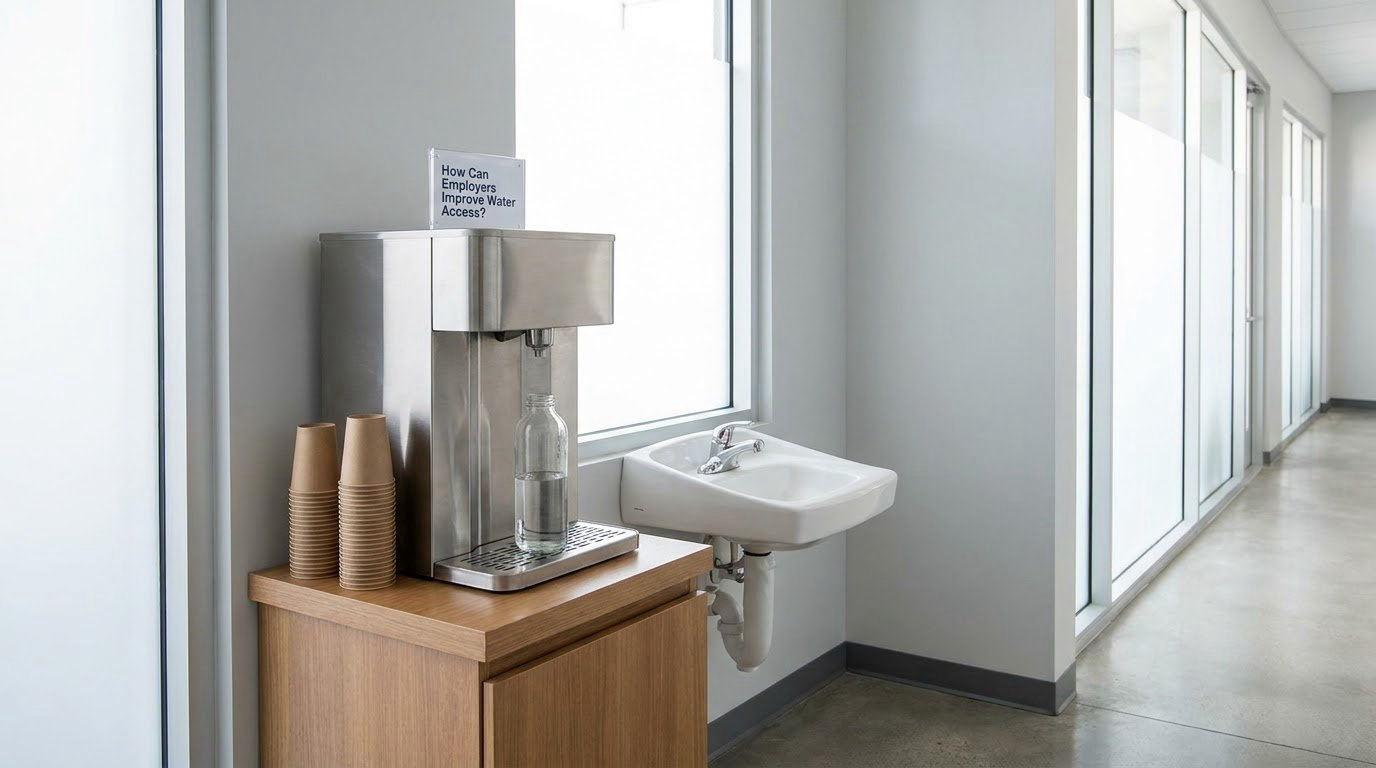
Improving water access is a facilities and scheduling problem, not a messaging problem. Work through this checklist in order, and the cheapest fixes come first.
- Map where water is and where work happens. Walk the floor and note the walking time from each work area to the nearest point.
- Move and add refill points. Put filtered or cooled dispensers where people already queue, on the warehouse floor rather than at the dock office, on each floor rather than in reception.
- Budget for volume and cups. Stock enough cups and filters that a dispenser cannot run dry during a shift, and check on a schedule rather than on complaints.
- Support reusable bottles. Bottle-filling taps at drinking fountains make refilling instant and cut single-use plastic at the same time.
- Protect the water. Post cleaning and filter-change schedules, keep cold water cold, and treat a taste complaint as a service call rather than a preference.
- Schedule breaks that work. In hot work, short scheduled hydration and cooling breaks beat one long break at the end.
- Train supervisors. Managers are where policy quietly disappears. Give them a script for answering a heat or hydration concern from their crew.
- Make it accessible. Check height, reach, clear floor space and route access for people using mobility aids.
In an office, the fix is usually a visible filtered dispenser on each floor plus a normal expectation that people drink at their desk. In a warehouse, it means dispensers inside the work zone and cups restocked by the same shift. On a construction site, portable stations work well, and the only complaints tend to appear when the cups run out.
For delivery drivers, plan the refill into the route rather than leaving it to chance. For outdoor crews, put water at the point of work, not at the truck. For remote staff, supply a carafe, a filter or a stipend and say plainly that drinking water during the working day is expected, not optional.
Why Water Access Is Especially Important in Hot Work
In hot work, water is the control that every other heat safety measure depends on. Sweating is how the body sheds heat, and when fluid is not replaced, sweating slows, core temperature climbs and the risk moves from heat exhaustion to heat stroke, which is a medical emergency.
That is why water access cannot be separated from the rest of a heat illness prevention programme. NIOSH and OSHA guidance treats water as one element alongside shade or air-conditioned recovery areas, rest and cooling breaks, acclimatisation for new and returning workers, and training for supervisors to recognise symptoms and respond. Water without rest and shade is not enough, and rest without water accomplishes very little.
Two practical rules of thumb for hot work: put the water where the work is, not where the vehicle is parked, and give new workers time to acclimatise over roughly a week to two instead of putting them straight into full output. Heat stress risk climbs with humidity as well as temperature, and hard surfaces like asphalt and concrete hold heat well after sunset.
Watch for the early warning signs of heat illness: heavy sweating, headache, dizziness, nausea, cramps, and confusion or fainting in the worst cases. Anyone showing confusion, fainting, or symptoms that worsen quickly needs emergency medical help immediately rather than water and a rest break.
What Should Employers Monitor and Document?
You cannot improve what you never measured, and hydration programmes usually fail because employers watch usage while ignoring access. Track a small set of honest indicators and review them on a schedule.
- Access and uptime. Dispensers working, cups and filters in stock, service tickets closed within a set time, walking time from work areas.
- Usage patterns. Refill volume by location and by day, which tells you where the water actually goes rather than where you assume it goes.
- Employee feedback. A short pulse question on access and water quality at 30, 60 and 90 days catches problems before they become incidents.
- Conditions. Temperature, humidity and heat index on shift, especially when workloads change with the season.
- Training and procedure. Supervisor heat training completion, acclimatisation plans for new workers, and where the emergency response plan lives.
- Incidents and near misses. Record heat symptoms, first aid given, and the actual water supply available at the time. This is the record that matters after an event.
Set a baseline before you change anything, then compare at 30, 60 and 90 days. One survey question, one uptime log and one incident review will tell you more than an annual wellbeing survey ever will.
Frequently Asked Questions
Is an employer required to provide drinking water at work?
In the United States, yes as a practical matter. OSHA expects employees to have potable drinking water readily accessible, in adequate quantity and at a suitable temperature, and state heat standards set specific amounts for hot work. California, for example, requires enough fresh, pure and suitably cool water for outdoor workers to drink at least one quart per hour. Requirements differ by state and industry, so check the rule that applies to your site.
How often should workplace water dispensers be serviced?
Set a schedule rather than waiting for complaints. Daily visual checks for leaks, empty cups and running water, weekly cleaning of dispensers and fountains, and filter replacement on the manufacturer’s schedule or sooner if flow drops or taste changes. Record the service date. A dispenser with a visible last-serviced date gets maintained; one without it tends to be ignored until someone reports the taste.
Can employees be required to bring their own water bottles?
Requiring workers to supply their own drinking water as the only option is a problem, especially in hot work, because the employer still has to provide the supply. Personal bottles should be permitted alongside workplace water, not instead of it, and bottle-filling taps make refilling practical. If you have a policy limiting personal beverages, make sure it is actually about hygiene or safety and is applied consistently.
How can employers support hydration for outdoor or warehouse workers?
Put water inside the work zone, not at a distant break room or the parked truck. Stock enough cups and cool drinking water for the whole shift, schedule short hydration and cooling breaks rather than one long break, and acclimatise new workers gradually over a week or two. On a warehouse floor that means dispensers in the work area; outdoors it usually means portable stations beside the crew.
Is a water fountain enough to meet workplace hydration needs?
It can be, if it is working, kept stocked, suitably located and inside the walking time a worker can actually spare during the shift. One fountain at the end of a production line is not enough for a large shift because the queue removes the benefit. Employers often add filtered dispensers on the floor, bottle-filling taps and dedicated break schedules rather than relying on a single wall unit.
When should a workplace health concern be referred to a medical professional?
Refer any individual with symptoms that could be heat illness, and treat confusion, fainting, seizure, or rapidly worsening symptoms as an emergency requiring immediate medical help. Repeated headaches, dizziness or fatigue in a hot workplace deserve a conversation with a clinician, especially where an underlying health condition or medication is involved. Employers should also involve a qualified occupational health professional when setting heat and hydration policies.
Conclusion: Start With Distance, Not Awareness
If you do one thing this month, walk the floor and time how long a worker has to walk to the nearest working water point, then fix the worst one. After that, check cups and filters on a schedule, move dispensers into the work area, and make sure supervisors know they can approve a hydration break without making it a decision.
Water access at work is one of the cheapest safety and performance improvements available, and the evidence for it is not subtle. The only hard part is treating it as equipment rather than as a perk.