
If you are wondering how to run a fitness challenge at work, you need eight things in place before week one starts: a health-focused goal that avoids weight language, a format any employee can adapt, published measurement rules, a safety and accessibility plan, partners and resources, a clear announcement, a weekly motivation rhythm, and a way to report results to leadership. Give yourself six weeks of planning time for a four-to-six week challenge.
The programs that fail are rarely the ones with bad ideas. They fail because the goal rewards the three people who already run at lunch, because managers can see individual step totals, or because nobody told shift workers how to take part. Fix those three things and most challenges hold steady through week five.
Below is the process we hand to a wellness coordinator on day one. It assumes a mixed workforce of desk-based staff, remote employees and frontline shift workers, because that is what most organisations actually have.
Table of Contents
- What You Need to Run a Workplace Fitness Challenge
- Step-by-Step: How to Run a Fitness Challenge at Work
- Step 1: Define a Clear and Inclusive Goal for Your Workplace Fitness Challenge
- Step 2: Choose a Challenge Format That Fits Your Workforce
- Step 3: Set Fair Participation and Measurement Rules
- Step 4: Build a Safe, Accessible Activity Plan
- Step 5: Recruit Partners and Prepare Resources
- Step 6: Announce and Launch the Challenge
- Step 7: Maintain Motivation Without Pressure
- Step 8: Review Results and Sustain Healthy Habits
- Common Mistakes When Running a Workplace Fitness Challenge
- Frequently Asked Questions
- How long should a workplace fitness challenge last?
- Can employees opt out of a workplace fitness challenge?
- Is it legal to track employees’ step counts or health data at work?
- How do you measure the success of a workplace wellness challenge?
- How do you get employees to actually participate in a fitness challenge?
- What are some good office fitness challenge ideas?
What You Need to Run a Workplace Fitness Challenge
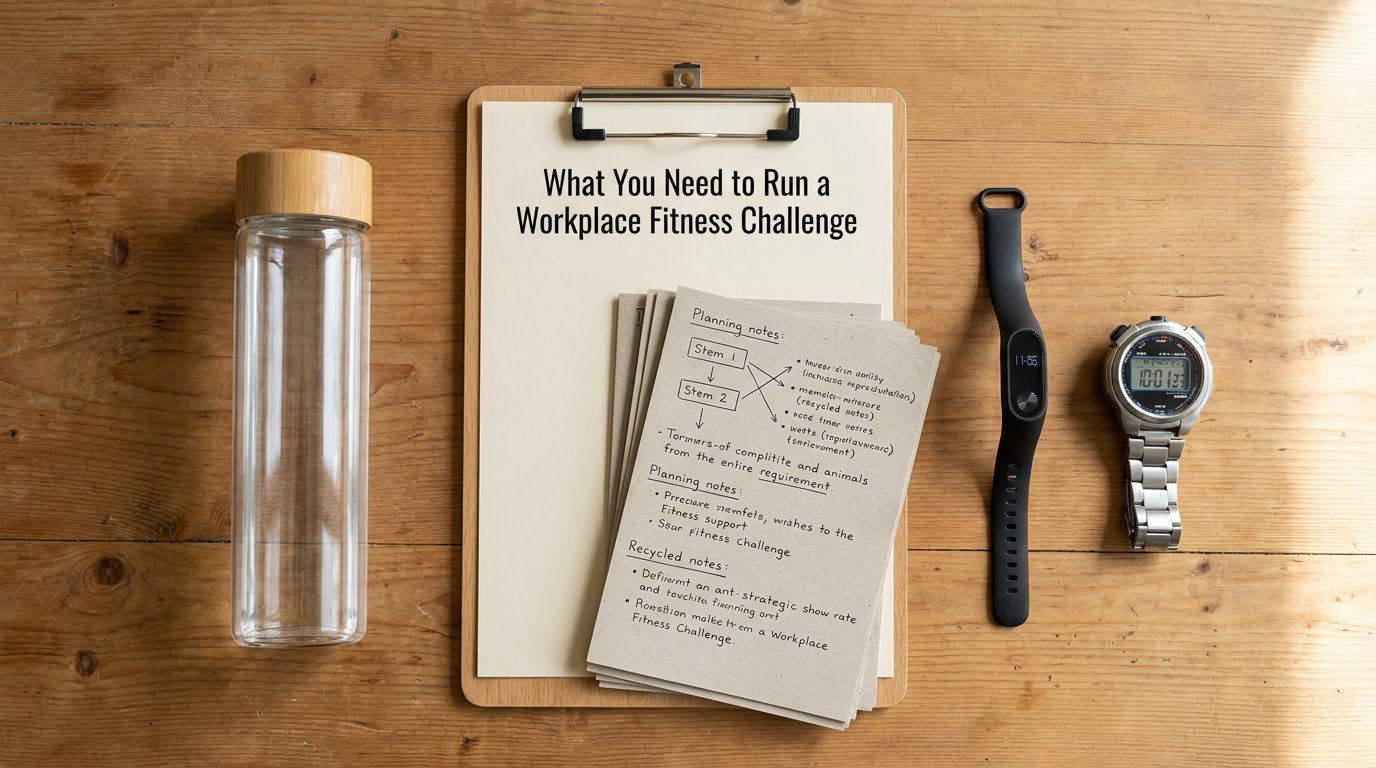
Gather these before you write a single announcement email. If a line item is missing, you are not ready to launch.
People to involve
You need one named program owner, at least two wellness champions from different teams or sites, and one person in HR or legal who has agreed to review your data and consent language. Champions matter more than vendors. Forum threads and program post-mortems agree on this: uptake climbs when a visible colleague in the team is taking part, and leadership participating visibly is the single strongest predictor of sign-up.
A written goal and rules document
One page, dated and versioned. It holds the challenge period, the metric, what counts as eligible activity, how teams are scored, the reward tiers, the opt-out route and the data you will keep. When someone asks a question in week three, the answer should be a link, not an explanation from memory.
A tracking method that works for everyone
Decide this before launch, and offer at least one option that does not require a wearable. Phone step counts, a shared spreadsheet of weekly active minutes, paper logs, and manual check-ins with a partner all work. The method decides the privacy profile, so it is not a detail to leave open.
A budget, however small
Recognition-only budgets are entirely workable and often outperform prize-heavy ones. A useful split is roughly half on participation rewards that almost everyone can earn, a fifth on milestone rewards, a fifth on the team prize, and a tenth on a most-improved or charity donation. The prizes themselves can be low value: extra paid time off, a team lunch, a donation to a charity the group picks, or plain public recognition.
Communication channels and a schedule
Decide where updates live before you need them. In most workplaces that means one company Slack or Teams channel, the intranet, and your HRIS or newsletter. Remote-first and frontline audiences need different channels than desk-based staff, so check what your people actually read.
Safety and accessibility resources
A written low-impact activity menu, a list of safe walking routes if the challenge is step-based, adaptations for people with mobility limits or chronic conditions, and a clear note telling anyone with a health concern to check with their own clinician first. Health questions from employees go to their doctor, not to you and not to the program.
A plan for reporting results
Know in advance what you will measure and who receives it. Participation rate, opt-out rate, team completion and a short anonymous pulse survey are enough. Individual health data never appears in a report.
Step-by-Step: How to Run a Fitness Challenge at Work
Step 1: Define a Clear and Inclusive Goal for Your Workplace Fitness Challenge
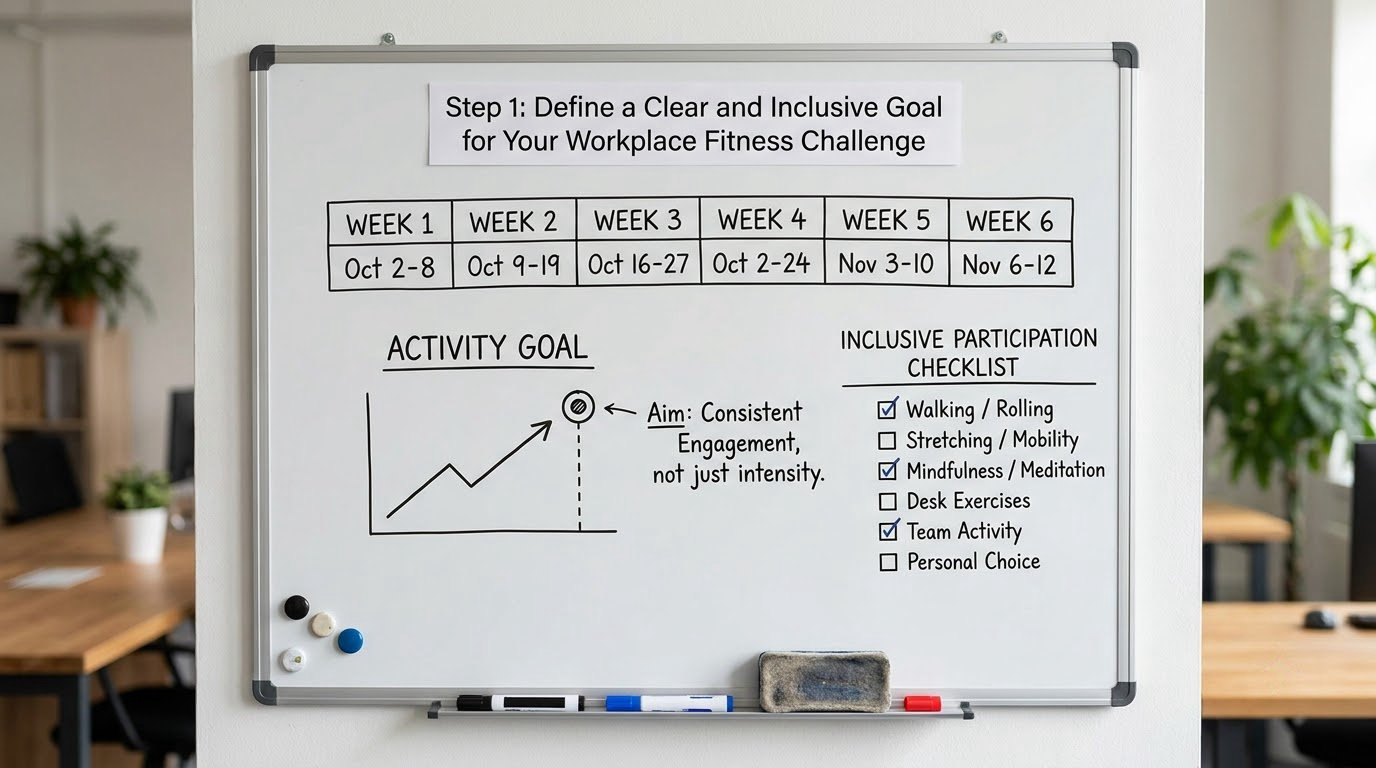
Write one objective that a non-fitness person can repeat back after hearing it once. “Get 60% of staff logging at least 150 active minutes a week for six weeks” works. “Improve the health of our workforce” does not, because nobody can tell whether you hit it.
Set four things in the goal statement: the behaviour you want, the number of weeks, who counts as a participant, and what a participant gets. Then set the participation expectation honestly. A stretch goal with no opt-out quietly teaches people that this program is for the athletes, not for them.
Leave weight out of it. Weight is health data, it invites body-image harm in a setting where colleagues already know each other, and in many places it exposes an employer to discrimination claims. Forum posters describing workplace weight-loss challenges describe the discomfort directly. If someone asks for weight tracking, redirect: offer active minutes, movement sessions or percentage improvement from a personal baseline instead.
How do you know this step worked? Your goal fits on one line, every participant could tell you what counts as success, and no sentence in it mentions body weight.
Step 2: Choose a Challenge Format That Fits Your Workforce
Format decides who can play. Step counts read well but exclude desk-bound staff, wheelchair users and anyone without a safe route to walk. Movement minutes, habit streaks and team formats are more forgiving. Compare your options before you commit.
| Format | Measured by | Typical length | Cost | Best for | Dropout risk |
|---|---|---|---|---|---|
| Step challenge | Daily steps, weekly totals | 4 to 6 weeks | Low to medium | Large offices with walking routes | Medium: excluding non-walkers |
| Active-minutes challenge | Minutes of moderate activity | 4 to 8 weeks | Low | Desk-based and remote staff | Low: counts cycling, swimming, yoga |
| Movement-session challenge | Number of sessions, any length | 4 to 12 weeks | Very low | Shift workers, low-mobility staff | Low: no device or pace needed |
| Habit streak | Days with any activity | 4 to 8 weeks | Very low | Building routines rather than volume | Medium: a missed day breaks the chain |
| Team relay | Combined team minutes or distance | 6 weeks | Low | Teams that dislike personal leaderboards | Low: social pull, no individual ranking |
| Charity fundraiser | Movement logged, converted to donation | 2 to 4 weeks | Donation amount | Organisations avoiding prize spend | Low: motive is not personal |
| Movement minutes donated | Minutes matched by employer per minute | 6 to 12 weeks | Medium | Groups who prefer purpose to prizes | Low to medium |
| Desk micro-challenges | Sessions of walking breaks, stairs, seated movement | 1 to 4 weeks | Very low | Sedentary, office-bound teams | Medium: novelty fades quickly |
Pick one primary format and one alternative route into it. “Ten thousand steps a day, or 150 active minutes a day, your choice” keeps the challenge open to far more people than a single metric does.
Step 3: Set Fair Participation and Measurement Rules
This is the step that determines whether people trust the program. Fairness complaints in workplace fitness threads almost always come back to unclear scoring, not to a dislike of exercise.
Write down what counts as eligible activity. If steps count, does cycling count, and at what conversion? If active minutes count, define moderate intensity in plain language and let people log manually if their device is unreliable. Vague definitions create arguments in week four.
Decide team scoring, individual scoring, or both. Individual leaderboards rank people and are the fastest way to create a public loser. Team totals let a colleague who contributes quietly still carry the group. If you publish individual rankings at all, publish them by improvement from baseline rather than raw totals.
Percentage improvement is the fairness mechanism employees ask for most often in forum threads. Everyone logs a baseline week before the challenge starts, then scores on the change from that baseline. A person walking 4,000 steps a day can win alongside a colleague already walking 12,000. Set a floor so that trivially low baselines do not create absurd percentage gains, and a ceiling so a very high baseline is not unfairly punished.
Then settle reporting frequency. Daily totals create noise and pressure. Weekly check-ins are usually enough, and give you a natural rhythm for step 7.
Step 4: Build a Safe, Accessible Activity Plan
Write the safety note plainly and put it in the announcement, not in a buried policy page: if you have a health condition, are pregnant, recovering from injury or managing a mobility limitation, talk to your own clinician before changing your activity, and choose from the modified options below.
Offer a low-impact menu by default rather than as an exception: walking at a conversational pace, seated leg and shoulder movements, gentle stretching, cycling or swimming, yoga at home, and mobility work. Include seated options specifically. A challenge where the only alternative to 10,000 steps is “sit it out” excludes more people than it protects.
Cover the practical risks too. If the challenge involves walking outdoors, share routes that are lit, paved and accessible, and say what to do in bad weather or extreme heat. Do not schedule optional sessions outside working hours for a workforce that includes shift workers, and never build a challenge around a single lunch-hour class.
Say plainly that participation is voluntary and that opting out affects no one’s employment, evaluation or standing. Keep the opt-out route simple: a private message to the program owner, no medical detail required, no reason requested.
Step 5: Recruit Partners and Prepare Resources
You can run this whole program on tools most organisations already own. A shared spreadsheet plus a chat channel will carry a team of 50. Past a few hundred people, the manual version starts eating the program owner’s week, which is when a tracking platform becomes worth it.
Before buying anything, line up the humans and materials. Recruit champions from each team, site or shift pattern, and give them a one-page brief: the goal, the dates, the message tone, and who they escalate questions to. Ask a qualified fitness or health professional to review your activity menu if you have one available, and check that any external vendor signs a data agreement before you let them see a single participant record.
Prepare the materials too: the rules page, the eligibility and safety note, the consent and privacy notice, a sign-up link, the weekly update template, and a short orientation recording for people who cannot attend a live session.
How do you know this step worked? Every team has a named champion, every question has one destination, and no vendor holds identifiable participation data without a written agreement.
Step 6: Announce and Launch the Challenge
One announcement does the heavy lifting. Keep it to a screen. It should carry the purpose in one sentence, the dates, the metric and the alternative metric, the reward tiers, the privacy position, the accessibility options, how to sign up, and what week one looks like.
Lead with the purpose rather than the prize. People respond to “we sit at screens all day and this is a structured way to move more” more than to a prize mention in the first line.
Make sign-up a single click and let people choose their team or declare their individual route. If sign-up takes more than two minutes you will lose the people who would have joined on Monday and not the people who would have joined in week three.
Run a short first-week orientation, recorded as well as live, covering the rules, the opt-out route, the safety note and how tracking works. Send the announcement on a Monday, not a Friday afternoon. Then send it a second time a week before the start, because roughly half the people who intend to join have not clicked the link yet.
Make your leadership visible. An executive who joins, or who says plainly that they are not joining but support it, sets the tone more effectively than any poster. Authenticity beats encouragement here.
Step 7: Maintain Motivation Without Pressure
Enthusiasm fades around week two in almost every challenge, workplace or otherwise. Plan for that dip rather than treating it as failure. Drop-off after the first fortnight is the single most common failure point, and it is usually a pacing problem, not an attitude problem.
Use a weekly rhythm: a short update with team progress, one story or tip, and one thing to do next week. Keep updates light. A weekly message that takes two minutes to read survives; a weekly report with three charts does not.
Pair people up. Buddy pairs are the most commonly reported thing that keeps someone going when motivation alone has run out, and they cost nothing. For remote teams, keep everything asynchronous so timezone differences do not decide who participates.
Recognise without ranking people. Milestone badges, a shout-out in the channel, a most-improved award and a team prize all work. Avoid loser labels, avoid any public commentary on someone’s low total, and avoid discussing anyone’s weight. Public visibility motivates some people and shames others, so publish progress at team level and keep individual numbers private unless the individual asks otherwise.
Watch for the point where the same two or three people win every week. Add a second and third tier of recognition, or shift to team scoring. A challenge where everyone can identify the winners by week three has already told the rest of the office what is worth chasing.
If participation collapses mid-challenge, run the recovery playbook: shorten the remaining period, add a low-effort catch-up option so people are not disqualified for a bad week, publish team progress instead of rankings, and lead the next update with participation rather than a leaderboard.
Step 8: Review Results and Sustain Healthy Habits
Report in aggregate only. Share participation rate, number of teams, opt-out rate, and results from a short anonymous pulse survey asking whether people found it fair, whether the rules were clear, and what they want next. Aggregate numbers describe the program; individual health data describes people, and you do not need it to make decisions.
Assess the two things that decide whether you run it again: inclusion and safety. Did desk-bound, remote and shift-working staff participate at roughly the same rate as walkers? Did anyone report pressure or discomfort? Fix those before you celebrate anything else.
Then keep something running. A four-to-six week challenge will not build a lasting habit on its own, since habit formation typically takes considerably longer than the challenge itself. Retire the leaderboard, keep the weekly team update, keep the walking group, keep the buddy pairs. Repeat the challenge in a different format, maybe a charity version or a movement-minutes-donated model, rather than running the identical thing twice.
Delete individual participation data when the program ends. Say when you will, and do it.
Common Mistakes When Running a Workplace Fitness Challenge
These are the errors that recur across HR forums, vendor post-mortems and program surveys. Each has a straightforward correction.
Making it winner-takes-all. One big prize for one winner produces a public loser every week and disengages everyone else. Build tiered rewards instead: a participation tier nearly anyone can earn, milestone tiers, a team prize, and a most-improved award. You can have winners without creating losers.
Collecting health data nobody needs. Step counts linked to named individuals, visible to a manager, are health data and a genuine legal problem in many jurisdictions. Set participation as voluntary, keep individual totals private, report in aggregate, and write a short retention statement: what you collect, why, and when it is deleted. Have HR or legal review it once. Rules differ by country and by state, so check what applies where your employees work.
Excluding the people the challenge was meant to help. A step-based challenge with no alternative quietly tells sedentary, disabled, pregnant and shift-working staff that the program is not for them. Offer at least one non-step metric and one seated or low-impact option, and score on improvement from baseline so mixed starting points are fair.
Using weight loss as the metric. It is health data, it raises body-image and discrimination concerns, and it rewards a small group. If employees ask for weight-based framing, offer active minutes, movement sessions or percentage-of-baseline improvement, and point anyone with weight questions to their own clinician or a registered dietitian.
Prizes that only excite people who already exercise. A prize tied to distance or pace appeals to runners, not to the desk-bound majority. Reward consistency and improvement instead of volume, and include low-effort options in the participation tier.
Complicated tracking. If signing up and logging take more than a couple of minutes, participation falls away. Offer more than one logging method, keep the weekly update to two minutes of reading, and let people submit manual entries without a fuss.
Launching and disappearing. A challenge with a big announcement and no follow-up reads as a one-off stunt. Publish the cadence up front, send the weekly update even when the news is thin, and tell people before the end what happens next.
Frequently Asked Questions
How long should a workplace fitness challenge last?
Most workplace fitness challenges work best at four to six weeks. That is long enough to build a routine and short enough that people can see results before motivation fades. Two-week challenges tend to end without changing habits, while twelve-week runs need strong mid-point communication or attendance drops sharply after week four.
Can employees opt out of a workplace fitness challenge?
Yes, and you should make opting out easy and private. A simple message to the program owner is enough, with no medical detail required and no reason requested. Participation should be voluntary, and opting out should affect no one’s evaluation or standing. State this in the announcement so people know it exists.
Is it legal to track employees’ step counts or health data at work?
Rules differ by country and state, so have HR or counsel check yours. As a general principle, collect as little as possible, get consent, never make participation a condition of employment, and keep individual totals private rather than visible to managers. Publish a short retention note saying what you hold and when you delete it.
How do you measure the success of a workplace wellness challenge?
Measure participation rate, opt-out rate, team completion and a short anonymous pulse survey on fairness and clarity. Report figures in aggregate only. Look at whether participation was even across desk-based, remote and shift-working staff, and whether people want the format run again. Avoid collecting individual health data at all.
How do you get employees to actually participate in a fitness challenge?
Offer more than one way to take part, keep sign-up to a single click, and let managers and executives visibly join. Use tiered rewards so most people can win something, and send a short weekly update on a fixed day. Buddy pairs and team totals consistently keep participation up past the second week.
What are some good office fitness challenge ideas?
Formats that suit office workers include team relay on movement minutes, active-minutes goals, movement-session counts, habit streaks, movement minutes matched to a charity donation, and desk micro-challenges built around walking breaks and seated movement. Pick one primary format and offer a non-step alternative route into it.
Start with step one this week. Write the goal on a single line, check it contains no weight language, and test it on two colleagues who are not fitness people before you build anything else around it. This page is written to be used as the working version of how to run a fitness challenge at work, so treat the eight steps as the checklist rather than as background reading.