

Budget for an employee wellness program by setting one annual pool, pricing every component per employee per month, and reserving 10 percent for measurement and administration. Most US employers land between 5 and 25 dollars per employee per month for the wellness layer that sits on top of health, dental and retirement benefits.
Those figures are planning ranges, not a market rate, and they move with region, headcount and vendor terms. They also exclude the core benefits most employers already pay for. The health premium contribution, the 401(k) match and paid time off are not wellness program costs, and mixing them into a wellness line is the fastest way to lose a budget argument with leadership.
What follows is the method I would use to build the number: fix the goals, size the scope, listen to employees, allocate the pool by category, price the options on total cost, model participation and equity, then reserve money for measurement. As of 2026, the cost of getting this wrong is usually not overspending. It is a per-employee rate that looks reasonable on paper and funds a program almost nobody uses.
Table of Contents
- What You Need
- Step-by-Step: How to Budget for an Employee Wellness Program
- Common Mistakes
- Frequently Asked Questions
- How much should an employer budget for an employee wellness program?
- What is a reasonable wellness program budget for a small business?
- Should employers budget per employee or use a fixed annual amount?
- How do we estimate employee participation when planning the budget?
- Are employee wellness program costs tax deductible?
- How can we tell whether the wellness budget is being used effectively?
- Conclusion
What You Need

Six inputs have to be in front of you before a single line item goes in the spreadsheet. If one is missing, the budget is a guess wearing a spreadsheet costume.
- Headcount and eligibility rules. Know who counts: full-time only, or part-time and seasonal staff too, and which locations and shifts are covered.
- Baseline data. Twelve months of participation figures, claims trend, absence records and EAP or counseling usage, if the program already exists.
- Program goals. Three to five specific priorities, not one sentence about being healthier.
- A benchmark range per employee per month. The planning figures below, adjusted for your company size and tier.
- A named decision-maker and approval path. Who signs off, who reviews it, and by what date the budget has to be final.
- Evaluation measures. The handful of numbers you will report back, chosen before the money is spent.
A methodology note, since these numbers get cited: the ranges below are typical US planning ranges assembled from published employer wellness and benefits guidance as of 2026. Vendor pricing, medical trend and state rules shift over time, so treat them as a starting point and re-verify against current quotes before approval.
Step-by-Step: How to Budget for an Employee Wellness Program
Step 1: Set the Program Goals
Write down what the program is supposed to change. Three to five priorities, each with an owner and a measure attached, beats a general commitment to wellbeing every single year.
Typical priorities look like: more employees using mental health support before it becomes a leave, a higher share of staff meeting activity guidelines, fewer employees taking short-term disability days for stress, or stronger retention among frontline staff. Each one implies a different budget line.
Keep the goal count small. When I have reviewed budgets with nine goals, no line item had a real owner and the review meeting ran ninety minutes without a decision.
Step 2: Estimate the Program Scope
Scope decides whether costs are fixed or variable, and that changes the shape of the whole budget. A program delivered to 40 people at one site and a program delivered to 900 people across six sites do not price the same way.
Answer five questions: how many employees are eligible, in which locations and on which shifts, whether participation is voluntary or opt-in, how long the program runs, and what delivery format applies (on-site, virtual, self-serve app or coaching).
Anything billed per person scales with headcount. Anything billed per site, per session or per contract does not, so a small company often pays a higher per-employee rate for the same service than a large one. That arithmetic is the single most common surprise in a first budget.
Step 3: Gather Employee Input
A needs assessment is the cheapest line item in the entire plan and the one most often skipped. Ten free survey questions and two 45-minute focus groups will tell you what the paid research would take a month to return.
Ask what people already use, what stress them most right now, what they would actually join, and what has stopped them joining before. A gym reimbursement for a desk-based team or a manual workforce wastes budget no matter how popular gym reimbursements are elsewhere.
Cross-check the survey against what people already touch. A benefits-usage report, an EAP utilization rate and a pulse survey give you three different views of the same workforce, and the gap between them is usually where the real need sits.
Step 4: Build a Prioritized Budget
Split the total pool into three columns: essentials you will fund regardless, enhancements you add if the numbers hold, and a reserve for the year-over-year change everyone forgets to plan. Essentials usually cover mental health support, core movement or stipend spending, and administration.
Use percentages of the pool as a starting allocation, then convert every category to a per-employee-per-month figure so you can price it against vendor quotes.
| Category | Share of the wellness pool | What it usually covers |
|---|---|---|
| Mental health and support | 30 to 40 percent | Employee assistance program, counseling sessions, manager training |
| Movement and physical activity | 15 to 20 percent | Fitness reimbursement, stipend, ergonomic assessments, screenings |
| Financial wellness | 10 to 15 percent | Retirement coaching, student loan support, emergency assistance fund |
| Family and caregiver support | 10 to 15 percent | Backup care, childcare referral, parental leave support |
| Measurement and administration | 8 to 12 percent | Vendor fees, platform access, reporting, campaign communications |
| Reserve | 5 to 10 percent | Renewal increases, mid-year additions, pilot funding |
Two worked examples make the arithmetic concrete. For a company of 50 employees at 12 dollars per employee per month, the pool is 7,200 dollars a year. Forty percent goes to mental health support, which is roughly 2,880 dollars, or 4.80 per person per month. A vendor flat fee of 2,400 dollars a year for an employee assistance program then consumes most of that line, and the rest funds a small stipend and the survey you already ran.
For 500 employees at 10 dollars per employee per month, the pool is 60,000 dollars a year. The same 40 percent is 24,000 dollars, which buys a flat-fee program plus a dedicated mental health line that a 50-person company simply cannot split. Volume pricing is the reason a per-employee rate can fall as headcount rises, and it is worth testing that assumption against two real quotes rather than one.
Read the table above as a starting allocation, not a prescription. If a survey comes back dominated by sleep, childcare or financial stress, move the percentages. Keep the total fixed and change the mix.
Step 5: Compare Program Options and Costs
Compare options on total cost of ownership, which includes admin time, contract minimums, renewal increases and the cost of driving participation. Headline price per employee is the least useful number on the quote.
| Option | Typical cost basis | Likely participation |
|---|---|---|
| Manager training, meeting norms, protected focus time | Staff time only | High, because it applies to everyone |
| Fresh or healthy food in the office or shipped home | Low recurring cost per person | High among hybrid staff |
| Flexible wellness stipend employees allocate themselves | Fixed monthly amount per person | High, because it is not prescriptive |
| Employee assistance program | Flat annual fee or small per-person rate | Low to moderate without active promotion |
| Digital meditation or sleep app | Per person per month, volume tiers | Moderate, then decays without reminders |
| Biometric screenings and health risk assessments | Per person per screening, often with setup fees | Low to moderate, and privacy-sensitive |
| On-site coaching or fitness classes | Per session or per site | Low unless tied to shift schedules |
The most valued item in the list is usually the one employees control. A flexible stipend that can cover a gym, children’s activities or sports equipment gets used, because it does not tell someone what their health problem is. Prescriptive benefits are easier to justify in a board deck and harder to actually use.
Step 6: Account for Participation and Equity
Estimate participation before you commit, then plan for it. New wellness initiatives usually draw 20 to 40 percent of eligible employees in year one, with regular reminders lifting it and a total absence of promotion dropping it. A program priced for full participation but reached by a quarter of the workforce is roughly four times more expensive per actual user than the plan implies.
Price access, not just entitlement. A benefit used only at 9 to 5 misses night shifts, warehouse staff and field teams, and the participation gap that creates is often the widest part of the whole program.
Make a decision about people the benefit plan does not cover: contractors, temps and part-time staff. Forum discussions on small-business wellness spending keep raising this group, because they are frequently excluded from the budget entirely and then asked to attend company wellness events. A small pool for contracted staff, or an annual stipend paid outside the plan, is cheaper than the retention problem that follows.
Reserve a slice of the pool for access work: translated materials, accessible formats, scheduling across shifts, and a simple sign-up flow that does not require a manager’s signature.
Step 7: Build Measurement and Review
Pick a small set of measures and baseline them before launch. Six numbers are enough: enrollment, participation rate, completion, satisfaction, cost per participating employee, and one outcome measure such as short-term disability days or self-reported stress.
Track two cost categories separately. Cost avoidance is what you did not spend, such as a claim trend that did not rise as expected. Cost reduction is cash you actually got back, which is smaller and takes longer. Reporting them as one number is how wellness programs lose credibility in their second year.
Presenteeism deserves a line of its own. Employees at their desks but not functioning is a bigger cost than absence days in most office-heavy workplaces, and almost no employer measures it because it requires a survey rather than a system report. A three-question pulse check twice a year is the cheapest instrument available.
Put the review on the calendar with a date, not an intention: usually 60 to 90 days after launch for participation, and again at the six-month mark for outcomes. That review is where the next year’s budget is defended or reduced.
Common Mistakes
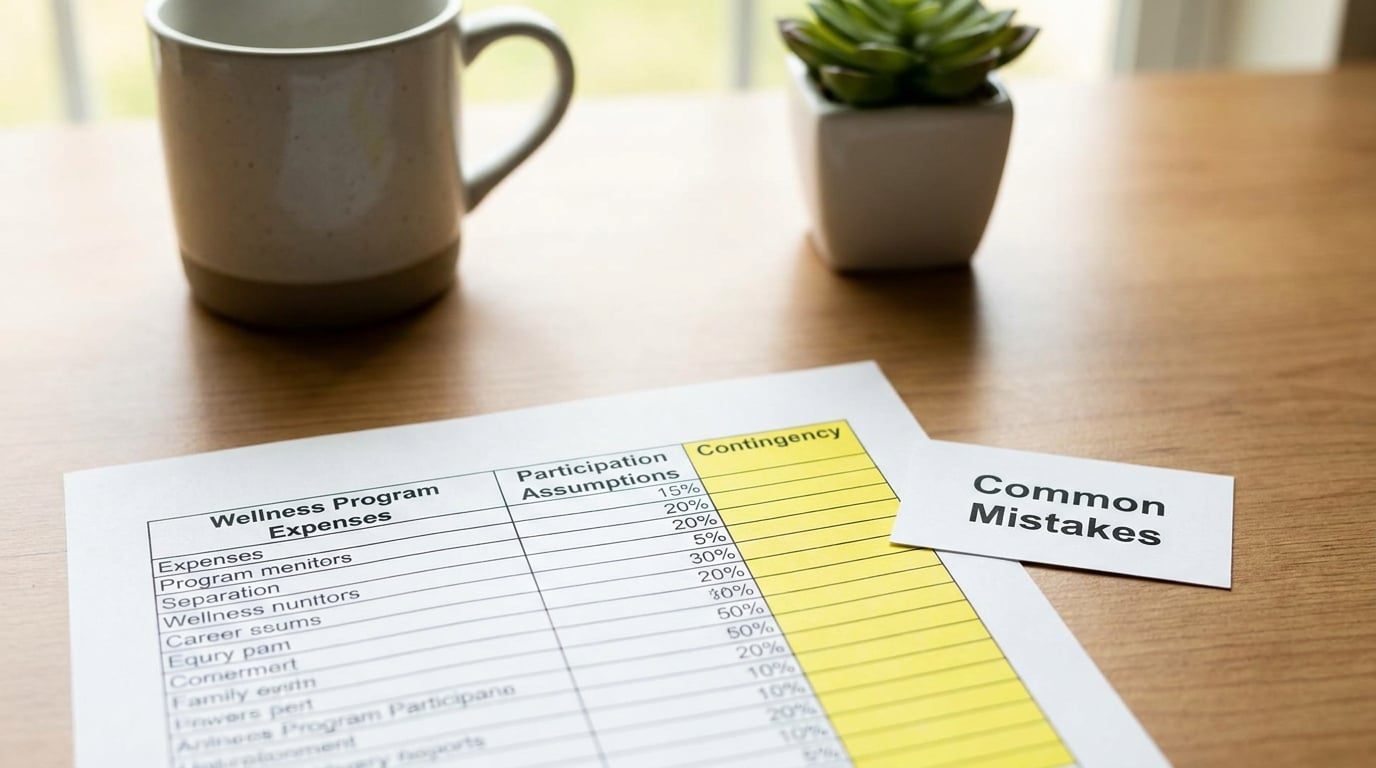
Copying another company’s budget. Per-employee rates from a 2,000-person manufacturer mean nothing for a 60-person agency with different shifts, salaries and provider pricing. Start from your own headcount, goals and survey results, and use the industry ranges as a sanity check only.
Funding perks before defining the problem. A popular benefit employees already use at home is not a wellness strategy, and it competes badly for money with an unmet need. Fix the goal first, then buy.
Ignoring administrative and contract costs. HR time for vendor management, reporting, renewals and enrollment campaigns runs well above zero, and vendor minimums mean a flat fee can exceed the per-person rate you budgeted. Put administration in its own line at 8 to 12 percent of the pool.
Overestimating participation. Assumptions of 80 to 100 percent in year one are the most common error I see in submitted plans, and they make the cost per user triple. Model 20 to 40 percent, price the promotion work that lifts it, and hold the reserve.
Failing to reserve for evaluation. Without money set aside for a survey, a vendor report and someone to read both, the program produces activity but no evidence, and the budget gets cut by whoever asks the hardest question first.
Losing the renewal conversation. Expect a vendor increase at contract renewal and budget for it rather than being surprised by it. If participation in a purchased benefit collapses, renegotiate the scope or let it lapse instead of renewing it by default.
Two cost drivers sit outside the wellness budget entirely. Workload, meeting load and manager behavior drive burnout more than any perk does, and a shrinking budget for private workspace or hot desking cannot be fixed by reallocating a wellness line. Be honest with leadership about which problems money solves.
Frequently Asked Questions
How much should an employer budget for an employee wellness program?
Most employers plan between 5 and 25 dollars per employee per month for wellness programming layered on top of health, dental and retirement benefits, and many land near the middle of that range. Small employers often spend more per employee because flat vendor fees do not shrink with headcount, while large employers get volume tiers. Publish one range in your plan and check every line item against it.
What is a reasonable wellness program budget for a small business?
Under 50 employees, budget the flat fee a vendor quotes rather than a per-employee rate, and expect the per-employee number to look high because minimums do not shrink. A practical first-year pool covers an employee assistance program, a stipend employees allocate themselves, and one or two low-friction perks such as healthy food. Hold biometric screenings and app bundles until usage data justifies them.
Should employers budget per employee or use a fixed annual amount?
Budget per employee for planning and reporting, because it scales and benchmarks cleanly, then convert to a fixed annual pool for approval. Multiply your per-employee-per-month figure by 12 and by eligible headcount, add a reserve of 5 to 10 percent, and present leadership with the annual total plus the per-employee figure. Vendors may quote either way, so convert before comparing quotes.
How do we estimate employee participation when planning the budget?
Assume 20 to 40 percent of eligible employees will take up a new benefit in year one, then raise that only if you have a promotion plan with a named owner and budget behind it. Use existing touchpoints to sanity-check the assumption: past EAP usage, benefits enrollment rates and survey intent. Report cost per participating employee, not cost per eligible employee, since the second figure flatters every program.
Are employee wellness program costs tax deductible?
Wellness program spending is generally treated as an ordinary business operating expense, so it is usually deductible, but reimbursements and stipends can be taxable to employees unless structured properly. Section 125 cafeteria plan elections and HSA or FSA-compatible spending accounts can change the treatment. Rules vary by country and state and change often, so confirm the treatment of your specific plan with your accountant or benefits advisor.
How can we tell whether the wellness budget is being used effectively?
Track six numbers from launch: enrollment, participation rate, completion, satisfaction, cost per participating employee, and one outcome measure such as self-reported stress or short-term disability days. Baseline them before the program starts and review at 60 to 90 days and again at six months. Report cost avoidance and cost reduction separately, since lumping them together is the fastest way to lose leadership trust.
Conclusion
Start with the three things that cost nothing: the employee needs assessment, three to five goals with owners, and a participation assumption you are willing to defend. Then set the pool, allocate it by category, and hold 10 percent back for administration, promotion and the renewal increase you already know is coming.
Once you have the annual total and the per-employee-per-month figure, get two real quotes against the same scope. That comparison, plus six baseline measures, is what turns a wellness budget into a plan leadership can approve and a program you can improve next year.