
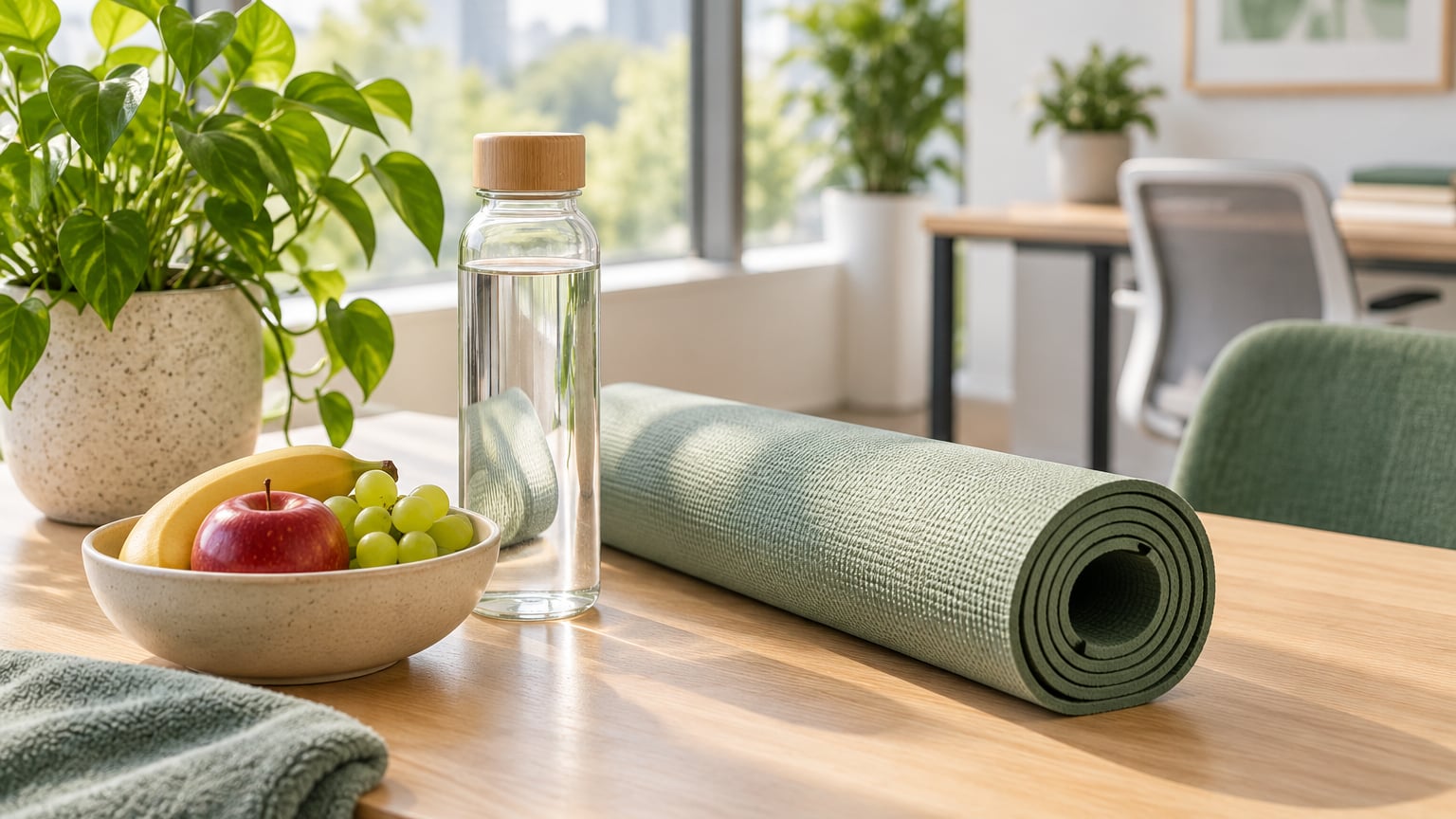
If you need wellness challenge ideas for the office, the ones that stick are small, optional, and easy to join in ten seconds flat. Pick a habit people can do at a desk, give it four to ten weeks, and let the reward be time and recognition rather than a trophy. Most office wellness challenges die from over-engineering, not from laziness.
What follows is a working set of twelve, ordered roughly from easiest to run to most involved. Each one includes how to run it, why it works, and a concrete example you can copy. I have also included the format, duration, and tracking method for all twelve in the table below so you can scan for a fit before you commit.
Table of Contents
- Wellness Challenge Ideas for the Office at a Glance
- 1. Daily Water and Hydration Challenge
- 2. Desk-to-Desk Movement Challenge
- 3. Mindful Minute Challenge
- 4. Posture Reset Challenge
- 5. Screen-Break Challenge
- 6. Sleep Routine Awareness Challenge
- 7. Healthy Meeting Snack Challenge
- 8. Stress-Free Email Break Challenge
- 9. Team Connection Walk Challenge
- 10. Sleep and Energy Tracking Challenge
- 11. Stretch and Mobility Challenge
- 12. Small Healthy Habit Team Challenge
- Frequently Asked Questions
- How long should a workplace wellness challenge run?
- What is a good participation rate for a workplace wellness challenge?
- How do you keep employees engaged past the first week?
- What rewards work best for office wellness challenges?
- Do workplace wellness challenges actually improve employee health?
- What is the 5-3-1 rule for wellness?
- Conclusion
Wellness Challenge Ideas for the Office at a Glance
| Challenge | Main focus | Workplace format | Typical duration | Individual or team |
|---|---|---|---|---|
| 1. Daily Water and Hydration Challenge | Hydration and nutrition | Kitchen board or shared tracker | 4 weeks | Individual, optional team tally |
| 2. Desk-to-Desk Movement Challenge | Movement breaks and circulation | Calendar nudge, no group needed | 2 to 4 weeks | Individual |
| 3. Mindful Minute Challenge | Stress and focus | Calendar blocks of 1 to 2 minutes | 4 to 6 weeks | Individual, optional group start time |
| 4. Posture Reset Challenge | Ergonomics and comfort | Scheduled reminder, twice a day | 4 weeks | Individual |
| 5. Screen-Break Challenge | Eye comfort and mental freshness | Hourly two-minute break | 2 to 4 weeks | Individual |
| 6. Sleep Routine Awareness Challenge | Sleep hygiene and wind-down habits | Self-directed, private | 4 weeks | Individual |
| 7. Healthy Meeting Snack Challenge | Food environment and nutrition | Rotating snack table, team-based | Ongoing or 6 weeks | Team |
| 8. Stress-Free Email Break Challenge | Boundaries, burnout prevention, focus | Three scheduled check windows | 2 to 3 weeks | Team or whole office |
| 9. Team Connection Walk Challenge | Social connection and team building | Walking meeting or group walk | Weekly, 6 to 8 weeks | Team |
| 10. Sleep and Energy Tracking Challenge | Personal energy habits and self-directed review | Private journal, no leaderboard | 2 weeks minimum | Individual, self-directed |
| 11. Stretch and Mobility Challenge | Comfort and mobility | Short guided break between meetings | 4 weeks | Individual or whole-floor |
| 12. Small Healthy Habit Team Challenge | Combined habits and small-office participation | Weekly habit board | 8 to 12 weeks | Team, no ranking |
One column in that table matters more than the others: individual or team. Teams add energy, but they also create the losers. If your office has fewer than about 25 people, skip anything that needs a team roster and start with the individual rows.
1. Daily Water and Hydration Challenge
A hydration challenge works because it needs no equipment, no app, and no gym time. You set a simple personal target, give people an honest way to record it, and check in once a week.
Why it earns a slot: most office complaints about mid-afternoon sluggishness are really complaints about sitting still in a warm room with a coffee. Mainstream health guidance treats regular fluid intake as basic self-care, not as a performance goal, so keep the framing there. No weight talk, no bottles on a scale, no comparing intake between colleagues.
How to run it: put a simple sheet or board near the kitchen with rows for names and columns for weekdays, and set the target at something achievable. Ask people to tick a box per break rather than logging ounces, because accuracy drops the moment people have to measure. A four-week run is plenty.
Concrete example: “Water Before Noon” runs the first four Mondays through Thursdays of the month. Each person marks one box per water break they take before lunch. The office posts a single tally of the whole team’s total marks on Friday, with no individual counts displayed. Weekly public accountability is the part people describe, over and over, as the reason a small habit stuck.
2. Desk-to-Desk Movement Challenge
This one is about interrupting sitting, not about working out. The target is a few minutes of movement scattered through the day, and it fits around a normal workload better than anything gym-based.
Why it works: long unbroken stretches of sitting are the default state of desk work, and the simplest fix is frequency rather than intensity. Short breaks also tend to happen when they are attached to something that already occurs, like a meeting ending.
How to run it: pick a rule before you launch. “A five-minute walk after two consecutive meetings” is easy to remember and easy to say yes to. “Ten thousand steps” is not, and it quietly excludes people with injuries, mobility limits, or caring responsibilities.
Concrete example: a four-week challenge where anyone who takes a movement break after two meetings in a row marks a dot on a wall calendar by the lift. By the end of week two, the dots themselves become the visible progress. There is more on the mechanics in our guide to workplace step challenge ideas for teams.
3. Mindful Minute Challenge
A mindful minute challenge asks for one or two minutes of quiet attention, which is a much lower barrier than a meditation course or a 20-minute session.
Why it earns a slot: it is the cheapest mental-wellbeing option on this list, it needs no equipment, and employees can do it anywhere, including at home. Be honest about what it is. This is a brief attention and breathing practice, not treatment for stress, anxiety, or burnout. If your program touches mental health at all, point people to your employee assistance program and to qualified providers rather than positioning a two-minute exercise as support.
How to run it: put the minutes in the calendar rather than in a group session. A recurring one-minute block titled “reset” that people can decline without explanation travels far better than a conference room event where attendance is visible.
Concrete example: for four weeks, a two-minute block appears in everyone’s calendar at 2:45pm on Tuesdays and Thursdays. Participation is entirely private, and the only public measure is how many people in the team say they kept the block. If you want structure for the whole program, the step-by-step on running a fitness challenge at work covers the announcement and tracking mechanics in detail.
4. Posture Reset Challenge
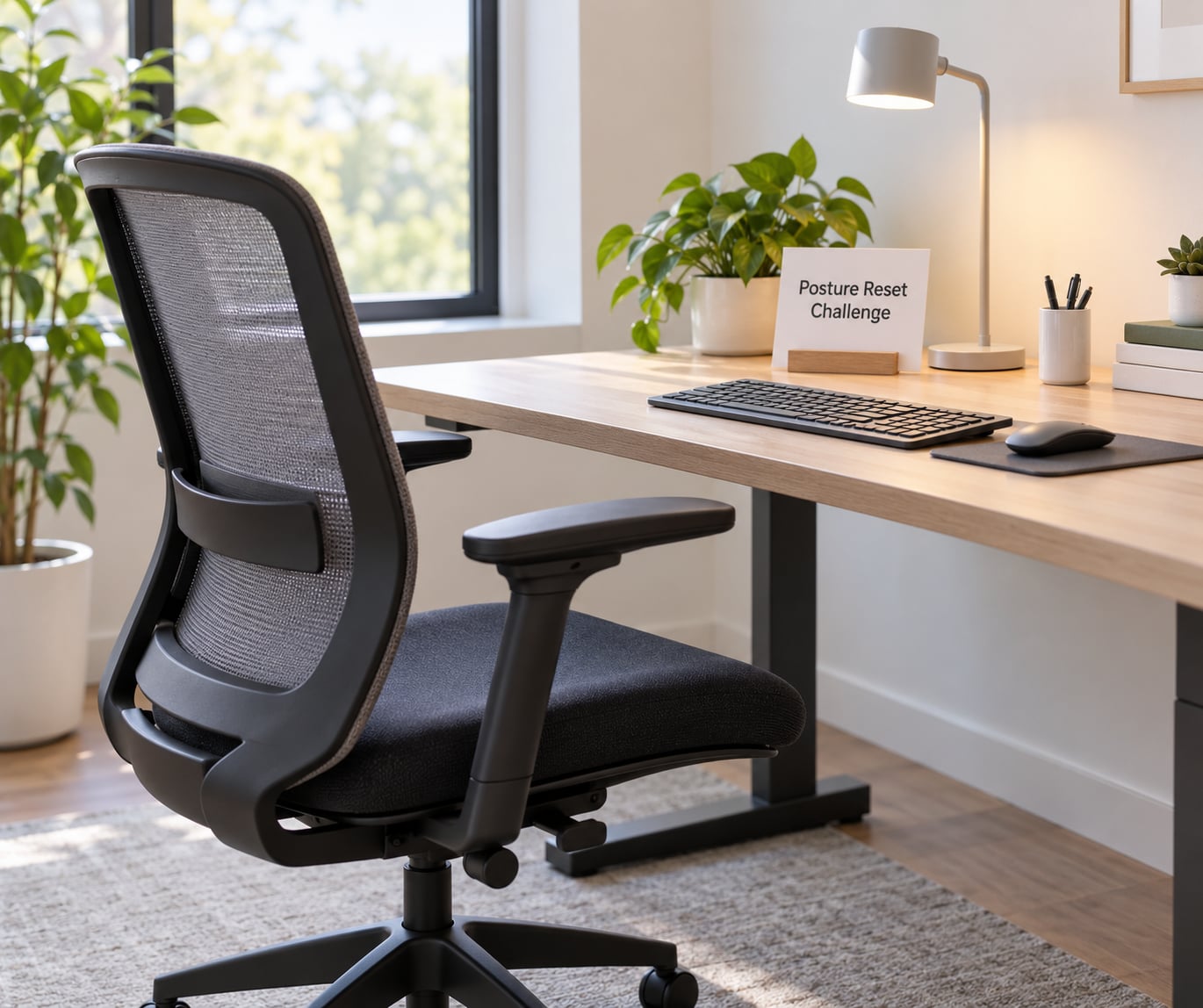
A posture reset challenge teaches a short, repeatable check that desk workers can run without thinking, then makes it easier by putting it on a schedule.
Why it matters: discomfort that builds slowly gets normalized. Most people adjust their setup once when they arrive and then spend years leaning toward a monitor. A scheduled check is the only part that reliably changes anything.
How to run it: choose a 30-second check with four things to adjust, and set it twice a day rather than continuously. Twice a day is a habit; every five minutes is background noise people learn to ignore. Keep the advice general and comfort-focused. Anyone with persistent pain, numbness, or a diagnosed condition should talk to a doctor or a qualified ergonomics professional, and workplace assessments should be arranged through the proper route rather than improvised by a wellness champion.
Concrete example: a four-week run with a reminder at 11am and 3pm that reads: feet flat, elbows near 90 degrees, screen at eye level, shoulders down. People post a single photo of their adjusted setup in the team channel on day one, then nothing after that. The photos give the whole floor a shared reference and take five minutes to collect.
5. Screen-Break Challenge
The screen-break challenge is about scheduled distance from the display. Every hour, people look at something far away for two minutes.
Why it earns a slot: it costs nothing, requires nothing, and works equally well at the office and at home. The 20-20-20 pattern, meaning roughly every 20 minutes look at something about 20 feet away for 20 seconds, is widely used as a comfort habit for screen-heavy days. Describe it that way. It is a comfort practice, not an eye test, and it is no substitute for an eye examination if someone has symptoms.
How to run it: keep it short and keep it boring. Two minutes an hour for three weeks builds a break into the muscle memory. A longer break gets skipped on deadline days; a two-minute one tends to survive.
Concrete example: the challenge runs for three weeks. Each person agrees a recurring two-minute reminder, and a shared tally in the channel counts how many breaks the team took in a week. No individual data, no screenshots, no dashboard. That last part matters more than most program designers expect.
6. Sleep Routine Awareness Challenge
This challenge is a non-competitive awareness exercise about wind-down habits, not a sleep competition and not a request for anyone’s sleep data.
Why it earns a slot: tired employees make more mistakes, and sleep is the one dimension of well-being that lives outside the office entirely, so the habits belong to the individual. The only useful thing you can do at work is make the wind-down visible and unembarrassing.
How to run it: keep participation private and refuse to collect times, durations, or app data. Give people general information from mainstream guidance and let them choose one change to try for four weeks. Anything framed as a target people could fail at is a compliance tool, and that is the version employees stop joining.
Concrete example: each participant picks one wind-down change, such as a device-free last half hour before bed, a consistent lights-out time on work nights, or a set wake time regardless of what happened the night before. The only requirement is a yes or no on a private form at the end. Where sleep or burnout is a real concern, signpost the employee assistance program instead of running a challenge about it.
7. Healthy Meeting Snack Challenge
Rather than asking people to change what they eat, this one changes what the office puts in front of them. Fruit, vegetables, nuts, or whatever your team actually eats get stocked, and the challenge is rotating who brings what.
Why it works: the food environment around a person does more to shape eating behavior than any amount of encouragement. It is also the only idea on this list that improves the office whether or not anyone formally signs up, and it does not ask anyone to weigh anything or restrict anything.
How to run it: agree a small standard, keep it loose, and let people opt out of bringing food entirely. Some employees have allergies, religious requirements, caregiving constraints, or a workplace where food in shared space is uncomfortable. A “no food” place at the table is part of the design, not an exception.
Concrete example: a rotating table with three slots for six weeks. Each week one team brings fruit, one brings vegetables, one brings nuts or a nut-equivalent, and a fourth spot is always empty for people who bring nothing. The empty spot is announced at the start, because if it is not, someone will feel odd about it. Follow the usual food safety basics for anything left out, and check with your facilities team before the table lives near communal fridges.
8. Stress-Free Email Break Challenge
This one reduces interruptions rather than adding habits. Teams pick a small number of email windows per day and close notifications outside them.
Why it matters for well-being: constant pings fragment attention, and fragmented attention is a well-documented driver of the feeling of never finishing anything. Batching email is a boundary-setting habit, which makes it as much a work-life balance intervention as a wellness one.
How to run it: agree the windows as a team, not as a rule from above, because a schedule nobody owns gets ignored in a week. Three windows a day is the number most teams can hold. One window per day is easier but rarely lasts past a busy Monday.
Concrete example: a three-week challenge with check-ins at 10am, 1pm, and 4:30pm, notifications muted in between, and a shared commitment that nobody answers urgent messages faster than the agreed window. Managers take part, visibly, because if leadership keeps pinging at 4pm the exercise is over. The reward is one shared lunch, not a prize. If the deeper issue is the workload driving the constant checking, that is a conversation about staffing, and a challenge will not substitute for it.
9. Team Connection Walk Challenge
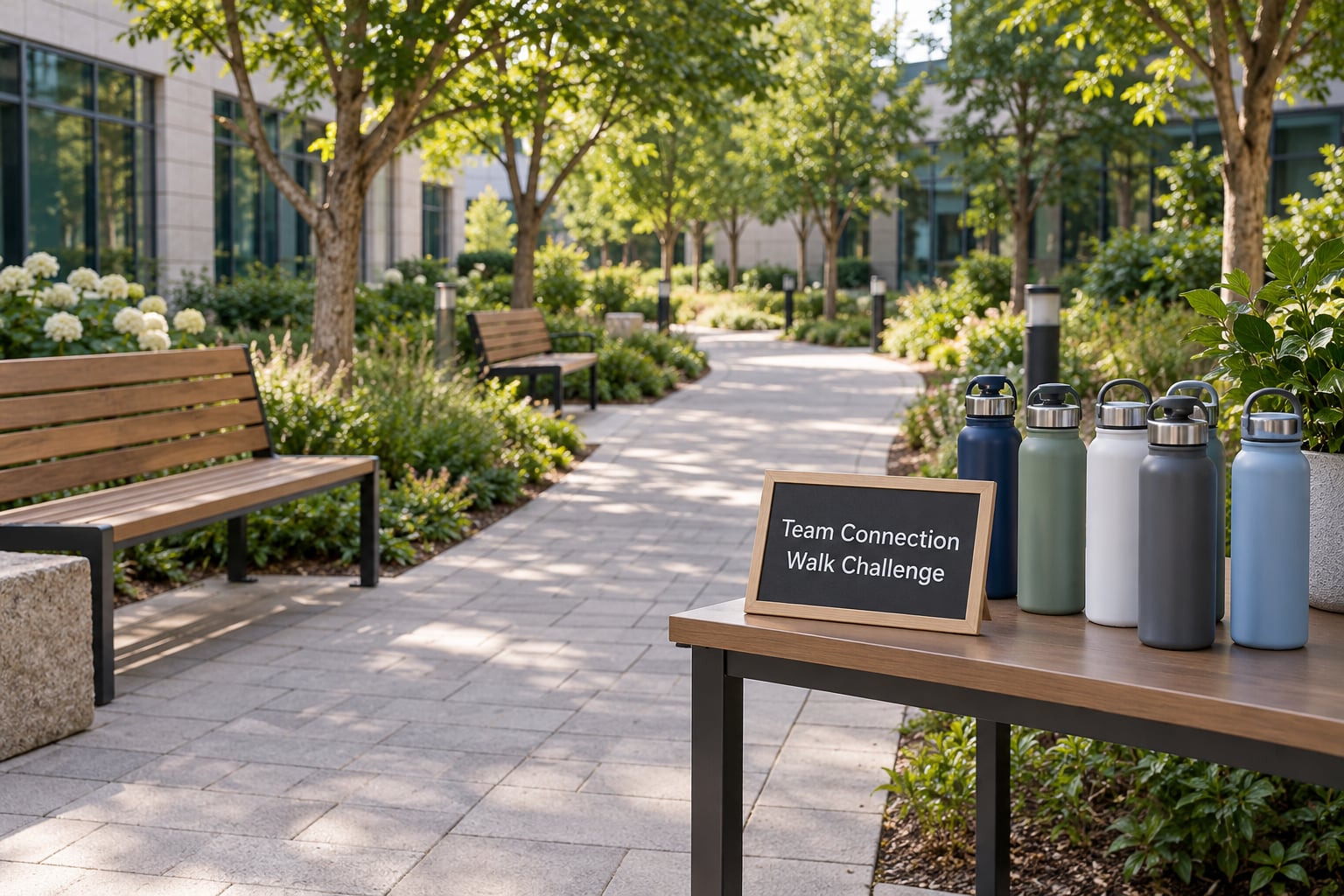
A walking meeting doubles as a team-building activity and a movement break, which is why it outlasts most one-off social events.
Why it works: walking side by side removes the table and the screen, and conversations that stall in a meeting room often move on foot. It also delivers movement, social connection, and a break from sitting in a single 15-minute slot.
How to run it: cap it at 15 or 20 minutes and keep it voluntary. For small teams, self-organized walks work better than a formal program. For hybrid teams, run it on the days the group overlaps in person rather than broadcasting an invitation that half the team cannot accept. Remote colleagues need their own version, and the usual workable one is a walking meeting where cameras are optional.
Concrete example: the same team walks for 15 minutes every Wednesday at the same time for eight weeks, leaving from the same spot each time. The consistency is the whole point. People who cannot walk can still join for the last five minutes at a bench, and a walking buddy option covers anyone who would rather not go alone. For more on making the joined-up format work, see our guide to how to get employees to participate in wellness programs.
10. Sleep and Energy Tracking Challenge
This is the fully self-directed version: each person identifies the habits that support their daytime energy, then compares two weeks against the next.
Why it belongs on the list: it is the only one of these twelve that is entirely private, and that is precisely its strength. Employees who resent being measured can still take part here, which widens the group you actually reach. The comparison is what teaches something, not the tracking.
How to run it: three to four weeks is enough, with a hard rule that no individual data is shared or collected. Give a short list of candidate habits to test, such as a consistent morning start, a short walk at lunch, water through the morning, or a protected end to the working day, and let people pick two. Do not ask anyone to track weight, calories, or mood scores on a shared sheet.
Concrete example: week one is baseline, nobody changes anything. Weeks two and three, each person tries two changes and rates their own energy at the start and end of each day on a private form. At the end, nobody reports results. If the group wants a share-back, people describe what they tried rather than how they scored, and “nothing worked” is an acceptable answer.
11. Stretch and Mobility Challenge
A stretch challenge is low-intensity movement you can do in work clothes at your desk, which is the practical constraint people care about most. Ask a room of office workers for something they can do in five minutes in a skirt or a suit and the list gets very short very fast.
Why it works: variety of position matters as much as duration, and a short mobility break between meetings gives people a genuine change of posture. Stretches that need no floor space, no gripping, and no balancing are the ones that survive a real workday, because nobody has to change clothes or find a private room.
How to run it: keep every movement gentle, keep the routine under five minutes, and use movements that require no floor space, no gripping, and no getting onto the floor. Anyone with an injury, a pregnancy, a recent surgery, or a diagnosed condition should skip the routine and check with a doctor or physiotherapist, which is worth stating plainly in the launch note rather than as fine print.
Concrete example: a three-minute routine pinned to the wall by the printer and shared in the team channel as text, because written instructions beat a video nobody can mute. The challenge runs for four weeks, with the same slot each afternoon. Participation is a tick in a shared box by the time clock, and nobody is asked to go further than the routine goes.
12. Small Healthy Habit Team Challenge
This is the one to run in an office with fewer than 25 people, where team competitions either have two teams or twelve teams of one. It combines a few inclusive habits into a shared, low-pressure goal.
Why it earns the last slot: almost every guide out there assumes team size. Small business owners keep asking peers what wellness programs they have actually run and how staff responded, and the honest answer is that anything needing teams breaks down under about 25 people. A single shared goal with no ranking sidesteps the problem.
How to run it: pick three habits from this list, put them on a board everyone can see, and count participation instead of performance. The goal is a percentage of the office taking part, not a score. Participation is also the number small employers tend to report caring about most, which is the right measure here too.
Concrete example: a ten-week board in an office of 18 people with three columns, eating a breakfast, taking a movement break, and going device-free for one evening each week. A dot per person per week fills in, and the office recognizes the week with the most participation, never the person. If the board stalls in week two, shorten it rather than piling on extra targets. One of the most common reasons a workplace wellness challenge loses people is that the design never got past week one, and a board small enough to glance at is harder to abandon.
Frequently Asked Questions
How long should a workplace wellness challenge run?
Four to ten weeks works for most office wellness challenges. Long enough for a habit to start forming and for progress to feel worth recording, short enough that people can see a finish line. Under three weeks feels pointless. Over ten, attendance drifts. If your office prefers monthly programming, run a four-week cycle and change the focus each month.
What is a good participation rate for a workplace wellness challenge?
Track two numbers rather than one: how many people signed up, and how many finished the full cycle. In a small office, thirty active participants and twenty finishing is a strong result. In a large organization, sign-ups around a third of eligible staff is a realistic target. The gap between those two numbers is where most programs quietly fail, so measure the finishers.
How do you keep employees engaged past the first week?
Week-one drop-off usually means the novelty wore off before the habit did. Shorten the gap between the launch and the first reward: a weekly team update, a mid-point check-in where people name one thing that worked, and recognition that credits effort rather than only first place. If a third of the team stops by week two, shorten the challenge rather than adding pressure to keep up.
What rewards work best for office wellness challenges?
Time, flexibility, and recognition beat swag almost every time. Popular options include a half-day of time off, a team wellness afternoon, a casual-dress day, a lunch voucher, or a donation to a cause staff choose. State the reward before sign-up opens, and run a prize draw for everyone so people who join late still have a fair chance at it.
Do workplace wellness challenges actually improve employee health?
A challenge on its own rarely changes anyone’s health. Participation drives short-term habit change and social connection, which is where most of the measurable benefit sits. Research on worksite wellness implementation finds that leadership buy-in, ease of participation, and non-punitive design decide whether a program survives, and that participation by itself does not guarantee behavior change.
What is the 5-3-1 rule for wellness?
The 5-3-1 rule is a habit checklist rather than clinical guidance: five days of physical activity, three liters of water, and one hour of something you genuinely enjoy. It circulates widely on social media, so treat it as a prompt rather than a recommendation from a doctor. All three targets fit inside a working week, which makes it useful as a ready-made team challenge.
Conclusion
Start with the screen break or the water challenge. Both take minutes to launch, both work from home as well as in the office, and neither asks anyone to be fitter, thinner, or braver than they feel on a Tuesday. Ask your team which of these twelve they would actually join before you commit to anything, then run it for four weeks and measure who finished rather than who started.
Whichever you pick from these wellness challenge ideas for the office, the design rules that decide whether it survives are the same: participation is optional, no body or weight is ever measured, remote colleagues get the same deal as floor staff, and the reward is time or recognition rather than a trophy. Updated for October 2026.