
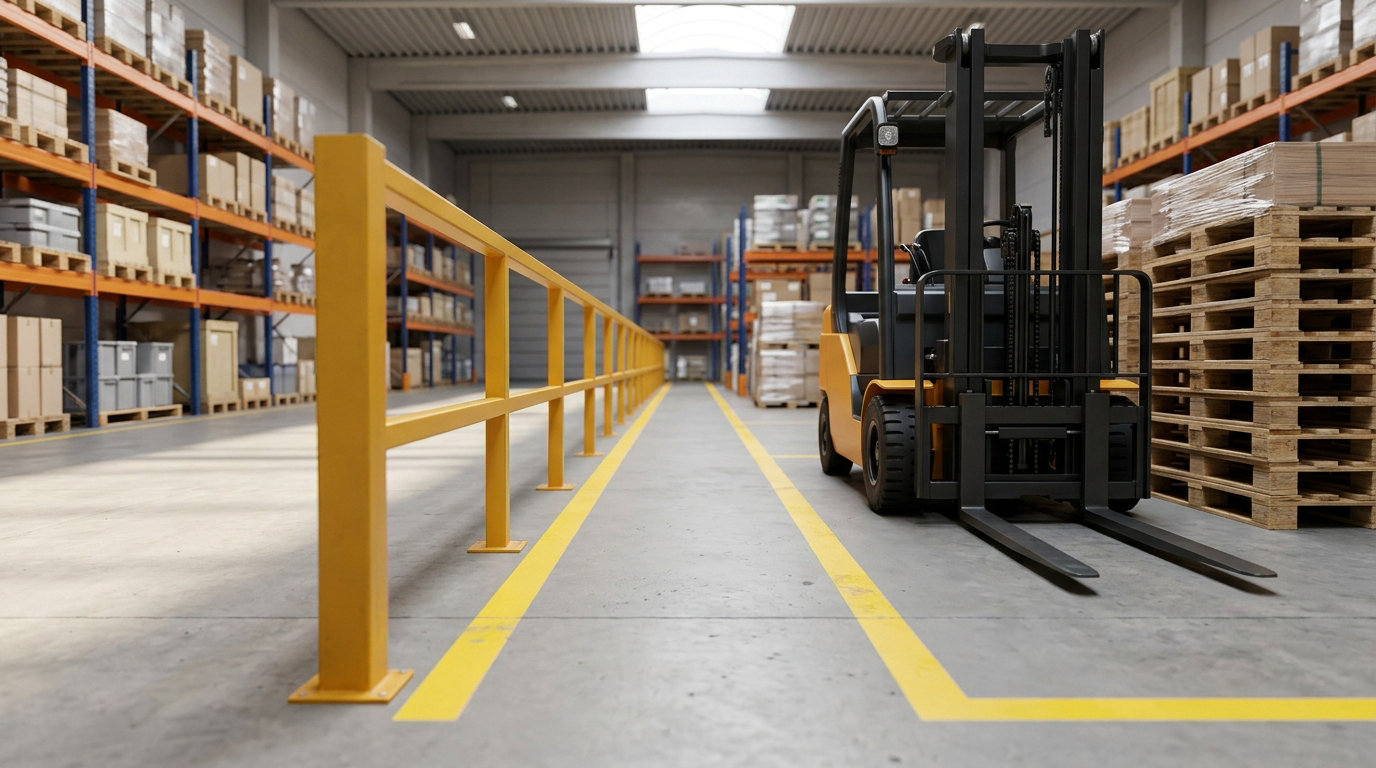
Forklift safety rules for pedestrians are the workplace rules that govern how people on foot must behave around powered industrial trucks: walk only in marked lanes and designated crossings, never stand under raised forks or loads, make eye contact with the operator before you cross, and never assume the driver can see you. The governing regulation is OSHA 29 CFR 1910.178, reinforced by the General Duty Clause.
It matters because forklifts routinely top the list of OSHA’s most-cited violations, and most of those citations come from operations rather than the truck itself. A counterbalanced forklift with a full load can weigh 9,000 pounds or more and still be moving under 10 mph, which is exactly the speed of someone walking toward a coffee break.
The injury pattern is well documented. The National Safety Council recorded 7,290 non-fatal injuries involving forklifts in 2020, and forklifts were the primary source of roughly 70 work-related fatalities the following year. Striking a pedestrian accounts for about 20% of forklift accidents, the second-leading cause behind struck-by impacts involving other vehicles.
Last updated October 2026. This guide covers what pedestrians must do, what operators must do, and where the two rule sets meet.
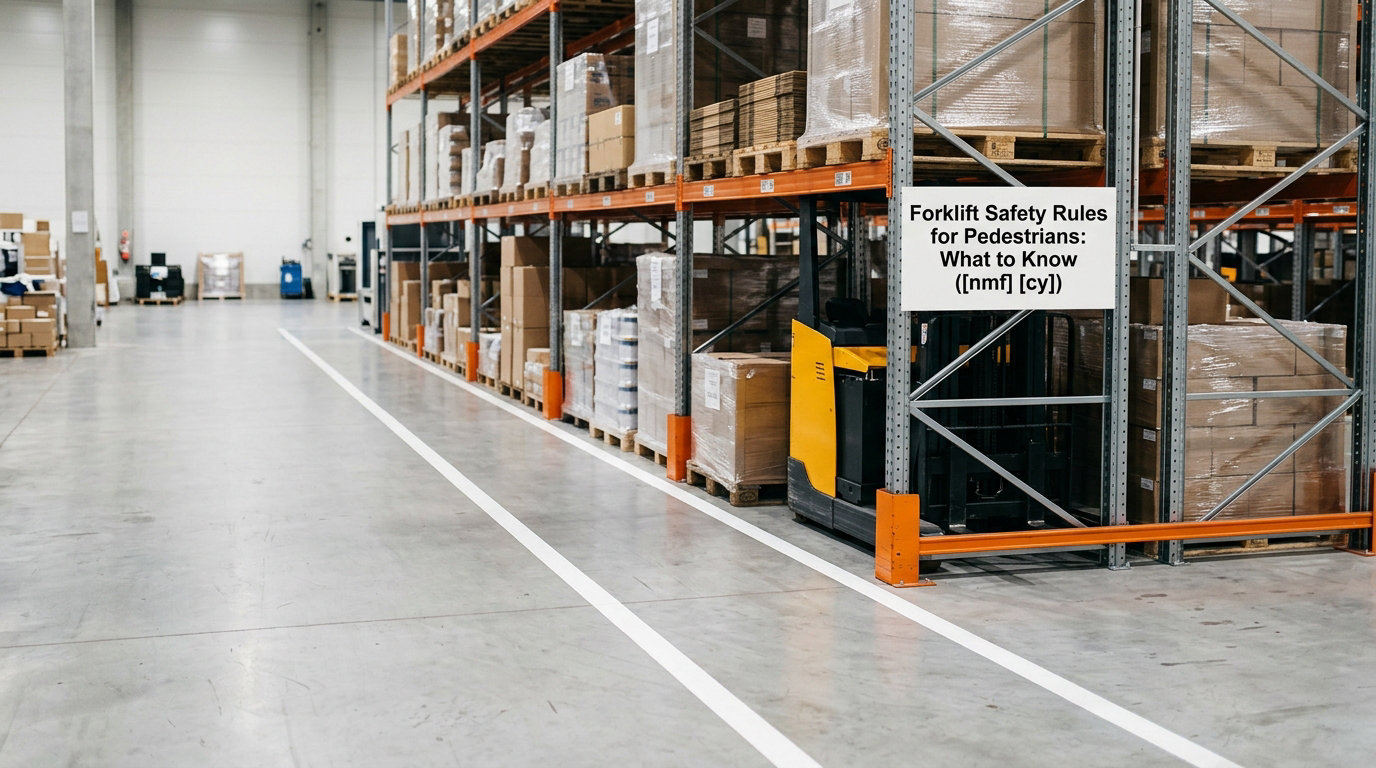
Table of Contents
- Forklift Safety Rules for Pedestrians: The Ten Rules That Matter
- What Areas Should Pedestrians Avoid Around Forklifts?
- How Should You Move Around an Operating Forklift?
- What Should Pedestrians Wear in Forklift Areas?
- What Should You Do If You Cannot Be Seen by a Forklift Operator?
- How Can Employers Reduce Forklift-Pedestrian Risks?
- Frequently Asked Questions
- What are the OSHA regulations for forklifts and pedestrians?
- Do pedestrians have the right of way with forklifts?
- What is the 3 foot rule for forklifts?
- What is the OSHA 25 foot rule for forklifts?
- Is forklift pedestrian training required by OSHA?
- Can you walk under raised forklift forks or ride as a passenger?
- Conclusion
Forklift Safety Rules for Pedestrians: The Ten Rules That Matter
Every rule below is written as a short imperative because that is the format safety briefings and training cards use. If your site has a written forklift safety policy, these are the ten lines it should contain.
- Walk only in designated pedestrian lanes and marked crossings, never in the forklift travel lane.
- Make eye contact with the operator before you cross an aisle, and never assume they have seen you.
- Never stand, walk, or sit under raised forks or a suspended load.
- Keep out of exclusion zones, including the space behind the truck and the counterweight swing radius.
- Cross at right angles to the travel path so you stay visible for as long as possible.
- Put the phone away and take one earbud out before entering any forklift area.
- Wear high-visibility apparel rated to ANSI class 2 or better, plus slip-resistant safety-toe footwear.
- Stop at marked crossings and wait until the operator has stopped and acknowledged you before you step into the aisle.
- Expect the truck to reverse. Look behind you before you pass an aisle opening, a column, or a parked load.
- If you are cornered with no escape route, press yourself flat against a wall or rack and let the truck pass.
Rule ten is the one people freeze on. A cornered pedestrian has three options: move toward the operator so they can see you, move sideways into a marked pedestrian lane if one is within reach, or stop moving entirely and flatten against the nearest solid surface. Running straight forward into a loaded truck is the worst of the three.
Rule seven has a standard behind it. ANSI class 2 high-visibility apparel is the usual specification for anyone working around powered industrial trucks, and a plain yellow vest does not automatically meet it.
What Areas Should Pedestrians Avoid Around Forklifts?
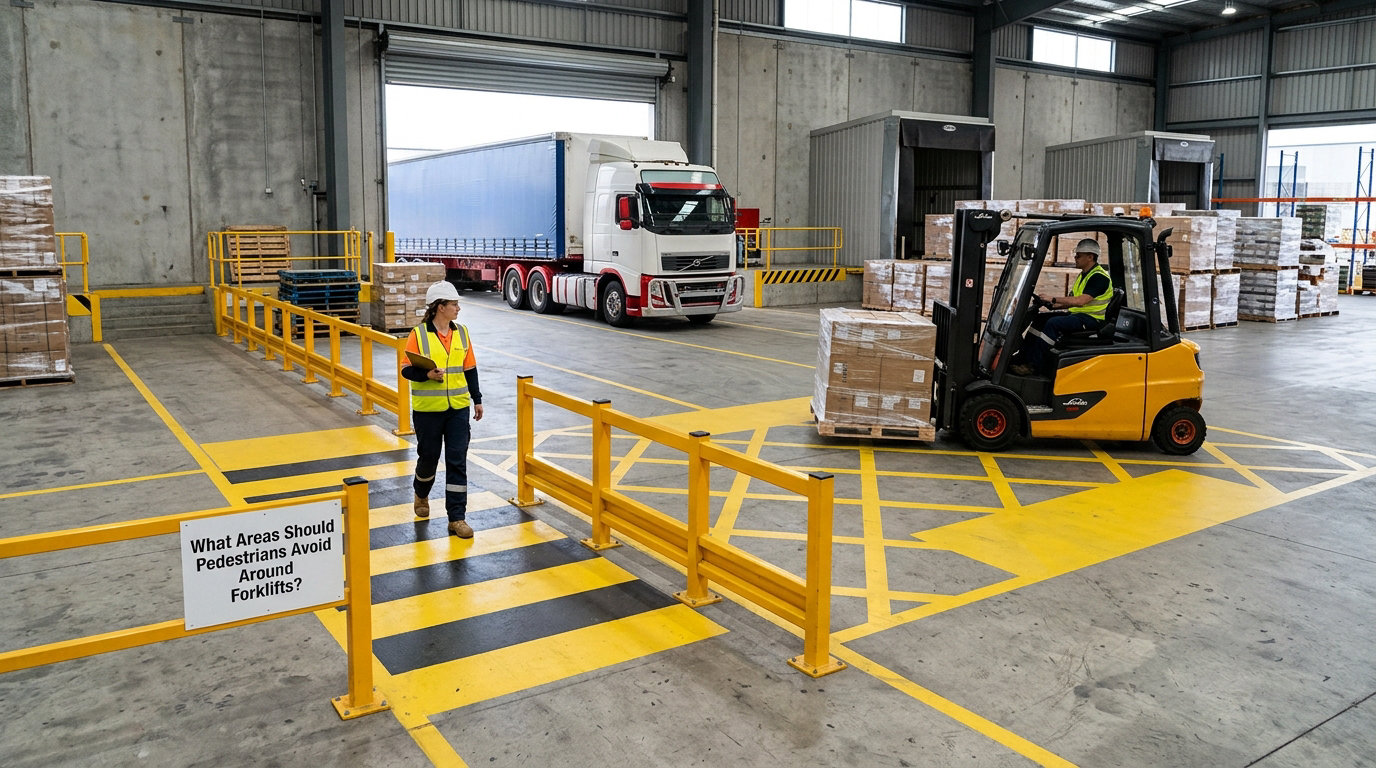
The dangerous areas are predictable once you understand why a forklift is hard to see. A sit-down counterbalanced truck has almost no forward visibility with the mast down, the operator sits behind a low overhead guard, and the load itself blocks the rest. The result is a zone of danger that extends several feet beyond the truck in every direction except directly ahead.
Behind the truck and the counterweight swing
The single most common strike happens while the truck reverses or turns. The rear swing radius of a counterweighted truck reaches further than most people expect, and a pedestrian who walks behind a parked forklift can be clipped by the counterweight even when the operator is stationary and the parking brake is set. Treat the entire rear arc as off limits.
Cross-aisle intersections and blind corners
Aisles are the most dangerous place in a building. Operators describe the worst locations as blind spots, elevator approaches, and tight corners where they have to guess whether anyone is coming. Pedestrians should stop at the marked crossing, look both ways, and never assume a truck on the perpendicular aisle can see them through racking.
Narrow aisles and racking lines
In a pick module or a narrow aisle truck configuration, a pedestrian cannot pass safely. There is no shoulder. The correct answer is to leave the aisle and use a designated crossing or a parallel pedestrian lane, not to squeeze past with your back to the operator.
Loading docks and trailer interiors
Dock areas mix forklifts, trailers, and truck drivers who have no reason to be walking in a live vehicle path. Pedestrians should stay behind the dock leveler, out of the trailer swing, and inside a designated staging area. Inside a trailer, a full-width spotter is the only acceptable arrangement.
Blocked sightlines from oversized loads
Paper and packaging plants, and any operation moving oversized rolls, create blind spots that no amount of signage fixes. Where sightlines are blocked, pedestrians should treat the corner as a stop-and-contact point rather than a look-and-go point.
So where is it okay to walk? In marked pedestrian lanes, on painted walkways, inside barrier-protected corridors, and through crossings designed for foot traffic. If a path is unmarked and inside the traffic area, ask your supervisor where the intended route is before you start using it.
How Should You Move Around an Operating Forklift?
Movement is where most near misses happen, because both sides are moving and both sides assume the other one is paying attention. Pedestrians have the right of way, and the operator has the harder job of yielding it. Forum discussions among safety professionals about forklift and pedestrian interaction keep returning to the same three causes: poor visibility at intersections, no clear separation between routes, and excessive speed in busy areas.
What the 3 foot rule actually means
The 3-foot rule is a facility safety standard rather than a federal OSHA requirement, and it has two halves. The operator must stop and remain stopped while a pedestrian is within about 3 feet of the truck, and the pedestrian should keep a similar buffer rather than closing to within 3 feet. It exists because a loaded truck’s stopping distance and its rear swing mean the driver needs room, and the walker needs a margin to back out of.
Treat it as a no-argument floor. If a truck stops for you at 3 feet, wait until the driver has fully stopped and made eye contact before you close the remaining distance.
Approaching a stationary or parked truck
Walk up from the side, never from directly behind, and announce yourself if the operator is in the seat. If you need to reach into the forks or the load area, make sure the truck is lowered, the key is out, and the parking brake is set. A truck that is idling with a raised mast is not a stationary truck.
Passing a moving truck
Never pass a moving forklift traveling in your direction of travel. If you must pass, do it on the operator’s side, at a distance, at a slower pace than the truck, and only after the operator has seen you. If you are on the operator’s blind side, back away instead.
Crossing in front of a moving truck
Never cross in front of a moving forklift. The driver may be focused on the load, the destination, or a reversing light, and the front of a truck is the one place the driver is least likely to be watching for a person at ankle height. Cross behind the truck only when it is fully stopped, or better, at a marked crossing.
Changing direction or reversing your own path
Most pedestrian strikes involve a person who was stationary, with their back to the traffic. Before you step out from behind a rack, a column, a stack of pallets, or a parked trailer, look both ways and behind. Give yourself a full second of stillness before you move.
The operator rules you can count on
Pedestrian rules are only half of forklift pedestrian safety. The operator side of the rule set generally includes yielding right of way, slowing to about 3 mph in foot-traffic areas, sounding the horn at blind intersections and obstructed views, stopping when a pedestrian is within 3 feet, using a spotter where visibility is limited, wearing the seat belt, and never carrying passengers. If an operator is not doing those things, that is a reportable behavior, and you should raise it with your supervisor.
What Should Pedestrians Wear in Forklift Areas?
Personal protective equipment is the least effective control on this list, and it is still required. Engineering controls like barriers and marked lanes do more than a vest, but nobody gets to skip the vest because the floor is well marked.
- High-visibility apparel rated to ANSI class 2 as a minimum, in a color that contrasts with the environment. A fluorescent yellow vest disappearing against a stack of yellow cardboard is not doing its job.
- Safety-toe, slip-resistant footwear. Warehouse floors are polished concrete, and a pedestrian who falls into an aisle is a pedestrian an operator will not see in time.
- Nothing loose and nothing trailing. Lanyards, badge reels, long sweatshirt cords, open jacket hems, and dangling keys can catch on a mast, a chain, or a moving wheel. Tuck them in or take them off.
- Long hair tied back and secured if you work near moving equipment or chain-driven conveyors.
- Hearing protection that lets you hear the truck. If your role requires hearing protection, use the over-the-ear or banded type that still allows backup alarms and horns to be heard, and confirm it with your safety lead.
One more habit matters more than any item on that list. A vest makes you visible; it does not make you predictable. Looked-at is not the same as seen-by, and a driver can look directly at you and still have a mast, a load, and a rack in the way.
What Should You Do If You Cannot Be Seen by a Forklift Operator?
There are three situations where visibility fails, and each has a different response. The common thread is the same: stop, get to a known safe location, and establish contact.
The sightline is blocked
If a load, a rack, a column, or another load makes you invisible, do not step out to test whether the driver sees you. Back into a marked pedestrian lane or a bay, or wait for the truck to pass. If you have to cross a blocked line of sight, do it only after making eye contact with the operator from a position where you can both see each other, and only after they have stopped.
Traffic is stalled and you cannot move
Standing between two trucks with no gap is the situation that turns into a crush. Move to a safe pocket: the end of a rack, a cross-aisle, a marked refuge area, or a stair landing. If nothing is available, flatten against a solid surface, keep your arms in, and hold position until the truck moves. Do not try to squeeze through a shrinking gap between a moving load and a rack face.
The truck is heading toward you
Step out of its path rather than across it, and get to eye level with the operator if you can do so safely. If you cannot be seen, do not run behind the truck, because the driver will reverse. Face the operator, make yourself as large as possible, and be prepared to move laterally at the last moment. If the truck stops and the operator looks your way, do not approach until they invite you forward.
After a near miss or a strike
Report every near miss the same day, even when nothing was hit. Near-miss data is the cheapest accident-prevention tool a site has, and several of the practice problems safety teams discuss actually start with a report nobody wrote down.
After an actual strike, get medical attention first, even if the injury looks minor, then report it. In the United States, recordable injuries go on the OSHA 300 log, and the injured party’s employer carries the reporting obligation. If you are the injured party and the report never gets filed, raise it with your supervisor or your union representative.
How Can Employers Reduce Forklift-Pedestrian Risks?
Individual behavior is the last line of defense, not the first. A site that manages forklift-pedestrian risk properly controls the environment first, sets the rules second, and trains people third.
Split the responsibility clearly
The confusion that causes strikes is usually a confusion about who is supposed to yield. Writing the two rule sets side by side removes it. Here is how the six most common situations break down, with what the person on foot owes the operator and what the operator owes the person on foot.
- Meeting in an aisle. The pedestrian stays in the marked lane and makes eye contact. The operator yields, slows to about 3 mph, and stops if unsure.
- Pedestrian within 3 feet. The pedestrian does not close the remaining distance until the truck is stopped. The operator stops immediately and remains stopped.
- Blind corner or cross-aisle. The pedestrian stops, looks, and listens for the horn. The operator sounds the horn and proceeds slowly.
- Truck reversing. The pedestrian expects it and never walks behind a truck. The operator uses the backup alarm and reverses slowly.
- Raised load in transit. The pedestrian never stands or passes beneath it. The operator carries forks low, about 6 inches, when not picking.
- Limited visibility. The pedestrian stays clear of the zone of danger. The operator uses a spotter or a pedestrian-occupied equipment mode.
Separate people from machines physically
Floor striping, hazard crosshatching, guardrails, bollards and a continuous pedestrian route are the controls that reduce strikes most, because they remove the decision from the moment. Mark the exclusion zone behind each truck position, not just the travel lane. Put mirrors or cameras at cross-aisle intersections where a driver physically cannot see through the racking.
Add technology that warns before a person is in danger
Hardware and detection systems are increasingly common, and they fall into a few categories worth understanding before a vendor pitches them.
- Zone warning lights project a colored beam on the floor ahead of and behind the truck, showing the operator exactly where the danger zone is.
- Backup alarms, horns, and blue LED safety lights warn pedestrians of an approaching or reversing truck. They are cheap, and they depend entirely on the pedestrian being alert.
- Proximity and UWB wearable tags detect a tagged person near a truck and slow or stop it. They work but require workers to wear the tag, so they suit controlled environments better than open yards.
- Vision-based pedestrian detection uses cameras to identify a person in the truck’s path without a tag, which is why it is increasingly common in cold storage and low-light facilities.
- Automatic braking and slow-down zones apply a speed limit near defined areas such as a dock door or a crossing.
None of these replaces a marked walkway. They are the last layer before the person, not a reason to skip the first one.
Why forklift safety rules for pedestrians are left to employers
This is the compliance gap most sites get wrong. OSHA mandates operator training and certification under 1910.178(l), with recertification typically every three years and retraining required after an incident or a change in conditions. It does not mandate training for pedestrians. There is no federal requirement that a picker or a visitor be trained on forklift rules.
That leaves the highest-frequency exposed group with the least legal protection, and it is a gap most safety teams close voluntarily. It is also why orientation for agency, temporary, and contractor workers matters so much. Temporary and agency workers are the group most likely to miss forklift orientation entirely, and they are the group most likely to be walking in an aisle nobody thought to teach them about.
What the 25 foot rule actually refers to
The 25-foot rule is not a pedestrian rule. It comes from the hazardous-location driving requirements in 29 CFR 1910.178(n), which cover where an operator may drive a powered industrial truck: near the edge of an unprotected ramp or drop-off where the surface is not level, near unguarded floor openings, and where there is a danger of falling more than 12 inches. Operators are required to slow down and use extra caution in those situations.
If you have seen the 25-foot figure quoted as pedestrian clearance or separation distance, it has been misused. Treat it as an operator edge-of-drops rule and nothing more.
Handle visitors, contractors, and truck drivers
Visitors and delivery drivers are the pedestrians most likely to be unescorted in a live traffic area, and the ones who will not be wearing a vest. Escort them or control them with the same discipline you would apply to a new hire: a waiting area outside the traffic zone, a briefing before entry, and a named person responsible for them. A locked secondary dock door is a good control. So is a driver waiting room with a line of sight to the dock.
Finally, treat visibility as an operating condition, not a fixed one. When a lane gets stacked above eye level, when lighting fails, or when a new product changes how loads are handled, the traffic plan needs to be re-walked by both operators and pedestrians. Rules that were safe with a clear sightline are not automatically safe after the sightline disappears.
Frequently Asked Questions
What are the OSHA regulations for forklifts and pedestrians?
OSHA 29 CFR 1910.178 covers powered industrial trucks, and it is written around the operator: training and certification under 1910.178(l), hazardous-location driving under 1910.178(n), and general safe operating practice. It does not contain a pedestrian-specific rule set. Pedestrian duties come from the General Duty Clause, Section 5(a)(1) of the OSH Act, and from the employer’s own written traffic rules, which is why site policies vary so much.
Do pedestrians have the right of way with forklifts?
In practice, yes, and every site policy says so. The operator has the legal duty to yield and to stop when a pedestrian is within about 3 feet of the truck, which is also why the operator holds the harder obligation in a collision. But holding right of way is not permission to walk into a travel lane. The pedestrian’s job is to use designated routes, make eye contact, and never assume the driver has seen them.
What is the 3 foot rule for forklifts?
The 3 foot rule is a facility standard, not a federal OSHA requirement. It has two sides: the operator must stop and stay stopped while a pedestrian is within roughly 3 feet of the truck, and the pedestrian should keep a similar buffer instead of closing the gap. It exists because a loaded truck needs room to stop and its rear swing reaches further than people expect, leaving the walker no margin to step back.
What is the OSHA 25 foot rule for forklifts?
The 25 foot rule is not a pedestrian clearance rule. It comes from the hazardous-location driving requirements in 29 CFR 1910.178(n), which apply when an operator drives near an unprotected ramp edge, an unguarded floor opening, or a place where a fall of more than 12 inches is possible. In those areas the operator must slow down and use extra caution. If a site quotes 25 feet as pedestrian separation, the policy is being applied incorrectly.
Is forklift pedestrian training required by OSHA?
No. OSHA requires operator training and certification, with recertification typically every three years and retraining after an incident or a change in conditions. There is no federal mandate that covers pedestrians, even though pedestrians are struck in roughly a fifth of forklift accidents. That gap is why agency, temporary, and contractor workers walking an unescorted aisle is such a common finding on safety audits.
Can you walk under raised forklift forks or ride as a passenger?
Never. Walking or standing under raised forks or a suspended load is the rule people break out of curiosity or hurry, and a dropped load does not care which. Riding on the forks is prohibited outright, and riding inside the cab without a seat belt is prohibited as well. If you need to reach into a load area, confirm the mast is lowered, the key is out, and the parking brake is set first.
Conclusion
The first thing to do is simple: know where your designated pedestrian route runs and walk it. From there, stay outside the exclusion zone, keep out from under anything raised or suspended, and treat every aisle crossing as a stop-and-contact moment until you have seen the operator see you.
None of that is complicated. It just has to be automatic, and it has to hold on the day you are late and the aisle is short.