
Oil and gas field worker safety basics are the hazard awareness, protective equipment, permit rules, and emergency procedures every new field worker must know before stepping onto a well site, production facility, or pipeline pad. Getting them right is what keeps a crew working and everyone coming home at the end of the rotation.
There is no single oil and gas safety standard you can read once and be done with. Upstream work is governed by a patchwork of OSHA rules, company life-saving rules, and site-specific procedures, and the gaps between those documents are where new hires get hurt.
This guide walks through what the basics actually cover, how to prepare before you enter a site, how to control the hazards you will actually meet, and what to do when something goes wrong. It is general guidance, not a substitute for your employer’s site induction, permits, or job safety analysis. Those always win.
Table of Contents
- What Are the Core Oil and Gas Field Worker Safety Basics?
- How Do You Prepare Before Entering a Well Site?
- How Do You Control the Main Oil and Gas Site Hazards?
- How Do You Choose and Use the Right PPE?
- How Do You Work Safely Around Vehicles and Heavy Equipment?
- How Do You Prevent Fatigue, Heat Stress, and Cold Stress?
- What Should You Do During an Emergency?
- How Do You Stop Work and Report an Unsafe Condition?
- Frequently Asked Questions
- What safety training do oil and gas workers need before working on a site?
- What PPE do oil and gas workers wear on a well site?
- Who is responsible for safety, the operator or the contractor?
- Is it safe to work alone at a remote well site?
- Why is hydrogen sulfide so dangerous in oil and gas work?
- How should a field worker respond to an emergency on site?
- Conclusion
What Are the Core Oil and Gas Field Worker Safety Basics?
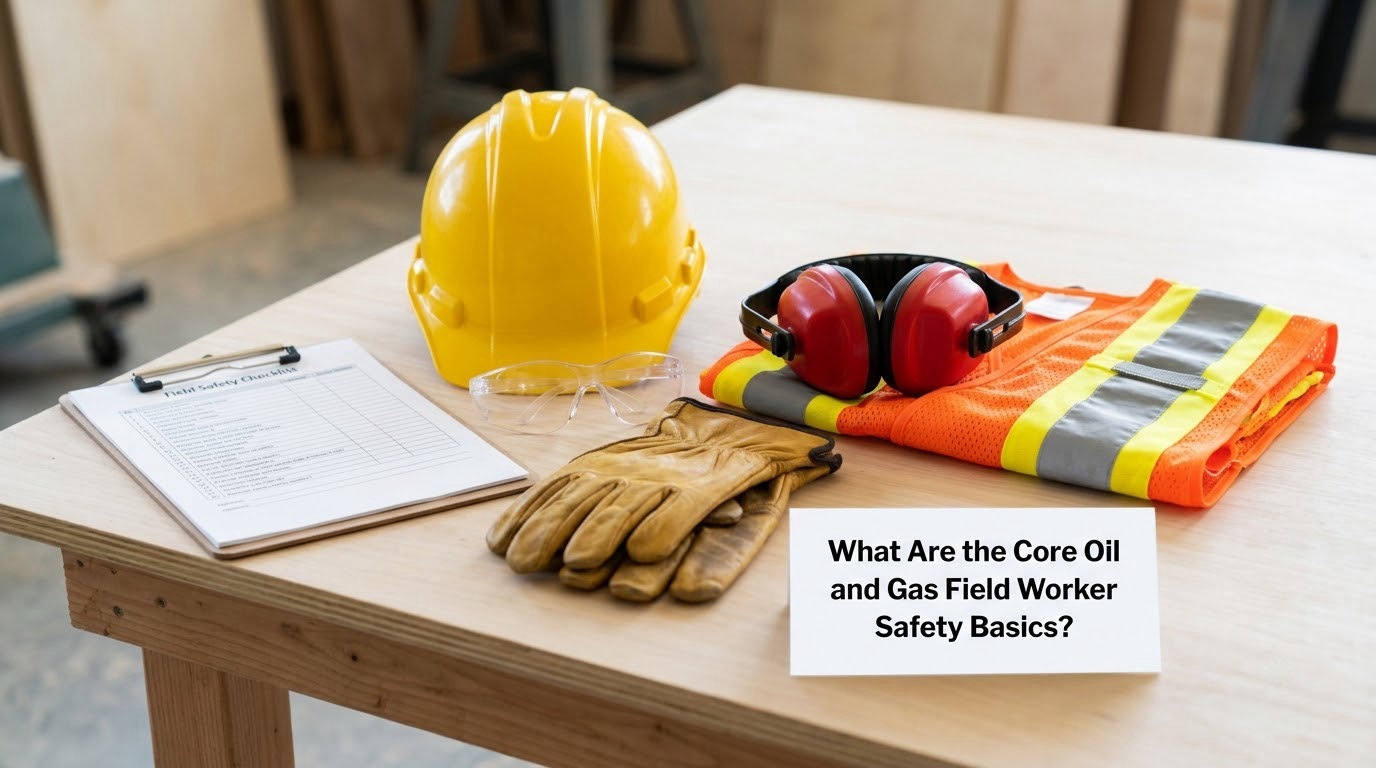
Six things sit at the centre of oil and gas field worker safety basics: recognizing hazards before you start, being trained and authorized for the task, planning the job, controlling hazardous energy, communicating clearly, and stopping work when conditions are not safe. Everything else is detail built on those.
The underlying principle is simple. Oil and gas extraction carries one of the highest fatality rates of any major industry. More than 118,000 US workers were employed in oil and gas extraction and support roles in 2022, and the International Association of Oil and Gas Producers reported 20 fatalities across 15 incidents in 2021. Vehicle crashes are the leading cause of death, and workers with less than six months on the job are dramatically overrepresented among the fatalities.
New workers are not careless. They are unfamiliar with how a rig actually works, and unfamiliarity looks exactly like carelessness from the outside.
| Risk Area | What It Looks Like on Site | Preventive Action |
|---|---|---|
| Well control | Unexpected pressure, kicks, or influxes | Job safety analysis, barrier verification, well control briefing before operations start |
| Hazardous gases | H2S, hydrocarbon vapour, oxygen deficiency | Gas test before entry, personal detector, alarm set points, escape route upwind |
| Working at height | Derricks, ladders, monkeyboards, platforms | Fall arrest with a rated anchor, guardrails, three points of contact |
| Mobile equipment | Cranes, service trucks, forklifts, excavators | Designated walkways, spotters, seat belts, blind-spot awareness |
| Stored energy | Pressurized lines, suspended loads, energized circuits | Permit to work, lockout/tagout, verified isolation and zero energy |
| Human factors | Fatigue, heat, cold, shift rotation, lone work | Planned breaks, hydration, buddy checks, fitness-for-duty reporting |
Worth noting: general awareness training on its own will not make you competent on a specific rig. Your employer still has to train you on the equipment, procedures, and hazards of that site.
How Do You Prepare Before Entering a Well Site?
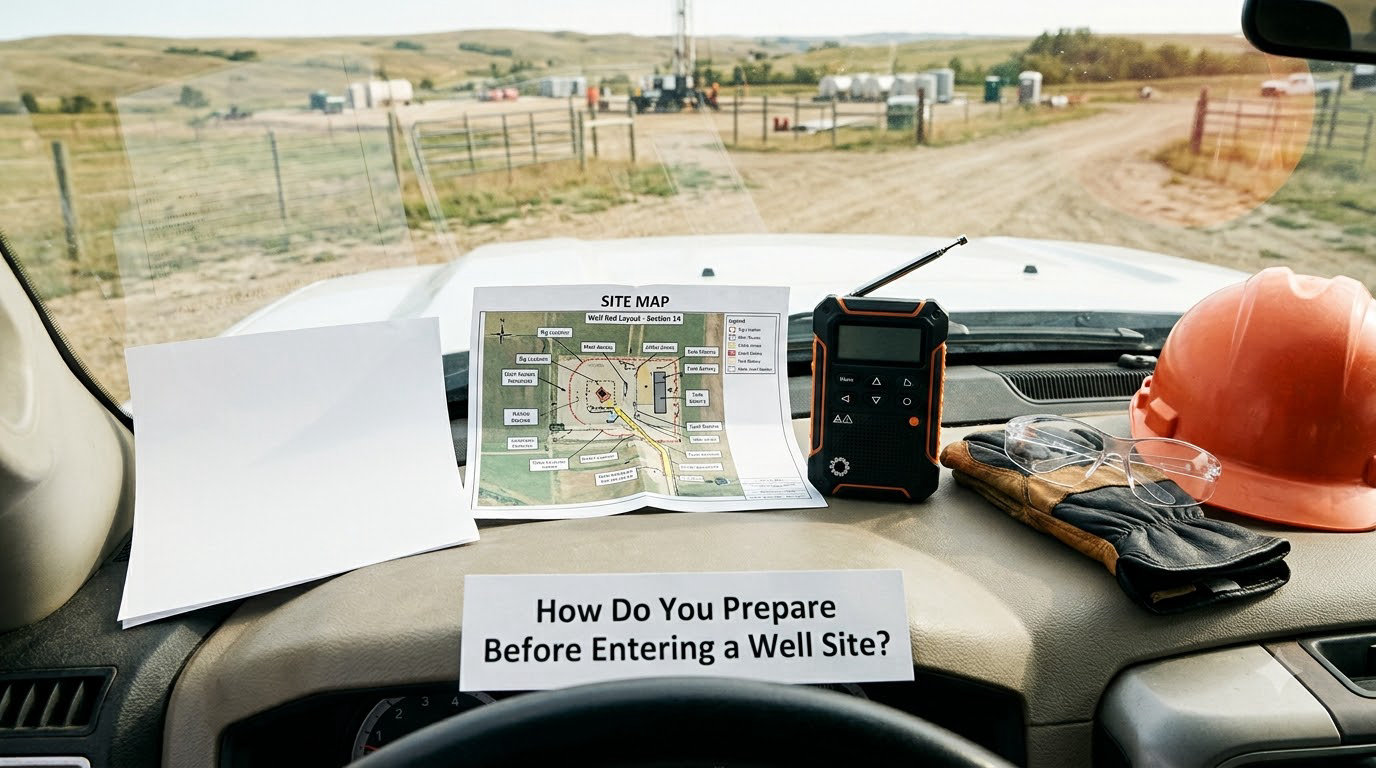
Preparation is the part workers skip when they are behind schedule, which is exactly when it matters most. Most of what prevents an incident happens before you touch a tool.
Start with the job plan. Know what the task is, what could go wrong, and what the critical steps are. Then confirm you have the authorization for it: a valid permit, a completed job safety analysis, and the competency sign-off your role requires. A permit issued for a different scope is not your permit.
Next comes the site itself. Review the site rules, the restricted and hazardous area map, the alarm signals, and where your muster point is. Check the weather, because wind direction decides which way you run in a gas release and which muster point is usable.
Finally, check your equipment and your people. Inspect the PPE you are about to wear. Confirm the emergency contacts and the radio channel. If you are travelling to a remote pad, tell someone your route and expected arrival.
A pre-start checklist you can keep in your truck or on your phone:
- Job plan reviewed and I can describe the critical steps
- Permit to work valid, correct scope, correct location
- Job safety analysis signed and understood
- Competency and authorization current for this task
- Gas test completed where required, readings within limits
- PPE inspected: helmet, eyewear, hearing, gloves, boots, respiratory
- Muster point and route identified, wind direction noted
- Emergency numbers and radio channel confirmed
- Tools inspected, guards in place, energy isolated
- Buddy or watch assigned if working alone or at height
If any line cannot be ticked, that is a conversation with your supervisor before work starts, not after.
How Do You Control the Main Oil and Gas Site Hazards?
Recognition is only half of it. The second half is the control, and the control depends on the hazard class.
Drilling and well control risks
Pressure you did not plan for is the hazard that ends careers fastest. Barriers between the well and the formation are verified by the well control team before operations proceed, and any change to the well condition triggers a review. Ask what the current barrier status is if you cannot find it in the plan.
Heights and dropped objects
Fall protection only works if it is the right system on a rated anchor. A harness worn loosely, clipped to a pipe railing, or connected to a fall-arrest lanyard that stretches under load will not hold you. Guardrails, toe boards, and tool lanyards do more for most crews than the emergency equipment they rarely need.
Vehicles and mobile equipment
Anything that moves is a hazard until it is parked and made safe. More field deaths come from vehicles than from any other single cause, and most happen in parking lots and driveways, not on the highway.
Hazardous chemicals and gases
Hydrogen sulfide is the one most workers underestimate, because at high concentrations it destroys your sense of smell before it stops you. Never rely on detecting it by odor. Personal gas detectors, fixed alarms, and escape respirators are the controls, and the alarm set point on your site tells you what to do next.
Crude, condensate, and drilling fluids also carry benzene and other aromatics, and silica dust shows up around frac and cement work. Routes of entry are the same four every time: breathing, skin, ingestion, and injection through a cut.
Noise
Noise-induced hearing loss is cumulative and permanent. It arrives quietly, at compressor decks, mud pump areas, and near the shaker. Hearing protection works, but only if it is worn consistently, and fit matters more than the model.
Confined spaces
Tanks, vessels, pit cells, and many production vessels are confined spaces, and some are permit-required under 29 CFR 1910.146. Under that rule the entrant, the attendant, and the entry supervisor each have defined jobs, and the attendant never enters and never leaves the post. No permit, no entry, no exception for a five-minute look.
Electrical exposure
Temporary power, damaged leads, and moisture near electrical equipment cause shocks and fires that are entirely preventable. Lockout/tagout means verifying zero energy, not just flipping a switch and hoping.
Extreme weather
Thunderstorms, high wind, lightning, ice, and dust stop work outdoors for a reason. Most sites have a defined trigger point, and it is not your judgment call to make alone.
How Do You Choose and Use the Right PPE?
Routine PPE is the layer you wear every shift, and task-specific PPE is the extra protection for a particular job. Mixing the two up is common: a pair of gauntlet gloves great for handling pipe can be a fire hazard near a flare, and a dust mask will not protect you from a gas no matter how comfortable it feels.
- Head: hard hat with chin strap for overhead and lifting work
- Eyes and face: safety glasses as the default, face shield for grinding, cutting, and hot work
- Hearing: plugs or muffs in posted noise areas, fitted to the ear canal not held in place by the headband alone
- Hands: task-matched: cut-resistant for wire rope, chemical-resistant for hydrocarbons, insulated for electrical
- Feet: steel or composite toe with slip-resistant sole and ankle support on uneven ground
- Respiratory: air-purifying respirator only for contaminants with a known cartridge, and only after a proper fit test; escape respirator for gas; SCBA for an unknown or oxygen-deficient atmosphere
- Fall protection: full-body harness, rated anchor, and connectors matched for the fall distance including clearance below
- Flame-resistant clothing: required where flash fire risk exists, and it does not protect you from a flare directly
Inspect before every use. A cracked shell, a torn strap, a missing filter cartridge, or a scratched lens is a replacement, not a repair. Look for the ANSI or EN marking, and check the standard it carries applies to the hazard.
One more thing worth saying plainly: PPE is the last line of the hierarchy of controls, below elimination, substitution, engineering controls, and administrative controls. When someone tells you to put on a respirator to fix a ventilation problem, ask whether the room can be ventilated instead.
How Do You Work Safely Around Vehicles and Heavy Equipment?
Walk where you can be seen and stay in designated walkways. Between parked trucks is a blind corridor where the driver has no idea you exist, and backing up adds the second vehicle you cannot see.
Assume the operator cannot see you until you have made eye contact. Do not approach a reversing vehicle or a swinging load until the operator signals you, and do not cross in front of a crane, excavator, or loader. Stay out of the swing radius and the drop zone, and keep clear of suspended loads and outriggers.
Agree on hand signals before the lift starts, and use one person as the signal person rather than several people shouting contradictory instructions.
Seat belts are not optional on service vehicles, and neither is a pre-trip inspection. Look at tires, lights, mirrors, horn, and any fluid leaks before you pull out. Park on level ground, in gear, with the key controlled, and never leave a vehicle where it blocks a route a spotter may need.
Follow the posted speed limit on site. It exists because the reaction distance you assume is not the one you get on wet gravel or loose sand.
How Do You Prevent Fatigue, Heat Stress, and Cold Stress?
Fatigue degrades judgment well before it degrades coordination, which means a tired worker is often the most confident worker in the group. Rotating crews and 12-hour shifts make this the normal operating condition rather than the exception, so managing it is part of the job.
Hydrate before you are thirsty, take breaks before you are exhausted, and protect sleep between rotations. If you are unfit for duty, say so early. A fitness-for-duty report protects you far more than it costs you, and fatigue should never be treated as a personal failing.
| Heat Risk Condition | Preventive Action |
|---|---|
| High ambient temperature with direct sun on the rig floor or decks | Schedule heavy work early or late, rotate crews through exposure, shaded rest area available |
| Humid or poor air movement with flame-resistant clothing | Shorter work-rest cycles, hydration reminders by the crew lead |
| New or recently returned worker not yet acclimatized | Reduced first-week exposure, buddy assignment, closer supervision |
| Signs of heat illness in a coworker | Move to shade, loosen clothing, notify supervisor, follow site response plan |
| Cold Risk Condition | Preventive Action |
|---|---|
| Winter work in northern basins and mountains | Layered clothing that keeps dry, wind-resistant outer layer, scheduled warm breaks |
| Long static shifts in cold weather | Change position regularly, warm breaks on a fixed schedule rather than on request |
| Wet clothing after rain, snow, or washdown | Replace immediately, dry shelter on site |
| Shivering, numbness, confusion, or clumsiness in a coworker | Bring to warmth, remove from exposure, notify supervisor, follow site response plan |
Watch each other, not just yourselves. A colleague who is stumbling, slow to respond, or unusually irritable is showing something you will not see in yourself. If you are unsure about a symptom, ask a doctor or your site’s medical provider rather than guessing, and treat heat illness as a medical emergency when it escalates.
Our guide to cold stress prevention for outdoor workers covers the clothing and break planning side in more depth.
What Should You Do During an Emergency?
Learn the alarm signal before you need it. Different sites use different sounds, and a fixed continuous tone generally means gas while an intermittent alarm means fire, but only your site’s plan is authoritative. Knowing that distinction in advance is the whole point.
When an alarm sounds, do not go looking for the cause and do not go toward the affected area to help. Evacuate by the route you identified at muster, moving upwind and uphill, or shelter as the plan directs. Go to your muster point and stay there so the headcount is accurate.
At the muster point, report in so you are accounted for, and report anything you saw on the way out: what happened, where, and whether anyone was still in the area. Do not re-enter until the authorized person releases the area.
For a release or a fire involving hydrocarbons, do not improvise. A trained emergency response team with the right equipment is what stands between a well-contained incident and a catastrophe, and untrained entry is one of the most common causes of multiple-fatality events.
First aid matters in the minutes before help arrives. Every site should have trained first aiders and accessible kits, and knowing where the nearest kit and AED are is part of preparation. For spills, alert people, identify the material if safe to do so, and follow the site spill response plan rather than improvising containment.
Report every incident and every near miss, including the ones that seemed unimportant. Near misses are free information: the same event that ends harmlessly on Tuesday is the one that kills somebody next year if the cause is never fixed.
Remoteness changes all of this. On a remote pad, the ambulance is not coming in ten minutes, so communication dead zones, check-in schedules, and medevac procedures are part of emergency planning rather than an afterthought. If you want the policy side covered, our piece on how to write a workplace health and safety policy goes into how those procedures get written and enforced.
How Do You Stop Work and Report an Unsafe Condition?
Every field worker has stop work authority. That means any worker, at any level, can pause a job they believe is unsafe without fear of retaliation, and most companies back it with a simple three-step sequence: understand the issue, seek clarification, and correct or escalate.
In practice, stopping work is straightforward. Make the area safe if you can do so without exposing yourself, tell the supervisor or the person controlling the work, and wait for the job to be cleared or the condition fixed. If the supervisor cannot resolve it, escalate to the site leadership rather than resuming.
Conditions that should trigger intervention, from the field rather than from a policy document:
- A gas alarm activating with no clear cause, or a gas test reading outside limits
- A permit that does not match the work being performed, or work starting before the permit is signed
- A missing guard, bypassed interlock, or defeated alarm on any machine
- A fall protection anchor point that looks improvised, damaged, or unrated
- A confined space entered without an attendant in position
- A crane or lift starting without a designated signal person
- Someone working at height alone, or with a harness not connected
- Uncontrolled fluid or hydrocarbon release, or a spill that has reached a drain
- Heat or cold conditions past the site trigger point
- A worker showing signs of fatigue, illness, or impairment
- Housekeeping bad enough that a trip or fire hazard is obvious
- Any task that has changed since the plan was written, with no management of change review
Document what you saw, not what you concluded. Time, location, equipment, what was happening, and what you did about it. That factual record is what lets the cause be fixed, and it protects you as well as the next crew.
Reporting is a habit the site has to reward. Our article on building a safety culture at work covers the supervisor behaviors that make people actually use stop work authority instead of working around it.
Free official material is worth knowing about. OSHA’s oil and gas extraction standards pages, NIOSH resources, and state workers’ compensation safety services are all free. In Texas, for instance, the Division of Workers’ Compensation provides accident prevention services at no cost to policyholders. Safety professionals building their own curriculum say the same thing on industry forums: good material exists, it is just scattered across agencies and vendors.
Frequently Asked Questions
What safety training do oil and gas workers need before working on a site?
New field workers need site induction covering the specific site hazards, an orientation to emergency procedures and muster points, hazard awareness training for chemicals and gases, and a documented competency check for the tasks they will perform. General awareness courses help but do not replace site-specific training on your actual equipment and procedures. Contractors usually need the same baseline plus their own client onboarding and access badge process.
What PPE do oil and gas workers wear on a well site?
A hard hat, safety glasses, hearing protection in posted areas, task-appropriate gloves, and steel or composite toe boots with slip-resistant soles form the routine set. Task-specific protection includes respirators or escape masks near gas, full-body fall arrest when working at height, flame-resistant clothing where flash fire risk exists, and face shields for cutting and grinding. Inspect every item before use and replace damaged gear rather than repairing it.
Who is responsible for safety, the operator or the contractor?
Both are. Host companies set the rules, issue permits, control access, and set stop work expectations, and they share responsibility for anyone on their site. Contractors must train their own people, supply compliant equipment and PPE, and follow the host’s procedures. A contractor worker keeps stop work authority regardless of who employs them, and reporting a hazard to the wrong person is not a reason to stay quiet.
Is it safe to work alone at a remote well site?
Not without a system in place. Lone work needs a written risk assessment, a reliable communication method, a scheduled check-in, a clear rule for missed check-ins, and an emergency response plan that accounts for the distance to medical help. Gas detection and an escape respirator are minimum controls where a gas hazard exists. Many operators prohibit lone working in designated areas entirely during certain operations.
Why is hydrogen sulfide so dangerous in oil and gas work?
Hydrogen sulfide is a toxic gas that can cause loss of consciousness and death within minutes at high concentrations, and it destroys your sense of smell at exactly those concentrations, so you cannot rely on odor to detect it. It is also heavier than air, so it collects in low areas, pits, and vessel bottoms. Personal gas detectors, fixed alarms, an escape respirator, and an upwind escape route are the controls that matter.
How should a field worker respond to an emergency on site?
Know the alarm signal and the muster point before you start work. When an alarm sounds, stop, evacuate upwind and uphill by your assigned route, and go to the muster point. Report in so you are counted, and report what you saw on the way out. Do not re-enter to help or investigate unless you are trained and authorized, and follow the site emergency action plan rather than improvising.
Conclusion
Oil and gas field worker safety basics come down to a handful of habits done without exception. Complete your training and confirm you are authorized for the task. Assess the job and the site before you start. Inspect your equipment and PPE rather than trusting them. Know the hazards specific to that location, and communicate them to the crew.
Control energy and traffic, monitor your own fatigue and the weather, and keep watching the person working next to you. When something is not right, use your stop work authority. That is the whole list, and the crews that follow it every single shift are the ones with good safety records in 2026.