
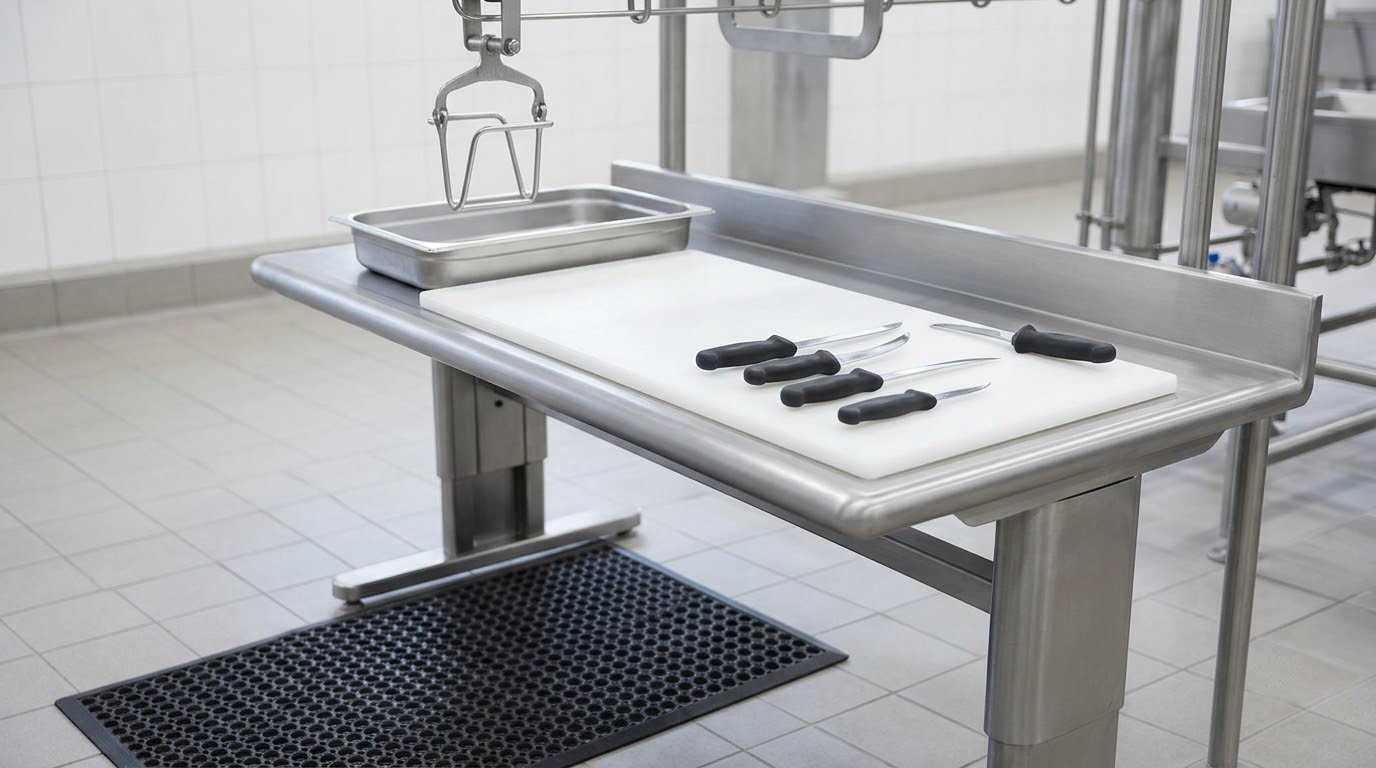
Poultry and meat processing ergonomics is the practice of matching the job to the worker: workstation height, tool weight, conveyor speed, line layout, break timing and staffing are all designed so a person can do a full shift without building up damage in their hands, shoulders, back or neck. In practice, that means identifying the seven physical risk factors in each station, redesigning the work where you can, and using breaks, rotation and training to reduce what remains.
Most plants know their injury numbers. Far fewer know which specific motion at which station is generating them, which is why the useful part of poultry and meat processing ergonomics is a method, not a rulebook. Below is how I would approach a plant walk-through, what to look at first, and how to tell whether any of it worked.
Table of Contents
- What Ergonomic Risks Exist in Poultry and Meat Processing?
- How Do You Conduct an Ergonomic Assessment?
- Poultry and Meat Processing Ergonomics: Controls That Work
- How Can Break Schedules and Job Rotation Reduce Fatigue?
- How Do You Train Workers and Supervisors?
- How Can a Plant Measure Whether Ergonomics Are Improving?
- Frequently Asked Questions
- Is OSHA required to have an ergonomics program in a meat or poultry plant?
- What musculoskeletal disorders are most common in meat processing workers?
- How do job rotation and rest breaks actually reduce injury risk?
- What PPE gives real protection against repetitive strain in a processing plant?
- How does line speed affect ergonomic risk?
- How is ergonomics different in poultry plants compared with red meat packing?
- Conclusion
What Ergonomic Risks Exist in Poultry and Meat Processing?
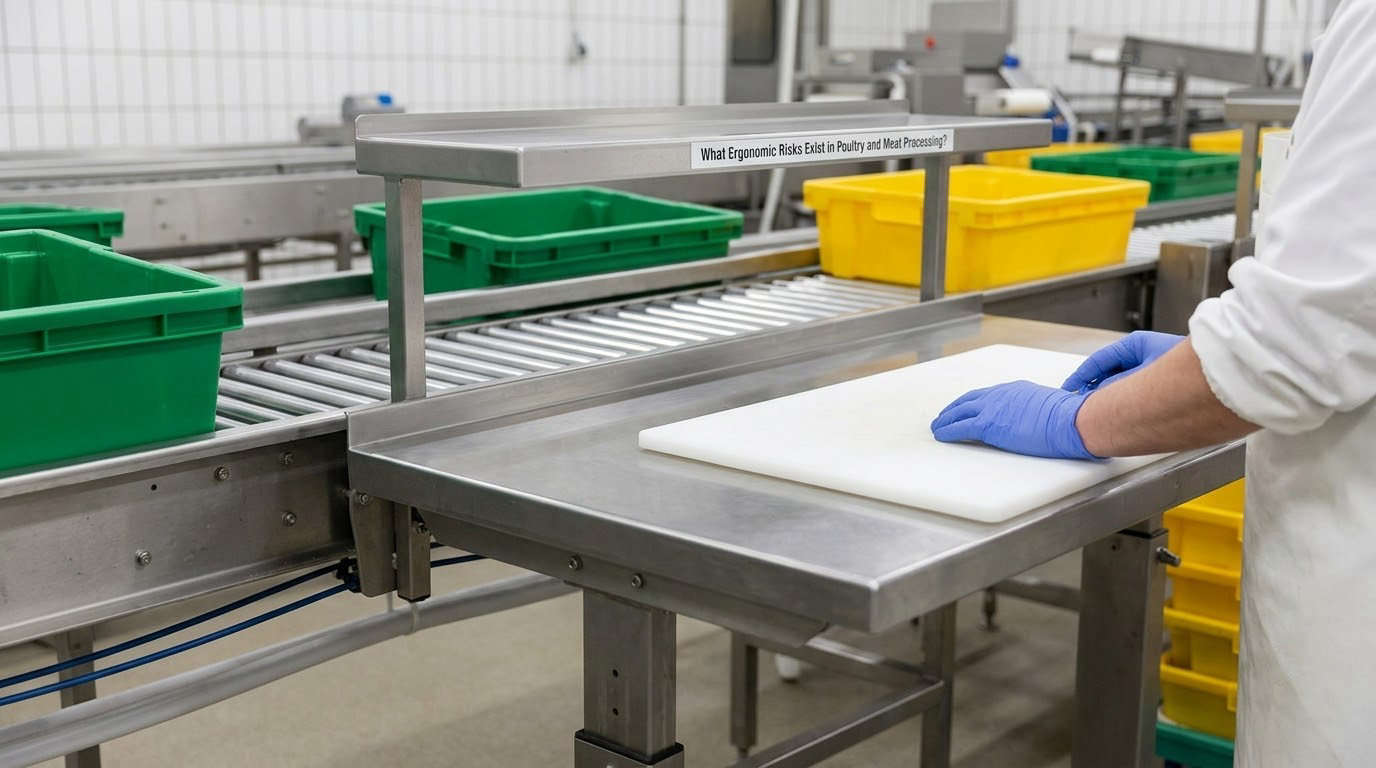
There are seven risk factors that cover almost everything a plant observer will find on a kill floor or in a cut-up room.
- Force. The effort needed to hold a carcass, pull a hook, drive a knife through bone, or lift a full case. Force alone can injure, but it does most of its damage when combined with repetition.
- Repetition. How often the same motion repeats in a minute, an hour, a shift. Poultry picking and deboning lines can cycle in the hundreds of motions per hour.
- Awkward posture. Twisting under a conveyor, reaching overhead into a chill tank, bending into a picking cabinet, or holding a product away from the body. Sustained posture beats force for how slowly it hurts.
- Contact stress. Pressure from tool handles, table edges, pinch points and sharp table rims resting against the thigh, wrist or forearm for hours at a time.
- Vibration. Hand-arm and whole-body vibration from handheld power tools, knife sharpeners, and equipment that transmits through floors and platforms.
- Cold. Chilling rooms, freezers and evisceration areas held near or below 40 degrees F. Cold stiffens muscles, reduces grip strength and dexterity, and is the reason many workers report finger numbness and white fingertips during a shift.
- Duration. Hours per shift, days per week, years on the same station. Duration is what turns an uncomfortable task into a disorder, and it is the factor most often ignored when a plant rebalances staffing.
Organizational factors sit on top of the physical ones. Pace pressure tied to line speed, fear of reporting symptoms, rotation schemes that simply hand the same bad posture to the next crew, and understaffed stations that force people to rush, all raise exposure without changing a single piece of equipment.
Stations cluster around these factors in predictable ways. Deboning and trimming combine high repetition, wrist deviation and steady gripping force. Live hang and evisceration combine overhead reach, twisting and heavy loads. Packing and case loading combine repeated lifting, awkward reaches into cartons and contact stress from carton edges. Cleanup and sanitation shift the load from repetitive motion to heavy wet-floor manual handling and cold.
Workers describe the result in plain terms: hands that swell until they cannot close them, backs that seize up after a shift, and the cold finger sensation that never fully goes away. Those complaints are the leading indicator, and they typically appear years before the injury log does.
How Do You Conduct an Ergonomic Assessment?
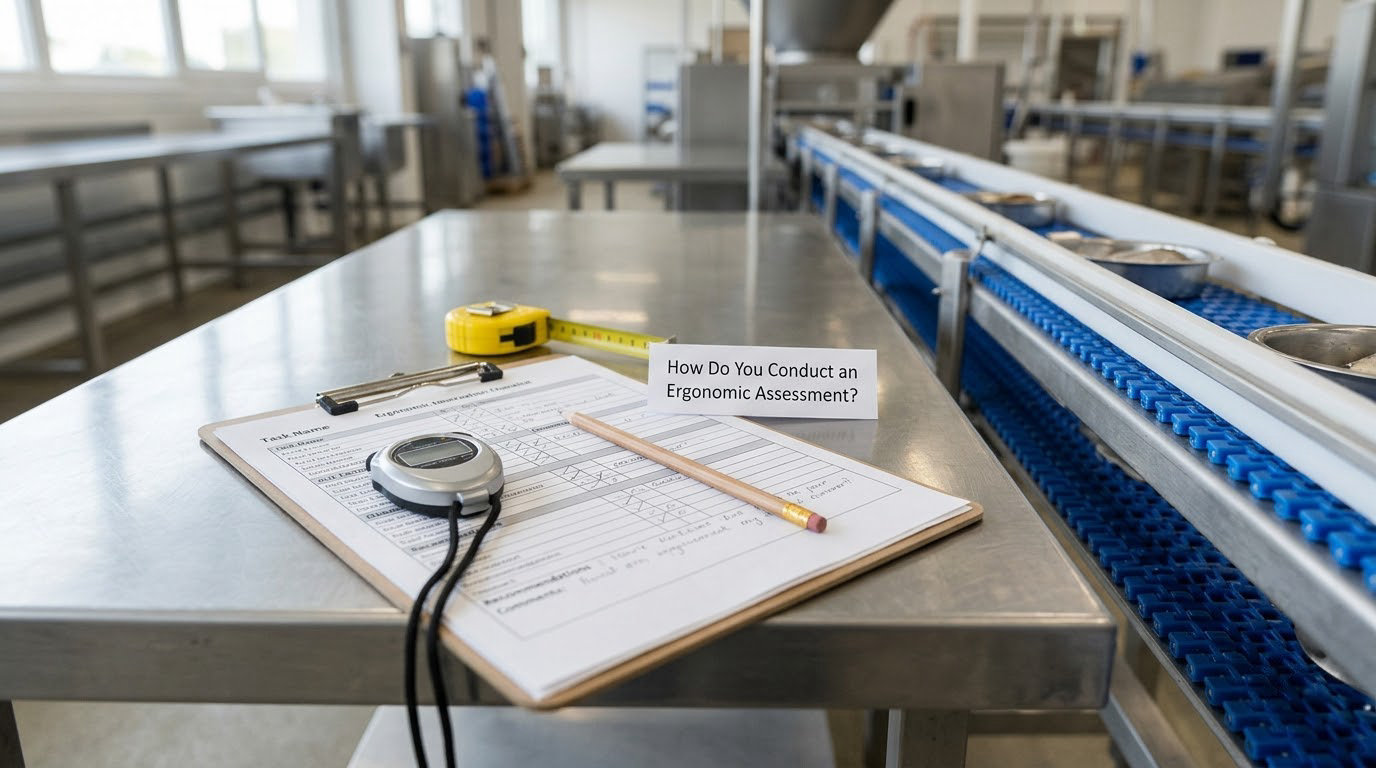
A generic checklist will miss the two things that matter most in a processing plant, which is who actually does the task and how fast the line is running when you watch it.
Start by choosing representative tasks rather than stations on the diagram. Watch a live run, not a paused line. Record for each task the cycle time, the number of motions per minute, the worst posture held, the load weight and the distance it travels. Watch at least three different workers per task, since a plant’s most experienced operators often work around strain rather than into it, and a new hire on a fast line is your worst case.
Bring the people doing the work into the observation. They will tell you which knives are dull, which hook comes loose, which belt edge catches a glove, and which station hurts after three hours in a way it does not hurt at hour one. Record that separately from your measurements so you can compare what you saw with what they feel.
Score the exposure rather than guessing at it. Posture tools such as RULA or REBA, the NIOSH lifting equation for boxes and carcasses, and simple cycle counts give you a ranking you can defend in a budget meeting. Video assessment software does the same thing at scale, which matters more in a plant with 40 lines than in an office with four desks.
Then rank exposures by severity, frequency and how hard the fix is. Tackle the tasks that combine high force, high repetition and long duration first, because those are where disorders actually come from.
Poultry and Meat Processing Ergonomics: Controls That Work
The hierarchy of controls decides the order of your fixes. Elimination means removing the exposure, usually by redesigning the task or automating it. Engineering controls change the equipment: conveyors, lift assists, adjustable platforms, tool balancers. Administrative controls change how the work is organized: rest breaks, rotation, staffing, line speed. Personal protective equipment comes last, and gloves or a back belt do not fix a badly designed station.
A spine that twists under a conveyor while a shoulder holds 40 pounds is a design problem, not a behavior problem. If your only answer is telling people to lift with their legs, you have skipped the two levels of the hierarchy that actually work.
Poultry and Meat Processing Ergonomics in Practice
At deboning and trimming stations, the levers are height, tool and pace. Set the working surface so the product sits near elbow height for the person at that station, and give each worker an adjustable platform rather than a fixed table they can only lean over. Hang knife and hook tools on balancers so the wrist is not holding the full tool weight through every cut. Programmable sharpening on a set schedule beats ad hoc sharpening at the line, because a dull blade forces more force per cut.
At evisceration, live hang and chill areas, look at reach and load transfer. Overhead rail heights that force constant shoulder elevation, and carcasses that must be lifted rather than transferred, are the two exposures worth a mechanical assist. Raising or lowering the rail a few inches removes hours of static shoulder load across a shift.
At packing and case loading, the work is lifting and reaching into containers. Set case heights so the worker does not lift above the knee or reach into a carton at shoulder level. Palletizing aids, case conveyors and turntables move the load without a lift. Cold storage work needs shorter cycles, more frequent recovery and genuinely warm rest areas, because cold combines with heavy lifting to multiply the risk.
At cleanup and maintenance, the load is slips and awkward reaches into equipment. Hose reels, overhead reels, slip-resistant footwear and non-slip flooring do more here than any back belt. Maintenance work benefits from lockout tagout and lift assists so technicians are not holding a guard or a pump by hand while crouched.
Standing work all day on concrete deserves the same attention as the cutting stations. Anti-fatigue matting, foot rails where a worker can change stance, and seating at inspection or scale stations reduce the low back and leg complaints that show up in the medical records rather than the injury log. Our guide to ergonomics for cashiers and standing jobs covers the same mechanics for people who never leave their feet.
How Can Break Schedules and Job Rotation Reduce Fatigue?
Recovery time matters more than break length. A short pause every 20 to 30 minutes of sustained repetitive work beats one long break at the end of the shift, because tissue tolerance is a time variable, not a daily total.
Build microbreaks around the task, not the clock. A picker who is doing 400 motions an hour needs more frequent and shorter pauses than someone on case loading. Let workers take the break when they need it within a defined window, so the break tracks fatigue rather than the whistle. Where production allows, slow the line briefly for a station rotation rather than stopping the whole line, which keeps output and lets crews actually change posture.
Rotation only works when the second job loads different muscles. Moving three people through the same deboning station in an hour reduces individual exposure and does nothing to the process. Alternate high-load stations with lower-load ones: trimming, grading, scale checks, tote handling, or documentation on a tablet at a bench.
Watch for the trap where rotation moves a hazard to a smaller crew or to new hires who have less skill and slower technique. If a task only hurts skilled workers, new workers will get hurt worse. Keep the assessment honest about who is on which station this shift, not who is nominally assigned.
How Do You Train Workers and Supervisors?
Training covers what the equipment is doing, how to adjust it, and how to report symptoms early. Workers should be able to set their own station height and conveyor height, choose the correct knife for the task, and know the sharpening schedule. Supervisors need to spot posture problems during a normal walk, log reports without blame, and stop a line when a fix is missing rather than press on.
Training also has to be honest about reporting. Workers who fear retaliation, or who believe missing a shift puts their job or immigration status at risk, will hide symptoms and end up on modified duty or off work entirely. A confidential reporting path and a clear statement that early reports are treated as a safety issue, not a performance issue, does more for early intervention than any poster.
Housekeeping belongs in training too: wiping down surfaces, clearing rims, keeping knives sharp. The format looks a lot like safe handling practices for nurses and patient handling, where the lift assist matters more than the body mechanics lesson.
Be clear where training sits in the hierarchy. A worker cannot lift 60 pounds safely through a bad design, and no amount of coaching changes that.
How Can a Plant Measure Whether Ergonomics Are Improving?
Track leading and lagging measures together. Injury rates alone tell you what already happened, and in a plant with heavy underreporting they are a lagging signal of a lagging signal.
Leading measures: symptom reports per station per month, near misses involving drops or caught hands, completed observations with corrective actions closed on time, break compliance audited by supervisor, staffing fill rate at each station, equipment availability, and time since the last tool balancer or lift assist repair.
Lagging measures: recordable musculoskeletal cases, days away and restricted duty, modified duty assignments, medical visits for MSD complaints, and workers compensation claim costs by department.
Set the baseline before you change anything, then re-score the same tasks on the same tools after six to twelve weeks. If the RULA score did not move and the line speed went up, the exposure went up too. Our practical safety guide for lab workers covers the same measurement discipline in a setting where the hazards are easier to isolate.
Frequently Asked Questions
Is OSHA required to have an ergonomics program in a meat or poultry plant?
There is no single federal ergonomics standard, so plants are covered by the General Duty Clause, which requires employers to address recognized hazards likely to cause serious harm. Several states, including California, have their own ergonomic standards with program and training requirements. Enforcement has focused on specific plants rather than the industry as a whole, so the practical driver is usually an injury complaint, an inspection, or a workers compensation claim.
What musculoskeletal disorders are most common in meat processing workers?
The most frequently reported conditions are tendonitis of the wrist and elbow, carpal tunnel syndrome, rotator cuff and shoulder problems, and lower back strain. Hand and wrist complaints dominate in deboning and trimming, where gripping force and repetition are highest. Back and shoulder complaints cluster around lifting, overhead reaching and twisting under conveyors. Cold working conditions tend to amplify both.
How do job rotation and rest breaks actually reduce injury risk?
They reduce exposure duration and give tissue a recovery window before fatigue degrades technique. Short breaks every 20 to 30 minutes work better than one long break at shift end. Rotation helps only when the second station loads different muscle groups and carries lower force and repetition. Rotating people through the same high-load task does little except spread the risk across more workers.
What PPE gives real protection against repetitive strain in a processing plant?
Cut-resistant gloves protect against lacerations but should be fitted so they do not add grip force. Supportive footwear and anti-fatigue matting help with standing fatigue, and heated or insulated gear is important in chill areas, though gloves alone do not solve cold exposure. Back belts are generally not recommended for manual lifting. PPE sits at the bottom of the hierarchy and cannot correct a poorly designed workstation.
How does line speed affect ergonomic risk?
Line speed sets the pace of the repetition cycle, so raising it raises the number of motions per hour without any change in workstation design. Workers compensate by shortening recovery time and using more force per cut. Any speed increase should be paired with a fresh ergonomic observation of the affected stations, added staffing, or an engineering change, because the physical plant does not adapt to a schedule change.
How is ergonomics different in poultry plants compared with red meat packing?
Poultry plants typically run higher piece rates and lighter loads, so repetition and wrist posture dominate, while the scale is smaller and lines are shorter. Red meat packing deals with much heavier carcasses and cases, so force, lifting and material handling dominate the exposure. Both share cold environments, wet floors, sanitation work and the same need for early reporting systems, and both benefit from the same assessment method.
Conclusion
Start with the highest-load tasks rather than the whole plant. Watch three live runs at deboning, trimming and case loading, bring the people at those stations into the observation, and score posture, force and cycle time.
Then fix in order: redesign the task, engineer the equipment, organize the work with breaks and rotation, and train. Track symptom reports, near misses and closure times on corrective actions so you know whether exposure fell or you simply got a quiet quarter. Poultry and meat processing ergonomics is not a one-time project, and the plants that treat it that way are the ones still writing the same report three years later.