
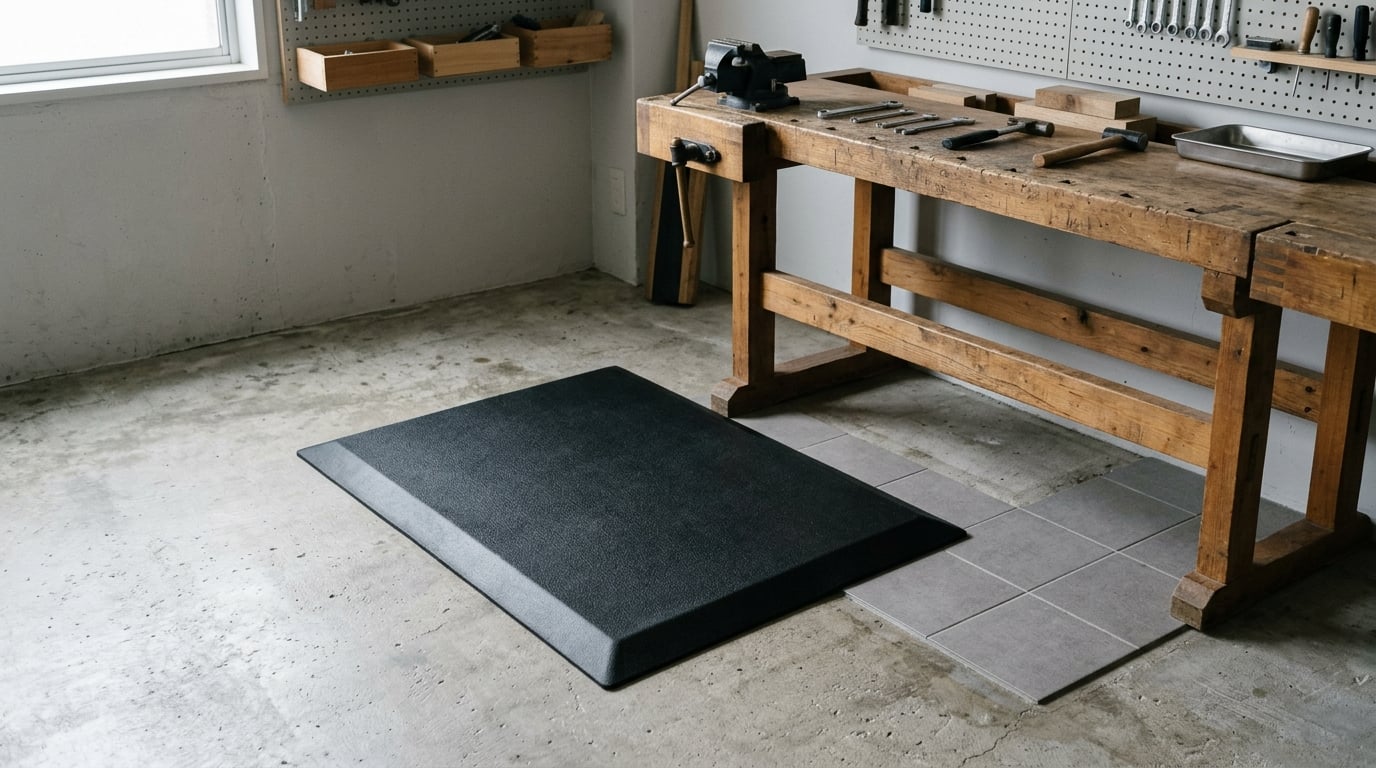
Yes, but with conditions. Randomised and crossover studies in hospital settings found that standing on a cushioned mat lowered reported pain and fatigue compared with bare hard flooring. The benefit is mostly about comfort, it is strongest in people who already get back pain from standing, and it does not cancel out a badly designed workstation. So whether anti fatigue mats do they actually help has a qualified yes as the answer, not a blank one.
That nuance matters because the marketing around these mats is loud and mostly one-sided. The research underneath is small, mixed in places, and much of it has never made it into the pages ranking for this question. I read the peer-reviewed studies rather than the product pages, and the picture is genuinely encouraging for a low-cost mat, with clear limits.
What follows covers what the mats physically do, what the studies found, who tends to notice a difference, and how to pick one if you decide it is worth it for your workplace. It is general information about work health, not medical advice.
Table of Contents
- What Are Anti Fatigue Mats?
- Anti Fatigue Mats: What the Evidence Shows
- Do Anti Fatigue Mats Actually Help?
- What Is the Most Comfortable Mat Type?
- How Do You Choose an Anti Fatigue Mat for Standing Work?
- How Can Employers Reduce Standing Discomfort Better?
- Frequently Asked Questions
- Are anti fatigue mats scientifically proven to reduce back pain?
- How long should an anti fatigue mat be used each day?
- What thickness is best for standing at work?
- Can anti fatigue mats create a slipping or tripping hazard?
- Are standing desks better than anti fatigue mats?
- When should persistent discomfort after standing be professionally evaluated?
- Conclusion
What Are Anti Fatigue Mats?
An anti-fatigue mat is a thick, resilient floor covering that compresses slightly underfoot and springs back. Most are made from rubber, closed-cell foam, polyurethane or PVC, and they run from roughly 10 millimetres to 25 millimetres thick.
What separates them from an ordinary floor mat is the foot-floor interface. A standard mat is thin, flat and essentially rigid, so your foot meets a hard surface no matter what is under it. An anti-fatigue mat is built to compress under the heel and forefoot, which changes how weight travels up the leg.
How the cushioning actually works
Two mechanisms are often talked about as one, and they are not the same thing. The first is cushioning, which spreads out peak pressure under the heel and ball of the foot. The second, which laboratory work suggests matters more for comfort, is micro-compliance: a surface that yields slightly lets the foot and body shift rather than hold perfectly still.
Static standing is tiring mostly because postural muscles stay engaged holding one position. A surface that permits small, frequent adjustments lets that load fluctuate. In a 2022 laboratory study in Applied Ergonomics, standing on a mat increased centre-of-pressure excursion by 35 to 55 percent and body weight shifts by 54 to 116 percent compared with a rigid floor.
So softness is not the goal. A mat that is too soft makes the ankle and knee work harder to stabilise, which is why hardness and thickness both matter, not just how plush it feels at first.
Anti Fatigue Mats: What the Evidence Shows
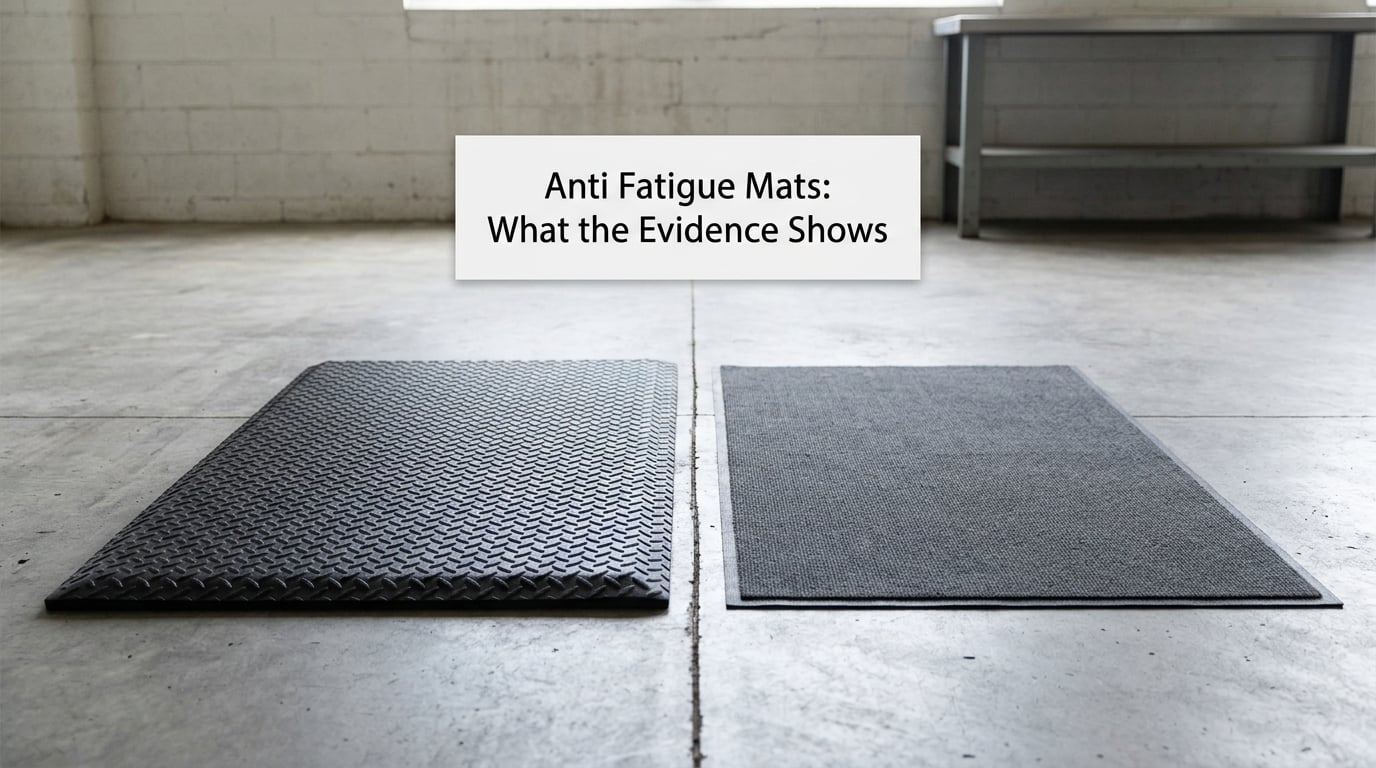
The honest summary is that the evidence supports reduced discomfort, strongest in certain people, with weaker support for any claim that mats change how your muscles work. Here is what the main studies actually found.
| Study | Design and sample | What was measured | Result |
|---|---|---|---|
| Elliott et al., 2025, Laryngoscope Investig Otolaryngol | Prospective randomised study, 4 months; 57 surgical staff across 34 long operations | Discomfort increase from pre-op to post-op and 24 hours later | Significantly smaller increases with a mat, immediately post-op and at 24 hours; less pain in ankles, feet, knees and shoulders |
| Unver and Makal Organ, 2023, Applied Ergonomics | Crossover study with a one-week washout; 38 surgical team members | Pain and fatigue on visual analogue scales after procedures | Significantly lower pain and fatigue on a 15mm rubber mat than on standard antistatic PVC flooring |
| Winberg et al., 2022, Applied Ergonomics | Laboratory exposure, 60 minutes of light manual work; 16 volunteers split into pain developers and non-pain developers | Low back pain on a visual analogue scale; centre-of-pressure excursion; body weight shifts | Low back pain fell from about 6.8mm to 3.6mm in pain developers; no change in non-pain developers; postural variability clearly increased |
| Aghazadeh et al., 2015, International Journal of Occupational Medicine and Environmental Health | Randomised interventional study; 16 participants without a low back pain history | Subjective low back pain and bilateral gluteus medius co-activation | Pain reduced in 15 of 16 participants, but no significant change in muscle co-activation and no drop in the number who developed pain |
| Hill et al., 2019, Safety and Health at Work | Within-subject repeated measures with surface electromyography; 15 participants | Lower extremity muscle activity before and after a workload, with and without a cognitive task | No reduction in muscle activity attributable to a softer surface; fatigue and cognitive load drove the demand instead |
| Soangra and Lockhart, 2012, Biomedical Sciences Instrumentation | Exploratory force-plate pilot; 7 healthy adults | Postural sway parameters during quiet stance | Responses were individual and inconsistent; no significant differences on one of the two sway analyses |
Two things jump out. The positive findings come from real work settings with long, painful shifts, mostly in operating rooms, which is a good test of the claim. The null findings come from shorter laboratory sessions measuring muscle electrical activity, which is a much stricter test than asking someone how their feet feel.
Both readings can be true at once. A mat may well reduce the discomfort of standing without visibly changing the recruitment pattern of your postural muscles.
Do Anti Fatigue Mats Actually Help?
They help, most reliably in four situations. First, when the floor is genuinely hard, meaning concrete, tile, sealed vinyl or hardwood. On carpet over a slab, the gap between a mat and no mat narrows quickly.
Second, when standing is continuous rather than intermittent. Someone on their feet for eight hours in a kitchen or a warehouse has a very different problem from someone who stands for twenty minutes an hour, and the mat earns its place in the first case.
Third, when you are the kind of person who develops lower back or leg pain from standing. This is the finding almost nobody repeats, and it comes from the 2022 study. Volunteers had been classified beforehand as pain developers, meaning they reliably get symptoms after prolonged standing, and as non-pain developers, meaning they do not. The mat cut pain roughly in half in the pain developer group. In the non-pain developer group, nothing changed at all.
Fourth, when your work involves a lot of small repositioning, such as assembly work or a checkout counter, where the extra postural movement is useful rather than wasted.
When the effect is small or absent
Expect little or nothing if your standing is already broken up by walking, if your floor is resilient, or if you do not develop pain from standing in the first place. That last group is not being short-changed. They had a real mat, on a real surface, for a real hour of manual work, and their pain scores did not move.
Results also vary by footwear. Safety footwear with a hard sole and minimal cushioning absorbs very little of what the mat offers, because the interface that compresses is the shoe, not the floor. A soft, well-fitting work shoe passes more of the mat’s give through to the foot.
Why a mat cannot fix a bad workstation
This is the part the sales pages skip. The Canadian Centre for Occupational Health and Safety is blunt about it: anti-fatigue matting does not by itself eliminate sore feet, and work design, opportunities to change position, footwear and the flooring material all matter alongside it.
A mat changes one variable at the foot-floor interface. It does nothing about a counter height that forces you to lean forward all shift, a task you cannot pause, a workstation you cannot adjust, or a shift spent in one static posture with no variation. Standing all day in a bad posture is still a bad posture, and a mat under it does not change the geometry of your spine or shoulders.
What the evidence does not show
No study in this body of work shows that anti-fatigue mats prevent injury. They show reduced reported discomfort in specific settings, and two studies found no change in objective muscle activation. The samples are small, mostly 16 to 57 people, mostly short exposures, and two of them come from the same clinical specialty.
So when a page tells you a mat will protect your back for a career, that is a claim nobody has earned.
What Is the Most Comfortable Mat Type?
The most comfortable mat is the one that is firm enough to stand on and thick enough to compress, sized to the space you actually stand in, and appropriate for the shoes you wear. Those four conditions matter far more than any material name.
Construction and materials compared
Rubber is dense, durable, easy to hose down and the default for kitchens, workshops and warehouses. It stays heavy and flat, which is good for stability and bad for storage, and it can be harsh on bare feet or thin soles in a cold room.
Polyurethane foam is the most forgiving on feet and quiet underfoot, which suits office standing desks and retail counters. It is also the most likely to compress permanently, so its useful life depends heavily on density and how long someone stands on the same spot.
Closed-cell foam wipes clean and resists liquids, which matters in food prep and clinical settings. Closed-cell material gives back less than rubber, so it feels less lively underfoot over a long shift.
| Material | Best suited to | Watch out for |
|---|---|---|
| Rubber | Kitchens, warehouses, workshops, plant floors, wet or washdown areas | Heavy, cold under bare feet, can be slippery when wet if wrongly rated |
| Polyurethane foam | Standing desks, retail, offices, anyone in soft shoes or socks | Compression set, flattening at a single standing spot, less useful on wet floors |
| Closed-cell foam or PVC | Food preparation, healthcare stations, areas needing frequent cleaning | Less give than rubber, some formulations become slippery with oils or grease |
| Carpet-backed or textile-backed | Dry indoor office and studio floors | Cannot be hosed down, holds spills, wears out fastest on hard floors |
Thickness, edges and texture
Most occupational health guidance points to a minimum of about 20 millimetres, and many people find 20 to 25 millimetres comfortable for long shifts. The 2023 surgical study used a 15mm rubber mat and still found a clear benefit, so the threshold is a reasonable floor rather than a magic number. Below roughly 10 millimetres you are closer to a comfort mat than a fatigue mat.
Beveled or sloped edges matter more than people expect. A mat with a square edge is a trip hazard to someone who is not watching their feet, which is most people on a busy shift. Sloped edges let a foot roll on and off rather than catch.
Texture is a genuine trade-off, and it is the one most often misunderstood. A heavily textured or anti-slip surface grips the shoe rather than the foot, and the friction can make your foot slide forward inside the shoe and generate heat. CCOHS specifically flags anti-slip matting as a possible cause of foot soreness for that reason. If you wear enclosed shoes, a moderately textured surface suits you better than an aggressively studded one.
Size follows the same logic. A mat big enough for you to shift your feet around, and to stand on in more than one position, beats a small pad you stand still on.
How Do You Choose an Anti Fatigue Mat for Standing Work?
Work through the task before you look at products. How long are you actually standing, uninterrupted? What is the floor? What do you wear? Those three answers rule out most options quickly.
Match the mat to the shift
For a carpeted office and short standing periods, a lighter mat around 20 millimetres is enough. For a concrete plant floor and a full shift, look for 20 to 25 millimetres, rubber, sloped edges and a backing that grips the floor without needing tape at every edge.
For wet or contaminated work, confirm the surface is genuinely washable and rated for the contaminants involved. Grease and standing water behave very differently on different compounds, and a mat that becomes slick is worse than no mat.
Check these before you commit
- Compression resistance. Stand on it in the shop or a showroom for ten minutes. If it feels noticeably harder afterwards than it did at first, the density is too low and it will flatten in months.
- Total footprint. Large enough for movement, small enough to be secured and stored. Very thick mats are heavy and awkward to roll.
- Edge profile. Sloped or beveled on all four sides, with no corner that lifts.
- Backing. Non-slip and sized so the mat is not a trip edge at doorways or aisles.
- Cleaning regime. Match it to the environment. A textile-backed mat cannot go near a washdown area.
- Footwear fit. Try it in the shoes and insoles you will actually wear. This is where the “great for my colleague, awful for me” problem usually comes from.
Know when to replace it
Watch for compression set, which is the permanent flattening a foam mat develops under repeated load. The sign is simple: the mat no longer springs back, or you can see a shallow depression where your feet land. Once that happens the mat is a floor covering again, not a fatigue mat. Rubber lasts longer but can split, harden or develop a slick surface from embedded oils, so check the underside and the top for cracks and gloss.
A rough working rule: expect a decent foam mat in heavy daily use to give out sooner than a rubber one, and judge replacement by feel rather than by a date on the box. In workshop and service jobs, lifespan rather than first-day comfort is usually what decides whether a mat was worth buying.
How Can Employers Reduce Standing Discomfort Better?
Treating a mat as the whole solution is the most common mistake employers make with standing work. It works better as one line in a wider plan.
Change the position, not just the surface
Variation is what the postural muscles actually need. Where the task allows it, alternate between standing and sitting, raise and lower the surface, or rotate the job. Even short changes every half hour break up static loading, and they cost nothing to trial.
Sit-stand stools and footrests serve the same goal in a different way. They let a worker shift weight onto one leg or perch rather than load both feet evenly, and they work in places a mat is impractical, such as behind a counter or on a busy shop floor. A footrest is worth trying when the counter is too low to stand comfortably.
Adequate shelving and a work surface at a height that keeps the shoulders relaxed does more for a standing worker than any mat. If someone cannot reach without stretching or cannot bend without rounding their back, the problem is above the floor.
Manage the rest of the exposure
Footwear is the other half. A supportive, well-fitting work shoe with a cushioned insole passes far more of the mat’s compliance through to the foot than a hard-soled boot does. Rotate between pairs if you can, since foam insoles that never recover contribute to the sore feet the mat was meant to address.
Build in actual rest opportunities, not just the permission to change position. A ten-minute seated break every two hours is worth more than a mat under continuous eight-hour loading, and it costs nothing to allow.
Give people a way to report discomfort and act on it. Most work-related musculoskeletal problems in the lower back and legs become chronic because they were tolerated for months, not because nobody could sit down.
On regulation: in the United States, OSHA does not require anti-fatigue mats. It has no standard prescribing them, and matting is not a substitute for the general duty to address recognised ergonomic hazards. A mat becomes defensible as part of a documented programme addressing prolonged standing, not as the whole programme.
A five-day check on whether it is working for you
Before and after a purchase, keep a two-line note for five working days: your discomfort rating from zero to ten at the end of each shift, and roughly how many times you sat or repositioned. If the comfort score drops and stays down while your work pattern stays constant, the mat is doing something. If the numbers barely move, the problem is probably not the floor, and you should look at posture variation, counter height and footwear next.
That is also the honest test of the sceptical question behind this topic. The evidence supports a real but bounded benefit, and this diary is how you find out where you sit inside that bound.
Frequently Asked Questions
Are anti fatigue mats scientifically proven to reduce back pain?
Partly. Two randomised and crossover studies in operating rooms found significant reductions in reported pain and fatigue when staff stood on mats, and a 2022 laboratory study found low back pain roughly halved in workers who were already prone to pain from standing. But two other studies found no change in objective muscle activation, and none show that mats prevent injury. The evidence supports less discomfort, not a proven health guarantee.
How long should an anti fatigue mat be used each day?
There is no recommended maximum, and no evidence that daily use is harmful. What matters is how long you stand on a hard surface without variation. A mat is most useful during long continuous shifts and least useful when your standing is already broken up by walking or sitting. If standing feels fine for the first two hours and uncomfortable after five, the later hours are where a mat earns its keep.
What thickness is best for standing at work?
Around 20 millimetres is a sensible minimum for sustained standing, with 20 to 25 millimetres comfortable for long shifts. A 15mm rubber mat still produced a measurable benefit in a 2023 surgical study, so the number is a guide rather than a threshold. Below roughly 10 millimetres you are getting comfort padding rather than a genuine fatigue mat.
Can anti fatigue mats create a slipping or tripping hazard?
Yes, in two ways. A mat that shifts or that has a square edge becomes a trip hazard, which is why sloped edges and a non-slip backing matter. Separately, heavily textured anti-slip surfaces grip the shoe and can make the foot slide forward inside it, generating heat and soreness. CCOHS notes that a mat installed improperly is a common cause of falls in workplaces.
Are standing desks better than anti fatigue mats?
They solve different problems. A standing desk changes the joint angles of the task, which addresses posture, while a mat changes only the foot-floor interface. Research on prolonged standing shows variation in position is what helps most, so a sit-stand desk that people genuinely alternate at tends to do more than a mat alone. Many workers use both, and the desk does not make the mat unnecessary on a hard floor.
When should persistent discomfort after standing be professionally evaluated?
See a doctor or occupational health professional if discomfort persists beyond a couple of weeks despite changing position, footwear and a mat, or if it wakes you at night, spreads into the legs, involves numbness or weakness, or follows an injury. Standing-related pain is often manageable with work design changes, but persistent symptoms deserve a proper assessment rather than another accessory. This article is general information, not medical advice.
Conclusion
Whether anti fatigue mats do they actually help is a question with a real but bounded answer. They reduce reported discomfort for many standing workers, most clearly for people who already develop pain from standing, and the mechanism is genuine: the surface allows small postural shifts that a rigid floor does not.
Start by assessing the task rather than the product. How long is the standing, how hard is the floor, what is worn on the foot, and how much the position already varies during a shift. If standing is long and continuous on hard flooring, trial a mat of roughly 20 millimetres or more with sloped edges, and run the five-day comfort diary to see whether it earns its place.
If discomfort carries on after those changes, the answer is not a thicker mat. It is a work surface at a better height, more position change, a supported work shoe, and a medical opinion if symptoms persist.