
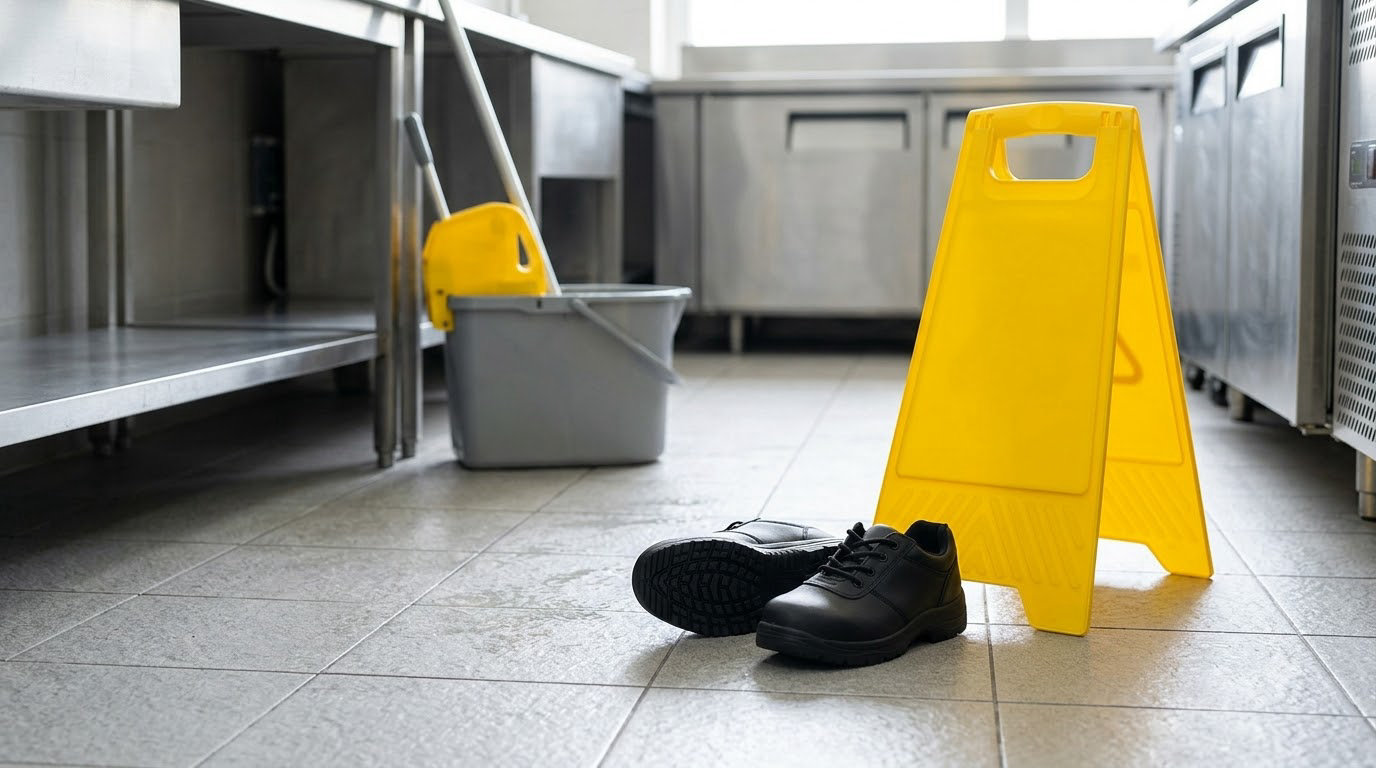
Food service slip prevention tips come down to a short list of habits: keep floors clean and dry, clean spills with the right chemistry for what spilled, fix damaged flooring, keep walkways clear and lit, and require slip-resistant footwear. Kitchens concentrate every major slip mechanism at once, which is why the same generic floor-safety advice keeps failing in this industry.
A cook stepping on a grease film at the fryer station, a server crossing a wet tile at a self-serve drink dispenser, a dishwasher walking out of a walk-in cooler with ice melt on the sole of a shoe. Each of those is a different slip mechanism, and each needs a different control. These food service slip prevention tips are ordered by how much risk they remove on a normal shift, not by how hard they are to implement.
The core controls, if you read nothing else:
- Maintain walking-working surfaces in a clean and, so far as possible, dry condition, per OSHA 1910.22(a)(2)
- Match the cleaning chemistry to the contaminant: water, cooking oil, and grease are three different problems
- Fix oil and grease at the source, at the fryer, the dish pit, and the floor drain
- Isolate damaged flooring immediately and repair it on a schedule with a name attached
- Require slip-resistant footwear under the 1910.132 PPE obligation
- Track every near miss so repeat locations and repeat process failures become visible
One note on regulation before you go further: OSHA proposed a dedicated Walking-Working Surfaces and Personal Protective Equipment rule in 2010 at 75 FR 28862. It was never finalized. As of 2026, the applicable floor obligation is still the general walking-working surfaces standard at 1910.22, and this area is worth re-checking periodically because a final rule would change the detail.
Table of Contents
- Food Service Slip Prevention Tips at a Glance
- 1. Keep Floors Clean and Dry Throughout Service
- 2. Use the Right Spill Kit for the Spill
- 3. Control Water, Grease, and Food Debris at the Source
- 4. Repair Uneven or Damaged Flooring Promptly
- 5. Keep Walkways Clear and Well Lit
- 6. Select and Maintain Slip-Resistant Work Shoes
- 7. Use Mats and Anti-Slip Covers Correctly
- 8. Make Safe Footwear and Housekeeping Part of Training
- 9. Install and Maintain Engineering Controls
- 10. Record Near Misses and Follow Up Correctly
- Frequently Asked Questions
- What is the best way to prevent slips in a commercial kitchen?
- Are anti-fatigue mats enough to prevent kitchen slips?
- Should employers require slip-resistant shoes for food service workers?
- How quickly should a spilled liquid be cleaned in a restaurant?
- Who is responsible for reporting a damaged or uneven floor?
- What should a worker do after a near miss without a fall or injury?
- What to Do First
Food Service Slip Prevention Tips at a Glance
Every tip below maps to a specific hazard, a specific action you can take today, and a number you can watch to know it is working. If you only have time for three, take 1, 3, and 10.
| Tip | Main hazard | Immediate action | Leading indicator |
|---|---|---|---|
| 1. Clean and dry floors | Standing water, moisture tracked across tile | Assign spill response by name for every shift | Percent of spills closed within five minutes |
| 2. Match the spill kit to the spill | Grease and oil spread under foot | Separate water, grease, and oil clean-up kits | Repeat incidents at the same station |
| 3. Control contaminants at source | Wash water, food debris, oil drips | Maintain drains, covers, and waste handling | Grate condition at inspection |
| 4. Repair damaged flooring | Cracks, raised seams, worn quarry tile | Barricade and log a repair with a deadline | Days open per repair ticket |
| 5. Clear and light walkways | Clutter, cords, carts, low light | Walk the route before every service | Lighting outages reported same day |
| 6. Slip-resistant footwear | Contaminated soles losing grip | Set a footwear standard in the employee handbook | Percent of staff in compliant shoes |
| 7. Use mats correctly | Curling edges and trapped grease | Edge-tape mats and clean them daily | Mats removed from service when worn |
| 8. Train for the habit | Rush-hour shortcuts, ignored signage | Run a 15-minute drill at shift start | Drill completion each week |
| 9. Engineering controls | Water pooling, floor slope errors | Have drainage inspected by a qualified person | Planned inspection dates met |
| 10. Record near misses | The same spot falling twice | Log with location, cause, owner, and date | Repeat-location count trending down |
1. Keep Floors Clean and Dry Throughout Service
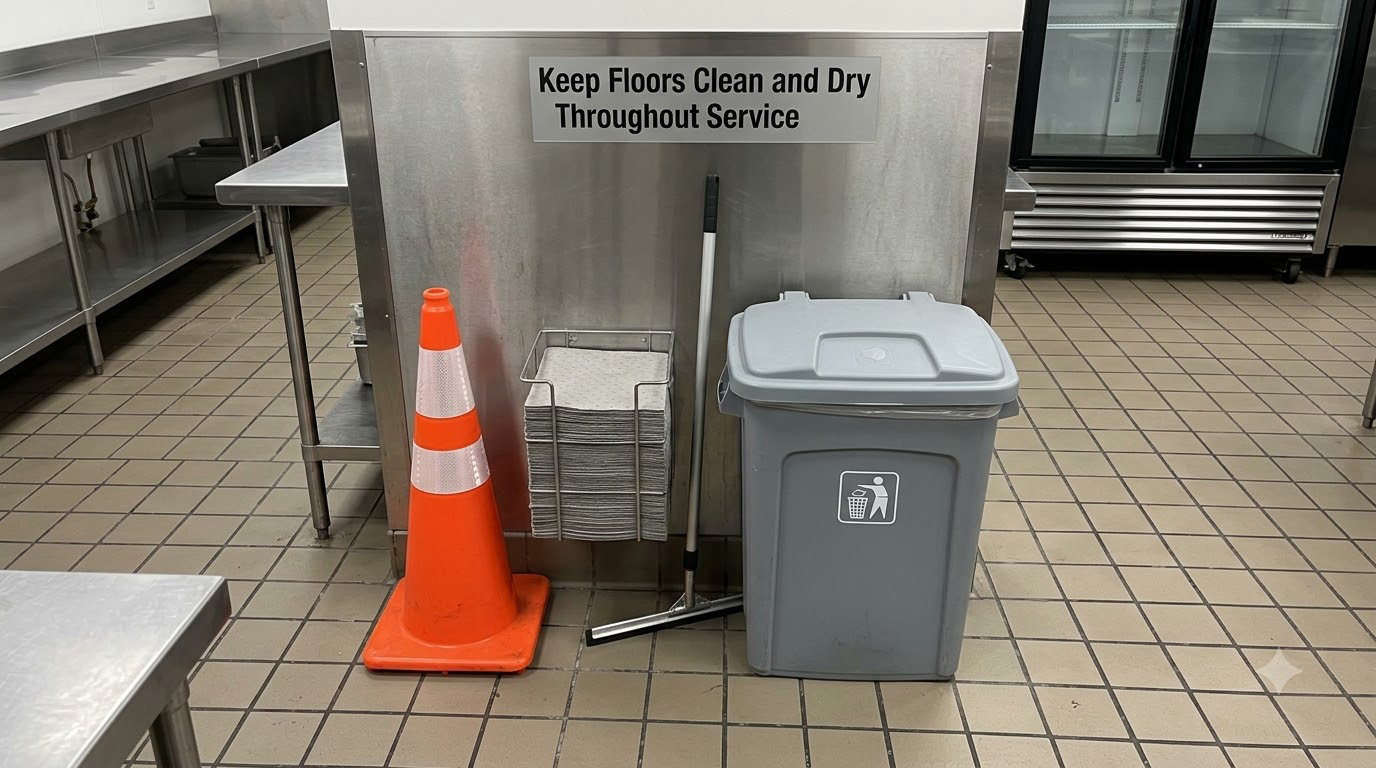
Clean and dry is the whole obligation, and most kitchens fail it on timing rather than effort. The floor gets wet, nobody is assigned, service picks up, and two hours later someone is still standing in it. Assign the response instead of hoping for it: every shift has a named person for the floor, with a named backup.
How OSHA frames food service slip prevention
29 CFR 1910.22(a)(2) is short and gets paraphrased constantly. The requirement is that aisles and passageways be kept clean and, so far as possible, dry, and a companion provision covers floors in work areas where oil and grease are used, requiring them to be kept free of accumulations to prevent or protect against slipping.
Two practical readings of that. First, “so far as possible” is not an excuse for a permanently wet kitchen. It is a duty to make conditions dry when you reasonably can, which is why drainage and floor slope belong in the same conversation as mopping. Second, the oil and grease language is the food service provision in disguise, and generic guidance about wiping up water will not satisfy it.
2. Use the Right Spill Kit for the Spill
Treating every spill with the same mop is the single most common error I see. Water, cooking oil, and grease respond to completely different chemistry, and the wrong one leaves a film that is invisible on wet-looking tile and lethal under a shoe.
Run separate kits. A water kit holds absorbent pads or granulate, a squeegee, and a flat mop. A grease and oil kit holds a commercial degreaser rated for the floor surface, a degreasing pad, and a sealed container for the soiled pad. A food debris kit handles solids first, then the wet clean.
For chemicals, read the label and use the listed personal protective equipment. Gloves and eye protection are the sensible default for any degreaser, and mixing cleaners is how kitchens generate a second, worse hazard. Contain and mark the area first, then work from the outside edge inward so you are not walking through the middle of it.
Know the difference between containing and cleaning. A large spill in a busy walkway gets barricaded and reported for a full clean. A small spill gets the full treatment immediately. Doing either one in the wrong place turns a ten-second task into a fall.
3. Control Water, Grease, and Food Debris at the Source
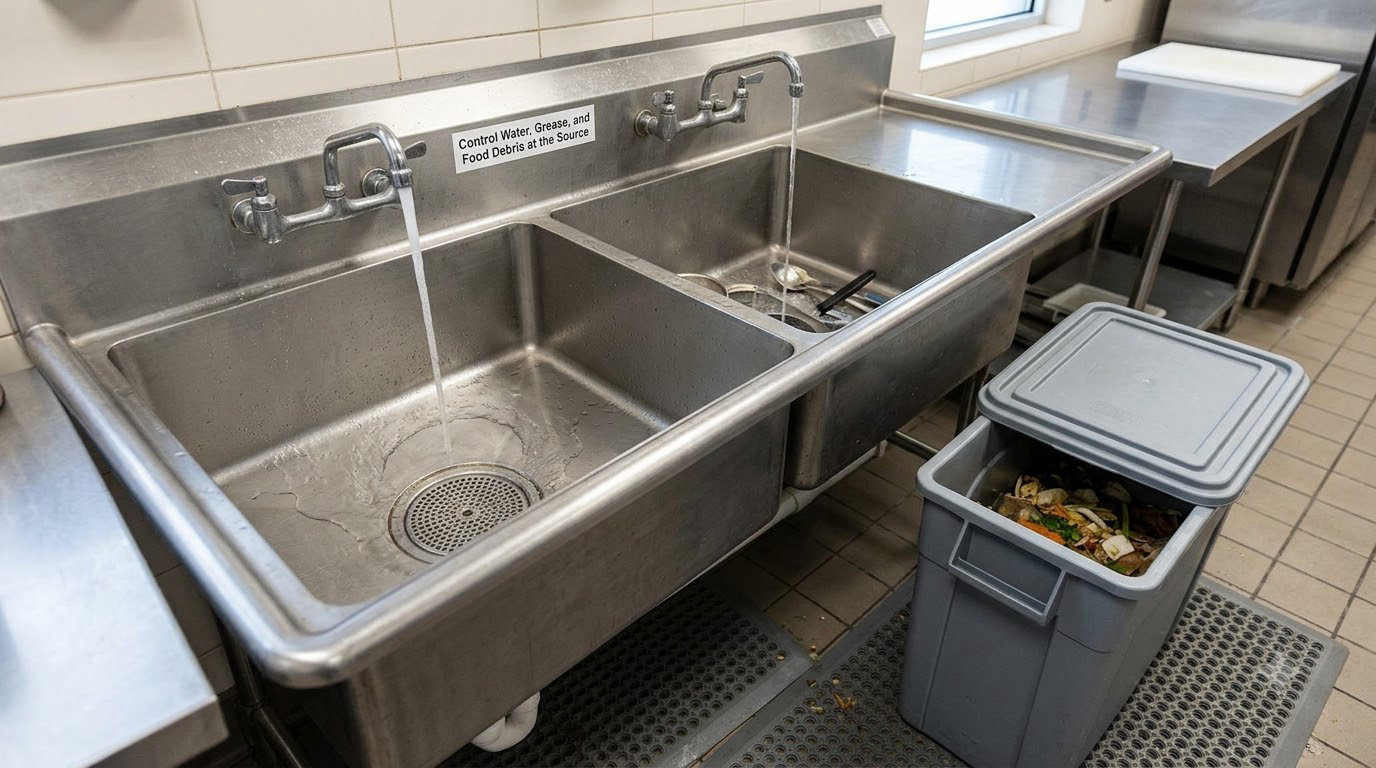
Mopping a floor four times an hour is a losing game if the water keeps arriving. Fix it at the point of creation: at the three-compartment sink, at the fryer, at the walk-in, at the beverage dispenser.
At the dish pit, stand water comes from overuse and from a drain that no longer moves water. At the fryer station, oil escapes from baskets, drip trays, and filter changes. At the salad bar, condensation drips from the canopy and juice runs off the edge of the pan onto the floor. Each of those has a mechanical fix, and each mechanical fix is cheaper than the mop cost that replaces it.
Food debris is a slip hazard twice over. It masks the wet floor underneath and it turns any clean-up into a smearing problem. Lidded waste containers near prep and service lines, emptied before they overflow, remove a whole category of hazard rather than cleaning it up.
4. Repair Uneven or Damaged Flooring Promptly
Warning signs in a kitchen are easy to spot once someone is looking. Loose or lifted tile, cracks that have opened into gaps, raised seams where two flooring sections meet, worn spots where quarry tile has been polished down to a smooth face, mats with curling edges, and abrupt transitions at thresholds, coolers, and patio doors.
Isolate first, log second, repair third. Barricade the area, note the location precisely enough that someone can find it, and record who reported it and when. A repair with no owner and no date is a repair that happens after somebody falls.
After the repair, confirm it with a qualified person rather than a general contractor who was sent to patch a crack. Uneven repairs create new lips and new trip edges, and a botched patch is harder to detect than the original defect.
5. Keep Walkways Clear and Well Lit
Trip hazards are mostly inventory problems. Cases stacked in an aisle, a pallet jack parked across a walkway, cords taped down near service lines, a bus tub left where the next one is needed. Walk the customer and staff routes before every service block and move what is in them.
Lighting is a slip control, not just a comfort feature. Low light hides a wet patch and it hides a damaged floor. Report a burned-out fixture the day it happens, especially in the walk-ins, the dish pit, and the dining room corners, where one dead tube can leave half a room in shadow.
Night and closing shifts deserve their own pass. Fewer people means nobody notices a hazard, and closing crews often work wet floors in low light with no one to call for help. Add a lighting and floor check to the close-out list.
6. Select and Maintain Slip-Resistant Work Shoes
Footwear is personal protective equipment under 1910.132, which requires the employer to assess hazards and provide appropriate PPE. Where a hazard assessment shows slip exposure, that obligation covers slip-resistant footwear, and this is a separate requirement from the floor standard at 1910.22. Conflating the two is the most common compliance mistake in this area.
When you evaluate slip-resistant footwear for kitchen staff, look at three things. The outsole pattern and compound, tested for the greasy conditions a kitchen actually produces rather than a dry tile lab. The tread depth on a new pair, because a shallow tread is what fails. And whether the shoe is comfortable through a full shift, because an uncomfortable shoe gets replaced with something worse by month two.
Set a standard rather than a suggestion: what the sole looks like, what disqualifies a shoe, and how often worn pairs come in for inspection. Then watch the contamination problem. A shoe that stepped through the dish pit has lost its grip whether or not it looks dirty, so give staff a way to clean contaminated footwear or swap to a designated pair. Nonslip gloves with a grip texture help with the fryer basket, but they do nothing for the walk across the floor.
7. Use Mats and Anti-Slip Covers Correctly
Anti-fatigue mats are not enough on their own to prevent kitchen slips. They help when they are the right size, secured, and clean. They fail when the edge curls, when grease soaks underneath and never comes out, and when nobody notices because the mat was there last month too.
Secure every mat edge. Anti-slip tape rated for commercial kitchen temperatures works for this, and PVC tape rated from roughly minus 20 to 220 degrees Fahrenheit tolerates the range a kitchen sees. Curling edges create trip hazards that are worse than no mat at all, because the eye expects a flat surface.
Clean mats on a schedule, take them up occasionally to clean the floor beneath, and pull any mat that is fraying, split, or holding grease into its backing. At the entrance, matting is a different job entirely: it stops water and grit being tracked across the dining room floor, which is the highest-leverage control in the front of house.
8. Make Safe Footwear and Housekeeping Part of Training
Training is where written policy either becomes a habit or stays a poster. Cover four things: what counts as a reportable hazard, the spill response sequence, what footwear is expected, and what to do after a near miss.
Run a fifteen-minute drill at shift start rather than a long annual session. Pick a real spot from the last month, walk the response out loud, and have someone else time how long it takes. New hires need the full sequence. Experienced hires need the refresher, because the shortcut they invented at 8pm on a Friday is usually the one that causes the fall.
Document it. Attendance at a floor safety drill is one of the few records that shows a program is real rather than decorative, and it supports the rest of these controls. A broader hazard assessment exercise is covered in our job hazard analysis walkthrough, which applies the same logic beyond the kitchen.
9. Install and Maintain Engineering Controls
Engineering controls do the work when people forget: floor drains with grate spacing that will not let a heel or a wheel wedge and stop the line, correct floor slope toward drains, air movers or dryers in the dish pit, grease interception kept on a service schedule, slip-resistant flooring in the zones that stay wet, and entrance matting at every public door.
The limits are worth stating plainly. A bad kitchen layout is mostly a bad slope and a bad drain location, and neither can be corrected by a mat. If water pools because the floor drains to the wrong place, the answer is a contractor conversation, not a squeegee rotation.
Have drainage and floor work inspected by qualified personnel on a schedule you can show. The same goes for slip-resistance testing of any flooring or matting you buy: NFSI B101 is the reference standard used for walkway slip resistance, and it is a private standards-developing organization standard rather than a regulation. Understanding how that testing works, including why a static coefficient of friction number can look fine while a moving worker still slips, gives you a real question to ask a supplier.
10. Record Near Misses and Follow Up Correctly
A near miss is free information. Somebody caught their balance on a wet floor and nobody got hurt, and if it is not written down, it happens again in a week with a worse outcome.
Record four things: the exact location, what spilled or failed, what allowed it, and what changed afterward. Location specificity is what makes the data usable. Spills at the third dish sink mean a drainage or workflow problem. Spills at the same corner of the dining room mean the matting or the drink station needs attention.
When one location shows up twice, that is not a coincidence, it is a process failure, and leadership should assign a corrective action with one owner and a date attached. This is the same discipline described in our warehouse safety guidance for new workers, where handoff structure does more for hazard control than any single piece of equipment.
Frequently Asked Questions
What is the best way to prevent slips in a commercial kitchen?
No single control carries it. Combine dry floors under a clean-and-dry standard, source control at drains and drains-adjacent equipment, slip-resistant footwear, secure matting, and spill response assigned by name every shift. Kitchens fail when any one of those is missing, because water, grease, and steam arrive continuously by design.
Are anti-fatigue mats enough to prevent kitchen slips?
Not on their own. Mats help when they are correctly sized, edge-secured, and cleaned often, and they introduce their own trip hazard when the edge curls or grease soaks into the backing. Treat them as one control inside a floor safety program, and use entrance matting specifically to stop water and grit being tracked across the dining room.
Should employers require slip-resistant shoes for food service workers?
Where a hazard assessment shows slip exposure, yes. Personal protective equipment obligations under 1910.132 are separate from the floor condition rule at 1910.22, and operators frequently confuse the two. Specify what compliant footwear looks like, define what disqualifies a pair, and give staff a way to clean or swap contaminated shoes.
How quickly should a spilled liquid be cleaned in a restaurant?
Immediately, and certainly before foot traffic resumes. The OSHA floor standard requires aisles and passageways to be kept clean and, so far as possible, dry, with a companion provision for areas where oil and grease are used. For large spills, barricade and mark first, then clean fully before reopening the area to traffic.
Who is responsible for reporting a damaged or uneven floor?
Every worker who sees it, and a named owner who follows up. Workers report, the assigned person isolates and logs the hazard with a location and date, and a qualified person confirms the repair. Writing that chain down stops the common failure where a floor is reported, forgotten, and tripped over repeatedly.
What should a worker do after a near miss without a fall or injury?
Report it the same shift, with the exact location, what spilled or failed, and why. That record is what lets an operator spot repeat locations and repeat process failures instead of treating each event as isolated. If the floor is still wet or still damaged, do not leave it for someone else to find.
What to Do First
Start with a walk-through during service. Take the routes staff actually walk, note every wet patch, greasy film, curled mat edge, and dark light fixture, and write each one down with a name and a date against it. Assign spill response by name, separate the grease kit from the water kit, and start the near-miss log the same week. If you want the background on the musculoskeletal side of kitchen work, knee pain from kneeling at work is worth reading alongside it, because floor posture and floor safety tend to be solved together.