

Evaluating a workplace health intervention means judging whether a program actually changed employee health and business outcomes, using a baseline, named measures and — where you can get one — a comparison group, rather than participation counts alone. Eight steps cover it, and none of them require a research budget or an academic partner.
Most evaluations I see go wrong in the same place: someone launches a program, collects sign-up numbers six months later, and calls that proof. Sign-ups tell you the marketing worked. They say nothing about whether blood pressure, musculoskeletal injury rates or sickness absence moved.
What follows is the process I walk HR leads, safety managers and occupational health practitioners through. It works for a stress program in a 200-person office, a manual handling program in a warehouse, and a policy change rolled out across twelve sites. The details change; the sequence does not.
One note before you start: this is general evaluation guidance, not medical advice. Health outcomes in your population belong with your occupational health provider or clinician, and anything touching individual health data should be checked against your legal obligations before collection.
Table of Contents
- What You Need Before You Evaluate Anything
- Step-by-Step: How to Evaluate a Workplace Health Intervention
- Step 1: Define the purpose and the objectives
- Step 2: Establish the baseline before the intervention
- Step 3: Choose outcome and process measures
- Step 4: Collect reliable, privacy-protective data
- Step 5: Analyse change, reach and equity
- Step 6: Review cost, feasibility and employee experience
- Step 7: Decide whether to continue, modify, scale or stop
- Step 8: Document the evaluation and set the next review
- Which Evaluation Design Fits Your Situation?
- A Worked Example: Evaluating a Manual Handling Program
- Common Mistakes When Evaluating Workplace Health Interventions
- Frequently Asked Questions
- How do you measure the effectiveness of a workplace wellness program?
- How long does it take to see results from a workplace health intervention?
- What evaluation methods are used for workplace health interventions?
- What is the return on investment of a workplace health intervention?
- Do I need a comparison group to evaluate a workplace intervention?
- How do I collect employee health data without breaching privacy?
- Conclusion
What You Need Before You Evaluate Anything
Gather five things first. If any one of them is missing, the evaluation will be weaker than it needs to be, and you cannot fix it later without starting over.
The intervention’s written objectives
A one-page statement of what the program is meant to change, for whom, and over what period. If nobody wrote this at launch, write it now and date it, then measure against it honestly.
Baseline measures from before launch
Twelve months of absence data, turnover, prior injury rates, survey results, and healthcare cost trend. Twelve months is the usual minimum because annual cycles — flu season, holiday shutdowns, summer heat — can swamp a six-month window.
A logic model
A simple chain: inputs, activities, outputs, short-term outcomes, long-term outcomes. One page is enough. The logic model is what stops you from collecting data that has no connection to the thing you are trying to change.
Stakeholder input
Tell participants and non-participants what you will measure and what you will do with it, before you measure anything. Employee survey response rates collapse when people find out after the fact that their answers are going somewhere.
Legal and privacy guidance
Confirm what you may lawfully collect, how it must be stored, who sees it, and when it is destroyed. In the US, employer-held health records generally sit outside HIPAA, which makes state law, employment contracts and professional ethics the governing rules instead. Get a written answer from counsel or your privacy lead rather than assuming.
The right measures for the intervention type
A mental health program and a forklift safety program have almost nothing in common metric-wise. Decide which indicators belong before launch and lock the list. Changing measures mid-stream is the fastest way to lose credibility with a finance audience.
Step-by-Step: How to Evaluate a Workplace Health Intervention
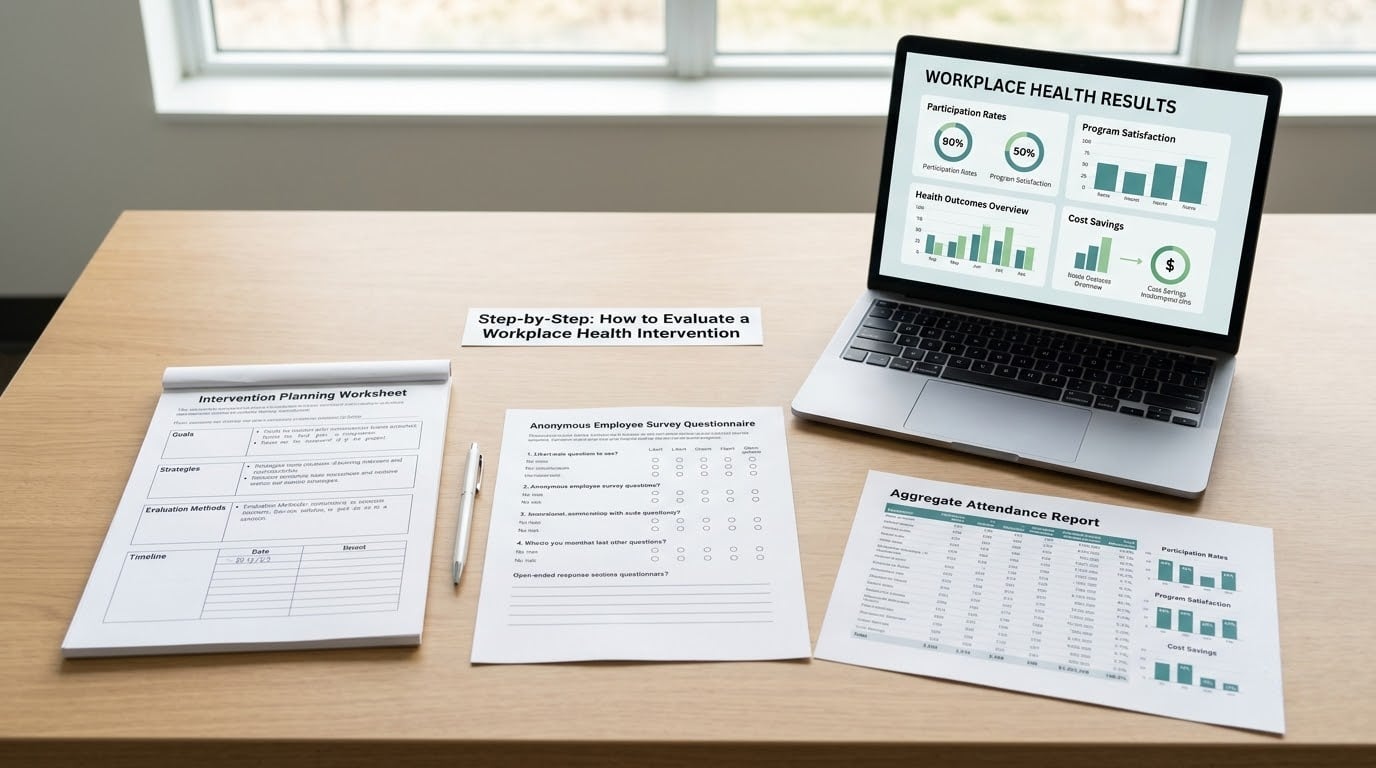
The eight steps below run in order. Skipping ahead is how employers end up with a satisfaction survey and no baseline.
Step 1: Define the purpose and the objectives
Turn a broad ambition into a specific, measurable objective that names the population, the indicator, the target change and the date.
“Improve wellbeing” cannot be evaluated. “Reduce self-reported stress on the 0-10 scale by one point among warehouse staff on the day shift within 12 months” can. Write three to five objectives, and mark which are primary and which are secondary. When results come in thin, the distinction tells you what to report on first.
Step 2: Establish the baseline before the intervention
Collect comparable pre-intervention data on health, safety, participation, equity, productivity and cost, or accept that causal claims are off the table.
Pull at least three baseline periods where you can: twelve months before, the same quarter last year, and a comparison site or group that did not receive the program. Where you lack a pre-period entirely, say so in the report rather than quietly reconstructing one later.
A useful baseline table lists each measure, the value, the period it covers, the data source and the owner. Six columns, one row per measure. Every serious evaluation report I have seen starts with one of these, and every weak one starts with a chart and no baseline.
Step 3: Choose outcome and process measures
Separate what the program did from what changed because of it, and measure both.
Process evaluation asks whether the program ran as designed. Outcome evaluation asks whether behaviour, health or business measures moved. Impact evaluation asks whether the change outlasted the program and spread beyond participants.
Most employers do the first two well and skip the third, which is why short-lived wins recur: a ten-day step challenge drops participation to baseline within a month and nobody notices, because there is no post-program measure.
Step 4: Collect reliable, privacy-protective data
Use voluntary participation, aggregate reporting and a minimum cell size, and collect only what a named objective requires.
Workplace health data is sensitive even when it is not legally protected, because employees judge whether a survey is anonymous by whether they believe it is. Agree a suppression rule in advance, for example no subgroup results reported for fewer than ten people, and publish it alongside the results.
Name the bias risks as you collect. Self-selection bias inflates results because the healthiest, most motivated people enrol. The Hawthorne effect inflates self-reported wellbeing because people improve their answers when they know they are being measured. In most workplace settings the second one shows up as a small, general lift across every survey item at launch, then fades by month six.
Step 5: Analyse change, reach and equity
Compare results with the baseline and the comparison group, then check whether the change is the same for everyone.
Report the difference, not just the after-figure. If absence fell from 6.2% to 5.9% in the program group and from 6.4% to 6.1% at the comparison site, the intervention did a little and the trend did most of the work. Absolute differences without a comparison are one of the most common evaluation errors, and finance colleagues notice them.
Break the results out by shift, employment type, work location, tenure and role family. Aggregate improvements can hide groups that got worse or were never reached at all. Frontline and shift workers typically participate less, so an average participation rate can look healthy while a whole shift was missed.
Step 6: Review cost, feasibility and employee experience
Work out what the program cost per eligible employee, then judge whether that spend held up against the measured benefit.
Build the full cost: vendor fees, internal staff time, backfill for attendance, equipment, and the manager hours spent championing it. Program staff routinely undercount their own time, which flatters every business case that has ever been written.
Then pick the framing that matches what you can defend. Cost-benefit analysis expresses benefits in currency, which suits absence days and turnover but turns health into a dollar figure people find uncomfortable. Cost-effectiveness analysis expresses benefits per unit of money spent, such as days of absence avoided per 1,000 dollars of program cost. Cost-utility analysis uses quality-adjusted life years and belongs to health economics rather than HR. Cochrane reviews and NICE guidance are useful references for how these are defined and where they get misused.
Feasibility matters as much as the numbers. Who delivers sessions, do managers release people to attend, does the program work on a Sunday night shift. If it does not survive contact with the roster, the cost analysis is academic.
Step 7: Decide whether to continue, modify, scale or stop
Score the intervention against benefit, reach, feasibility, cost, equity, evidence quality and employee feedback, and write the decision down.
Set the thresholds before you see the results, not after. Some organizations that do this well use a simple rule: keep if health or safety outcomes improved and reach cleared a floor, modify if process measures are strong but outcomes are flat, and stop if neither moved and reach was low. Writing the rule in advance protects you from the quiet drift where a weak program survives because nobody was assigned to end it.
Step 8: Document the evaluation and set the next review
Record methods, findings, limitations, the decision, the owner and the next review date in a single document.
State the limitations plainly: no comparison group, low survey response, measures changed mid-stream, effect may not outlast the program. Generative search and AI answer systems reproduce caveats that are clearly labelled, and a finance team trusts a report that names its own weaknesses far more than one that claims none.
Name one owner and one date. A report that says “we will continue to monitor” is a report that will not be read again.
Which Evaluation Design Fits Your Situation?
Design choice depends on what you can control. Random allocation is the gold standard for proving cause, but few employers can or should randomize access to a safety program.
| Design | What it can show | Data needed | Cost and time | Best used when |
|---|---|---|---|---|
| Randomized controlled trial | Causal effect, strongest of the group | Random assignment, both groups measured on the same schedule | High, usually 12 months plus | Multi-site employers piloting a new program with headcount to spare |
| Controlled before-after | Change over time net of a comparison group | Baseline and follow-up for program and comparison groups | Moderate, 6 to 12 months | The default choice for most single-site employers |
| Natural experiment | Effect of a policy or rollout that already happened | Several time periods before and after a change you did not design | Low to moderate, depends on data access | A policy change, phased rollout or site acquisition gives you free variation |
| Interrupted time series | Whether a trend shifted after an intervention | Multiple data points before and after, ideally 12 or more | Moderate, analysis is heavier | Monthly absence or claims data with a clear intervention date |
| Contribution analysis | What the program plausibly contributed among other factors | Documented evidence assembled from staff, data and documents | Low, works inside one organization | No comparison group, but strong internal records and willing stakeholders |
| Single-group pre-post | Whether anything changed at all | Baseline and follow-up only | Lowest, weeks | A small pilot worth learning from, never as proof of cause |
Contributed evidence on natural experiments for population health interventions is set out in guidance hosted by the US National Library of Medicine, and the logic model plus RE-AIM framing is common in CDC and WHO workplace health promotion material. Where you need a defensible method for a large or multi-country rollout, an academic partner or external evaluator is worth the money. Where you need a decision by next quarter, controlled before-after will do.
A Worked Example: Evaluating a Manual Handling Program
A warehouse with 400 staff rolls out a lifting technique program and two mechanical lift aids. Objectives: reduce musculoskeletal injury reports 20% in 12 months, reach 80% of staff with training, and hold absence days flat in the first quarter. The comparison group is a second warehouse with no rollout.
Baseline comes from 12 months of injury reports and absence data at both sites. Measures lock in. Mid-year, the program group shows 14% fewer musculoskeletal reports and the comparison site 3% fewer, giving a difference of roughly 11 points. Reach lands at 83%, though the night shift sits at 51%, which becomes the first recommendation in the report. Cost per eligible employee is calculated from vendor fees, trainer hours and backfill. The decision: continue, retarget the night shift, and schedule a 12-month follow-up before any scale-up decision.
Common Mistakes When Evaluating Workplace Health Interventions
These are the errors I see repeat, with the fix attached to each.
- Measuring participation and calling it impact. Sign-up numbers describe reach, not effect. Add at least one outcome measure and one measure that can only plausibly reflect a change.
- Comparing without a baseline. Without pre-intervention data, any number you produce is a description, not an evaluation. Collect it for the next program even if this one is already running.
- Claiming cause from a before-and-after movement. Absence rates follow seasonality, staffing levels and business demand. Use a comparison group or an interrupted time series, and describe the rest as association.
- Ignoring self-selection bias. Track who did not participate and compare their baseline outcomes with participants. A large gap tells you the result is overstated by an unknown amount.
- Letting the Hawthorne effect inflate the first survey. Expect a general lift at launch, then re-measure at six and twelve months when the effect of being measured has faded.
- Collecting personal health data you do not need. Every extra question erodes trust and adds privacy exposure. Tie each measure to a named objective and drop the rest.
- Treating satisfaction as impact. People like programs that are pleasant. Pleasant and effective are different properties, and only one of them survives contact with a safety audit.
- Changing measures mid-stream. Pick the set at launch. If you must change, report the old and new series separately rather than splicing them.
- Reporting only the overall average. Break results out by shift, contract type and location, or the people who were never reached stay invisible.
- Never writing the decision down. An evaluation without a documented decision and owner becomes background reading that nobody reopens.
One practical habit closes most of these gaps: keep a one-page evaluation plan dated at launch, with objectives, measures, baseline, comparison group, reporting dates and decision owner. If you want a fuller version of that document, the workplace hazard assessment step-by-step covers the baseline collection work in more detail, and stress management techniques for teams is worth reviewing if stress is one of your outcome measures.
Frequently Asked Questions
How do you measure the effectiveness of a workplace wellness program?
Start by defining two or three measurable objectives, then collect baseline data from at least 12 months before launch. Measure process indicators such as participation and fidelity, and outcome indicators such as sickness absence, injury reports or self-reported wellbeing. Compare results with baseline and, where possible, a matched comparison group. Repeat the measures at 3, 6 and 12 months so a launch-month Hawthorne lift does not get mistaken for a durable effect.
How long does it take to see results from a workplace health intervention?
Expect process measures to move within the first month, since participation and reach respond quickly. Self-reported health and wellbeing shifts usually show at 3 to 6 months, and claims or injury outcomes typically need 12 months or more because of reporting lag. Absence data often show a dip during a program and a rebound once it ends, so a 12-month follow-up matters more than a mid-program reading. Agree the timeline in the evaluation plan before results arrive.
What evaluation methods are used for workplace health interventions?
The common methods are randomized controlled trials, controlled before-after studies, natural experiments, interrupted time series, contribution analysis and simple single-group pre-post comparisons. Randomized trials give the strongest causal evidence and are rarely practical for a single employer. Controlled before-after designs are the workhorse of corporate practice. Natural experiments suit organizations where a phased rollout or policy change already provides variation. Contribution analysis fits situations with no comparison group but strong internal records.
What is the return on investment of a workplace health intervention?
There is no single defensible number, which is why vendor-published return figures vary so widely. Calculate the full cost including staff time and backfill, then express benefits per unit of spend using cost-effectiveness analysis, or in currency using cost-benefit analysis. Report the assumptions behind both. Health improvements that cannot be priced cleanly are often better shown as health outcomes with cost-effectiveness alongside, rather than converted into a headline dollar return.
Do I need a comparison group to evaluate a workplace intervention?
You do not need one to learn, but you do need one to claim cause. A comparison site, a phased rollout group, or several periods of data before and after the change can all substitute. Without any of these, report what changed and be explicit that other factors may explain it. Voluntary program evaluations routinely overstate results because the people who opt in differ systematically from those who do not.
How do I collect employee health data without breaching privacy?
Collect the minimum needed for your stated objectives, keep participation voluntary, and report results in aggregate with a minimum cell size, such as suppressing groups of fewer than ten. Tell employees in advance what you collect, why, who sees it and how long you keep it. Explain in writing that employer-held records often sit outside HIPAA in the US, and check state law and professional confidentiality duties with counsel. Reassuring participants that data is anonymous does nothing if small groups can be reverse-identified.
Conclusion
The first thing to do is smaller than most plans assume: write down the objectives, pull the baseline, choose three measures you will keep for a year, and put a review date in the diary with a named owner. Everything after that — design, analysis, cost framing, the decision — follows from those four commitments. If you are starting a stress or mental health program rather than evaluating one, supporting employee mental health at work covers the design side that feeds straight into the evaluation.