

A logic model for a workplace health program is a map that traces what you put in, what you do with it, who reaches, what changes for them, and what changes for the organization. Written as a table or a left-to-right diagram, it forces a program to state its causal theory before money is spent and to attach a measure to every claim in that theory.
If you have ever handed a CFO a wellness budget request and heard the follow-up question — how do we know it works? — the logic model is the document that answers it. It is also the appendix most grant applications ask for, and the fastest way to see that a program is confusing its activities with its outcomes.
This guide walks through the six components, gives you a fully populated example, a blank template you can print, and a measure-selection table. The examples run through workplace health promotion programs like stress reduction, vaccination clinics, ergonomics, and safety initiatives.
If you have not run a wellness program at all yet, start with how to start an employee wellness program first, then come back and map it.
Table of Contents
- What Is a Logic Model for a Workplace Health Program?
- Why Use a Logic Model to Plan Workplace Health?
- How Do You Build a Logic Model for a Workplace Health Program?
- Step 1: Name the population and the single priority outcome
- Step 2: Define pre-implementation conditions
- Step 3: Write the inputs
- Step 4: Write the activities
- Step 5: Write the outputs
- Step 6: Work backwards through the three outcome levels
- Step 7: Write the assumptions, external factors and the measures
- Five common logic model mistakes and how to fix them
- What Should Be Included in Each Part of the Model?
- How Do You Choose Measures for a Workplace Health Program Logic Model?
- How Can You Test and Improve a Workplace Health Logic Model?
- Frequently Asked Questions
- What is the difference between a workplace health logic model and a theory of change?
- Do I need a logic model for a small workplace wellness program?
- What outcomes should a workplace health program logic model include?
- How often should a workplace health logic model be reviewed?
- How can I measure whether the activities in my logic model worked?
- Can a workplace health logic model include employee privacy concerns?
- Conclusion
What Is a Logic Model for a Workplace Health Program?
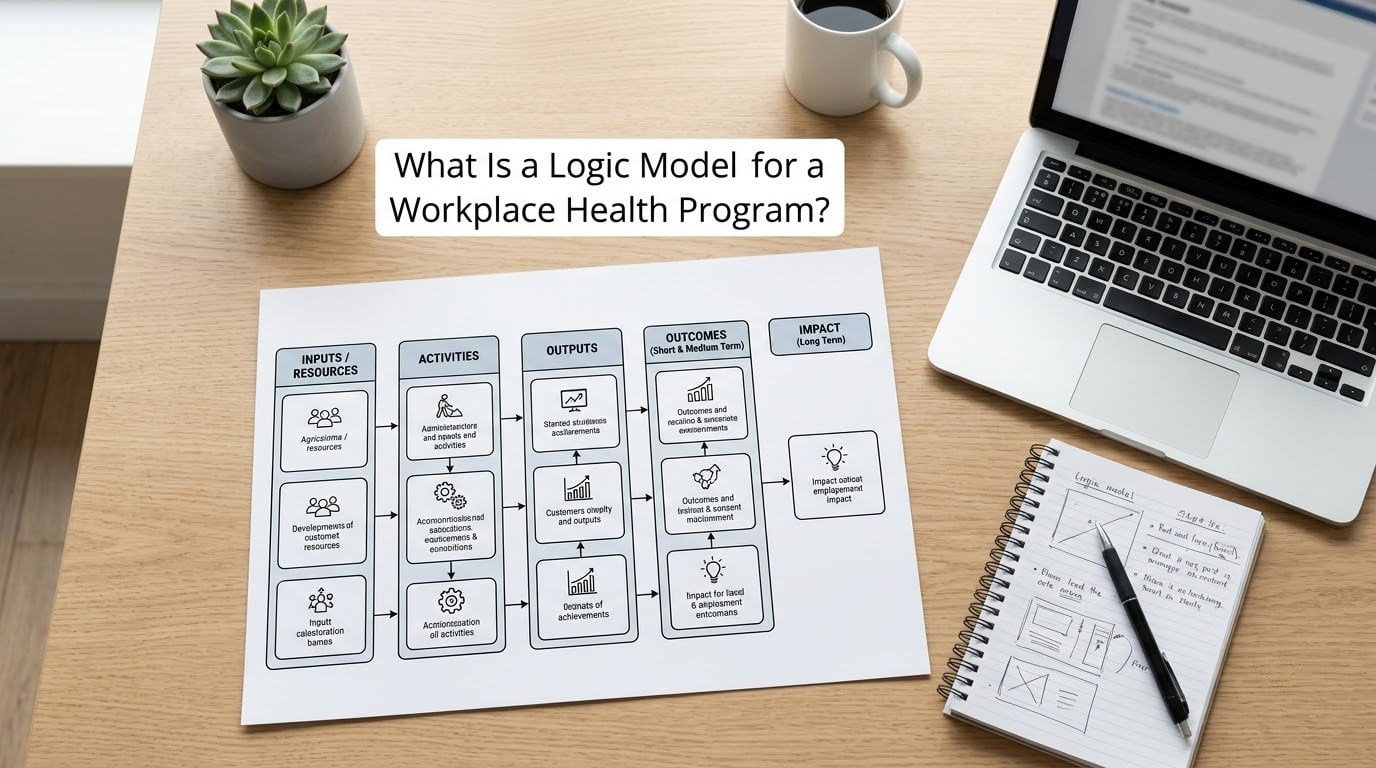
A logic model for a workplace health program is a visual or tabular map showing how the resources you commit (inputs), the work you do (activities), the people you reach (outputs), and the resulting changes in employee behavior and organizational performance (outcomes) combine to produce the health results you are aiming for. It is a statement of cause and effect, drawn on one page, that anyone in the organization can read.
The word model matters here. A logic model is not a theory you defend in a paper — it is a working artifact you draw before launch, hand to your finance team, and revise every quarter. The CDC’s Healthy Workplace Participatory Program evaluation framework is the best-known workplace example, and it starts one stage earlier than most: pre-implementation.
The six components of a workplace health logic model
Most workplace models use six boxes, in this order:
- Inputs — the money, staff hours, leadership permission, space, technology and partner relationships you bring to the program.
- Activities — what the program actually does: health education sessions, screenings, policy changes, walking meetings, ergonomic assessments, on-site vaccination clinics.
- Outputs — the reach and dose of those activities: how many people were reached, how many sessions ran, how much content was delivered. Outputs are counts, not changes.
- Short-term outcomes — immediate shifts in awareness, knowledge, intention and self-efficacy among participants.
- Intermediate outcomes — behavior change: more physical activity minutes, healthier eating, lower perceived stress, fewer unsafe tasks performed.
- Long-term impact — organizational results: reduced absenteeism, lower health care claim costs, improved productivity, reduced chronic disease burden, better retention.
Assumptions and external factors sit above or below the whole chain, because they describe what must stay true for the arrows to work.
Logic model, logic diagram, theory of change: what is the difference?
These four terms get used interchangeably and they are not the same thing. Knowing which one you need saves an argument later.
- Logic model — a structured map with predefined components (inputs, activities, outputs, outcomes, impact). Workplace health promotion uses this format most often.
- Logic diagram — the picture version of the same thing. It carries identical content in a visual form; the diagram is what gets pasted into a slide deck.
- Theory of change — the underlying causal argument, often written as a narrative or a set of if-then statements, before any boxes are drawn. A logic model is usually built from a theory of change, not the other way around.
- Contribution analysis — an evaluation approach for programs that cannot claim sole credit for an outcome, such as reduced smoking in a company that also raised prices at the cafeteria. It asks what the program plausibly contributed rather than what it caused outright.
Outputs are not outcomes
The single most common error in workplace health programming. We ran 12 lunch-and-learn sessions is an output. Participants reported better understanding of sleep hygiene is an outcome. If your model jumps from session counts straight to reduced health care costs, you have skipped the two boxes that carry the actual evidence.
Why Use a Logic Model to Plan Workplace Health?
A logic model is worth the afternoon it takes to build for five reasons that show up in the first planning cycle, not years later.
It forces priorities. Writing everything in one column makes it obvious which items are activities someone actually enjoys and which are outcomes the business cares about. More than one workplace program has been saved by this step alone.
It gets leadership and employees pointing at the same goal. A logic model gives HR, safety, occupational health and employee representatives a shared document. Disagreement moves from do we like walking meetings? to is walking meetings going to move our intermediate outcome?, which is a question worth having.
It aligns evaluation instruments with goals. When measures are attached to each box up front, you collect data that actually tests your theory instead of data that happens to be easy. Schaller and colleagues noted in their 2021 workplace physical-activity study that a logic model makes it easier to coordinate evaluation instruments with program goals.
It builds a fundable business case. The business case for workplace health promotion has improved since the 2012 American Journal of Health Promotion meta-evaluation reported average health care claims savings of roughly 25 percent among participating organizations. A logic model is how you explain which parts of your program would produce that kind of effect and how you would know.
It exposes weak links early. An arrow that cannot be defended — say, from standing desks purchased straight to reduced absenteeism — is far cheaper to fix in the planning meeting than eighteen months in.
None of this requires special software. Plenty of occupational health nurses build the first version in a spreadsheet, then graduate to a visual once the content holds up. The design sequence used in starting an employee wellness program is a natural place to slot the model in early.
How Do You Build a Logic Model for a Workplace Health Program?
Work backwards. Start from the health result you want and ask, in order, what would have to be true at each step to get there. Filling boxes left to right is how most models end up full of activities nobody can justify.
Step 1: Name the population and the single priority outcome
Decide who the program is for before deciding what it will do. A model aimed at all 1,400 employees and a model aimed at 180 warehouse staff on night shift are different programs with different measures. Then pick one long-term outcome to lead with — reduced musculoskeletal injury claims, say, not a list of twelve goals.
Step 2: Define pre-implementation conditions
This is the stage most how-to guides skip, and it comes straight from the CDC Healthy Workplace Participatory Program framework. Pre-implementation covers what has to exist before any activity happens: leadership commitment, a planning team, an employee needs assessment, a signed budget, a data-sharing agreement, occupational health involvement. If these are missing, nothing downstream runs, and no amount of session counting will tell you why.
Step 3: Write the inputs
List the resources you are committing, in plain terms a finance team recognizes: program budget, allocated staff hours per month, leadership sponsor time, meeting space, an existing occupational health nurse or vendor contract, health plan partnership, and technology for screening or tracking. Also list the policy permissions you need, such as time during shift for participation.
Step 4: Write the activities
Activities are the verbs. Lift-assessments on the packing line, a monthly ergonomics clinic, an on-site influenza vaccination clinic, manager training in psychological safety, a tobacco use policy revision, subsidized standing desk options for the assembly floor. Be specific enough that someone could confirm whether it happened.
Step 5: Write the outputs
Translate each activity into a count or a dose. Hours of ergonomic training delivered. Number of workstations assessed and adjusted. Number of employees vaccinated. Share of the target population reached — and reached equitably, which is where shift, hourly, remote and disability-access issues surface. See how to conduct a workplace hazard assessment if you are building the ergonomic strand.
Step 6: Work backwards through the three outcome levels
Ask what must be true for the intermediate outcome, and what must be true for that. A worked stress program chain looks like this:
- Inputs: occupational health nurse at 0.2 FTE, a funded annual budget line, protected 30-minute breaks, leadership modeling use of the breaks.
- Activities: four stress-management workshops, manager training in supportive conversation, referral list to an employee assistance program.
- Outputs: 240 employees attended at least one workshop, 42 managers trained, 180 employees given EAP referral information.
- Short-term outcomes: participants can name at least two personal stress triggers and one coping technique they intend to use.
- Intermediate outcomes: increased self-reported ability to manage stress, reduced after-work rumination scores on a short validated check, uptake of EAP counseling among referred employees.
- Long-term impact: fewer stress-related absence days in the affected departments, lower EAP claim volume, improved scores on a quarterly two-question engagement pulse.
A vaccination program follows the same chain with different verbs: inputs are clinic vendor slots and paid vaccine supply; activities are the clinic itself plus reminder messages; outputs are doses administered by department; short-term outcomes are intent to complete the second dose; intermediate outcomes are series completion rates; impact is fewer infection-related absence days and lower seasonal claim costs.
Step 7: Write the assumptions, external factors and the measures
Assumptions are the internal beliefs your chain depends on: employees have time to attend during shift, the health plan will cover screening without a copay, managers will not treat participation as a performance factor. External factors sit outside your control: state vaccination rules, local labor market, seasonal illness, benefit plan design changes. Then attach a measure to every box — the details are in the next section.
Five common logic model mistakes and how to fix them
- Counting activities as outcomes. Fix: move every count into the outputs column and write what changed for the person.
- Skipping outputs entirely. Fix: add a outputs row. Without reach and dose you cannot explain weak outcomes.
- Writing an impact goal with no measurement plan. Fix: if you cannot name a data source and a collection date, move the goal down a level.
- Listing everything as a priority. Fix: one priority outcome, two or three supporting ones.
- Designing for the average employee only. Fix: add a reach row that names shift, hourly, remote, part-time and disability-access considerations, then check participation rates by group.
What Should Be Included in Each Part of the Model?
Here is a fully worked example for a two-year worksite physical activity and stress program at a mid-sized manufacturer, then a blank version you can copy.
| Component | What belongs in the box | Workplace example |
|---|---|---|
| Pre-implementation | Conditions that must exist before activity begins | Leadership sponsor named, employee needs assessment completed, budget approved, occupational health nurse assigned |
| Inputs | Resources and permissions committed | Annual program budget line, 0.2 FTE occupational health nurse, 40 manager hours, protected breaks, health plan screening partnership |
| Activities | The work the program performs | Four stress workshops, 12 walking-group cohorts, standing desk trial on two lines, tobacco policy revision |
| Outputs | Reach and dose, counted not judged | 240 employees reached (51% of workforce), 180 workshop seats filled, 96 workstations assessed, 42 managers trained |
| Short-term outcomes | Awareness, knowledge, intention, self-efficacy | Participants name two stress triggers and a coping method; 62% report intending to walk during breaks |
| Intermediate outcomes | Behavior and condition change | Increase in self-reported break-time physical activity, reduced musculoskeletal discomfort scores, 5-point drop in perceived stress |
| Long-term impact | Organizational results | Fewer stress- and injury-related absence days, lower claim incidence on the two trial lines, better retention on lines using the program |
| Assumptions | Internal beliefs the chain depends on | Employees can attend during paid time; managers do not track individual participation; screening stays voluntary |
| External factors | Influences outside your control | Shift schedules during peak season, seasonal illness rates, health plan benefit design, local hiring trends |
What does not belong: budget figures with no stated use, named vendors who have not been selected yet, individual employee health data, and outcome statements so broad they cannot be falsified.
Blank logic model template
| Component | Your entry | Measure |
|---|---|---|
| Priority outcome | ||
| Target population | ||
| Pre-implementation conditions | ||
| Inputs | ||
| Activities | ||
| Outputs | ||
| Short-term outcomes | ||
| Intermediate outcomes | ||
| Long-term impact | ||
| Assumptions | ||
| External factors |
How Do You Choose Measures for a Workplace Health Program Logic Model?
Attach a measure to every box, and pick measures from five families. Process measures confirm the activity happened as designed. Reach measures confirm who was touched, broken down by shift, location, employment type and remote status so gaps show up. Dose or quality measures confirm it happened at enough intensity to matter. Outcome measures confirm change in people. Organizational measures confirm change in the business.
Be honest about what your organization will actually collect. A measure that depends on voluntary survey response every quarter usually dies by quarter three.
| Box | Example indicator | Data source | Timing | Owner |
|---|---|---|---|---|
| Outputs | Reach share by shift and location | Registration and attendance records | Per activity | Program coordinator |
| Outputs | Sessions delivered against plan | Program calendar | Monthly | Program coordinator |
| Short-term outcome | Knowledge score on a short pulse survey | Three-item anonymous survey | Pre and post | Occupational health nurse |
| Intermediate outcome | Self-reported weekly physical activity minutes | Anonymous survey item | Baseline, 6 months, 12 months | Program coordinator |
| Intermediate outcome | Workstation adjustments completed | Ergonomic assessment log | Continuous | Ergonomics lead |
| Long-term impact | Days absent for stress or musculoskeletal reasons | HR absence records, aggregated by department | Quarterly | Benefits analyst |
| Long-term impact | Claim incidence on participating lines | Claims data from broker, aggregated | Annual | Risk manager |
Two guardrails matter here. First, keep health data aggregate: report participation and outcomes by group of five or more, never pass individual health information to a manager, and tell employees plainly what is collected and who sees it. Employee trust is a program input, and it disappears quickly. Second, connect cost outcomes to a cost framework, as in how to measure wellness program ROI, so a finance reader can follow the arithmetic. Third, set the incentive deliberately: step-count and team-challenge incentives produce participation spikes, and evidence for durable behavior change behind them is mixed. Put it in your model as an assumption, not a certainty.
How Can You Test and Improve a Workplace Health Logic Model?
A logic model is a set of claims about cause and effect, and claims can be tested before you spend the year finding out they were wrong.
Walk the arrows one at a time. For each pair of boxes, say the sentence out loud: because we did X, Y changed. If the sentence needs a hedge word, the link is weak. Replace it with a more modest claim you could actually support.
Test the assumptions, not just the outcomes. Put two or three assumptions in front of the employees and managers who would know: will people really take breaks when production is tight? Twenty quick conversations often reveals that a middle box was never going to happen.
Review the model with employees and partners. A participatory walkthrough catches design errors that no planning meeting will. The participatory framing is central to the CDC workplace model.
Revise and version it. When a link breaks, change the box rather than defending the chain. Give the model a version number and a date so nobody argues about which draft they read.
Review on a fixed cadence. Quarterly for the first year is a reasonable rhythm: check reach and dose numbers, compare short-term outcome trends to plan, and confirm the data you expected actually arrived. A big shift in population, policy or leadership is a good reason to redraw earlier.
Frequently Asked Questions
What is the difference between a workplace health logic model and a theory of change?
A theory of change is the causal argument itself, usually written as a narrative or as if-then statements explaining why a program should work. A logic model is the structured map built from that argument, using defined boxes for inputs, activities, outputs, outcomes and impact. You usually write the theory of change first, then lay it out as a logic model so other people can check each link.
Do I need a logic model for a small workplace wellness program?
You need something simpler than a full one-page model, but you still need the chain. A 15-person firm can fill in six boxes in twenty minutes and it will still catch the common mistake of assuming a program worked because it felt good. Small employers gain the most from writing assumptions down, because there is no evaluation team to do it for them and no budget line for a consultant.
What outcomes should a workplace health program logic model include?
Three levels: short-term outcomes in awareness, knowledge and self-efficacy; intermediate outcomes in behavior, such as physical activity minutes, healthier eating or reduced discomfort; and long-term impact in organizational results like absenteeism, claim costs, productivity and retention. Choose one priority outcome in each level rather than listing everything, and only claim a long-term impact you have a realistic way to measure.
How often should a workplace health logic model be reviewed?
Review it quarterly during the first year, then twice a year once the program is steady. Each review should check whether reach and dose numbers match plan, whether short-term outcomes are trending as expected, and whether the data you planned to collect actually arrived. Redraw the model sooner if the target population, policy environment or leadership changes materially.
How can I measure whether the activities in my logic model worked?
Start at the bottom of the causal chain and work up. Check outputs first, because weak outcomes under a weak reach figure usually mean a delivery problem, not a program problem. Then examine short-term and intermediate outcomes against your baseline, and treat long-term impact figures as context rather than proof, since many factors outside the program move those numbers. Compare participating and non-participating groups where your data allows.
Can a workplace health logic model include employee privacy concerns?
Treat privacy as an input and an assumption rather than a footnote. Write into the model that all reporting is aggregate, that no individual health data reaches a manager, that participation is voluntary, and that employees are told what is collected and why. These belong in the assumptions row because the whole chain depends on people trusting the process enough to participate honestly.
Conclusion
Start small and finish the boxes. Name one priority outcome for your workplace health program, list the activities that could plausibly move it, attach a measure to each box, and write down the assumptions you are betting on.
Then take that single page to the people who fund, deliver and use the program before anything launches. Almost every weak logic model I have seen was fixable with one honest conversation at exactly that point.