

Figuring out how to run a peer support program at work comes down to eight things in place: a written scope, a confidential referral route, a named program owner, a trained cohort of employee volunteers, a supervision structure, a launch plan, a measurement set, and a quarterly review rhythm. Most failures I see come from one of those eight being skipped.
A workplace peer support program is a structured system where trained employee volunteers offer confidential, non-clinical listening and signposting to colleagues who are struggling. It sits alongside your employee assistance program (EAP), never in place of it.
This guide is written for HR, wellness and workplace health leads. It is built around what the evidence and practitioner literature actually support, including the parts that are less comfortable to hear. The framework most organizations use is Mental Health First Aid (MHFA), which reliably improves supporter literacy and confidence; evidence for improved organisational outcomes is still developing, and I would be misleading you if I pretended otherwise.
Table of Contents
- What You Need
- Step-by-Step: How to Run a Peer Support Program at Work
- 1. Define the Program’s Purpose and Boundaries
- 2. Assess Employee Needs and Choose the Support Model
- 3. Create a Confidential Referral and Escalation Protocol
- 4. Select and Train Peer Supporters
- 5. Launch a Small Pilot and Promote Participation
- 6. Support Peer Supporters Without Overloading Them
- 7. Measure Use, Quality, and Workplace Outcomes
- 8. Review and Improve the Program Quarterly
- Common Mistakes
- Frequently Asked Questions
- Do peer supporters need specialized credentials?
- Should a workplace peer support program be voluntary?
- What should a peer supporter never do?
- How should managers respond when an employee discloses distress?
- When is professional or crisis support needed instead of a peer?
- What are the downsides of workplace peer support?
- Conclusion
What You Need
Before you recruit anyone, you need a small set of documents and decisions in place. These are the artefacts that make the program defensible to HR, to legal, and to the employees you are asking to trust it.
| Document or decision | Who owns it | It is ready when |
|---|---|---|
| One-page scope statement | Program owner | It states what peers do and explicitly exclude therapy, diagnosis, medical advice and complaint handling. |
| Confidentiality policy clause | HR with legal review | It names the narrow exceptions, in writing, before anyone uses the service. |
| Referral directory | Program owner | EAP, occupational health, community and crisis contacts are listed, tested and dated. |
| Escalation protocol | Program owner with HR | Safety, harassment, injury and substance-use concerns each map to a named channel. |
| Named program owner | Executive sponsor | One person owns the budget, the schedule and the quarterly review. |
| Trained peer cohort | Program owner | Selection criteria are documented and training is completed, not just scheduled. |
| Supervision arrangement | Program owner | A recurring slot exists for peer supervision and workload check-ins. |
| Measurement baseline | Analyst or owner | EAP usage, absence and turnover data are recorded before launch for comparison later. |
Two of these matter more than the rest. The confidentiality clause and the escalation protocol are what employees test first, usually by asking a peer whether anything they say ends up in their file.
If your organisation is building the wider programme around this, it is worth reading how to support employee mental health at work first, because peer support sits inside a wider structure rather than replacing it.
Step-by-Step: How to Run a Peer Support Program at Work
Each of the eight steps below should leave you with something usable: a document, a trained person, a working referral route, or a measurable pilot result. If a step produces nothing, it was a meeting, not a step.
1. Define the Program’s Purpose and Boundaries
Write down what the program is for, in one page, before anyone is trained. The usual purpose is non-clinical listening, practical workplace support and navigation to employee assistance, occupational health or community services.
The exclusions matter as much as the inclusions. State plainly that peers do not provide therapy, diagnosis, medical advice, or help resolve a formal workplace complaint. A peer who is asked to investigate a harassment complaint is now a fact-finder with no training and no legal footing.
Define voluntary participation in the same paragraph. Nobody is referred to a peer by their manager, and using the program is never discussed in a performance review. If you have a broader mental health strategy in progress, how to start an employee wellness program is a useful companion read.
2. Assess Employee Needs and Choose the Support Model
Choose the model from what your people actually report, not from what is easiest to administer. A short confidential survey plus two or three focus groups will usually tell you whether the pressure point is stress, caregiving transitions, bereavement, burnout, isolation or return-to-work strain.
Three models cover most cases. Peer listening circles suit small teams that want a light touch. One-to-one peer contacts suit larger organisations where a person wants to approach someone privately. A trained peer ambassador network suits distributed workforces with several sites or shift patterns.
Bring in your safety and occupational health partners before you decide. They see the incident data and the absence data, and both are useful signals about where peer capacity should sit.
3. Create a Confidential Referral and Escalation Protocol
Write the escalation map before launch, not during an incident. Map urgent and safety-related concerns, harassment and discrimination reports, injuries, substance-use disclosures and mental-health concerns to specific channels: HR, EAP, occupational health, community crisis services or emergency services.
Then tell peers what they must not do. Peers do not investigate incidents, do not keep records of disclosures, do not promise secrecy, and do not delay urgent help to check with anyone first. That last one is the rule that saves lives, and it is the rule most likely to be broken by a well-meaning peer.
Escalation belongs alongside the wider psychological safety work described in how to build a safety culture at work, because it depends on people trusting that raising something is safe.
4. Select and Train Peer Supporters
Recruit against written criteria: openness, discretion, communication skill, and representation across departments, levels, locations and shift patterns. Publish the criteria before you read applications, because the appearance of favouritism does lasting damage in a program built on trust.
Train on active listening, empathy, boundaries, cultural responsiveness, confidentiality, recognising escalation cues, and referring to the right resource. Include practice scenarios. A trained peer who has only read a slide deck will freeze the first time a colleague discloses something serious.
Put a process in writing for stepping a peer back from the role when they cannot hold the standard. Usually the issue is overreach, not bad intent, and it needs a named route rather than a quiet conversation that never happens.
5. Launch a Small Pilot and Promote Participation
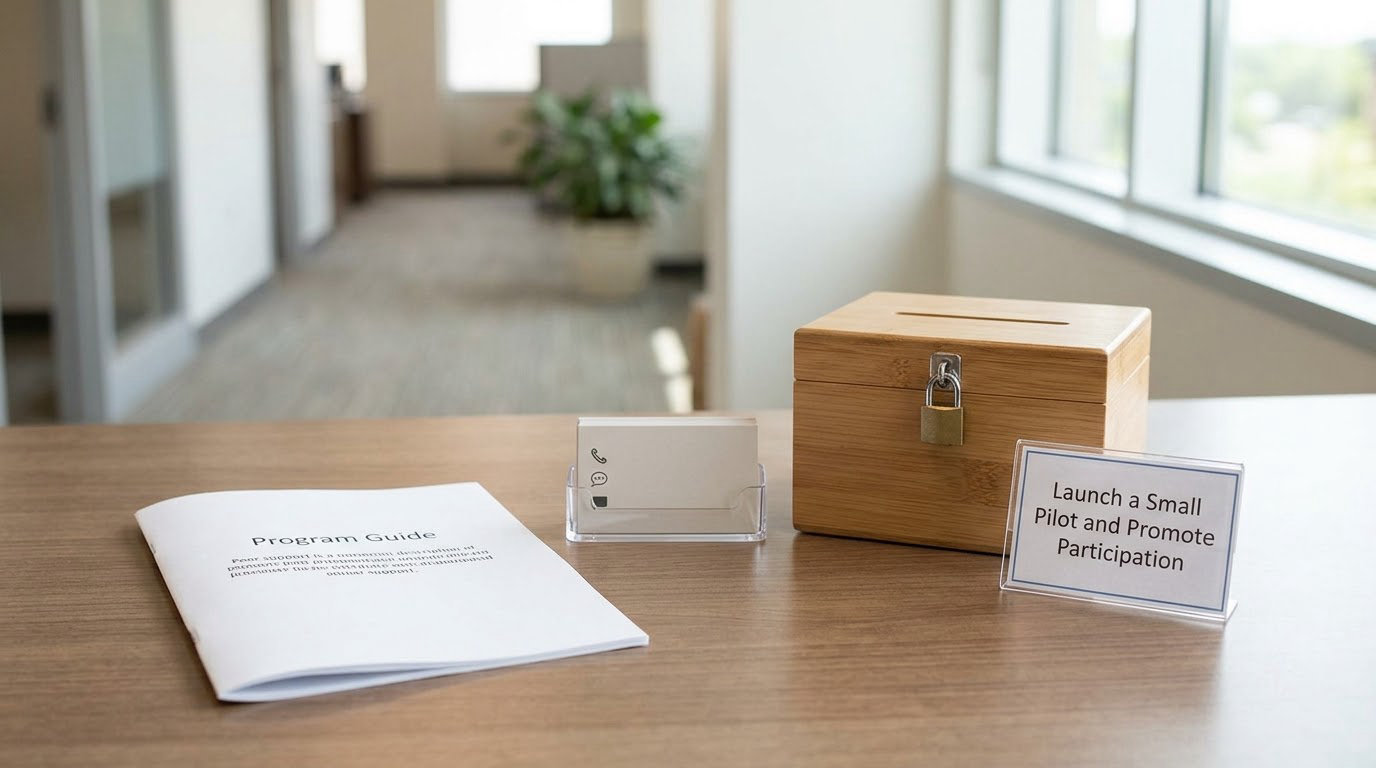
Pilot with a defined group rather than the whole workforce. Six to ten peers, one or two departments, twelve weeks. You are testing the protocol and the supervision, not proving the concept.
Give managers a short script. The message that works is plain: participation is voluntary, nothing goes in a personnel file, and using the program says nothing about performance. Managers who improvise on this are where trust leaks out.
Publish the peer names and contact channels, and write plainly what a conversation with a peer involves and how long it takes. If you are starting from nothing in this area, how to support employee mental health at work covers the wider messaging side.
6. Support Peer Supporters Without Overloading Them
Give peers protected time, a recurring supervision slot, approved talking points, and a program lead they can call between sessions. Set a soft ceiling on how many active contacts one peer holds at once; the number that feels right is lower than most programs set.
Watch for vicarious stress. Carrying other people’s distress shows up as withdrawal, cynicism, sleep disruption and a peer who stops mentioning it, which is why the supervision slot needs to be mandatory rather than offered.
Also monitor access. If support exists on one shift, on one site or through one person, the program has quietly excluded everyone else. Check who used the pilot by department and shift, not just in total.
7. Measure Use, Quality, and Workplace Outcomes
Track aggregate measures: reach, participation, repeat use, referrals completed, user confidence, perceived response quality, and training completion. These are simple to collect and they tell you whether the program is being used by the people who needed it.
Where you can, watch trends in absenteeism, presenteeism, turnover intent and perceived support against your baseline. Report them as trends, not causes. A programme that coincides with better retention has not been shown to cause it, and saying so invites exactly the kind of overclaim that ends a wellness budget.
Protect small-group privacy in every report. Never publish a cell that could identify an individual, and never report participation at a level where a two-person team becomes legible.
8. Review and Improve the Program Quarterly
Every three to six months, pull anonymised feedback, referral patterns, complaints and outcome trends, and ask peers directly whether their workload is sustainable. Update the training and the directory, retire the processes nobody uses, and close equity gaps you found in the data.
Then tell employees what changed and why. Publishing what you changed, without disclosing any individual’s information, is the cheapest trust signal available to a program like this.
Common Mistakes
These are the failures that recur most often, and each has a straightforward correction.
Treating peers as therapists
The scope statement exists to stop this. When a colleague asks for advice about medication, diagnosis or treatment, the peer signposts to a qualified service rather than answering.
Forcing participation
A manager who sends a direct report to a peer has turned support into surveillance. Participation is voluntary, always, and the program dies quietly the first time it is not.
Promising absolute confidentiality
You cannot promise secrecy when someone’s safety is at stake, so do not promise it at all. Publish the narrow set of exceptions in advance; workers accept a stated limit far more readily than a promise that sounds too good to be true.
Making support available on one schedule only
A single daytime contact number excludes night, shift, remote and multi-site staff, who are often the group with the least access. Map coverage across the working patterns you actually have.
Skipping supervision
Unsupervised peers absorb distress until they burn out or overreach. A monthly supervision slot is the minimum, and it should be in the peer’s workload rather than on top of it.
Allowing manager access to individual disclosures
The reporting line for a peer must visibly not run to the manager of the person seeking help. Anything else makes the confidentiality clause decorative.
Counting participation without quality
A rising contact count with falling user confidence is a warning, not a success. Pair every volume metric with a quality measure or you will optimise for the wrong thing.
Supplying a poster and a phone number
A referral directory nobody has used is worthless. Test each contact before publishing it, and refresh it, because word about a poor resource spreads as fast as word about a good one.
Frequently Asked Questions
Do peer supporters need specialized credentials?
No. Peer supporters are volunteers selected for communication skill, discretion and shared workplace experience, not for clinical qualifications. Most programs train them in a recognised framework such as Mental Health First Aid, which builds listening skills, boundary awareness and referral confidence. Credentials are not required, but training and supervision are.
Should a workplace peer support program be voluntary?
Yes, participation has to be voluntary. If managers can refer employees to a peer, the program becomes a reporting mechanism and stops being trusted. Write voluntary participation into the policy, keep peer contacts out of performance reviews, and make sure nobody is asked why they did or did not use it.
What should a peer supporter never do?
A peer should never diagnose, counsel, treat, give medical advice, investigate an incident, keep written records of a disclosure, or promise complete secrecy. Peers listen, signpost to appropriate resources and escalate when safety is involved. Breaching these limits puts the individual peer and the whole program at risk.
How should managers respond when an employee discloses distress?
Managers should listen, thank the person for raising it, avoid probing, and connect them with a peer, the EAP or occupational health. They should not ask for details, request a written account, or treat the disclosure as a performance issue. Training managers in psychological first aid is a core part of a working program.
When is professional or crisis support needed instead of a peer?
A peer is the right first contact for everyday stress, isolation, burnout and practical workplace strain. Professional or crisis support is needed when someone expresses hopelessness, talks about self-harm or suicide, describes harm to others, or is in immediate danger. Peers escalate in those situations rather than continuing the conversation themselves.
What are the downsides of workplace peer support?
The real risks are on the supporter side. Unsupervised peers can absorb distress, experience secondary traumatic stress, or drift beyond their competence. Programs also fail when they are volunteer-only with no protected time, or when access is uneven across shifts and sites. Regular supervision and a named program owner address most of this.
Conclusion
Start with the scope statement and the referral protocol. They are the two documents everything else depends on, and they can be written in a week without spending anything.
Then pick a small, representative group, train them properly, supervise them, and run a twelve-week pilot with a measurement set agreed before you start. A limited pilot with clear privacy and escalation rules will teach you more than a companywide launch, and it is much easier to fix.