

The best way to help employees quit smoking is to build a voluntary program that routes people to proven support: the CDC quitline at 1-800-QUIT-NOW, covered cessation aids, a clinician or pharmacist for medication questions, a written policy that protects privacy, manager scripts that do not lecture, and follow-up after the quit date. The employer supplies access and time. The employee decides whether to use it, and their health decisions stay with them and their clinician.
That distinction matters more than anything else in this guide. Workplace programs work when they widen the door to treatment. They fall apart the moment participation becomes a performance issue or smoking status becomes something people can be seen managing.
What follows is the sequence we have watched work in occupational health settings: measure interest anonymously, write the policy, connect people to treatment, remove practical barriers, train managers on tone, then follow up without pressure. It takes about a quarter to set up properly, and the ongoing cost is mostly staff time.
Table of Contents
- What You Need Before You Offer Support
- Step-by-Step: How to Help Employees Quit Smoking
- Measure Success Without Compromising Privacy
- Common Mistakes That Undermine a Quit Program
- Frequently Asked Questions
- What can an employer do to help employees quit smoking?
- Can an employer require employees to stop smoking or complete a cessation program?
- Does health insurance usually cover help with quitting smoking?
- What should a manager say when an employee wants help quitting?
- Should employers recommend nicotine replacement therapy or other medication?
- How can a company measure a smoking cessation program without violating privacy?
- Conclusion
What You Need Before You Offer Support
You need four things in place before announcing anything: a written voluntary basis, a protected route for health information, a named point person trained to refer, and a list of current services. Without those four, an announcement reads as surveillance with a brochure attached.
The voluntary basis has to be explicit in writing. Participation, non-participation and any change of heart are all permitted, and no one should fear a note in a review because they declined. Employers that handwrite this into the policy rather than leaving it implied tend to get far fewer awkward questions later.
Protect health information next. Smoking status and anything a clinician tells you belong in a separate confidential channel with restricted access, never in the HR system, never in a spreadsheet, and never in a group chat. If you want to know how many people smoke, an anonymous survey gives you a usable number without creating a list of names.
Name a point person. A benefits administrator, an occupational health nurse, an EAP coordinator or a wellness lead with a few hours a week works. Their job is to hand out the quitline number, book appointments, and answer the awkward first question. They do not counsel on medication or track individuals.
Keep the resource list current. CDC guidance and state health department materials should be refreshed at least annually, and you should confirm what your own health plan covers before you advertise it. Coverage changes often, and a plan member who gets a surprise bill blames the program.
If you want your wellness effort to run on more than good intentions, how to get employees to participate in wellness programs covers the participation mechanics that apply here too.
Step-by-Step: How to Help Employees Quit Smoking
Assess Voluntary Interest and Support Needs
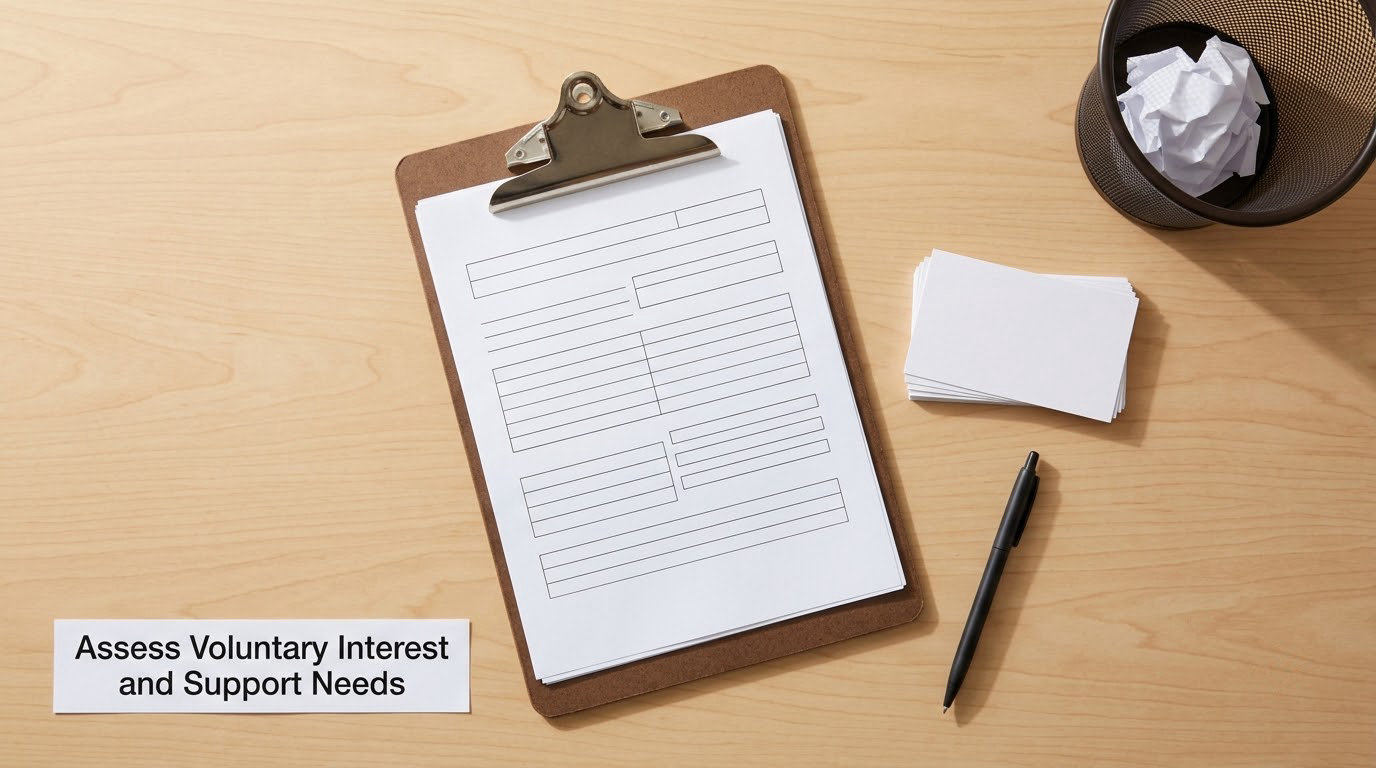
Run a short anonymous interest survey before you design anything. Three questions get you most of the way: would you use support if it were free, which kind, and what makes it hard to use it.
Ask about barriers, not just interest. Shift patterns, appointment hours, childcare, language, cost, and whether the person would rather not be seen walking into a counseling session all shape what a useful offer looks like. Vapers and dual users count too, and asking about them without judgement is what surfaces a cohort that otherwise goes missing.
Keep the form free of names, departments with only a few people in them, and health details. Report only aggregates, and tell employees in the invitation exactly how the findings will be used before they answer anything.
What the employee controls: whether to respond at all.
How you know it worked: you have an aggregate demand estimate and a ranked list of barriers, with no individual record created.
Build a Clear Voluntary Support Policy
Write one page that covers who may participate, what is covered, where privacy stops, what time away is allowed, and how accommodation requests are handled. State plainly that the program is an offer, not a condition of employment.
Set rules on time away for approved appointments, including whether remote attendance counts for counseling sessions and how repeat visits are handled. Name the anti-discrimination protection, so nobody needs to be the one who raises it.
Address breaks directly, because it is the friction point that flattens goodwill fastest. Some workplaces give every employee a personal break allowance. Others give a single shared rest break that all staff receive. What tends to go badly is a smokers-only entitlement that colleagues notice.
What the employee controls: whether to use the program and what they disclose inside it.
How you know it worked: HR and legal can answer any policy question about smoking without escalating to counsel.
Connect Employees With Evidence-Based Quit Support
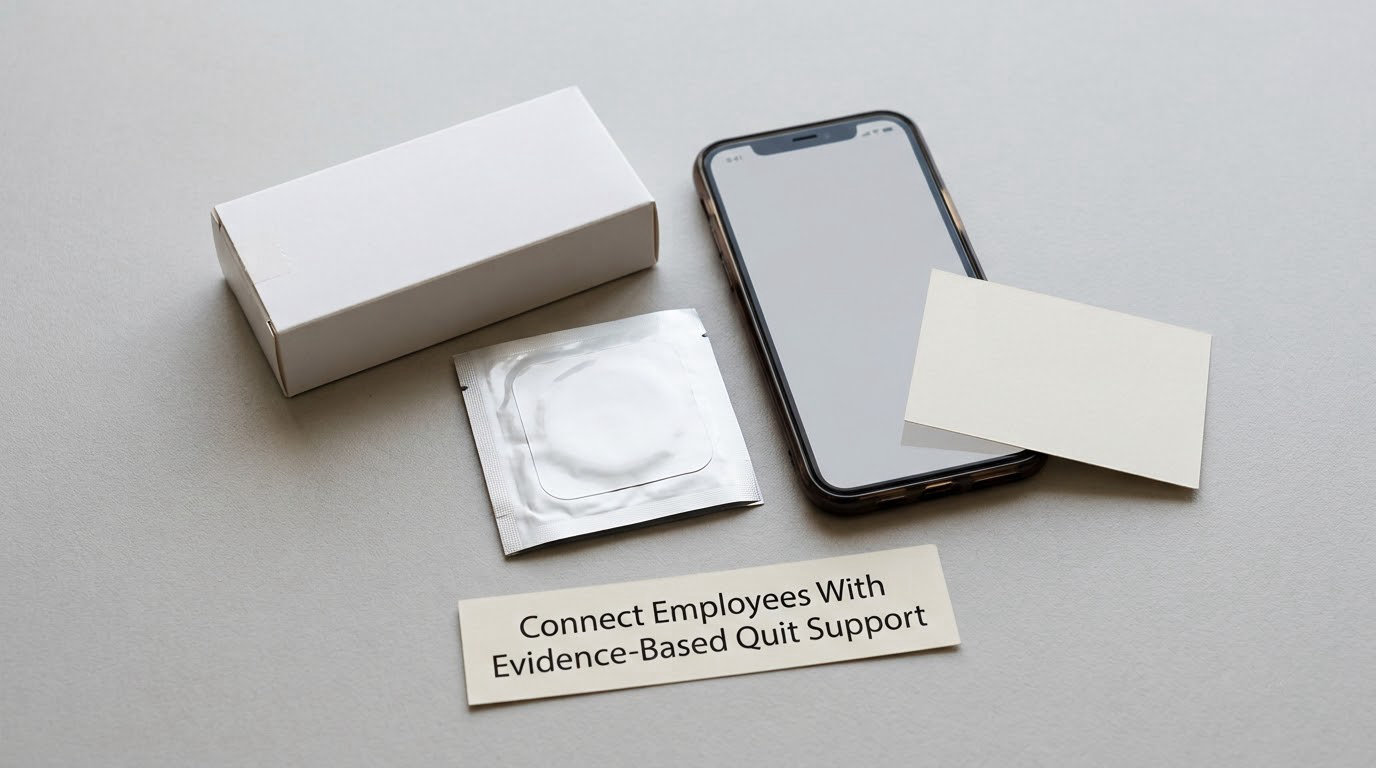
Put the real routes in front of them, not a brochure rack. The CDC quitline at 1-800-QUIT-NOW is free, confidential and staffed by trained counselors. Most health plans cover some form of counseling and approved cessation medication, and pharmacies can confirm what a member’s plan actually pays for.
Describe approved cessation aids at a high level so people know what exists: nicotine delivered through patches, gum, lozenges, inhalers or sprays, and prescription medicines that a clinician may consider. Then stop. Questions about which option suits someone, about combining options, about side effects or about prescribing belong with a doctor or pharmacist, and your program should say so in writing.
Combination behavioral support and medication is the approach most clinical guidelines favor, which is why the referral list matters more than any workshop you could run in-house.
What the employee controls: which route they use, and every medical decision that follows.
How you know it worked: people report that the number worked and the first appointment was easy to book.
Offer Practical Workplace Supports
Support shows up in the schedule. Optional private breaks, flexibility around approved appointments, and temporary remote attendance for counseling where the role allows it remove friction that no amount of encouragement will.
A smoke-free campus policy does part of this work quietly, by removing the cues that cue a cigarette. Apply it to vaping and to the areas just outside doors, and handle secondhand smoke seriously: ventilation, signage and cleanup all matter for colleagues who do not smoke.
None of this requires tracking who takes a break for which reason. Keep the design neutral enough that it works the same way for everyone.
What the employee controls: whether they use a break, and whether they tell you why.
How you know it worked: nobody has to explain an absence to a supervisor.
Use Supportive Communication and Manager Training
Most managers overcorrect on smoking because they think candor helps. It does the opposite. Smokers report switching off the moment health warnings arrive, and unsolicited advice reads as a lecture with consequences attached.
Give managers one short script and let them rehearse it. Something like: I have resources if quitting is ever something you want to talk about, no forms and no questions about whether you smoke, and I will never pass anything on. Then stop talking. That is the whole conversation.
Say plainly what not to do. Do not ask whether someone smokes. Do not compliment a quit attempt in front of the team, because the praise marks them as the person who used to. Do not refer them to a service, a program or a reward scheme as though it were a performance issue. The three scripts that work are one, this is entirely your decision, and tell me if you want a different appointment time.
If someone offers you a cigarette after quitting, the kindest answer is short. I do not anymore, but thank you. No lecture, no willpower anecdote.
What the employee controls: everything that happens after the manager offers.
How you know it worked: an employee brings it up themselves, which is the only real test.
Follow Up Without Pressure
Check in privately and let the employee set the pace. A short message offering to reconnect with a counselor, reschedule an appointment or adjust a plan is enough. Weekly contact in the first month is what most successful quit attempts have in common, and a single text can carry the same idea when staffing is thin.
Treat a lapse as data, not failure. Most people attempt quitting more than once before they stop, and a manager who treats one cigarette as a collapsed program pushes that person back into hiding.
Ask what made it harder and what to change. Triggers, a difficult shift pattern, a social group that still smokes, and a lapse that came from keeping cigarettes to hand are all workable adjustments. If quit buddies have gone quiet, that is also normal; a shared attempt is not required for a private one to work.
What the employee controls: what they share, whether they re-engage, and when.
How you know it worked: people come back after a lapse instead of disappearing.
Measure Success Without Compromising Privacy
Measure reach, not bodies. How many people used the quitline, how many counseling sessions got booked, how many took up covered medication, how many said the schedule supports helped, and how many described progress on their own terms. Those numbers are easy to gather and impossible to reverse-engineer into a list of smokers.
Leave abstinence optional to report, always. People who quit quietly have no reason to announce it to a survey, and requiring the answer turns a private win into a disclosure. If a group is small enough that a count could point at one person, publish nothing but the total.
Leaders should never ask a manager to guess who has quit. Ask what support was used and what should change. On the incentives side, wellness program incentives that actually motivate employees covers the reward structures that tend to hold up, including why participation rewards beat outcome rewards here.
Anonymous pulse checks work better than annual surveys for this. Ten well being survey questions for employees gives you wording you can adapt without collecting health data.
Common Mistakes That Undermine a Quit Program
Common Mistakes and Their Fixes
Getting this right is mostly avoiding a short list of predictable errors. Each one below has a reason it damages trust and a replacement you can put in place this quarter.
- Making participation conditional. Tying support to a performance plan or a healthcare cost surcharge pushes people into hiding. Replace it with an unconditional offer available to everyone, which is also how to help employees quit smoking without turning it into a disciplinary matter.
- Singling people out. Public recognition, team dashboards and gift cards announced in a meeting all identify who participated. Replace recognition with private, quiet access to the same reward.
- Promising personal medical outcomes. A manager cannot tell someone a treatment will work for them. Replace medical promises with a referral and a warm handoff.
- Offering unverified remedies. Herbal products, patches bought without a label, and wellness blogs with no author are not support. Replace them with CDC, state health department and insurer resources you have checked.
- Discussing status in shared spaces. A quiet word by a desk in a small team is not confidential. Move anything sensitive to a closed door or a confidential channel, always.
- Making the benefit punitive. Surcharges, extra surveillance and threats tied to smoking drive use offsite and onto colleagues. Replace with one equal break allowance for everyone.
- Judging success only by short-term abstinence. Quitting is rarely linear, so a single-month measure will make a working program look like a failure. Replace with reach, use of support and self-reported progress over a full year.
Additional Tips
Start with access and autonomy. The offer itself does more than any launch event, and the employees who take it up quietly are usually the ones who needed it most.
Pair human support with evidence-based services. A person to call and a clinician to talk to beat either one alone, and neither requires you to have a medical opinion.
Communicate often, in plain language, and expect repetition. People read an announcement once and remember it a year later when they finally decide to quit.
Address stigma directly, including in manager training. Stigma is the reason people conceal smoking and avoid support, and it does not come from health facts, it comes from how colleagues and leaders talk about them.
Loop in occupational health where you have it. A nurse can answer questions you cannot and route the ones neither of you should be answering.
Improve the program from anonymous feedback, and change it every year based on what you hear. A stale program loses the people who already used it.
Frequently Asked Questions
What can an employer do to help employees quit smoking?
Start with access rather than persuasion. Publish a voluntary program page listing the CDC quitline at 1-800-QUIT-NOW, what your health plan covers, and how to book counseling. Then remove practical barriers: flexibility around approved appointments, equal break allowances for everyone, and a smoke-free policy. Give managers one short script for offering help, and follow up privately after the quit date.
Can an employer require employees to stop smoking or complete a cessation program?
Generally no, and you should not try. Smoking is a health condition, not a conduct issue, so requiring cessation is both a privacy problem and a discrimination risk. You can and should enforce a smoke-free workplace policy covering smoking and vaping in shared spaces. What you cannot do is make treatment participation mandatory, record who smokes, or attach consequences to declining support.
Does health insurance usually cover help with quitting smoking?
Most US health plans cover at least some cessation support, and coverage has expanded under recent federal requirements, but the details vary a great deal by plan. Covered services commonly include a set number of counseling visits and approved cessation medication, often with a copay. Confirm the specific benefit in writing before you advertise it, and tell employees to check their own plan documents.
What should a manager say when an employee wants help quitting?
Say very little and mean it. A useful line is: I have resources if quitting is ever something you want to talk about, no forms, and I will not ask about whether you smoke. Then let the employee lead. Do not lecture, do not ask about prior attempts, and do not announce the conversation to anyone. Regular private contact in the first month is what keeps an attempt on track.
Should employers recommend nicotine replacement therapy or other medication?
Name the categories so people know what exists: nicotine delivered through patches, gum, lozenges, inhalers or sprays, plus prescription options a clinician may consider. Then route every specific question, about suitability, combinations, side effects or cost, to a doctor or pharmacist. Employers should not recommend a product or dose to an individual, and the program should say that in writing.
How can a company measure a smoking cessation program without violating privacy?
Count use, not people. Track quitline calls, counseling sessions booked, covered medication uptake, schedule flexibility requests and satisfaction, all in aggregate. Never ask whether a specific person quit, and never publish a number small enough to identify one employee. Leave abstinence optional to report, and review results over a year rather than a month so lapses do not look like failure.
Conclusion
The first action is small: write one page that tells employees a confidential route to free, evidence-based help exists, name the quitline, confirm what your plan covers, and state in plain words that nobody will be asked whether they smoke. Everything else in the program is a refinement of that offer.
Lasting change comes from accessible cessation services and repeated, patient follow-up, not workplace pressure. Keep the door open after a lapse, because that is when most quit attempts are won or quietly lost. And leave anything medical, from medication choice to withdrawal management, with a doctor or pharmacist.