
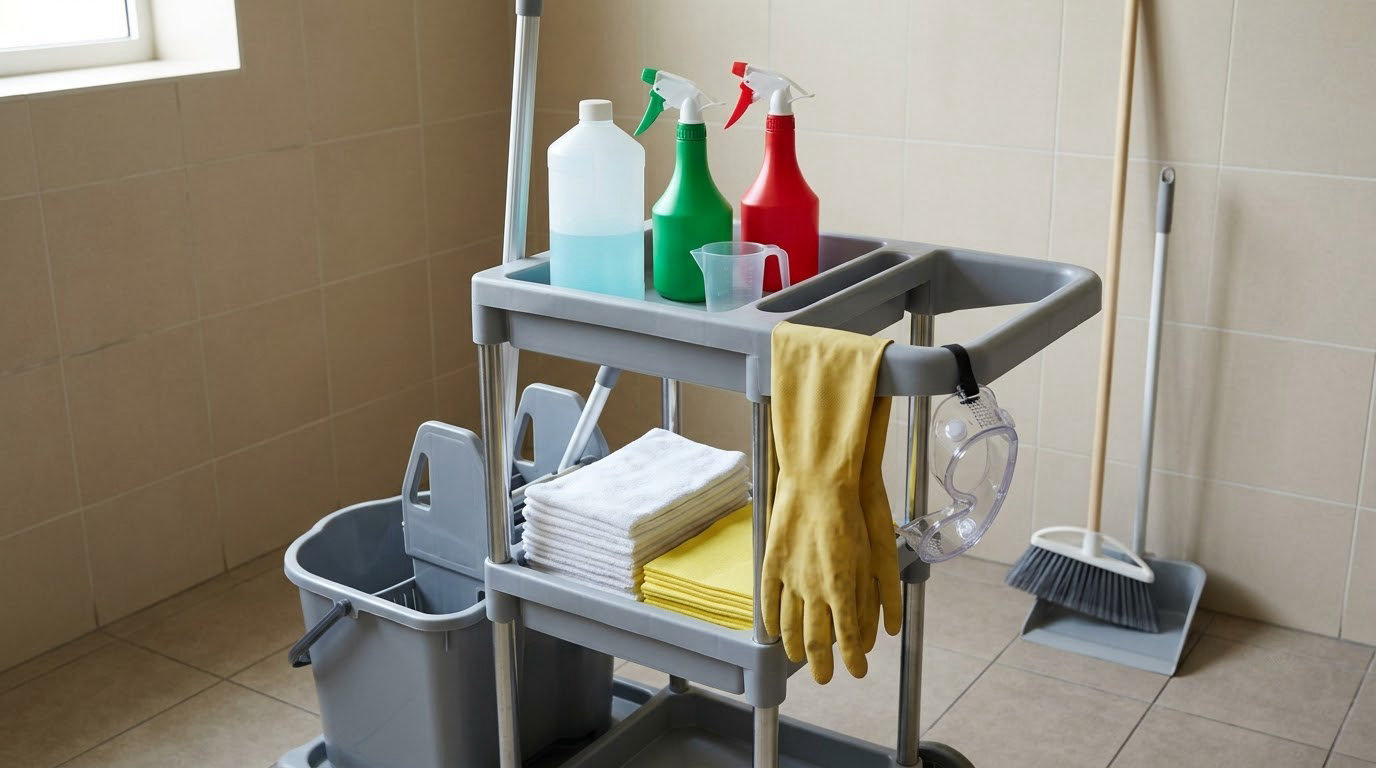
Janitorial worker chemical safety is the set of habits, protective gear, and OSHA-required hazard communication steps that cleaning staff use to handle, dilute, store, and dispose of cleaning chemicals without burning themselves, breathing in fumes, or poisoning the people inside the building. It runs on one rule that never bends: never guess what is in a bottle.
That rule sounds simple. It is not, because a janitor’s day involves far more than a bucket and a mop. A typical closet might hold a bleach concentrate, an ammonia glass cleaner, a disinfectant wipes canister, a solvent carpet spotter, a degreaser, and three spray bottles somebody decanted last year and never labeled. Every one of those is a different hazard class, and the injury usually comes from doing two of them in the wrong order.
The good news is that nearly every serious cleaning chemical incident traces back to a handful of preventable actions: an unlabeled bottle, a mixed product, no gloves, no eyewash, and a worker who was told to hurry up. This guide walks through the full plan, from building the chemical inventory to reviewing it after a change in products or tasks.
Table of Contents
What You Need
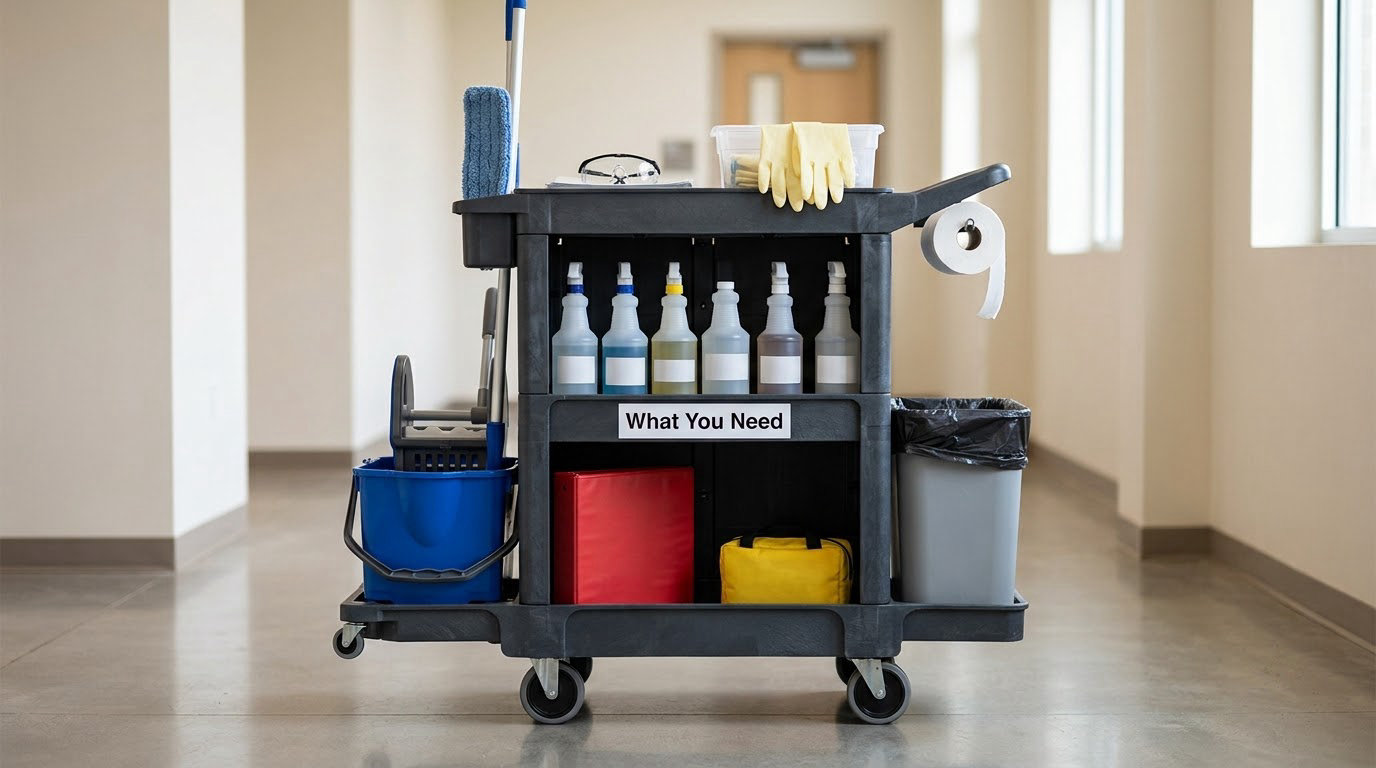
You cannot run a safe chemical routine with a rag and a spray bottle. Before the first task of the shift, a janitorial worker chemical safety setup needs six things in place, and a supervisor needs the paperwork to prove it.
- Safety Data Sheet access. A physical binder in the janitor closet or a link from your phone is fine, but it has to be reachable in under a minute. A locked office drawer is not access.
- Labels and a marker. Every container holding a chemical needs the product name and the hazard words from the original label. This includes spray bottles you decanted yourself.
- Chemical-resistant gloves and eye protection. Nitrile gloves cover most dilute cleaners. Splash goggles matter for mixing, spraying, and any bathroom or kitchen task.
- A spill kit. Absorbent pads, a scoop or disposable litter pan, a sealable waste bag, and a wet floor sign. Store it where the spill is likely, not in the closet three rooms away.
- Dilution equipment. A measured dispenser, a dedicated mixing bottle with printed graduations, and a dedicated dip-dilution bottle for concentrates. Guessing is how the wrong strength gets made.
- Eyewash access. Know where the nearest eyewash station or emergency shower is before you start. If the building has none, that is a report to your supervisor, not a problem to solve with the breakroom sink.
Supervisors add two more items to that list: a current chemical inventory of everything in the building, and a training record showing who has been trained on which chemicals and when.
Step-by-Step: A Janitorial Chemical Safety Routine
The seven steps below run in order and then repeat. The verification point at the end of each one tells you whether it actually worked, which is the difference between a routine and a good intention.
1. Identify Every Chemical in the Work Area
Build an inventory of every cleaner, disinfectant, solvent, polish, wax, and degreaser you might touch, including products other staff decant into bottles. For each one record the product name, the manufacturer, the hazard warnings, where it is stored, and what it is used for.
Walk the closets, under-sink cabinets, food-service areas, and the cage where the pool and restroom chemicals live. Watch for unlabeled spray bottles, buckets, and decanted jugs. Those are the highest-risk items on the list because nobody can tell what is inside them.
To verify: pick any three containers at random during the shift and find the matching SDS and label for each. If you cannot do that within a minute, the inventory is not finished.
2. Read the Label and SDS
Read the label and the Safety Data Sheet before the first use, not after a problem. Reading the label and SDS is the core of janitorial worker chemical safety, and it is the step that stops most accidents before they start.
A GHS label gives you six things: the product identifier, the signal word (Danger or Warning), the pictogram, the hazard statement, the precautionary statement, and supplier contact information. The SDS expands that into 16 numbered sections, with section 2 covering hazards, section 4 first-aid measures, section 7 handling and storage, and section 8 exposure controls and PPE.
Here is where to look on the label and in the SDS, and what each part changes about the way you work:
- Signal word on the label. Tells you how severe the hazard is. Warning means follow the precautions; Danger means treat every exposure seriously.
- Hazard statement. The specific harm, such as causes severe eye damage or may be fatal if inhaled. Match your PPE and ventilation to this sentence.
- SDS section 4. First-aid steps for eye, skin, inhalation, and ingestion. Read it before you need it, not during an emergency.
- SDS sections 7 and 8. Storage rules and required exposure controls. Confirm your gloves and goggles match section 8.
- SDS sections 10 and 11. Stability and toxicology information. Check what happens if the product contacts another one.
An MSDS is the old 16-section format OSHA used to require. If someone hands you an MSDS, ask for the current SDS, because the GHS version states the hazard classification explicitly instead of leaving it to the reader.
To verify: describe out loud what the label’s most serious warning means for the task you are about to do. If you cannot, you have not read it yet.
3. Match PPE and Tools to the Task
Choose gloves, eye protection, footwear, and clothing from the product and the task, not from what is already on your belt. One PPE combination does not fit every chemical, and that is one of the most common citation triggers in this industry.
- Dilute, non-corrosive cleaners: disposable nitrile gloves are usually adequate for wet work and restroom cleaning.
- Corrosive products such as acid toilet bowl cleaner: chemical-resistant gloves plus splash goggles, and never a bare hand on the rim.
- Solvents, degreasers, and carpet spotter: gloves that actually resist that solvent. Thin nitrile is poor protection against many solvents, so check the SDS section 8 glove recommendation.
- Spraying or disinfecting: goggles, not just safety glasses, because mist reaches eyes from the side.
- Blood and body fluid cleanup: gloves, gown or apron, mask and eye protection, and a puncture-resistant container for sharps.
Replace gloves the moment they are torn, contaminated, or when you switch tasks. Flipping a rag from a toilet to a sink is the habit that spreads contamination through an entire building.
To verify: before you start, hold up your glove and check the SDS section 8 line for the product. If you cannot match them, ask your supervisor for the right glove instead of guessing.
4. Store and Mix Chemicals Safely
Keep chemicals in their original containers with the original label intact, and never mix two products unless the manufacturer explicitly permits it. The dangerous combinations are ordinary ones that most workers never think to avoid.
- Bleach with ammonia or an ammonia-containing glass cleaner can produce chloramine gas and chloramines. If this happens, leave the area, get fresh air, and notify your supervisor immediately.
- Bleach with vinegar, descaler, or an acidic toilet bowl cleaner can release chlorine gas. Do not attempt to neutralize it yourself; evacuate the space.
- Bleach with another disinfectant or floor finish creates heat and fumes and stops the disinfectant from working. Rinse the surface thoroughly between products.
- Any two products not named together in a label or SDS can react in unknown ways. Use one product per task and rinse between tasks.
Decanting is allowed when a smaller container is easier and safer to use, but the new container must be labeled with the product name and the hazard words, and it must stay in the same work area. Never pour a chemical into a drink bottle, a coffee cup, or an unlabeled bucket.
Store chemicals upright, closed, and separated from incompatible groups. Bleach stays away from acids and ammonia products. Chemicals go in a ventilated cabinet, not on the floor where a cart can catch them.
To verify: pull any container from the shelf without reading it. If you cannot name what it is and what it reacts with, it is in the wrong place or the wrong bottle.
5. Use Chemicals With Ventilation and Work Practices
Follow the dilution directions exactly, because both under-diluting and over-diluting carry risk. Under-diluting leaves a caustic concentrate on a floor someone walks on; over-diluting wastes product and pushes the worker toward a stronger substitute.
Ventilate before you mix, not after. Open a window, switch on exhaust, or work in a ventilated closet. Spraying creates an aerosol that puts the chemical directly into the air you breathe, so apply with a damp cloth or a low-spray setting whenever the job allows it.
Keep food, drinks, personal items, phones, and medical supplies away from chemicals and away from chemical storage. Never take a break in a room where concentrates are stored or mixing is happening.
Use clean, dedicated tools for each zone, and keep mop handles and chemical hoses off the floor where someone can trip over them.
To verify: at the end of the task, cap every container, return it to its labeled location, and confirm the ventilation is still running or the area is aired out before anyone else enters.
6. Handle Spills, Exposures, and Broken Containers
Stop work, get people away from the area, and only then deal with the spill. A ten-minute cleanup is better than a chemical burn treated for six weeks, and small spills become injuries when someone rushes them.
For a small spill you are trained and equipped to handle: put on the gloves and goggles from the SDS, contain it with absorbent pads from the spill kit, scoop the material into a sealed bag, and place it where it cannot be walked on. Then ventilate the area and re-check the floor for residue before returning it to service.
For anything larger than a mop bucket, anything involving an unknown liquid, anything near a drain or a vent, or any spill where the SDS says to evacuate, stop and notify your supervisor immediately. Do not flush chemicals down a drain unless the SDS specifically says to.
For exposure to skin or eyes, get to the eyewash station or running water immediately and flush for the time listed in SDS section 4, usually 15 to 20 minutes. Remove contaminated clothing while you flush. For inhalation, move to fresh air. For ingestion or any severe symptom, call emergency services.
For a broken container, evacuate, ventilate, and notify. Pick up glass only with a broom and dustpan, never bare hands.
To verify: put the wet floor sign up before you start, and take it down only after the floor is dry and re-inspected.
7. Dispose of Waste and Review the Program
Dispose of contaminated materials the way SDS section 13 describes, and never down a regular drain, storm drain, or open trash without checking. Soiled mop heads, pads, gloves, and disposable wipes go in a sealed container so one wet bag does not leak onto the rest of the load.
Record the incident. Who was involved, what product, what happened, what treatment was given, and which SDS you followed. These records are what an employer needs to meet recordkeeping obligations and what workers’ compensation claims depend on.
Check for expired and past-shelf-life products on a schedule, and drop the container contents down a drain or in the trash only as the label allows. Some products degrade into more irritating vapors as they age.
Retrain whenever a new chemical enters the building or a worker changes duties. Refresh the whole crew on a set schedule, and keep the training log with names, dates, and the chemicals covered.
To verify: after any change in products, tasks, or staff, update the inventory, confirm every new SDS is accessible at the worksite, and re-check glove choices for the new products.
Common Mistakes
Most incidents trace back to one of the same short list of errors, and each one has a straightforward fix a supervisor can put in place this week.
- Unlabeled bottles. A decanted spray bottle with no product name is the single most common citation trigger in janitorial work. Fix: label every container with the product name and hazard words the moment it is filled.
- Mixing bleach with ammonia, vinegar, or another disinfectant. Fix: one product per task, and rinse the surface with clean water between products.
- Pouring chemicals into unlabeled containers. Drink bottles and coffee cups are common in break areas and cause serious ingestion incidents. Fix: never use food or drink containers, and store the real containers away from them.
- Ignoring the SDS. If the file lives in a supervisor’s office and nobody else can reach it, treat the requirement as unmet. Fix: binder in the closet plus electronic access on site.
- Wrong glove for the chemical. Cheap thin gloves feel protective and are not. Fix: match the glove material to SDS section 8 and to the specific product, not the task category.
- Treating every spill as routine. A spill near a doorway, an unknown liquid, or a spill the label says to evacuate is not a mop-up job. Fix: set a size and an unknowns limit beyond which you stop and call.
- Understaffing and time pressure. Rushing dilution is what produces the over-concentrated bucket. Fix: pre-measure concentrates during a low-traffic period rather than at 7 am in a busy lobby.
- Skipping the hands-on part of training. Workers who cannot practice dilution do not get it right under pressure. Fix: on-shift practice with the actual products, in a language everyone on the crew reads.
One more deserves its own note. If PPE is unavailable, ratcheted down, or worn out, that is a workplace safety problem to escalate, not something to work around by rinsing your hands in a sink and continuing.
Frequently Asked Questions
What is the OSHA standard for chemical safety?
The main one is the Hazard Communication Standard, 29 CFR 1910.1200, which requires employers to inventory hazardous chemicals, keep labels intact, provide accessible Safety Data Sheets, and train workers before their first assignment. For janitors, 29 CFR 1910.1030 covers bloodborne pathogens, and 29 CFR 1910.141 covers sanitation. Subpart I of the standard covers personal protective equipment requirements.
What training does a janitor need?
Before any chemical assignment, a janitor needs hazard communication training covering chemical names, hazard labels and pictograms, how to read an SDS, how to use required PPE, how to dilute and apply products, and how to respond to spills and exposures. Cleaning crews that may handle blood or body fluids also need bloodborne pathogens training under 29 CFR 1910.1030, including the hepatitis B vaccination series offered by the employer.
Is it legal for my employer to not give me gloves?
No. Under 29 CFR 1910.132 and 1910.1200, the employer must assess hazards and provide appropriate personal protective equipment at no cost to the worker. Refusing is a citable violation. Document what you asked for and the response, raise it in writing to your supervisor and safety contact, and file a complaint with your state or regional OSHA office if nothing changes.
What should I do if I get a cleaning chemical on my skin?
Get to water immediately and flush the area for the time listed in SDS section 4, usually 15 to 20 minutes. Remove contaminated clothing while you flush. Do not apply neutralizing products or home remedies to the skin. Tell your supervisor the same shift so the incident gets recorded, and seek medical care for burns, blistering, breathing trouble, or any eye exposure. Report it to a doctor and let them decide what treatment is right for you.
What chemicals should never be mixed when cleaning?
Bleach mixed with ammonia or an ammonia-containing glass cleaner produces chloramine gas. Bleach mixed with vinegar, descaler, or acidic toilet bowl cleaner releases chlorine gas. Bleach combined with another disinfectant or floor finish can generate heat and fumes and stops the disinfectant from working. The rule that covers everything else is simple: use one product per task and rinse with clean water in between.
Where should janitors find safety data sheets?
Safety Data Sheets must be accessible to every worker who handles the product, at the time and place it is used. A binder in the janitor closet is the traditional answer, and an electronic system is fine as long as staff can open it in seconds without asking permission. If yours is locked in an office or only on a supervisor’s laptop, that does not meet the right-to-know requirement.
If you take one thing from this, do it in this order: label every container tomorrow, pull the SDS binder into the janitor closet today, and confirm every worker on the crew can name the signal word and the first-aid section for the products they use. Janitorial worker chemical safety is built in those small repetitions, not in a policy binder nobody opens.