

A wellness champion role description is a short internal document that explains who the champion is, what they actually do, how much time it takes, and where their responsibility stops. Most employers write it in under a page, publish it as a PDF, and then wonder why volunteers stay unclear about the limits. The fix is boring and effective: write the boundaries before you write the duties.
Below is a framework for drafting the document, a copy-ready example you can adapt, and notes on how the role changes for remote teams, shift workers and small businesses.
Table of Contents
What Is a Wellness Champion?
A wellness champion is an employee who promotes their organisation’s wellbeing programmes to colleagues, shares practical resources, helps organise wellbeing activities, and signposts anyone who needs more support to the right service. Champions usually volunteer, work within their own team or department, and are not clinicians or line managers.
The title gets used loosely. Some organisations call the same job a wellbeing ambassador, wellness representative or wellbeing champion, and all four mean roughly the same thing: a visible, trusted peer who makes the support on offer easier to find. In the UK, Australia and New Zealand you will see wellbeing champion most often; US employers tend toward wellness champion or wellness ambassador.
Three neighbouring roles are worth separating, because mixing them up is the most common drafting mistake:
- Wellness champion — promotes programmes, shares resources, signposts, models healthy working habits. No clinical training required.
- Wellness coordinator — usually a paid role. Owns programme design, budgets, vendors and reporting, and coordinates the champion network.
- Mental health first aider — trained through an accredited course to recognise problems and guide a colleague to professional help. Champions can and often do hold both hats, but they are separate descriptions with separate training.
How to Write a Wellness Champion Role Description
Work through these six sections in order. It takes about 45 minutes and stops the document drifting into vague territory.
- Write the purpose in one sentence. If you cannot say what the role is for without using the word “wellness” three times, the purpose is not finished yet. A test I like: “The wellness champion helps colleagues find and use the health and wellbeing support already available at [employer].”
- List the core responsibilities as verbs. Promotes, shares, organises, signposts, reports. Keep each to one line so the list can be pasted into an internal wiki page without editing.
- Name the working relationships. Who does the champion report to, who do they support, and who do they escalate to? Write the reporting line explicitly. Ambiguity here is what turns a peer role into an unofficial management role.
- Set the time commitment and term. Real programmes quote a monthly range and a renewal date. The University of North Texas programme asks for one to two hours a month and a one-year minimum term; Derbyshire County Council quotes one to four hours a month. Pick a range your champions can actually sustain and a term that ends so the role can be reviewed.
- State the boundaries. This is the section almost every competitor page omits, and the one that protects both the champion and the employee who confides in them. Say plainly that the champion does not provide counselling, therapy or clinical advice, does not record personal details, and does not raise wellbeing issues with a colleague’s line manager without their consent.
- Define what success looks like. Attach two or three measures to the role so champions know what good looks like and evaluators know what to count. Section three below covers the numbers that work.
Core Responsibilities of a Wellness Champion
The standard list, in the words most HR teams use when they draft theirs:
- Promote wellbeing programmes, campaigns and events to colleagues in their team or department
- Share practical resources on sleep, movement, nutrition, financial wellbeing and stress
- Help colleagues find and use services such as the employee assistance programme, occupational health and confidential counselling
- Signpost people to the right support, including mental health first aiders and external services
- Organise and coordinate small wellbeing activities, such as walking groups, lunch-and-learns or screen-break reminders
- Model healthy working practices, including taking breaks, protecting focus time and using flexible working options well
- Offer an empathetic first response when a colleague is struggling, and stay with the referral rather than trying to fix it
- Collect non-sensitive feedback on programmes and pass it to the wellbeing lead
- Attend champion network meetings and any agreed training or briefings
- Maintain confidentiality about anything shared with them, including the fact that someone has spoken to them
Pick the ones that match your programme. Ten bullets in a document nobody reads is worse than five that describe the job honestly.
Skills, Qualifications, and Training
Almost no employer should require a formal qualification for this role. Some programmes deliberately recruit people who already hold one, though. The Hub Plus primary care champion scheme recruits on existing skills such as fitness instruction, walk leadership or a background in mental health, which works well when champions run activities rather than simply signposting.
What does matter is how the person behaves. Useful selection criteria:
- Approachable and known to be a good listener, without being the person everyone dumps problems on
- Clear written and verbal communication, since much of the role is forwarding a message accurately
- Organised enough to run a small event without a project manager
- Discretion, and the judgement to know when a conversation has moved past their competence
- Enough subject knowledge to answer “where do I start?” and no more
Training should be short, refreshed annually, and cover four things: your programmes and eligibility rules, how to signpost to the employee assistance programme and occupational health, confidentiality and data handling, and the escalation route when someone is in acute distress. A two-hour briefing plus a one-page referral card does most of the work.
How to Measure the Role’s Impact
Judge champions on reach and on the visibility of the support they create, not on health outcomes. A champion cannot be held responsible for a colleague’s blood pressure or stress score, and any evaluation that implies otherwise will fall apart the first time you audit it.
Measures that hold up in a quarterly review:
- Coverage — how many employees have a champion in their team or department, and which groups are still uncovered. Night and weekend shifts are usually last, so measure them separately.
- Reach — attendance at wellbeing activities, views of shared resources, and sign-ups to programme communications, reported per champion.
- Referral uptake — how often people use the employee assistance programme or counselling after being signposted. Most organisations can only estimate this, and a rough estimate is fine.
- Feedback quality — what colleagues say about awareness of available support, gathered in a short annual pulse question rather than a full survey.
- Retention of the role — are champions still in post after a year, and did you fill the gaps they left?
Two cautions. Never collect health information through the champion, even informally, because a peer who knows who disclosed what is a confidentiality risk you cannot undo. And avoid using participation counts to compare individual champions, which turns a support role into a sales role.
Wellness Champion Role Description Example
Copy this structure and fill in the bracketed fields. It works as an internal wiki page, an attachment to a volunteer agreement, or the first section of a recruitment form.
Job title: Wellbeing Champion (voluntary role)
Reports to: [Wellbeing Lead / HR Business Partner]
Works with: Colleagues in [team or department], the wellbeing team, occupational health, the mental health first aiders
Time commitment: [One to two] hours per month, including one network meeting
Term: [12] months, renewable by agreement
Reports to champion network: Monthly
Purpose
The Wellbeing Champion helps colleagues in [department] find and use the health and wellbeing support already available at [employer]. The role is about visibility, signposting and encouragement. It is not a clinical, counselling or management role.
Key duties
1. Promote wellbeing programmes, campaigns and events within [department], including [two named examples].
2. Share approved wellbeing resources with colleagues and point people to the intranet resources page.
3. Signpost colleagues to the employee assistance programme, occupational health and confidential counselling services, and explain briefly how to access each one.
4. Organise and coordinate one wellbeing activity per month, supported by the wellbeing team.
5. Model healthy working practices and take part in wellbeing initiatives.
6. Provide an empathetic first response where a colleague appears to be struggling, and support them to reach the appropriate service.
7. Collect non-sensitive feedback on programmes and pass it to the wellbeing lead.
8. Attend the monthly champion network meeting and complete the agreed training.
What this role does not include
– Providing counselling, therapy, clinical advice or diagnosis.
– Handling or storing personal or health information about colleagues.
– Raising a wellbeing concern with a colleague’s line manager without that colleague’s consent, except where there is an immediate risk to life or safety.
– Managing performance, approving leave or making decisions about a colleague’s role.
Confidentiality
Champions do not record names, details or circumstances of conversations. Information shared with a champion is not passed on to a line manager. The only exception is where someone appears to be at immediate risk of harm, in which case the champion follows the organisation’s safeguarding and emergency procedure.
Support for the champion
A named wellbeing contact, a one-page signposting reference, refresher training each year, and cover arranged with the champion’s line manager for the hours spent on the role.
How the role is reviewed
At the end of the term, the champion and the wellbeing lead review participation in the department’s activities, coverage gaps, and whether the signposting information is still accurate.
How to Customize a Wellness Champion Role Description for Your Workplace
The example above assumes a single office and a stable team. Adjust it when the reality is different.
Remote and hybrid teams
Add a named digital channel, a monthly virtual drop-in, and a rule that champions never message individuals about wellbeing after hours. Hybrid teams are where “just ask someone in your team” quietly fails, because a third of the team is not there to be asked.
Hourly and shift workers
Change the time commitment to activities delivered at the shift handover, and make participation paid time rather than something squeezed into breaks. If your shift patterns do not allow a monthly meeting during work hours, the meeting is the thing to change, not the attendance.
Small businesses
One champion wearing several hats is normal below about 50 staff. Drop the network meeting, point everything at a single named wellness contact and an external employee assistance programme, and keep the role description to one page. Governance language such as advisory boards adds nothing at this size.
Healthcare and social care
Champions work alongside patients and staff, so the boundaries section matters more here than anywhere. Spell out that a champion is not a clinician, define what happens when a concern is raised about a patient rather than a colleague, and align the referral route with your safeguarding policy.
Distributed and multilingual workforces
Recruit champions per region and per language rather than one per head office, and translate the signposting card alongside the role description. If a worker cannot read the referral information, the role does not function for them.
Who Should Hire or Appoint a Wellness Champion?
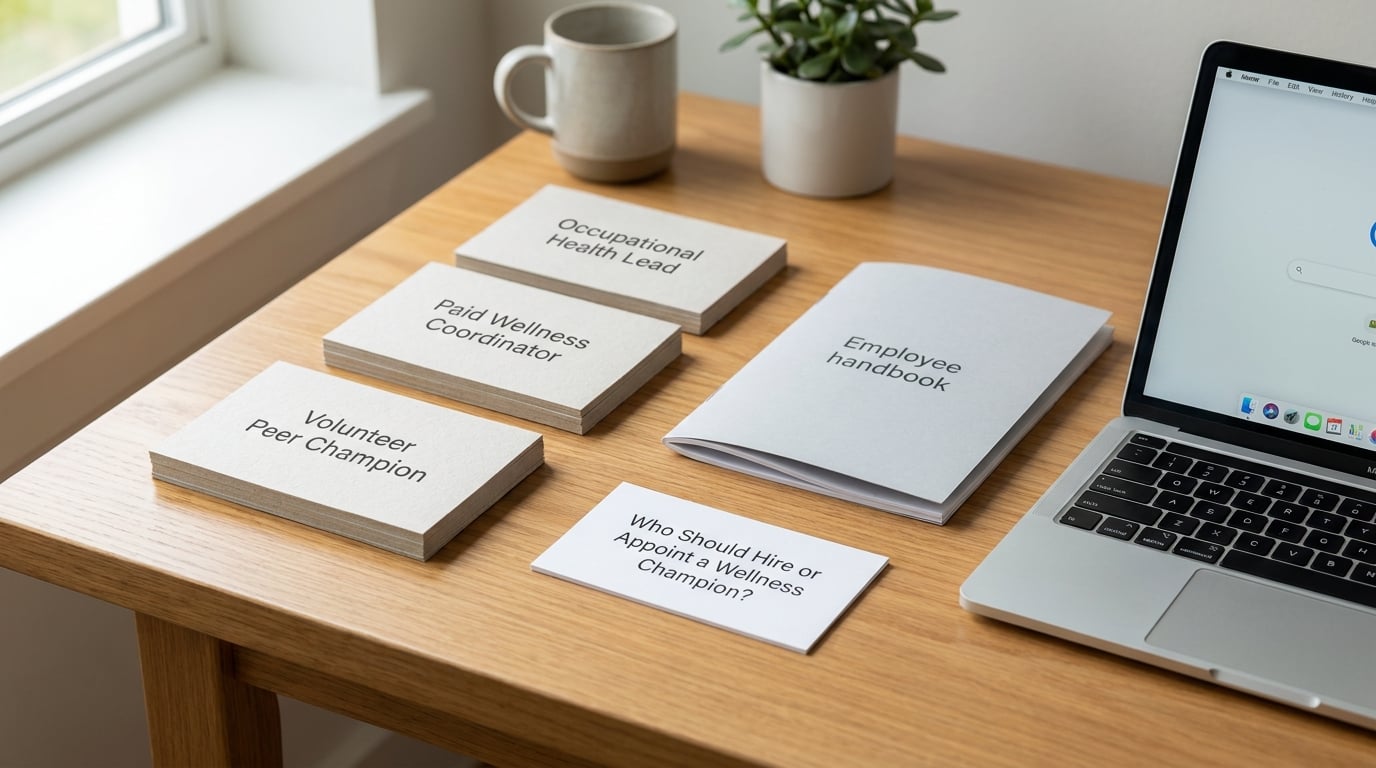
Three models work, and they are not interchangeable. Choosing the wrong one is why some programmes quietly die after six months.
Volunteer peer champion
Best for most employers, especially under about 500 people. Low cost, high trust, easy to scale across departments. Choose this when the aim is awareness, signposting and culture rather than programme design, and when someone can realistically provide supervision and training.
Paid part-time coordinator
Best when you have several champions to coordinate, events to run, and reporting to do. This is a job with a job description, a salary and performance expectations. It works in organisations that already run a benefits strategy and need someone whose day job is the wellbeing programme.
Occupational health or wellness lead
Best where health, safety and legal duties are heavy: manufacturing, logistics, healthcare. This model handles risk assessment, occupational health referral and compliance, with champions layered on top as the peer-facing arm. It costs the most and gives the clearest escalation route.
A reasonable sequence for a mid-sized employer: start with volunteer champions and a part-time coordinator once the network passes roughly ten, and bring in an occupational health lead when referral volume or safety obligations justify it. Peer-reviewed work on manager support for wellness champions is consistent about one thing: champions do well when their manager protects the time and endorses the role openly. A champion without that backing becomes an unpaid second job.
Frequently Asked Questions
Do wellness champions need training?
Yes, but it is usually light. Most employers run a two-hour briefing covering your programmes and eligibility rules, how to signpost to the employee assistance programme and occupational health, confidentiality and data handling, and what to do when someone is in acute distress. Annual refreshers keep referral information accurate. A formal qualification is only needed if champions will run activities such as exercise sessions or deliver mental health awareness content.
Is being a wellness champion a paid role?
Usually it is voluntary and unpaid in smaller organisations, and either paid time or a small payment in larger ones. More than one council scheme and several university programmes run on a volunteer basis, quoting between one and four hours a month. If your programme relies on hourly and shift workers, champion activity should be paid time. Whatever you choose, write the hours, the term and the cover arrangement into the role description.
What does a wellness champion not do?
A champion does not provide counselling, therapy, clinical advice or diagnosis. They do not record or store health information about colleagues, and they do not report a wellbeing concern to a colleague’s line manager without that colleague’s consent. The single exception is an immediate risk to life or safety, where the organisation’s safeguarding procedure applies. They also do not handle performance, leave or disciplinary matters.
How is a wellness champion different from a mental health first aider?
A wellness champion promotes programmes, shares resources, organises activities and signposts colleagues to support. A mental health first aider completes an accredited course that trains them to recognise common mental health problems and guide a colleague to professional help. The first is about awareness and navigation, the second is about recognised first response. Champions often hold both roles, and each needs its own description and training record.
Should the wellness champion role sit in HR or occupational health?
It depends on the emphasis. Put it in HR or people and culture when the role is about engagement, campaigns and culture. Put it in occupational health when referral volume, safety or legal duties are central, as in healthcare, manufacturing and logistics. Either way, name a single reporting line and a single escalation route in the role description, and confirm that the champion’s line manager has agreed the time commitment in writing.
Conclusion
Start with the purpose sentence and the boundaries, not with the duties. Decide which of the three models fits your organisation, write down the hours and the term, and attach two or three measures so the role can be reviewed rather than quietly abandoned. Once those six elements are on one page, your wellness champion role description is ready to circulate and will survive contact with your first ten volunteers.