
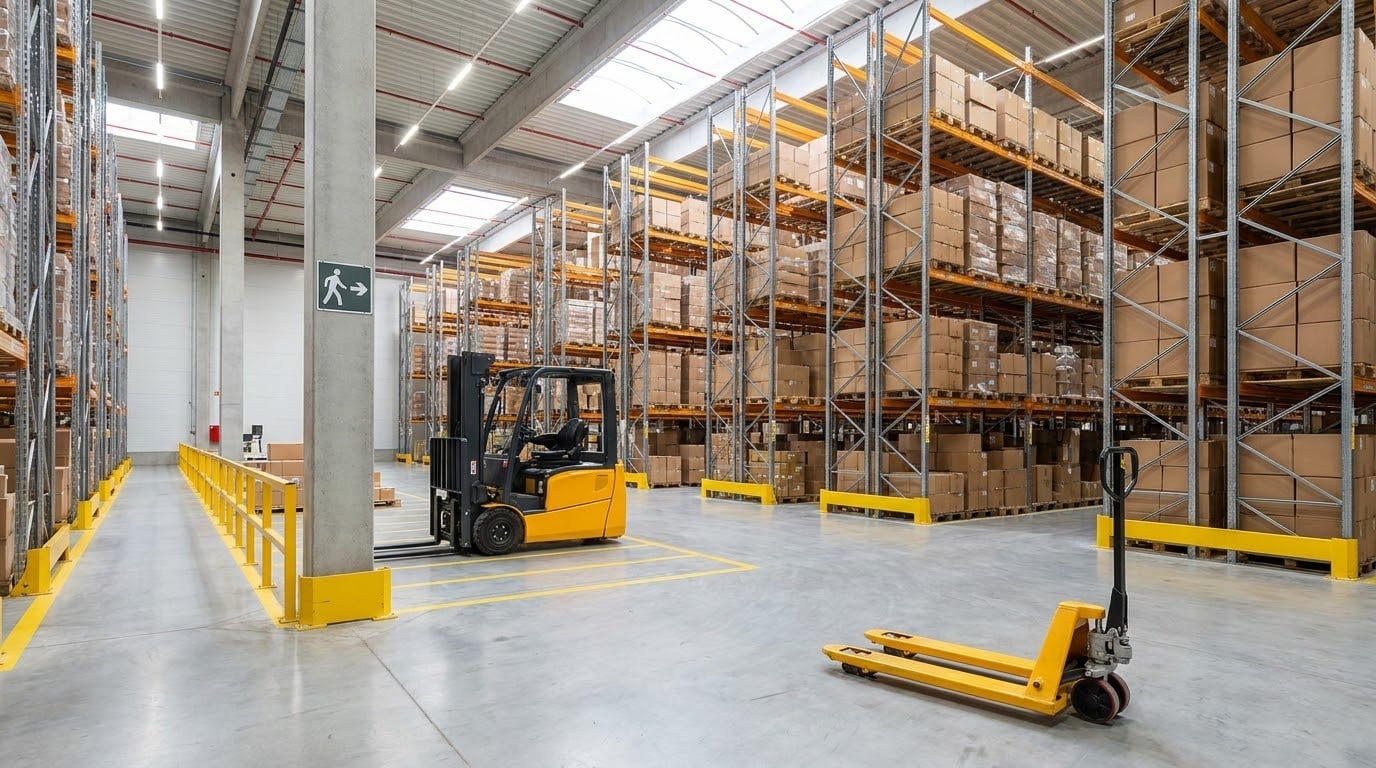
Warehouse safety tips for new workers come down to one habit: learn how the building moves before you start moving through it. Forklifts, pallet jacks, conveyors, racking and loading docks all run at once, and the first few shifts are when most new hires get hurt, simply because nobody has shown them yet where the blind corners are. These ten tips cover what to learn on hour one, what to wear, when to stop working, and how to report something that looks wrong.
Warehousing is one of the more injury-prone sectors in the US, running roughly 4.7 nonfatal injuries per 100 full-time workers against about 2.7 across all private industries, according to Bureau of Labor Statistics data. Slips and trips, manual handling, and falls from height account for most of those, and all three are mostly avoidable with correct behavior from the start.
Nothing here is a substitute for your employer’s own safety rules and training. Treat this as a checklist to take to your first shift and use for the conversation with your supervisor.
Table of Contents
- Warehouse Safety Tips for New Workers at a Glance
- 1. Learn the Warehouse Layout and Emergency Exits
- 2. Follow Site Safety Rules and Training
- 3. Wear Required Personal Protective Equipment
- 4. Recognize Forklift and Material-Handling Hazards
- 5. Keep Aisles and Work Areas Clear
- 6. Lift and Move Loads Safely
- 7. Use Equipment Only After You Are Trained
- 8. Control Chemical, Dust, and Noise Exposure
- 9. Report Hazards, Injuries, and Near Misses
- 10. Build a Safety-First Daily Routine
- Frequently Asked Questions
- What should a new worker do before starting a shift in a warehouse?
- Do new warehouse workers need safety training before operating equipment?
- What PPE should new warehouse workers wear?
- How should a new worker lift a heavy or awkward package?
- What should a worker do if they notice a spill or blocked aisle?
- How should new workers report an injury or near miss?
- What to Do First on Your First Shift
Warehouse Safety Tips for New Workers at a Glance
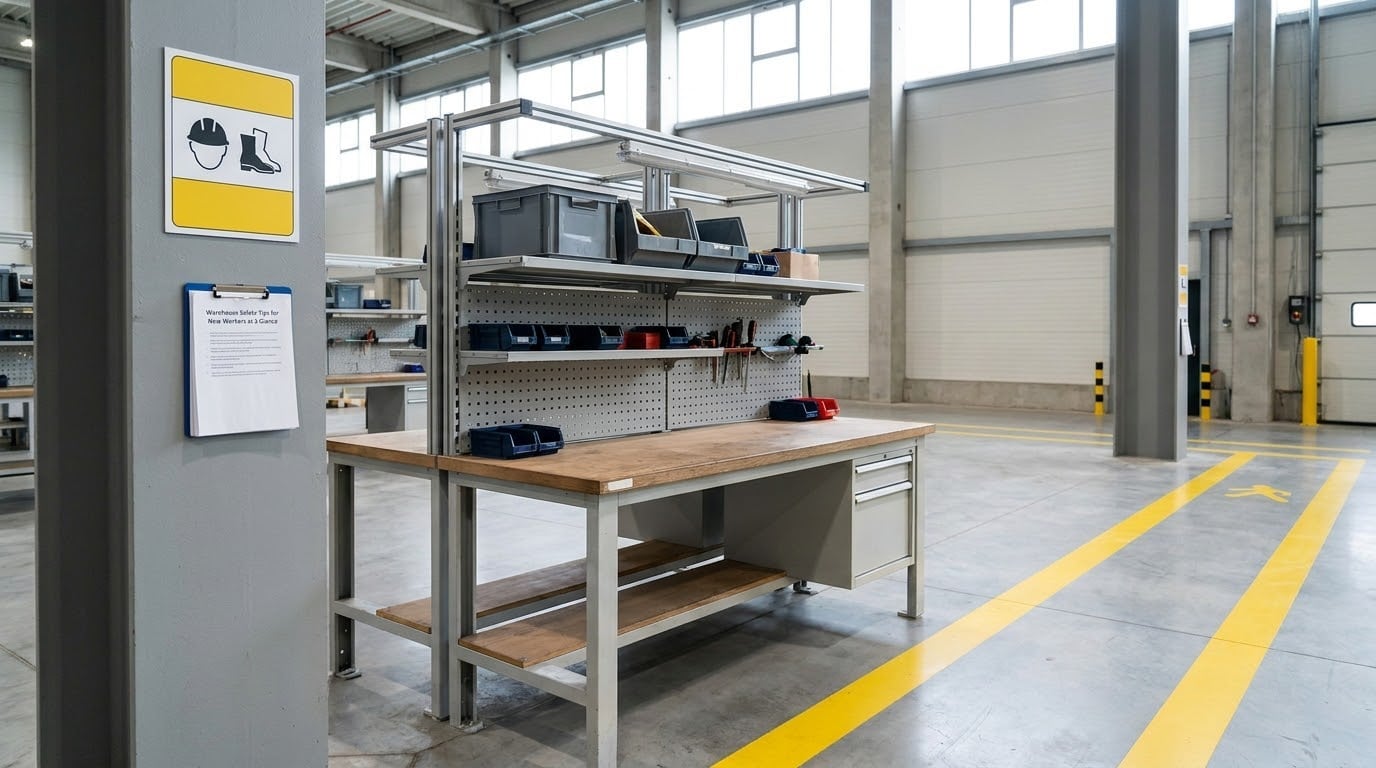
The table below is the whole list in one place. Each row names a safety area, why it matters on a warehouse floor, and the specific action to take in your first week.
| Safety area | Why it matters | Your action in week one |
|---|---|---|
| Layout and emergency exits | You cannot avoid a hazard you have never located | Walk the marked pedestrian routes and find the nearest exit, extinguisher and assembly point before your first task |
| Site rules and training | Every building has local habits that override the general ones | Read the standard operating procedures for your role and ask when anything is unclear |
| Personal protective equipment | Vests, footwear and eye protection only help if they fit and are worn | Collect your PPE on day one and report damaged or ill-fitting gear immediately |
| Forklift and material handling | Forklifts carry loads at head height and have large blind spots | Stay out of vehicle lanes and fall zones, and never operate a powered industrial truck until you are trained and authorized |
| Aisles and work areas | Most slips, trips and collisions trace back to clutter and spills | Keep walkways clear, deal with spills at once, and report damaged racking rather than working around it |
| Lifting and manual handling | Back and shoulder injuries build slowly and then stop you working | Check the load, lift in four stages, and ask for a team lift or a cart when the item is heavy or awkward |
| Powered equipment | Conveyors and packaging machines can pull a limb in before you react | Operate nothing until authorized, run the pre-use check, and never remove a guard or reset a jam you are not trained to clear |
| Chemicals, dust and noise | Cleaning products, dust and 85 decibels or more damage you gradually | Read the label and safety data sheet, use products as directed, and wear the protection the site requires |
| Reporting | A near miss reported today is the injury that never happens | Report hazards, damaged equipment, spills and near misses through your site’s channel, in writing when you can |
| Daily routine | Most mistakes happen at shift change when attention drops | Build a fixed start-of-shift and end-of-shift check so nothing depends on how tired you are |
1. Learn the Warehouse Layout and Emergency Exits
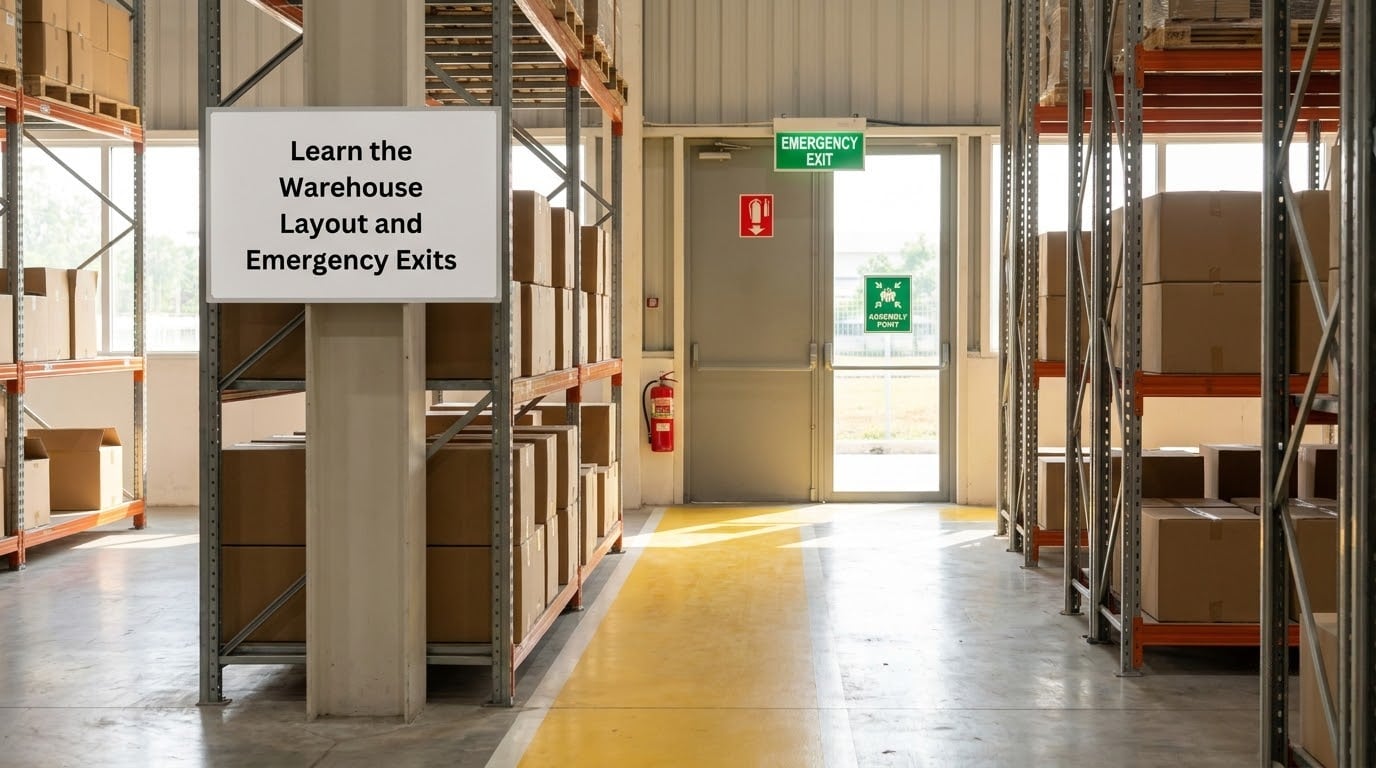
Spend the first part of your first shift learning the building rather than picking product. Identify the marked pedestrian walkways, the aisles where powered industrial trucks operate, the zones you are not permitted to enter, and the location of every exit on your route.
Then find the details that matter in an emergency. Locate the fire extinguishers, the eyewash station, the spill kit, the first aid kit, the emergency alarm, and the assembly point outside. If you are not sure what your facility’s alarm sounds like, ask before you need to know it.
One habit pays for itself. Stop at the end of every aisle and look both ways before stepping into a vehicle lane, because racking blocks the sight line in both directions and a forklift carrying a tall pallet may be traveling faster than it looks.
2. Follow Site Safety Rules and Training
Attend the orientation and read the standard operating procedures for your role rather than watching a coworker and copying them. Site rules differ between buildings: hair length, clothing, phone policy, break locations, and where you are allowed to walk are all local decisions.
New workers often guess when a procedure is unclear, and guessing is how a near miss happens. Ask your supervisor to demonstrate the task once, then watch them check the standard work instruction yourself. If a written procedure and what you were shown do not match, that is worth raising immediately.
Be clear about one thing. Your employer owes you training, protective equipment, and hazard communication. Being handed keys to a forklift or a pallet jack on day one without instruction is not training, and it is reasonable to ask for the formal session before you operate anything.
3. Wear Required Personal Protective Equipment
Wear the protective equipment your site requires, and wear it correctly from the first minute rather than when a supervisor notices. The usual set is safety footwear with a toe cap, a high-visibility vest, cut-resistant gloves for handling cartons or banding, safety glasses, and hearing protection near conveyors, compressors, and loading areas.
Fit matters more than people expect. Ill-fitting steel-toe shoes cause foot pain that accumulates over a week, and loose gloves catch in rollers. If the gear you are given does not fit, ask for a different size or an alternative before you start work, and report anything damaged or worn out instead of making do.
One point workers raise often: protection that does not fit the job is decoration. Eye protection is no use under a welding face shield, and gloves are wrong for a rotating shaft. Ask what the task requires rather than wearing whatever is in the bin.
4. Recognize Forklift and Material-Handling Hazards
Powered industrial trucks are the single largest source of serious warehouse injuries, and most of that comes from pedestrians. A forklift’s operator sits low, the mast and load block the forward view, and the machine can carry a load at your head height, so drivers may not see you at all.
Learn the fall zone: the area around a forklift equal to roughly twice the height of the load it is carrying. Never walk under raised forks, never pass a load traveling overhead, and never step into a lane where a truck is moving or where you cannot see the driver clearly.
Watch for pinch points at the base of racks and at conveyor transfer points, for blind corners where racking blocks the view, and for pedestrians stepping out from behind a stack of pallets. If a forklift approaches you in an aisle, step to the side behind a solid barrier, make eye contact with the driver, and do not attempt to pass. If a load looks unstable or the situation feels wrong, stop and alert your supervisor rather than improvising.
5. Keep Aisles and Work Areas Clear
Clutter causes the slips, trips, and falls that lead roughly a quarter of major warehouse injuries, and most of it comes from routine small decisions. Put material away instead of leaving it in the aisle, keep empty pallets flat and stacked, and use the designated staging areas rather than the walkway.
Treat spills as urgent. Clean a spill immediately or barricade it and report it, rather than stepping over it and hoping. Watch for the small hazards that are easy to ignore: shrink wrap stretched across a floor, a loose carton flap, banding underfoot, and trailing cords at workstations.
Damaged racking deserves particular attention. If an upright looks bent, a beam is twisted, or a rack foot is resting on a shim or a piece of timber instead of being anchored to the floor, do not work around it and do not put product on it. Move the load to an undamaged location, stop using that bay, and report it in writing.
This is the daily practice behind 5S, the housekeeping method common in warehouses: Sort what you need from what you do not, Set items in a defined place, Shine the area you work in, Standardize the label, and Sustain the routine. It sounds corporate, but the worker version is simple. Put things back where they belong.
6. Lift and Move Loads Safely
Check the load before you touch it. Look for the weight label, see whether the carton is damaged or wet, and test the weight by tilting one corner rather than committing your whole body to it. Manual handling injuries are usually cumulative, which is why a back strain on day nine often started on day two.
Lift in four stages. Prepare by clearing the destination and checking your footing. Lift by keeping the load close, bending at the knees, and avoiding a twist. Carry it where you can see over and around it. Set it down by bending the knees and lowering with control, rather than dropping or throwing the last few inches.
Cut boxes open away from your body so the blade travels away from your hands, and cut on a stable surface at waist height. When an item is too heavy, too awkward, or beyond your comfortable range, ask for a team lift or use a mechanical aid such as a hand truck, pallet jack, or cart. That is not slowing down, it is the intended process. Nobody has ever been disciplined for using the right equipment.
7. Use Equipment Only After You Are Trained
Walk away from powered equipment you are not authorized to operate: pallet jacks, order pickers, reach trucks, conveyors, packaging machines, and carton cutters. Formal instruction, hands-on practice, and an evaluation come before certification, not after.
Once you are authorized, run the pre-use inspection every shift. Check forks, mast, tires, horn, lights, brakes, restraints, and the load capacity plate, and report defects rather than working around them. A damaged machine should be tagged and removed from service until it is repaired.
Around conveyors and packaging equipment, keep hands, hair, loose clothing, jewelry, and long ties away from rollers and drive points. Never ride, lean on, or sit on a conveyor, and never reach into a running machine. Before any clearing, adjustment, or repair, the machine must be shut down, isolated, and locked out. If you have not been trained on lockout/tagout, that is not a job you do at all.
8. Control Chemical, Dust, and Noise Exposure
Read the label on every container before you use it, and find the safety data sheet, or SDS, which tells you the hazards, required protection, first aid, and spill response for that product. Cleaning chemicals, solvents, aerosols, and battery electrolyte all fall under this.
Use the product as directed. Never mix two products because the bottles were next to each other, never transfer a chemical into an unlabelled container, and report a leaking or damaged container immediately rather than tightening the cap yourself. Know where the spill kit and eyewash station are before you need them, and make sure a colleague knows you are going into an area where a spill response might happen.
Noise and dust are quieter hazards with permanent consequences. Warehouses often run above 85 decibels, where hearing protection is required, and airborne dust needs ventilation or respiratory protection as the site’s program specifies. If you find yourself adjusting your hearing or rubbing your eyes by mid-shift, that is information, not toughness.
9. Report Hazards, Injuries, and Near Misses
A near miss is an incident that did not cause an injury but easily could have: a pallet that came off a stack a foot from someone, a forklift that passed close behind you, a spill you stepped over. Near misses are free information, and the ones that get reported are the ones that prevent the next accident.
Report hazards, damaged equipment, and near misses as soon as you can, using your site’s method. If the channel is verbal, follow it up with an email or a note so there is a record. A written report is not an accusation; it is a timestamp.
Understand where you stand. In the US, raising a safety concern is a protected activity, and an employer may not retaliate against you for reporting a hazard in good faith, for asking whether an operation is safe, or for participating in an inspection. The General Duty Clause also requires the employer to provide a workplace free from recognized hazards. Outside the US the specific rules differ, but the underlying principle is common: employers owe workers training, equipment, and a genuine route to raise concerns.
When a task genuinely looks unsafe, you can pause and ask about it, and you can raise the concern through the chain above your supervisor if the first answer is not satisfactory. If you are ever unsure whether a load, a piece of equipment, or a route is safe, the correct answer is to stop and check, not to guess.
10. Build a Safety-First Daily Routine
Make the safe choice the automatic one by giving it a fixed place in your shift. At the start: check in, look at the area you are working in, note any spill, damage, or obstruction left from the previous shift, and confirm the equipment you are about to use passed its pre-use check.
During the shift: stay on the marked route, take your breaks on time, drink water, and change your socks and stretch your feet if you are on your feet all day. Fatigue is not a personality flaw; it slows reaction time, and most near misses that involve people who were not hurrying are caused by people who were exhausted.
At the end: clear your workstation, return tools to their place, remove personal items from the floor, and note anything you saw today that the next shift should know about. A two-minute routine at each end of the shift catches more than an hour of reactiveness in the middle of one.
Frequently Asked Questions
What should a new worker do before starting a shift in a warehouse?
Walk your zone before you pick anything. Check the marked pedestrian route, note where the vehicle lanes are, find the nearest emergency exit, fire extinguisher, eyewash station and assembly point, and look for spills, obstructions, or damaged racking left from the previous shift. Then confirm the equipment you will use has passed its pre-use check. Five minutes of orientation on day one prevents most of the surprises that cause injuries in week one.
Do new warehouse workers need safety training before operating equipment?
Yes. Operating a powered industrial truck such as a forklift or pallet jack requires formal instruction, hands-on practice, and an evaluation before certification, plus refresher evaluations on the schedule your site follows. Training is also required for conveyors, packaging machines, and any task with a specific written procedure. If you are handed keys before that training, ask for the session rather than treating the handover as instruction.
What PPE should new warehouse workers wear?
Most sites require safety footwear with a toe cap, a high-visibility vest, cut-resistant gloves for cartons and banding, and safety glasses, with hearing protection near conveyors, compressors, and loading areas. Collect it on day one and confirm the fit, since ill-fitting boots and loose gloves cause foot strain and catch hazards. Report damaged or wrong-sized equipment and ask what a specific task requires rather than wearing whatever is available.
How should a new worker lift a heavy or awkward package?
Check the label and test the weight by tilting a corner before committing. Then lift in four stages: prepare by clearing the destination and checking your footing, lift with knees bent and the load close to your body, carry it where you can see past it, and lower it under control rather than dropping or throwing it. If the item is too heavy or awkward for you, ask for a team lift or a cart. Asking is the process, not a delay.
What should a worker do if they notice a spill or blocked aisle?
Clean a small spill immediately using the site method, or if it is too large, chemical, or near live traffic, keep people away and report it right away. For a blocked aisle, do not squeeze past a load that limits your view, and do not move heavy material alone. Report the blockage so the obstruction is removed and the cause is fixed. Leaving it for a few minutes is what turns a small problem into a trip or a collision.
How should new workers report an injury or near miss?
Tell your supervisor as soon as it happens, get first aid if you need it, and follow it up in writing so there is a record. For near misses, describe what you saw and where, including anything that would have made the outcome worse. In the US, raising a safety concern in good faith is a protected activity and employers may not retaliate for it. If the first response does not address the hazard, take it to the next level of supervision.
What to Do First on Your First Shift
Start with tip one. Spend the first part of your shift learning the layout, the exits, and the assembly point, and collect your protective equipment before you are given a task. Everything else on this list builds on those two things.
After that, work the habit rather than the list: stay on the marked route, stop at the end of every aisle, ask before you operate anything, and report what looks wrong. Speed in a warehouse comes with weeks of familiarity, and the people who finish strong are the ones who were not careless in the first week.