
The short answer to whether nap policies at work help is a qualified yes. A well-designed workplace nap policy, with a booked private space and a clear time limit, tends to improve self-reported alertness and mood for the people who use it. The gain is modest, it is inconsistent across jobs, and it disappears entirely if the rest of the workplace design is broken. So the honest summary is: nap policies help when fatigue is real and the policy is specific, and they mostly waste space when employers treat them as a wellness perk instead of a fatigue-control tool.
What follows is what the published research actually shows, what a usable policy contains, how long a nap should run, and how an employer can tell whether the program is working. It is written for HR leads, operations managers and anyone else who keeps wondering whether a nap room would pay for itself.
Table of Contents
- Nap Policies at Work: What the Evidence Says
- What Benefits Can Workplace Naps Provide?
- What Should an Effective Workplace Nap Policy Include?
- Where Should Employees Take a Nap at Work?
- What Are the Safety and Operational Risks?
- How Much Time Should a Workplace Nap Last?
- Do Nap Policies Work for Shift and Night Workers?
- How Can an Employer Measure Whether a Nap Policy Helps?
- How Do Nap Policies Fit with Rest Breaks and Fatigue Management?
- What Legal and Equity Considerations Apply?
- Frequently Asked Questions
- Should employers let employees nap during the workday?
- How often can an employee nap at work?
- Can taking a nap at work be treated as a performance issue?
- Are workplace nap rooms required by law?
- What should employers do if a worker falls asleep at their desk?
- Can a short nap replace getting enough sleep at night?
- Conclusion
Nap Policies at Work: What the Evidence Says
A workplace nap policy is a written employer rule covering when, where and for how long staff may nap during working hours, whether that time is paid, and which roles are eligible. On the question of whether nap policies at work do they help, the evidence points to real but limited benefit. Short planned naps improve alertness and performance for some workers, particularly in settings built around long or irregular shifts.
Results vary with nap length, the environment, the task and the person. Nothing in the research supports a blanket rule for whole organisations, and the strongest studies repeatedly flag sleep inertia and disrupted night sleep as the failure modes. The table below summarises what has been measured.
| Source | What was studied | Reported effect |
|---|---|---|
| CDC / NIOSH work-hour training | Planned napping during extended work periods | Described as a useful strategy for increasing alertness on duty |
| Field experiment with roughly 450 workers (actigraphy tracked) | A short midday nap compared with extra night-time sleep | About a 2.3% productivity gain from the nap, framed as comparable to a large wage increase; longer night sleep alone did not lift output |
| NASA aviation sleep research | A 40-minute nap in operational settings | Reported improvements in pilot performance and alertness |
| Controlled daytime nap trial | A 10-minute daytime nap | Reported benefits lasting around two and a half hours with few side effects |
| Review of on-duty napping in public safety roles | Napping while on duty in emergency and response work | Possible reductions in fatigue-related risk, but practice is often discouraged or prohibited |
Two things stand out. The gains are percentage-level, not transformation-level. And the study where extra night-time sleep failed to improve output is a useful corrective, because it suggests that a nap is not a polite substitute for going home and sleeping.
What Benefits Can Workplace Naps Provide?
The honest answer separates what nap policies plausibly deliver from what has actually been measured. Four benefits have reasonable support behind them: alertness during long or monotonous stretches, a small improvement in perceived performance, better mood, and a lower risk of error on repetitive tasks. Everything beyond that is mostly plausible rather than proven.
How Do Short Naps Affect Alertness and Performance?
Very short naps lift alertness with minimal grogginess, and the effect can outlast the nap itself. Studies of daytime naps report benefits persisting for a couple of hours, which is why a ten-minute break in the early afternoon can feel like it buys the rest of the shift.
Longer is not automatically better. Past roughly 20 to 30 minutes, the chance of entering deep sleep climbs, and waking out of deep sleep produces sleep inertia, a groggy period lasting from a few minutes to around half an hour where reaction time and judgement are temporarily worse than before. That is the central argument for time limits.
Timing matters too. A nap late in the working day borrows from night sleep and leaves people lying awake at 2am, which is a fast route to feeling worse than before.
Which Types of Workplace Naps Have Been Studied?
Researchers generally separate napping into a few practical categories, and they behave differently enough that a policy should treat them differently.
| Nap type | Purpose | Typical use | Limitation | Workplace suitability |
|---|---|---|---|---|
| Coffee nap | Caffeine taken immediately before a short nap | Driver approaching fatigue on a long stretch | Caffeine side effects; needs a genuine place to lie down | Occasional and situational, not a routine break |
| Quiet 10 to 20 minute nap | Alertness with almost no post-nap impairment | Mid-afternoon dip, monotonous data or monitoring work | May not be long enough for sleep-deprived staff | The easiest thing to fit into a normal working day |
| Restorative 30 to 60 minute nap | Reaching deeper sleep and easing accumulated sleep debt | Night-shift workers, on-call staff, long-haul drivers resting | Higher sleep inertia risk; can disturb night sleep | Works best in protected settings away from immediate duties |
What Should an Effective Workplace Nap Policy Include?
A policy that skips any of these ten elements tends to create the exact problem it was meant to solve: a sanctioned nap that quietly becomes a disciplinary issue for the one person who uses it.
- Eligibility. Name the roles that qualify and the ones that do not, rather than leaving managers to guess.
- Frequency. How many times per shift or per week. Two or three short naps across a long shift is a reasonable default.
- Duration limit. A hard ceiling, usually 20 to 30 minutes for standard shifts, with a timer in the room and an alarm for the person.
- Scheduling. A booking system so two people are not arriving at the same door.
- Voluntary participation. Nobody is assigned a nap, and nobody is asked to justify taking one.
- Timekeeping clarity. State plainly whether nap time is paid, unpaid, or drawn from a break entitlement.
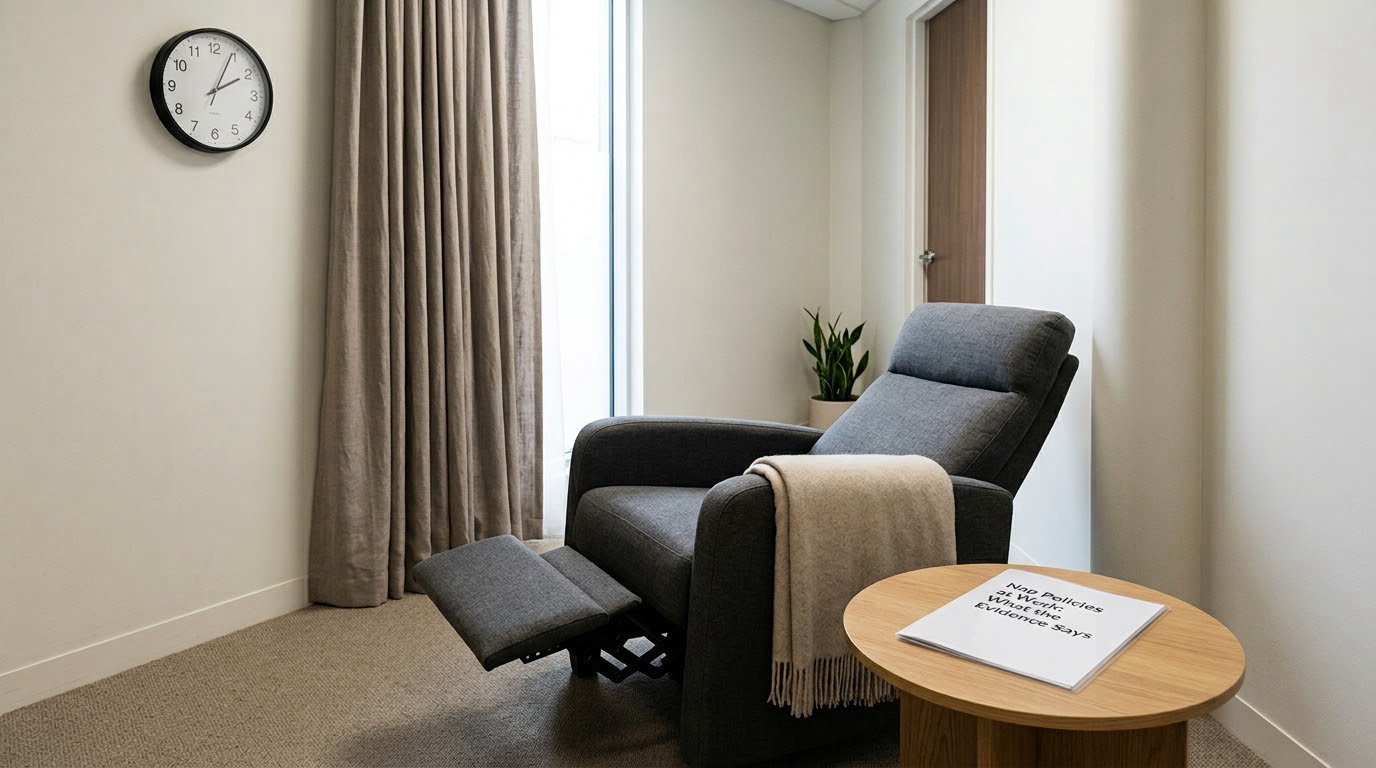
- Space standards. Lockable, quiet, dim, cool, cleanable, and accessible to the employee population.
- Safety rules. A short recovery period before returning to safety-sensitive duties, and a clear rule against on-duty napping for designated roles.
- Accommodations. How a request is made and who approves it, so a medical or pregnancy-related need is handled properly.
- Evaluation. How the employer will check whether the policy is being used and whether it helps.
One clause matters more than the rest for workplace trust: the nap must not count against attendance or performance records. Once that is true, participation stops being a gamble.
Where Should Employees Take a Nap at Work?
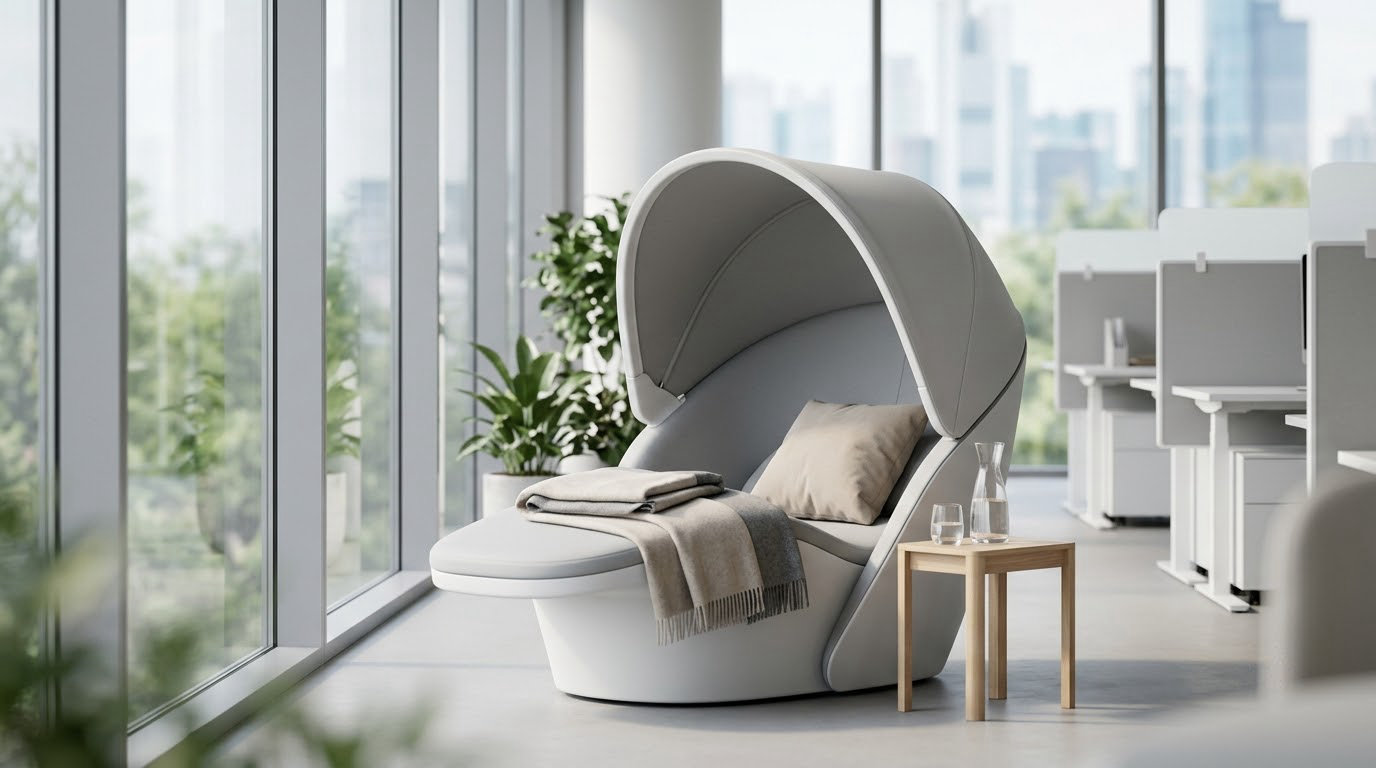
Space is the single biggest practical constraint, and it decides whether a policy works before any evidence is considered. Most employers end up choosing between a repurposed room and a purpose-built pod.
| Option | Strengths | Drawbacks |
|---|---|---|
| Dedicated nap room | Multiple people, full control of temperature and light | Most expensive, needs a booking system and a cleaning routine |
| Single-user pod | Lockable, no disturbance, sits anywhere with power and floor space | One user at a time, so it needs a queue |
| Wellness or quiet room | Usually already exists, doubles as a decompression space | Booking disputes, and often booked out in the afternoon |
| Private office | Workaround when nothing else exists | Occupies a scarce resource and interrupts calls |
| Parked vehicle | Private, available to drivers on long journeys | Uncontrolled temperature, not accessible to all staff, security questions |
| Outdoor break | Fresh air, daylight, no room needed | Weather, noise, privacy |
Forum discussion makes one failure mode obvious: when there is no private space, people use break rooms, cars and lactation rooms, and then resent it. A shared lounge with a sofa is not a nap room. If the policy books out before 3pm every day, the space is too small and everyone knows it.
What Are the Safety and Operational Risks?
Naps are low-risk when they are short, voluntary and separated from critical duties. They are not risk-free, and the risks are mostly about timing and fit rather than about sleep itself.
- Sleep inertia. The period straight after waking is the real hazard. Reaction time is briefly worse, which is why a nap should never end five minutes before a driving task or a shift handover.
- Overlong naps. Beyond an hour, deep-sleep wake-up grogginess and night-time insomnia both become more likely.
- Late naps. A nap in the last few hours of a shift pushes sleep pressure into the night, which hurts recovery on a repeating roster.
- Missed handoffs. On teams without cover, an absent colleague creates work for someone else. Coverage beats permission.
- Roles that cannot pause. Driving, operating machinery, clinical duties under observation, lone working and emergency response need clear exclusion rather than individual judgement.
- Shared-space hygiene. Surfaces, linens and ventilation in a small enclosed room need a named cleaning routine.
If you read one line into a policy from the safety literature, make it this: the exclusion list should be written before the permission is announced, not after the first incident.
How Much Time Should a Workplace Nap Last?
Most workplace policies land between 10 and 30 minutes, and the shorter end carries the least risk. Longer durations serve a different purpose and belong in a different setting.
| Duration | What you get | Main drawback |
|---|---|---|
| 10 minutes | A quick alertness lift with very little grogginess; reported effects can persist for a couple of hours | May not reach real sleep, so it suits a mild dip rather than genuine sleep debt |
| 20 minutes | Often described as the sweet spot: enough for light sleep, short enough to avoid deep-sleep inertia | Requires an alarm; 20 minutes can tip into sleep for some people |
| 30 minutes | More reliable restoration, common ceiling in general workplace policies | Noticeable inertia for around 15 to 30 minutes afterwards |
| 60 minutes | Deeper sleep, useful for night and on-call recovery in protected settings | Highest inertia risk, and it can damage night sleep if taken late |
Two practical rules keep most employers out of trouble. Cap routine daytime naps at 30 minutes, and set a cut-off time, often early afternoon, after which routine napping stops for people on a normal night schedule.
Do Nap Policies Work for Shift and Night Workers?
They matter more here than anywhere else, and they also need a different design. The population that most needs a nap is the one most likely to be harmed by a standard 20-minute office rule, because their recovery window competes with daylight sleep.
For night and rotating teams, the useful policy allows more individual control over timing, protects a nap window as part of the roster rather than as a favour, and gives nap rooms priority to workers on their longest stretches of night duty. On-duty napping in public safety roles remains genuinely contested, and the published review literature notes that some organisations discourage it outright.
The bigger point is that a nap room is not a fatigue management system. Roster design, protected recovery time between shifts, limits on consecutive nights, transport home after a night shift, and a reporting route for unsafe conditions do more for a tired worker than any single short sleep.
How Can an Employer Measure Whether a Nap Policy Helps?
Measurement decides whether a pilot survives. Keep it voluntary, aggregated and free of anything that could read as medical surveillance, and ask twice: once before the policy starts, once a few months in.
- Short voluntary alertness check-ins, self-reported, with participation rate tracked alongside results.
- Error and near-miss trends in teams that use the room, compared with the baseline period.
- Absence and overtime patterns, which often shift before any productivity metric moves.
- Room utilisation by hour of day, which tells you whether the cut-off time and capacity are right.
- Staff feedback on whether the policy felt fair, and whether anyone felt penalised for using it.
Run it the way the field experiment ran: two comparable teams, one with nap access, one without, measured over the same weeks. It is not laboratory science, but it is far more convincing to a sceptical leadership team than a wellness brochure.
How Do Nap Policies Fit with Rest Breaks and Fatigue Management?
A nap is a supplement, not a substitute, and a policy that treats it as a substitute is where the criticism comes from. If someone is sleeping four hours a night, a 20-minute nap will not fix the underlying problem, and employers should say so plainly rather than advertising the nap room as a wellbeing solution.
Napping sits alongside, and never replaces, adequate sleep, sensible rosters, genuine rest breaks, workload management, and the right to report unsafe conditions without fear. It also has to coexist with ordinary breaks: if a nap consumes your lunch, it is not a nap policy, it is a cut to a break.
Coffee naps and timing of caffeine matter too. A short caffeine dose before a nap appears in the research literature as a way to prolong the effect, but it carries its own side effects and is not a substitute for the space.
What Legal and Equity Considerations Apply?
There is no universal rule that employees have a right to nap at work. Whether napping is permitted, whether it is paid, and what an employer can do about sleeping on duty all depend on jurisdiction, contract, working-time rules and the nature of the job.
The questions that generate the most friction are about discipline and accommodation. Can an employer discipline someone for sleeping during a shift they were supposed to be working? That depends on whether the behaviour is actually permitted, whether the employee knew it was not, and how consistently the rule has been applied. Medical need, disability, pregnancy and religious observance can each change the analysis, and reasonable accommodation may be appropriate.
Two practical points. Write the rule down, because unwritten rules are applied inconsistently and inconsistency is where claims come from. And treat every employee the same way, because a nap policy that operates unevenly across roles or shifts invites a fairness complaint. For anything beyond drafting, take advice from qualified counsel in the jurisdictions where you operate; this is general information, not legal advice.
Frequently Asked Questions
Should employers let employees nap during the workday?
Where fatigue affects safety or output, a written policy that permits short voluntary naps usually helps more than it costs. The key elements are a bookable private space, a clear time limit of 20 to 30 minutes, a cut-off time in the early afternoon, and an explicit rule that using it never counts against attendance or performance. For safety-critical roles the policy should name exclusions rather than leave them to individual judgement.
How often can an employee nap at work?
Most policies cap routine napping at two or three short naps per shift, with a weekly limit where space is limited. Frequency should follow genuine fatigue rather than habit, and the room booking system usually becomes the real constraint before the written rule does. Track usage by hour and adjust capacity or the cut-off time accordingly, since a policy that cannot be booked at 2pm is not really a policy.
Can taking a nap at work be treated as a performance issue?
Only where the employer has made the behaviour a genuine rule and applied it consistently. If a policy permits napping, using it cannot then be treated as a performance problem. Where no policy exists, the answer depends on the contract, the working-time rules in that jurisdiction and whether the employee could reasonably tell the conduct was prohibited. Unwritten and unevenly applied rules are the usual source of disputes, so get the rule down in writing first.
Are workplace nap rooms required by law?
Generally no. In most jurisdictions there is no legal right to a nap room, and no general obligation on an employer to permit napping during working hours. What does exist is working-time regulation, health and safety duties around fatigue, and equality law that may require accommodation for a medical, disability, pregnancy or religious reason. Rules differ by country and state, so confirm the position locally before writing anything into a handbook.
What should employers do if a worker falls asleep at their desk?
Check whether a policy is in place before you check who was wrong. If the behaviour was permitted and the nap was within the rules, it is not a performance issue. If there is no policy, treat the first instance as a conversation about expectations and fatigue, document it, and then write the rule down so the next case is easier. Never discipline selectively: uneven enforcement is what turns a manageable issue into a claim.
Can a short nap replace getting enough sleep at night?
No. A 20-minute nap reduces acute sleepiness for a few hours; it does not repay accumulated sleep debt, and one field experiment found that increasing night-time sleep on its own did not lift measured output while a short midday nap did. Naps work best as a supplement for people already sleeping a reasonable amount, and they do not excuse roster patterns that prevent adequate night sleep in the first place.
Conclusion
Start small and write it down. Pick one team, one bookable space and a 20-minute limit with an early-afternoon cut-off, agree which roles are excluded before you announce anything, and confirm in writing that using the room never affects attendance or performance records.
Then measure before and after. If alertness and error trends improve and nobody feels penalised, extend the policy. If the space sits empty, you probably needed a roster change rather than a nap room, and that is a useful finding too. Updated for 2026, this guide reflects the current published evidence on planned napping at work.