
The 20 20 20 rule for eye strain is a simple habit: every 20 minutes of screen work, look at something about 20 feet away for at least 20 seconds. That is the whole idea. It costs nothing, needs no equipment, and is aimed squarely at the tired, dry, achy feeling that comes after a long stretch at a monitor.
The rule was proposed by Dr. Bruce Anshel and spread through optometry offices for a good reason. Screen work holds your eyes in one fixed near-focus position for hours, and that is a posture human eyes were not built to sustain. The 20 20 20 rule is a preventive habit, not a treatment and not a cure, which is the part most write-ups leave out.
What follows is the plain-language version: what each number means, why the habit works mechanically, how to fit it around real work, and when the symptoms are telling you to stop managing them yourself and book an appointment.
Table of Contents
- What Is the 20 20 20 Rule for Eye Strain?
- How Does the 20 20 20 Rule Help Your Eyes?
- What Symptoms Does Computer Eye Strain Cause?
- How to Use the 20 20 20 Rule at Work
- Can You Do the 20 20 20 Rule Without a Computer Reminder?
- Does the 20 20 20 Rule Work for Reading, Gaming, and Phones?
- What Else Helps Reduce Eye Strain at a Workplace?
- How to Adapt the Habit for Different Work Environments
- When to See an Eye-Care or Medical Professional
- Frequently Asked Questions
- Conclusion
What Is the 20 20 20 Rule for Eye Strain?
The 20 20 20 rule is a habit where you look at an object about 20 feet away for 20 seconds, every 20 minutes of screen use, to reduce digital eye strain. Nothing more complicated than that. It was designed for desk workers, students, programmers, and anyone who stares at a screen for two or more hours without a real break.
Broken out, the three numbers are:
- Every 20 minutes — the interval that triggers the break. It is a practical prompt, not a medical threshold.
- For 20 seconds — long enough for the focusing system to actually shift and settle, not a quick glance.
- At 20 feet away — roughly 6 metres, which is far enough that your eyes relax instead of refocusing hard. Any distant point counts, not a specific object.
One clarification worth making early, because people mix it up constantly: 20/20 vision is not part of this. 20/20 is a score on an eye chart. The 20 20 20 rule has nothing to do with it, and doing the habit will not turn an uncorrected 20/40 into a 20/20.
How Does the 20 20 20 Rule Help Your Eyes?
Two mechanisms, and both of them are about the near-focus posture that screen work demands.
The first is accommodation. When you look at something close, the ciliary muscle inside the eye contracts and the lens thickens to bend light properly. It is an active, sustained contraction, and near work like a laptop screen keeps it contracted for a long stretch. Looking 20 feet away lets that muscle relax completely, which is why distance specifically matters rather than just looking at a different object on the same screen.
The second is the blink rate drop. Normal blinking runs about 15 to 20 times a minute. On a screen it falls to roughly 5 to 7, because the act of concentrating on text suppresses it. Each blink spreads a fresh layer of tears across the cornea, so fewer blinks means a thinner, patchier tear film, faster evaporation, and the dry, gritty, burning feeling that readers usually rank as the most disruptive symptom of screen fatigue.
So a 20-second distance break does two things at once. It releases the focusing muscles, and because the eye blinks more freely when it is not locked on text, it tends to re-wet the surface. The honest limit: dry eye can persist even when you follow the rule consistently, because some people have underlying dry eye disease rather than a screen-triggered problem.
What the research does and does not show
Worth being straight about, because few pages get this right. Controlled studies of the 20 20 20 rule found no significant difference in visual acuity, accommodative posture, stereopsis, fixation disparity, or ocular alignment compared with other break strategies. On those measures, the rule does nothing.
What it does show benefit for is symptoms. A 2020 patient-education study found that teaching people with computer vision syndrome about the 20 20 20 rule led to significant improvements in dry eye symptoms and tear film stability. That framing matters: this is symptom management. If you are following it and your headaches, dryness, and end-of-day blur ease up, the habit is doing its job. If you are following it and your prescription is drifting, you need an optometrist, not more breaks.
What Symptoms Does Computer Eye Strain Cause?
Digital eye strain, also called computer vision syndrome, is a cluster of temporary symptoms rather than a single condition. Most people notice two or three of them together, usually worse late in a workday.
| Symptom | Likely connection to screen work | Practical response |
|---|---|---|
| Blurred vision that clears when you look away | Sustained accommodation leaves the focusing system temporarily “stuck” near | Do the 20-second distance break, then return |
| Tired, heavy, aching eyes | Long near-focus sessions without relaxation | Break every 20 minutes, plus longer movement breaks each hour |
| Dry, gritty, burning or watery eyes | Blink rate drops from 15-20 to 5-7 per minute, so the tear film breaks up | Deliberate full blinks during breaks, screen slightly below eye level, discuss drops with a clinician |
| Headache, usually frontal or around the eyes | Combination of eye fatigue, glare, and screen-hunch posture | Adjust brightness and lighting, take a real break away from the desk |
| Neck and shoulder discomfort | Leaning toward a screen held too low or too far | Reposition the screen, then take walking breaks |
| Redness at the end of the day | Reduced blinking and surface irritation | More frequent blinks and breaks, get symptoms assessed if persistent |
Safety note: persistent, severe, or sudden changes in vision are not eye strain. Double vision, flashes of light, new floaters, a curtain across your vision, or sharp eye pain need prompt medical attention rather than another app or another break.
How to Use the 20 20 20 Rule at Work
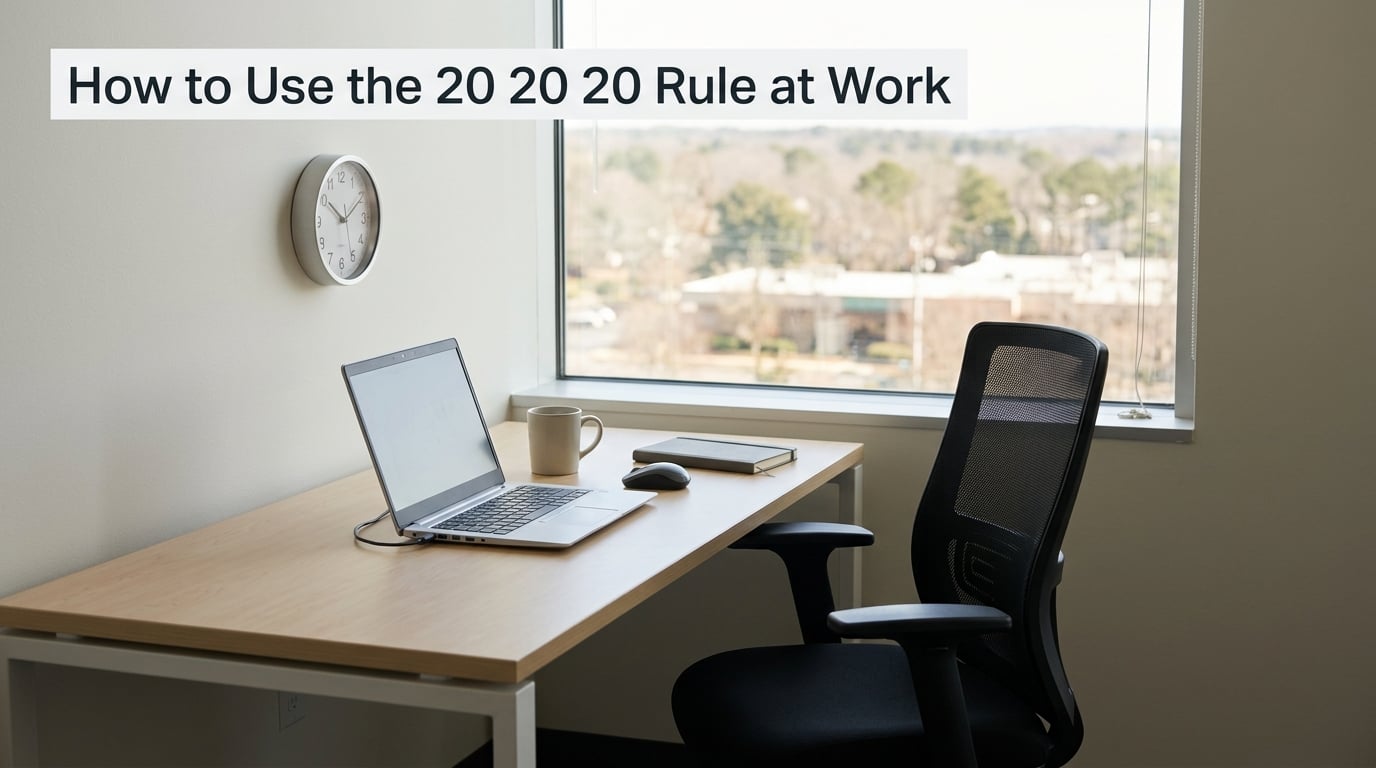
The trick is deciding what counts as your distance target before you need it, because hunting for something 20 feet away mid-task is how the habit dies.
- Estimate 20 feet without a tape measure. About four standard doorways, or a long room end to end. It does not have to be precise. Anything past 15 feet gets most of the benefit.
- Pick a fixed target in advance. A far wall, a window frame, the end of a hallway, a spot on the ceiling across the room. A fixed point is easier than scanning.
- Stand or step away while you look. Moving changes the posture as well as the focus, which is why it helps the neck too.
- Blink deliberately during the break. Two or three complete, slow blinks, lids fully closed.
- Turn off the screen for the full 20 seconds if you can. Looking away from a screen while still reading at the same near distance is not a break.
In practice, different jobs trigger it differently. Deep-focus writing or coding runs in solid blocks, so a calendar invite every 20 minutes is more realistic than a passive reminder. Reading-heavy work has natural pauses at paragraph and section ends. Meetings give you the distance break for free, since the point is to look at faces across a room. On a multi-monitor desk, glance at the far monitor to reset your focus, then look out past it properly.
One point of honesty: 20 minutes is a habit people can follow, not a number the research established. If 20 minutes never happens, 30 minutes beats zero.
Can You Do the 20 20 20 Rule Without a Computer Reminder?
Yes, and some people prefer it that way because another screen-based tool is one more thing to look at. Task transitions are the most reliable natural cue: sending an email, grabbing a coffee, walking to a printer, or waiting for a build to finish all give you a natural gap.
Standing during phone and video calls works well since the other person is not in the room to look at. A visual cue near the workstation, a sticky note on the monitor bezel or a small clock, works if you are the kind of person who notices the spot out of the corner of your eye. A recurring calendar event is the least intrusive software option because it does not add a second app.
Watch for the trap of turning every break into a screen-based habit. Scrolling a phone during your distance break puts the focus back on something 15 inches away and undoes the point.
Does the 20 20 20 Rule Work for Reading, Gaming, and Phones?
The rule is about near focus, so it applies to anything held close, including paper. The change is the target.
Printed material and long close reading. Hold the page at a comfortable near distance, and use natural chapter or page transitions to look up and out. Do not try to keep reading while glancing far away, since the eyes are still working at near range.
Gaming and streaming. Sessions run long by design, so the interval matters more here than anywhere else. Set the break on the game’s own settings menu or the console’s timer where one exists, and take the break on menus and loading screens. Fast action where you track movement in the periphery still benefits from a genuine distance look.
Phones and tablets. This is where the rule is hardest because the device is also the trigger. Putting the phone down for 20 seconds works better than looking up while still holding it. Reading a phone in a car or on a train is worth a break every 20 minutes regardless, since the vehicle is moving and the reading distance is closer than you think.
For children and teenagers the habit is still fine, though the numbers matter less than the surrounding behaviour: total screen time limits by age, and daylight time outdoors, which is the stronger lever for myopia. If you are concerned about a child’s prescription changing, speak with an eye-care professional rather than relying on a break rule.
What Else Helps Reduce Eye Strain at a Workplace?
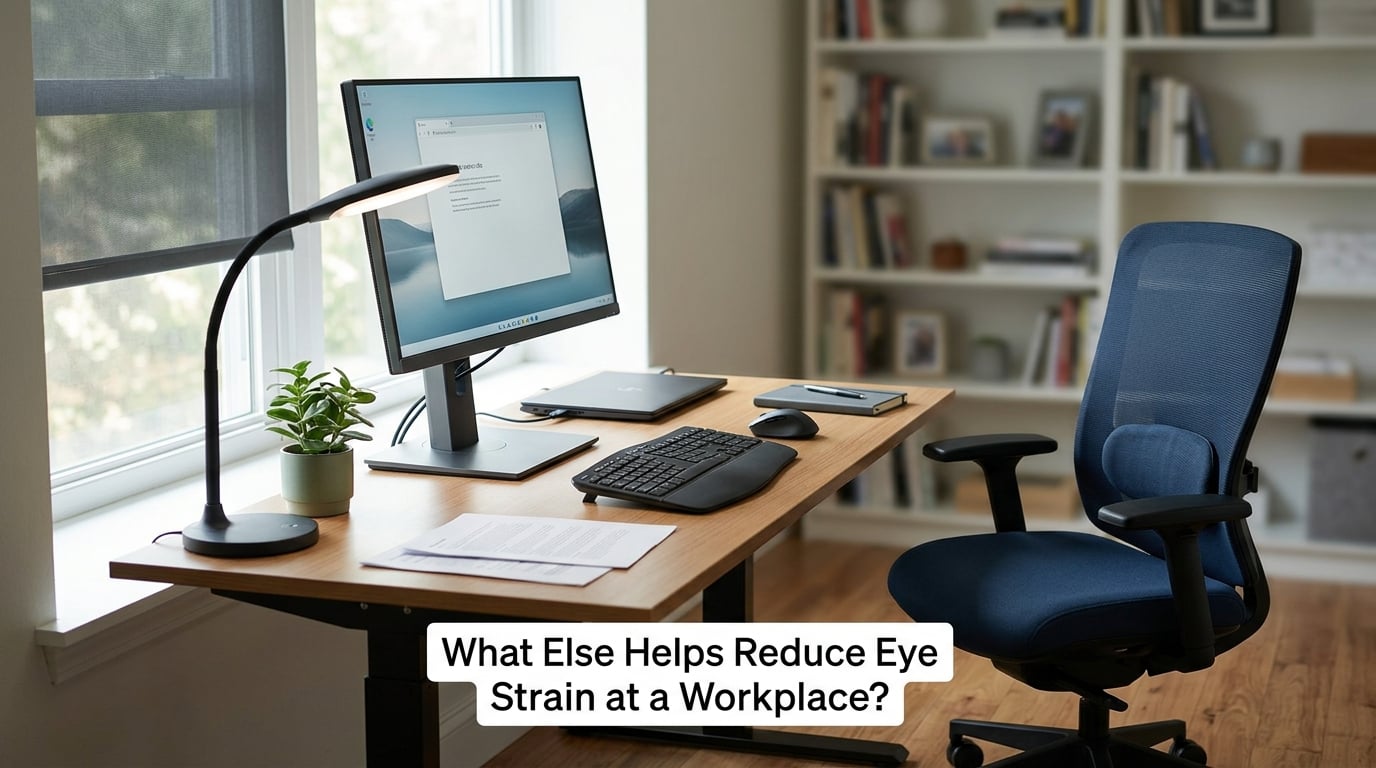
The 20 20 20 rule is one lever. These do more day to day, and they are free.
- Position. Top of the screen at or slightly below eye level, roughly 50 to 60 cm away, about an arm’s length. Looking slightly down is more comfortable than looking slightly up.
- Lighting. Add an angled task lamp behind or beside the monitor rather than overhead lighting straight ahead, and set brightness to match the room rather than the monitor’s factory default.
- Glare control. Rearrange the desk so windows sit to the side, not behind you or directly in front. Adjustable matte anti-glare filters help when you cannot move the screen.
- Deliberate blinking. A reminder to blink fully, several times a minute, addresses the tear film directly.
- Longer movement breaks. One to two minutes of walking or stretching every half hour beats five 20-second glances. Eye strain and neck strain are usually sitting together.
- Prescription check. Uncorrected astigmatism, hyperopia, or an outdated prescription makes screen fatigue noticeably worse.
On blue light-blocking glasses: the eye-strain benefit people report is generally attributed to the glasses changing screen colour or reducing glare, not to a proven biological effect of the light itself. Treat them as an accessory, not the fix.
There is no federal OSHA rule called the 20 20 20 rule. What exists is general guidance on computer workstation ergonomics, including regular eye breaks and tasks designed to let the eye refocus at different distances. Individual employers may set their own break policies, so check your workplace policy before assuming a flexible approach is allowed.
How to Adapt the Habit for Different Work Environments
Most people who think the rule is impossible are in an environment where 20 feet is not obviously available. It usually is, once you know where to look.
| Environment | Easiest practical adaptation |
|---|---|
| Open-plan office | Use the far wall or a window on an opposite wall as your fixed target, and take the break standing |
| Windowless office or cubicle | Pick a far wall, a ceiling point, or an open doorway; brightness matching matters more here than elsewhere |
| Home office | Use the furthest window or door in the house, and turn off the laptop rather than just swivelling to a second monitor |
| Shared or hot-desk space | Use a portable timer or a paper reminder, since you cannot rely on desk setup persisting |
| Field and site work | Use natural pauses in the task and any distant horizon available; sun protection and real distance from the device matter more |
| Driving or transport shifts | Use stops and rest breaks; do not use the habit as a substitute for actual rest away from the wheel |
Distance does not have to be 20 feet on the nose. If your space gives you 10 feet, take the break at 10 feet. The mechanism is distance relative to your normal working distance, and if you already sit 24 inches from the screen, a 10-foot look is a genuine change of focus.
When to See an Eye-Care or Medical Professional
If symptoms persist after a couple of weeks of regular breaks and better ergonomics, book an exam. A comprehensive eye exam can catch a prescription change, astigmatism, or dry eye disease, none of which a break rule addresses.
Do not wait if you notice double vision that does not clear, blurring that does not return to normal, flashes of light, a sudden increase in floaters, a shadow or curtain over part of your vision, or sharp pain in the eye. Those are urgent, and they are not strain symptoms.
Also worth raising with a clinician: headaches that still arrive every afternoon despite breaks, pain that wakes you at night, or symptoms that affect driving or reading. And be direct in the appointment about how many hours a day you are on screens, because that context changes what the clinician looks at.
Frequently Asked Questions
How do I actually measure 20 feet?
You do not need a tape measure. Four standard doorways laid end to end, a long room from one wall to the other, or a window on an opposite wall all get you there. Precision is not the point. Anything noticeably farther than your normal 18 to 24 inch screen distance gives the focusing system a real change of focus, which is what the habit depends on.
Does the 20 20 20 rule help with dry eye?
Partly. A 20-second distance break usually includes more complete blinking, and more blinking re-wets the eye surface, so many people notice less grit and burning. Studies of the habit have also found improvements in dry eye symptoms and tear film stability. Persistent dryness is often underlying dry eye disease rather than screen fatigue, and that needs a clinician rather than more breaks.
Does the 20 20 20 rule prevent myopia or improve eyesight?
No on both counts, and this is the most common misunderstanding. Controlled studies found no significant change in visual acuity, accommodative posture, stereopsis, fixation disparity, or ocular alignment. For children, time spent outdoors in daylight is the stronger lever associated with slower myopia progression. If your prescription is changing, get it checked rather than adding breaks.
Can I use the rule with glasses or contact lenses?
Yes. Glasses and contacts do not interfere with looking at a distant target, and people who wear them get the same symptom benefit. Contact lens wearers often report more end-of-day dryness because lenses can reduce how freely the lids spread tears. If dryness is your main complaint, mention the lenses at your eye exam, since that changes the options available to you.
How long does computer eye strain last before it goes away?
For most people, noticeably within a few days of regular breaks and better screen positioning, and within a couple of weeks for the remainder. If headaches, blur, or dryness are still interrupting your evening after two to three weeks of consistent effort, that is the point to book an exam rather than keep adjusting habits. Sudden or severe vision changes should be assessed immediately.
Conclusion
Start with one thing: pick your distance target now, put a 20-minute reminder in your calendar, and look away for a full 20 seconds when it fires. That is a low-effort habit with real evidence behind it for symptoms like dryness, end-of-day headache, and temporary blur.
Pair it with the unglamorous parts: screen at arm’s length with the top at or below eye level, lighting angled to kill glare, deliberate full blinks, and a walking break every half hour. Together those usually beat any gadget on the market.
And keep the boundary clear. The 20 20 20 rule is prevention and comfort, not a diagnosis, not a myopia treatment, and not a substitute for an eye exam. If symptoms persist or anything changes suddenly, talk to an eye-care professional.