
Stop the task, wash or flush the exposed area, report it immediately, and get medical evaluation today. That sequence takes under an hour and it matters, because HIV post-exposure prophylaxis only works when it is started within 72 hours of the exposure, and works best within the first few hours. This guide walks through the whole response, from first aid to follow-up testing, for anyone whose job puts them near blood or other potentially infectious material.
Two things to keep in mind before you read on. First, nobody should decide alone whether an exposure is serious enough to report. The assessment belongs to a clinician, not to you at 2am with a puncture you cannot quite see. Second, most occupational exposures do not result in infection, and the response steps below are what keep the odds that way.
Information here is educational and does not replace your employer’s occupational health program, a clinician’s judgment, or current CDC and OSHA guidance. Post-exposure prophylaxis eligibility and follow-up schedules vary by jurisdiction and are determined by a qualified clinician.
Table of Contents
- What You Need
- Bloodborne Pathogen Exposure: Step-by-Step
- Common Mistakes
- Frequently Asked Questions
- Does every bloodborne pathogen exposure need emergency medical care?
- How soon after an exposure should hepatitis C or HIV testing begin?
- Can an exposed worker keep working while waiting for medical evaluation?
- What if I do not know whether the source person has an infection?
- Does a small splash of blood on intact skin count as an exposure?
- Can an employer require workers to disclose the medical reason for evaluation?
- Conclusion: What to Do First
What You Need
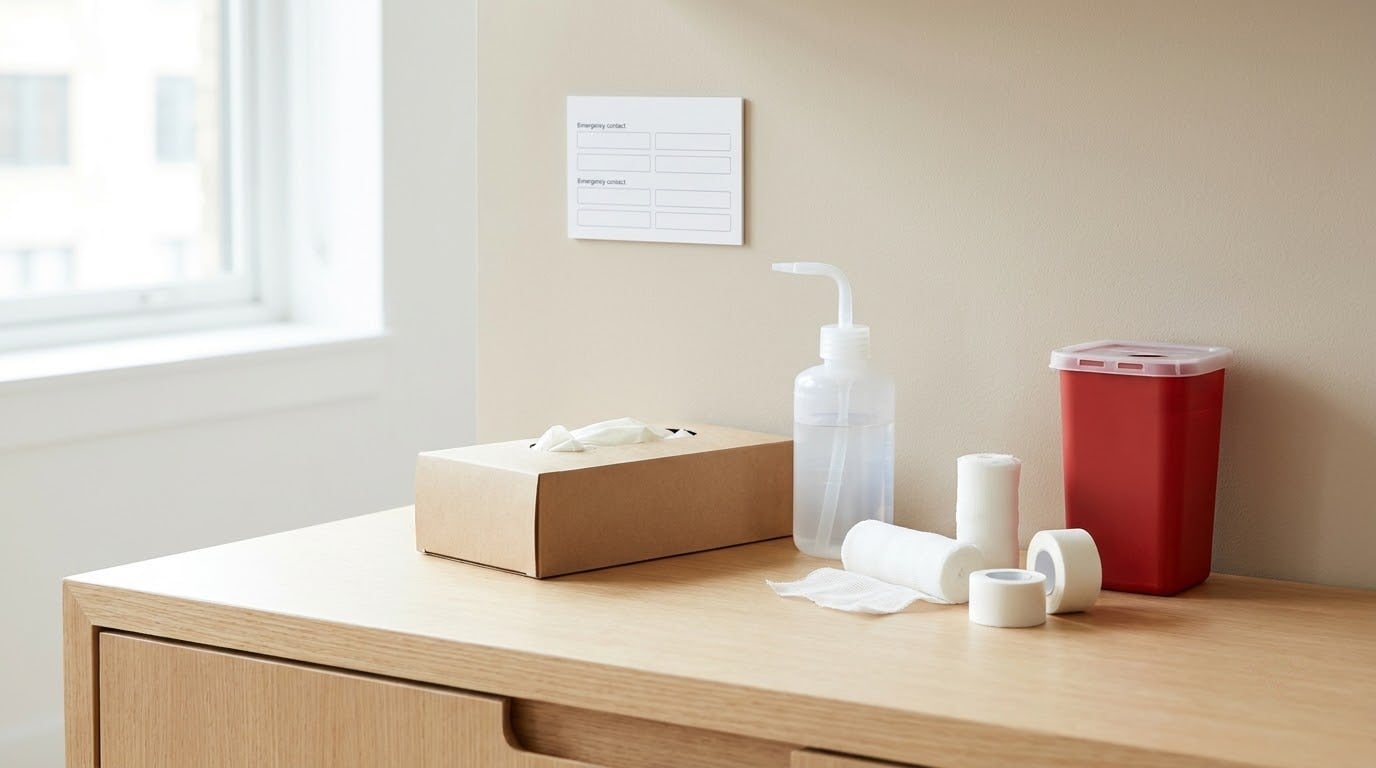
The response works far better when the supplies and phone numbers are already known rather than hunted for during an emergency. Before you need them, find out where these live in your workplace.
- The exposure control plan. Under OSHA’s Bloodborne Pathogens Standard at 29 CFR 1910.1030, covered employers must have a written plan that names responsible people and lists the tasks that carry exposure risk. Ask to see it or read the version posted at your site.
- A named contact. Get the direct number for occupational health or employee health, your supervisor, and the safety officer. Write them on a card in your badge holder or locker.
- An eyewash and sink you can reach quickly. Know the location of the nearest emergency eyewash station, not the one two wings away.
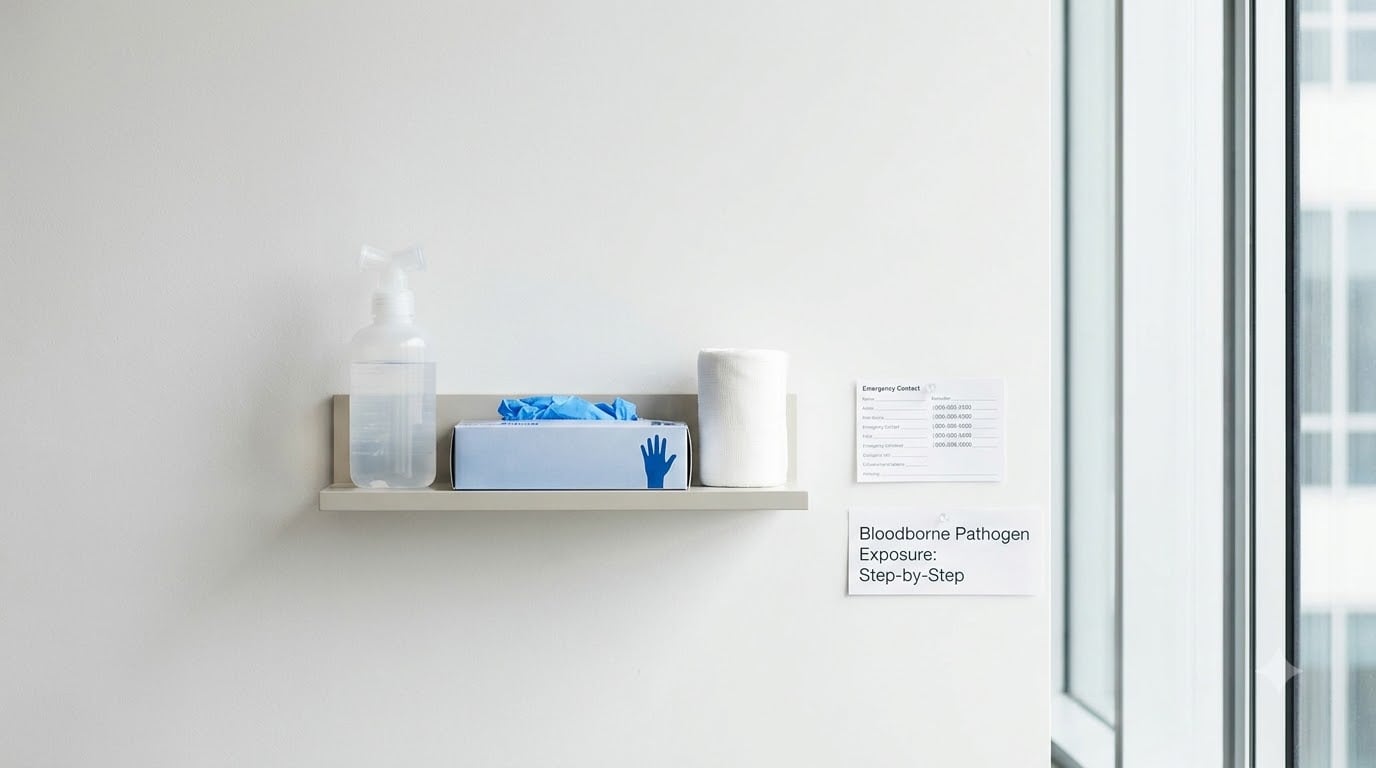
- First-aid supplies. Soap and running water, clean water or sterile saline for irrigation, sterile gauze and tape, disposable gloves, and a pocket mask if your role involves airway work.
- The reporting forms. Know which incident report, sharps injury log, and workers’ compensation form apply at your site, and who signs them.
- The PPE that fits the task. Gloves, gowns, eye and face protection, and any task-specific equipment your hazard assessment calls for. Gloves reduce the chance of a needlestick; they do not eliminate it.
Most sites run an annual bloodborne pathogen training requirement for exactly this reason. If you have not taken yours, or you cannot remember what your plan says, that is a gap worth raising with your supervisor now rather than during an incident.
Bloodborne Pathogen Exposure: Step-by-Step
1. Stop Work and Make the Area Safe
The first move is to stop what you are doing and prevent a second exposure. Put down the task, step back, and do not touch the contaminated material, the device, or the surface involved until you have assessed it.
If there is an ongoing hazard, such as an uncapped needle on a tray or a leaking specimen, make the area safe first and then deal with yourself. Notify your supervisor or the designated safety officer, and do it early enough that urgent care is not delayed while someone fills out a form. For a large spill or an injury with ongoing bleeding, call emergency services.
2. Wash or Flush the Exposed Area Immediately
Wash or flush the exposed area at once, and the route of exposure decides how. The goal is to physically remove the material before it enters the bloodstream, so time is the whole point.
- Puncture or cut, including a needlestick. Wash the site with soap and running water, then let it bleed briefly. Do not squeeze hard, scrub, or try to suck the wound. A thorough wash with soap and running water, rather than a quick swipe, is the current recommendation.
- Non-intact skin such as a cut, graze, or cracked area. Wash with soap and water, then cover with sterile gauze.
- Eyes. Flush with clean water or sterile saline at an eyewash station, holding the lids open. Irrigate generously rather than briefly; guidance for mucous membrane exposures calls for sustained flushing rather than a token rinse.
- Nose or mouth. Do not swallow. Rinse the mouth with water and spit, and flush the nose with saline or water.
- Intact skin with no break. Wash the area with soap and water anyway. It is usually not a reportable exposure, but washing costs nothing and you may not be certain the skin was unbroken.
Do not put bleach, alcohol, antiseptic, or any harsh chemical into the wound. Those agents irritate tissue and can slow healing, and they do not reduce transmission risk. Some older guidance suggested encouraging bleeding at the site; current practice favors gentle washing and allowing normal bleeding without forceful squeezing.
3. Report the Exposure and Seek Urgent Evaluation
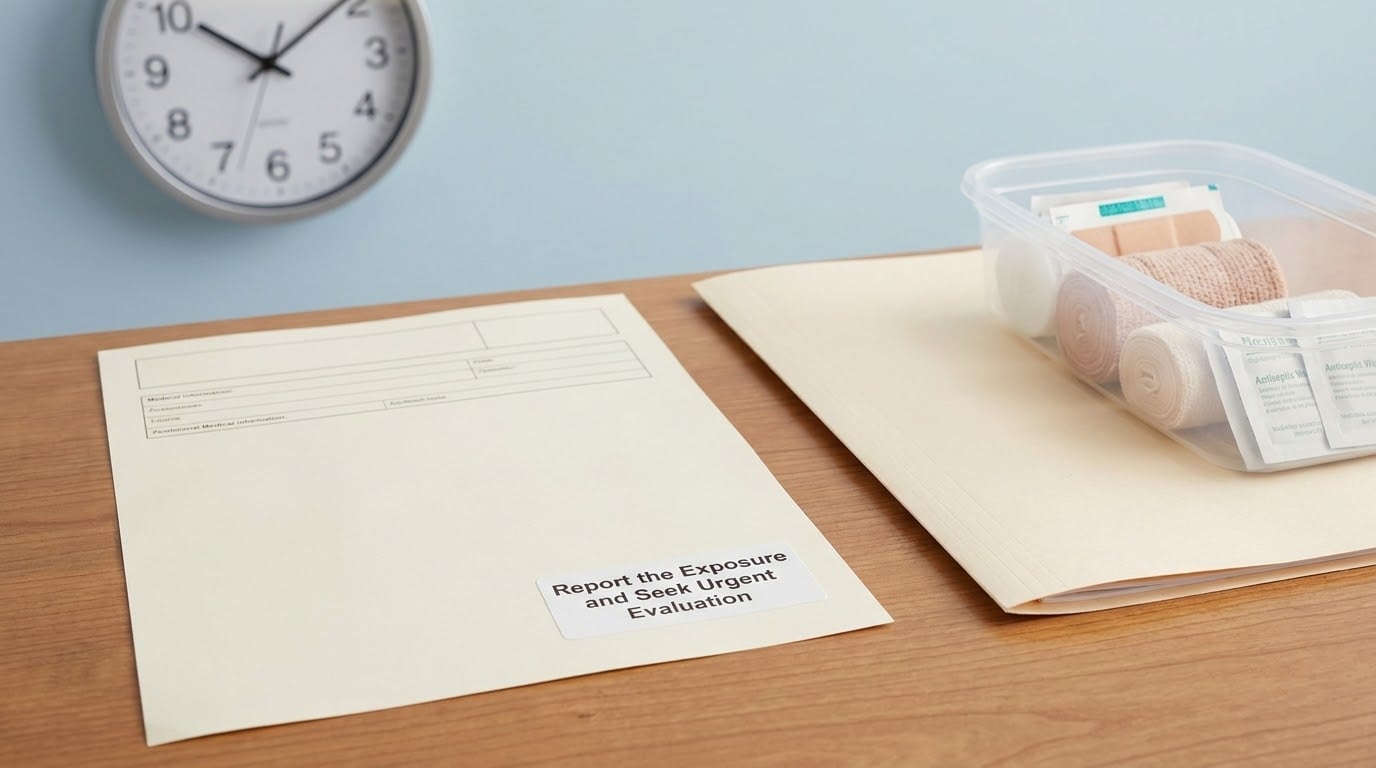
Report it as soon as you can, and get evaluated the same day. The exposed worker should be sent for a confidential medical evaluation as soon as possible after the exposure, with the referral ideally arranged within hours rather than days.
Employers with covered employees are required to provide this evaluation at no cost to the worker, and to keep the worker’s identity and medical information confidential. That is a real protection, not a formality, and it is one of the reasons a hand-written note saying “possible blood exposure at 1430, source unknown” is enough to start the process. You do not need to be certain it qualifies.
If your employer has no occupational health program, or no one is reachable, go to an emergency department or urgent care directly and say it is an occupational blood exposure, so the prophylaxis clock starts on the record. Whatever the setting, the sequence is the same: gloves off, wash with soap and water, tell your supervisor, go to employee health.
If you did not report at the time, report now. Delays of days are common and they narrow options, particularly around prophylaxis, but going to a clinic is still far better than staying quiet. Workers on forums describe avoiding reports because they were embarrassed, blamed themselves, or worried about how it would land in a review. None of that changes the biology, and the paperwork exists to fix the cause, not to find someone to blame.
4. Follow Medical Recommendations and Testing
A clinician will decide what is needed, and typically that includes baseline blood tests, source-patient testing when permitted, a hepatitis B vaccination check, and a decision about HIV post-exposure prophylaxis.
Baseline testing is drawn right after the exposure. It does not detect the exposure itself; it documents your status beforehand, which matters if any later result is ambiguous. HIV post-exposure prophylaxis is a 28-day antiretroviral course that must start within 72 hours of exposure, and it is recommended far more often when started within hours. It is not recommended when more than 72 hours have passed, because the benefit drops away. Hepatitis C has no preventive treatment, so early detection is what allows treatment to start if transmission occurred; hepatitis B is addressed with vaccination status, vaccine, and in some cases hepatitis B immune globulin.
Follow-up testing then continues on a schedule. A commonly used pattern is HIV testing at about 6 weeks, 3 months, and 6 months, with earlier HCV RNA testing around 1 to 2 weeks when the source patient is positive or unknown. The clock runs from the exposure date, not from the day you got around to reporting, so ask for a written schedule and put the dates in your calendar the same day you leave the clinic.
A negative result today does not close the question. Every test has a window period, which is why the follow-up draws exist.
5. Document the Incident and Prevent Another Exposure
Complete the paperwork, because documentation is what gets the fix funded and tracked. Fill out the incident report, the sharps injury log where one applies, and the workers’ compensation form. Employers maintain a needlestick and sharps injury log and make certain entries reportable on the OSHA injury log and the OSHA 301 incident report.
Ask what corrective action came out of it. That means an exposure determination, a review of the device and the task, checks that sharps containers were not overfilled, confirmation that safety-engineered devices were available and used, and retraining where the procedure was the problem. A container filled to the fill line is the single most common preventable cause of these injuries, and a report that does not trigger a container change has missed the point.
Keep your own copy of dates, names, and test results. Request the written follow-up schedule and make the appointments yourself if nobody else does.
Common Mistakes
Waiting to see if it looks serious. Puncture wounds are small and infections are not visible. The correction is simple: report any exposure involving blood or other potentially infectious material, and let the clinician categorize it.
Deciding that no visible blood means nothing happened. Visible blood is one factor among several, not a threshold. Report it, and let the assessment take in the device type, the depth of the injury, and the source status.
Using harsh chemicals on the wound. Bleach, alcohol, and peroxide irritate tissue and do not lower transmission risk. Use soap and running water, then sterile gauze.
Squeezing the puncture hard to get the blood out. Forceful squeezing damages tissue and can push material inward. Wash, let it bleed naturally, cover it.
Skipping the paperwork because care is already underway. The report is what prevents the next injury and what protects you if complications appear later. It is also cheap to do while you are already at the clinic.
Treating the emotional aftermath as a reason to stop following up. Waiting for results over several weeks is genuinely hard, and support from occupational health, peer support, or a counselling service is part of a complete response, not an optional extra.
Assuming a source person who tests negative ends the question. Test results reflect the window period of the test used. If the source is negative on recent testing and has no risk factors, risk is very low, but the clinician still decides what follow-up makes sense.
Frequently Asked Questions
Does every bloodborne pathogen exposure need emergency medical care?
Any exposure involving blood or other potentially infectious material should be reported and evaluated the same day, because the time-sensitive decision is whether HIV post-exposure prophylaxis applies and it must start within 72 hours. A small splash on intact skin with no break is often not reportable, but the person exposed should not make that call alone. When in doubt, go and be assessed.
How soon after an exposure should hepatitis C or HIV testing begin?
Baseline blood tests are drawn as soon as the exposure is reported, ideally the same day, to document your status before the window period. Follow-up HIV testing commonly lands at about 6 weeks, 3 months, and 6 months, and hepatitis C RNA testing may be done at 1 to 2 weeks when the source is positive or unknown. Your clinician sets the exact schedule for your exposure.
Can an exposed worker keep working while waiting for medical evaluation?
Most workers continue their normal duties, including while taking a 28-day course of HIV post-exposure prophylaxis, though some facilities restrict certain procedures or patient populations during treatment. There is no standard federal rule requiring removal from work, and any restriction is employer policy. Ask your supervisor and occupational health before assuming, and never skip care because a shift is coming up.
What if I do not know whether the source person has an infection?
Report it anyway. An unknown source does not end the assessment; it changes the decision path. Clinicians can treat the exposure as higher uncertainty, arrange testing where the source can be identified, and often recommend PEP when the source cannot be tested. A discarded needle found on a floor with no known origin is the clearest example, and that exposure still warrants evaluation.
Does a small splash of blood on intact skin count as an exposure?
A splash on unbroken skin is not a reportable exposure under the standard, because there is no route into the bloodstream. It still deserves a wash with soap and water, and if you cannot be certain the skin was unbroken, or if the material is not blood, tell your supervisor and ask occupational health. The distinction that matters is whether skin was broken or a mucous membrane was involved.
Can an employer require workers to disclose the medical reason for evaluation?
An employer may require you to report that an exposure occurred and to complete the incident documentation, but it cannot require you to disclose the medical details of your evaluation or results. Employers are required to keep the worker’s identity and medical information confidential, and those records are kept separately from personnel files. Employers usually cover the cost of evaluation, post-exposure prophylaxis, and follow-up testing.
Conclusion: What to Do First
Stop the task, make the area safe, wash or flush the exposed area with soap and water or clean water, and report it the same day. Then get the confidential medical evaluation, because the HIV post-exposure prophylaxis decision only stays open for 72 hours and works best within the first hours.
Average occupational transmission from a single needlestick is roughly 0.3%, and the risk is much lower or effectively absent for most splash exposures on intact skin. That is a reason for confidence, not for delay. Report it, document it, and get the schedule for follow-up testing in writing.
Reviewed against CDC HIV Nexus clinical guidance for PEP, NIH HIVInfo, the OSHA Bloodborne Pathogens Standard at 29 CFR 1910.1030, and NIOSH employer guidance. This article is educational and does not replace employer occupational health services or a clinician’s advice.