
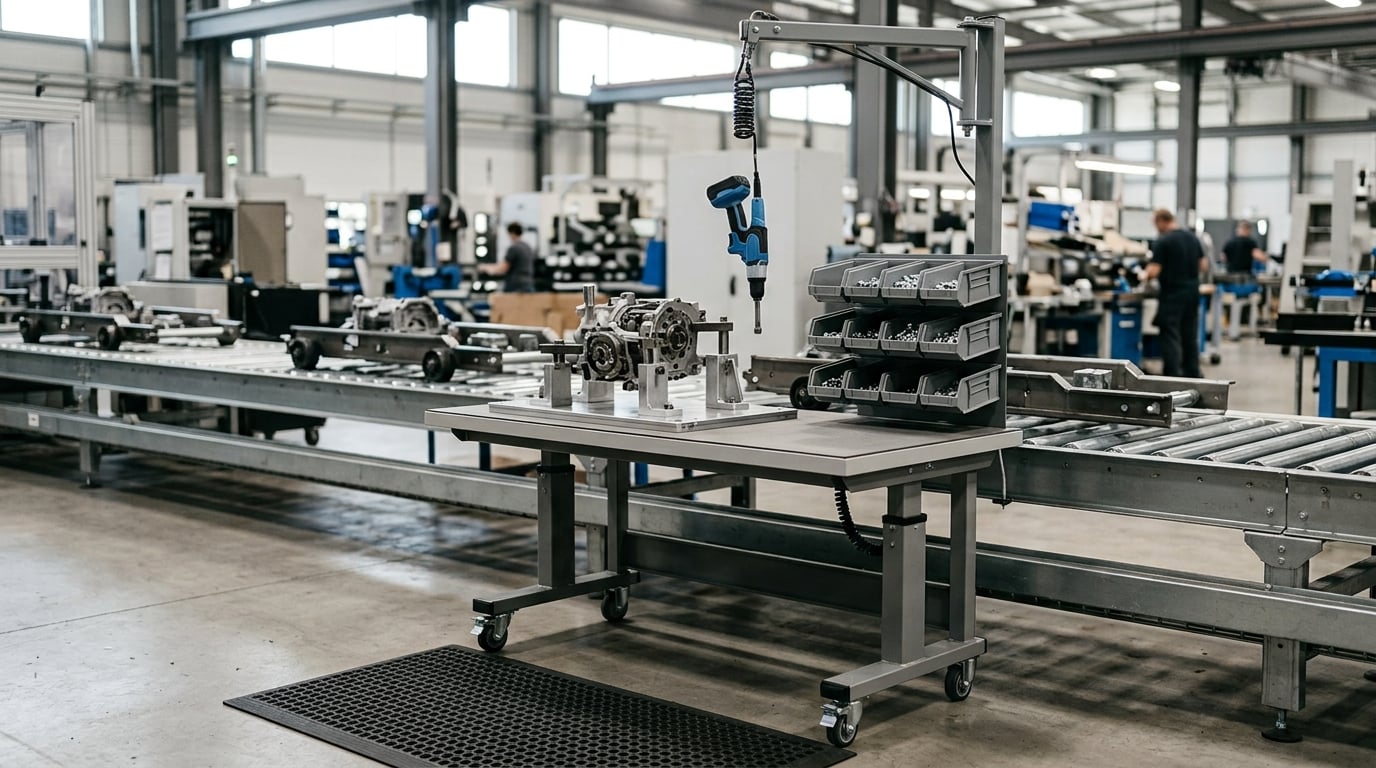
To reduce repetitive strain injuries on an assembly line, you engineer the hazardous motion out of the job first, then manage whatever exposure remains with rotation, recovery time and training. Instructions to “lift properly” come last, not first, because a worker cannot lift a 25 kg tote in a safer way every 40 seconds for a whole shift.
Most plants that struggle with this try to solve it with a stretch program or a laminated card at the station. Those changes cost almost nothing and they usually disappear within a month, because the pain isn’t in the worker’s technique. It’s in the cycle time, the part presentation and the tool in their hand.
The route that works is a staged programme: measure what is happening, find the worst stations, control them in the order the hierarchy of controls requires, then verify that the change held. On a typical line, you can identify the three or four highest-risk stations and start controlling them within a quarter. Injuries do not drop on day one, because the conditions that produced them took years to build.
Table of Contents
- What You Need to Reduce Repetitive Strain Injuries on an Assembly Line
- Step-by-Step: From Hazard Identification to Verified Improvement
- 1. Establish the Injury and Near-Miss Baseline
- 2. Observe the Entire Cycle at the Workstation
- 3. Identify and Prioritize the Highest-Risk Tasks
- 4. Reduce Repetitive Strain Injuries at the Source
- 5. Match Tools and Workstations to Individual Needs
- 6. Rotate Tasks Without Creating New Strain
- 7. Train Workers and Supervisors on Safer Work Methods
- 8. Check Improvements and Monitor for Regression
- 9. Escalate Persistent Pain and Injury Signals
- Common Mistakes That Leave Injuries on the Line
- Frequently Asked Questions
- What is the most effective way to reduce repetitive strain injuries on an assembly line?
- Should assembly-line workers rotate tasks to prevent repetitive strain injuries?
- Are stretching and warm-up programs enough to prevent repetitive strain injuries?
- How often should assembly-line workstations be ergonomically assessed?
- What should an employer do when a worker reports persistent hand or wrist pain?
- Where to Start
What You Need to Reduce Repetitive Strain Injuries on an Assembly Line
Before you change anything, you need the raw material that makes the changes defensible. Without it, every proposal becomes an argument about who is complaining more, and the loudest station wins instead of the most dangerous one.
Leadership and budget authority
Someone needs authority to change a fixture, a tool, a cycle time or a line layout. On many lines the ergonomics effort dies there: the assessment says the fastener station needs a torque arm, and the request has to travel through a capital request that never returns.
Workers who do the job
The operators at the station know which reach hurts on hour six, which part jams, and where they improvise a shortcut. Involving them early is not politeness, it is accuracy. A control installed without operator input usually gets worked around, and the workaround puts the strain somewhere less visible.
Observation access and time
You need permission to watch complete cycles at each station, on each shift, ideally with the line running at normal pace. A workstation visited for ten minutes at a quiet moment tells you very little.
Injury, first-aid and near-miss records
Pull at least two to three years of recordable injuries, first-aid cases, medical restrictions, workers’ compensation claims and reported near misses. Note the station, shift, task, body part and job tenure for each one.
Equipment and workstation data
Collect cycle and takt times, part weights, tool weights and torque settings, bench heights, reach distances, conveyor heights, and drawings or specifications for fixtures and aids. Also note which products run on the line, because a station that changes every product change is a different assessment problem each time.
A written method
Pick your assessment approach and write it down: RULA for upper-limb and seated postures, REBA for whole-body tasks and lifting, the NIOSH revised lifting equation for two-handed lifting, the Strain Index and ACGIH Hand Activity Level for repetitive hand work, Snook and Liberty Mutual tables for manual handling limits, and a simple discomfort survey for a fast department-wide screen. Whichever guidance applies in your jurisdiction, use it as the reference so the score means the same thing to everyone reading it.
Worth doing because the exposure is large. Roughly 30% of private-sector injury cases involving days away from work in the United States are musculoskeletal disorders, according to Bureau of Labor Statistics data cited in ergonomic assessment guidance, and WSIB data reported in Canadian manufacturing coverage puts repetitive strain injury claims at around 30% of lost-time claims, with back, shoulder, knee and ankle injuries the most frequently reported body regions.
Step-by-Step: From Hazard Identification to Verified Improvement
Run the steps in order. The sequence matters because each step supplies the input the next one needs, and skipping ahead is how plants end up buying a tool for the wrong station.
1. Establish the Injury and Near-Miss Baseline
Sort every record you have by station, shift, task, body part and job tenure, and then look for patterns rather than totals. A station with four hand reports in five years may matter less than a station with one report from a worker who has only been on the line eight months.
Keep the measure simple enough to repeat: reportable cases per station per year, first-aid cases per station per year, near misses reported, restricted-work days. Do not assign causes, and do not diagnose. Your record system tells you where and when, not why.
Who does it: the safety or occupational health lead with a production analyst pulling the data.
How you know it worked: you have a baseline you can reproduce in 12 months from the same definitions, and a ranked shortlist of stations worth watching.
2. Observe the Entire Cycle at the Workstation
Watch several complete cycles and record, for each task: the reach envelope, the postures held, the force required, the repetition rate, the time the task runs, the handling of parts and product, the machine or line timing, and anything that interrupts recovery. Also record what the operator does when the feeder jams, when a part is missing or when the conveyor stops, because those unplanned moments are often the worst postures in the cycle.
Watch on more than one shift if the staffing or pace changes. A line running at high overtime, or staffed with newer workers who have not yet developed efficient movements, does not behave like the same line on a normal day.
Who does it: a trained assessor paired with the operator, ideally two people so one can watch while the other records.
How you know it worked: you can describe a full cycle from your notes without guessing, and the operator agrees the description matches what they actually do.
3. Identify and Prioritize the Highest-Risk Tasks
Rank the tasks you observed on five factors: the severity of the possible outcome, how often the exposure happens, the evidence of harm already recorded at that station, how many workers do that task, and how realistic a control is to install. Severity plus frequency alone will push a rare heavy lift to the top; weighting the number of exposed workers keeps you honest about the stations that quietly wear down a dozen people for years.
Have the workers who operate the task rank it too. They will usually add hazards you missed, and they will also tell you which of your observations were wrong.
Who does it: the assessors, the operators, and a supervisor who owns the station.
How you know it worked: you have three to five ranked tasks rather than a list of twenty, and the operators agree with the order.
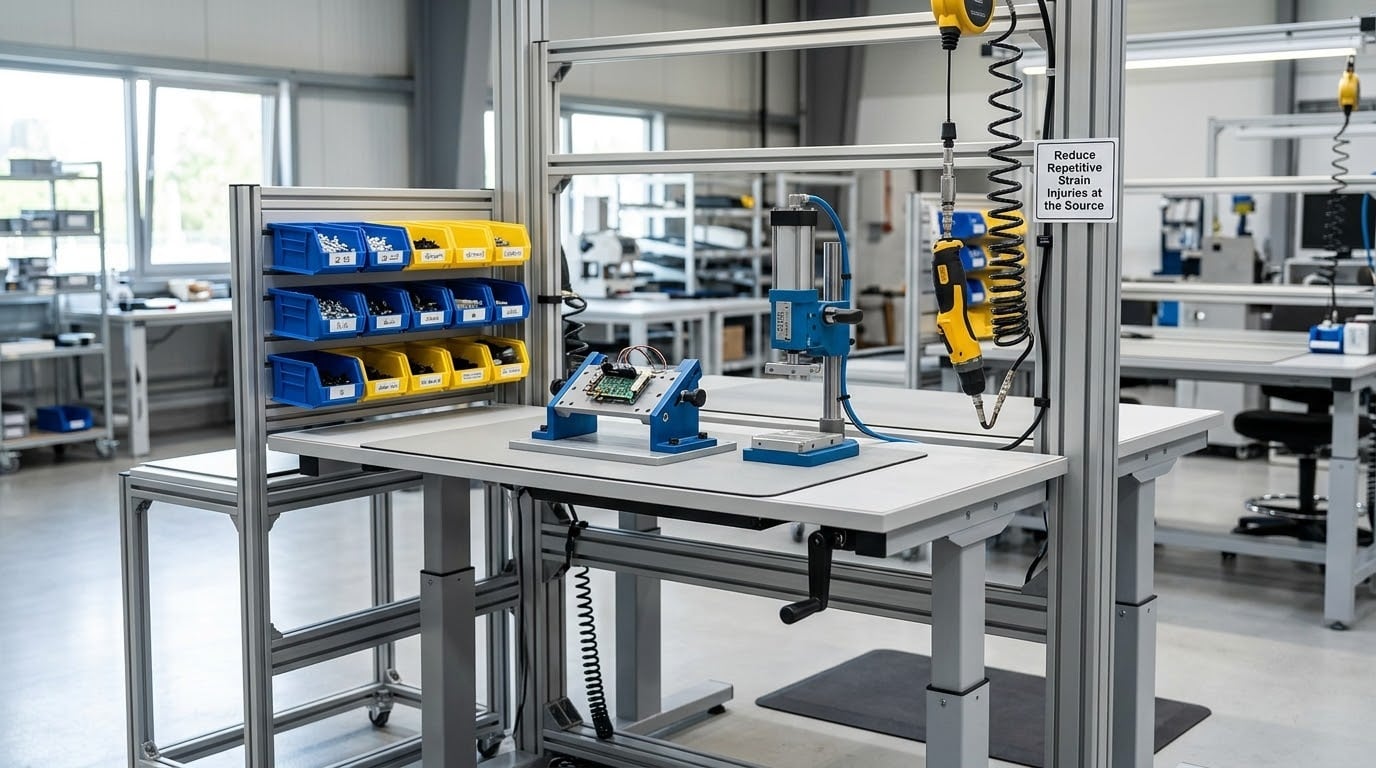
4. Reduce Repetitive Strain Injuries at the Source
Control the task, not the person. The hierarchy of controls is the order you work in, and each step down is weaker than the one above it.
| Control level | What it means on an assembly line | Strength | Limitation |
|---|---|---|---|
| Eliminate | Remove the task from the cycle: fewer fastening operations, fewer handling steps, redesigned product or packaging | Removes the exposure entirely | Usually needs engineering or product change, so it is the slowest and least likely to be approved |
| Substitute | Do the same job with less demanding demands: lighter parts, pre-cut material, torque-by-software fasteners | Low disruption for the line | Limited to what suppliers or product design allow |
| Engineering | Tool balancers and torque arms, gravity feed and part presentation, fixtures, height-adjustable benches, powered drivers, reach reduction | Removes load or posture for every user, permanently | Cost, floor space, and maintenance responsibility |
| Administrative | Task rotation, rest pauses, takt-time changes, staffing, job enlargement, scheduling of overtime | Fast to implement and free | Depends on people behaving as planned, and often spreads exposure instead of removing it |
| Training and awareness | Workstation set-up, use of aids, neutral working positions, reporting symptoms | Cheap, fast, supports everything above it | Weakest control on its own; poor technique under pace pressure will always lose to the cycle time |
| Personal protective equipment | Gloves, wrist supports, anti-fatigue surfaces | Low cost, immediate | Does not reduce repetition, force or reach; some gloves reduce grip force and make things worse |
In practice, look at the process before the hardware. Cutting the number of repetitive steps in a cycle reduces the repetition rate for everyone at once, and it is the only change on this list that also helps throughput. Where a task must stay, present the part to the operator instead of making them reach into a bin, hold the fastener, aim it and drive it. Fixtures that locate the part in the hands free up the reach and the visual effort. A powered driver on a balancer removes the weight and the force from the wrist, and an adjustable bench puts the work near elbow height for the person actually standing there.
Who does it: manufacturing or process engineering for the process changes, maintenance and industrial engineering for the fixtures and tools, operators for the trial.
How you know it worked: a repeat observation shows lower force, shorter reach or fewer repeated motions at the same output, and the operators do not revert to the old method within a few shifts.
5. Match Tools and Workstations to Individual Needs
A workstation set for a 50th-percentile body is wrong for most of the people who use it. Fit the equipment to the task and the range of bodies on the line instead of trying to fit people to one fixed setup.
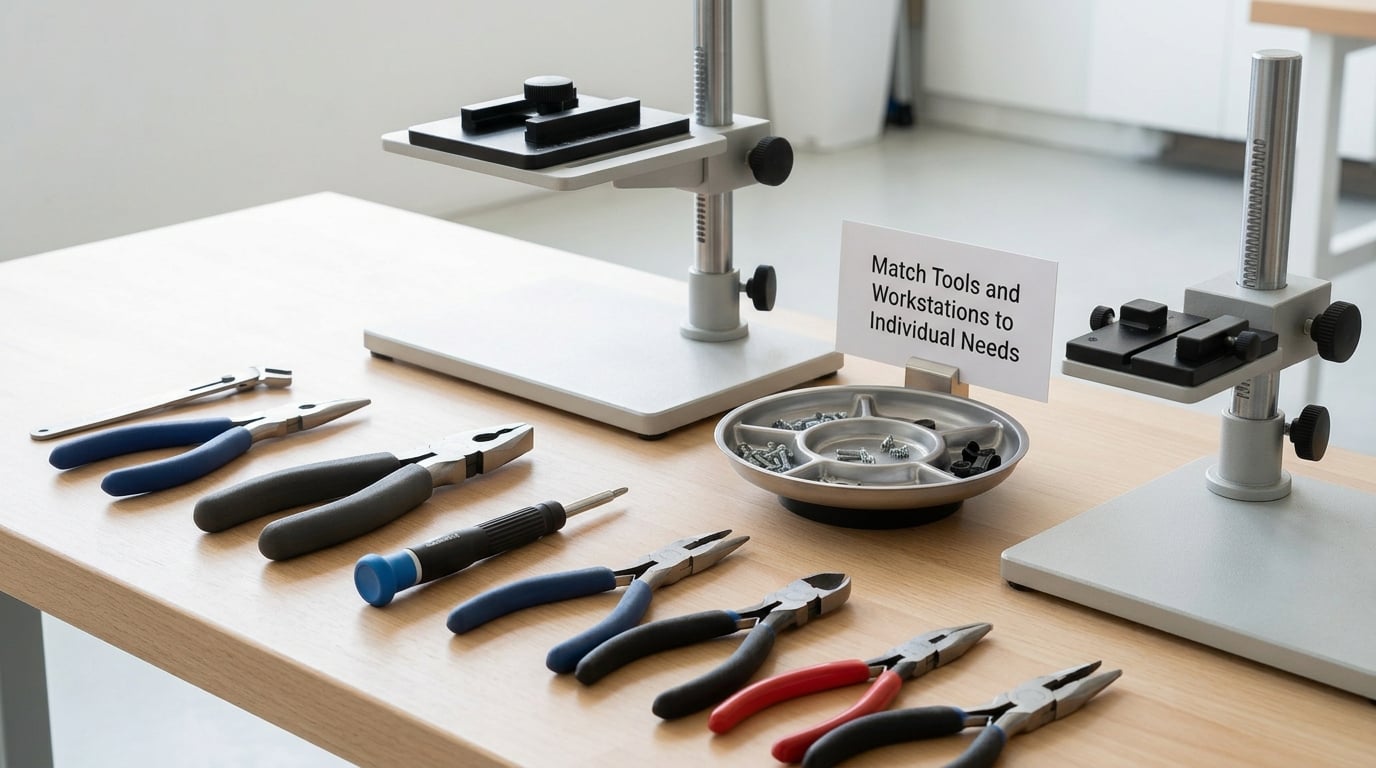
For tools, look at weight, grip, handle shape and trigger force. A tool that needs a pinch grip to hold it while a trigger is squeezed forces the forearm into a sustained contraction; a power grip that fits the palm and a trigger you can reach with a straight finger is easier to sustain. Test the tool with gloves on, because gloves change grip. Balance or suspend heavy tools so the arm is not holding the weight at the end of every stroke.
For the workstation itself, check the working height against elbow height for each operator, the reach to the parts and the fixture, seating where sitting is used, foot support and floor surface, lighting and glare, shadow over the work point, and the height and location of material delivery. Height-adjustable benches and fixtures that move in and out are what make this practical on a line where people differ in height, and they also let one station cover several products.
Shared equipment needs a written set-up standard. Otherwise each shift re-invents the height, and the improvement quietly disappears.
Who does it: the supervisor and operator together, with industrial engineering support, using a short measurement checklist.
How you know it worked: the operator reaches the parts and the tool without shoulder elevation or trunk twist, and can set the station without asking anyone for help.
6. Rotate Tasks Without Creating New Strain
Rotation helps only when the tasks you are rotating between actually differ in posture, force and skill demand. Moving a worker from one high-frequency wrist task to another high-frequency wrist task changes nothing except which shoulder hurts this month.
Build the rotation around demand types, not around station names. Pair a high-force task with a low-force, low-repetition one, and give the worker enough recovery at the demanding station to matter. Stagger the schedule so two people are not arriving at the hardest task together, keep rotation periods long enough to learn a new task well, and avoid rapid cycling that leaves nobody competent at anything.
Rotation is an administrative control, so treat it as a second-line measure. Where engineering controls are possible, they come first.
Who does it: the line supervisor with the production planner, since rotation only works if the schedule can absorb it.
How you know it worked: discomfort reports spread more evenly across the rotated tasks instead of concentrating, and nobody’s output drops because they are new to a station.
7. Train Workers and Supervisors on Safer Work Methods
Training works when it is specific to the control you just installed. Teach people how to adjust the bench, how to set the fixture, how to use the aid or the powered tool, how to hold the part in a neutral wrist position, and how to pace themselves within the cycle. Supervisors need the same training plus the authority to reset a station when the product or the fixture changes.
Explain the reporting route early and repeatedly: who to tell, what happens next, and why reporting discomfort early helps the worker. Fear of looking slow is one of the strongest reasons injuries get reported late.
Be clear about the difference between a temporary safe operating procedure and a permanent control. A temporary procedure is a written workaround with a date and an owner; if it is still in place a year later, it has become the standard and the real control never arrived.
Who does it: the supervisor or a trainer, with operators doing hands-on practice at their own station.
How you know it worked: workers can set up their own station correctly, use the aids without being reminded, and report discomfort early rather than pushing through.
8. Check Improvements and Monitor for Regression
Verification is the step that gets skipped, and it is the step that tells you whether any of this worked. Repeat the observation at the stations you changed, using the same method and ideally a different observer, and compare force, reach, repetition and posture against your baseline notes.
Track both kinds of numbers. Leading indicators tell you the exposure changed: repeat assessment scores, near misses reported, discomfort survey results, and observations of the new work method actually being used. Lagging indicators tell you the health effect changed: reportable cases, restricted days, first-aid cases and claim volume at that station.
Set a reassessment date after each control goes in, and reassess on change rather than on schedule alone. New product, new fixture, new tool, a revised takt time, a new shift pattern, a new worker population or a layout change all restart the clock, because any of them can reintroduce the exposure you removed.
Who does it: the ergonomics lead with the station owner, reviewed at a monthly meeting with the numbers on one page.
How you know it worked: you can show a before and after for the same station using the same measure, and no station has gone more than a year without review.
9. Escalate Persistent Pain and Injury Signals
Prevention fails for some people despite good controls, and the response is escalation, not blame. A worker reporting continuing pain, numbness, weakness, swelling or reduced function should be able to stop or modify the task where it is safe to do so, and to say so without being treated as a problem.
Route the report to occupational health, document the task exposure, and reassess that station immediately, because a signal from one worker often points at a hazard affecting everyone. Where symptoms persist or function changes, recommend evaluation by a qualified clinician, and involve the return-to-work or modified-duty process early rather than waiting for a full restriction.
Take the opportunity to check whether a similar exposure exists at the neighbouring stations. Repetitive strain injuries cluster, and a single case is often the visible part of a wider problem.
Who does it: the supervisor first, then occupational health, with an ergonomics reassessment of the station.
How you know it worked: people report early, the report triggers a station review rather than a conversation about pacing, and modified duty is arranged without delay.
Common Mistakes That Leave Injuries on the Line
Most failed ergonomic programs fail the same way. Here is what I see repeatedly, and what to do instead.
Waiting for injury reports. By the time someone reports, the exposure has been present for months or years and other people have been affected too. Run discomfort surveys and watch the near-miss log, which capture problems before anyone claims anything.
Running a stretching program and calling it a program. A short break that eases stiffness has a place, but it does not change force, reach or repetition rate. Keep it, and do not count it as your control.
Buying tools before measuring the task. A tool balancer on a station that was never the problem leaves the real hazard untouched. Observe first, then specify.
Setting the workstation for an average-sized worker. The average worker does not exist on your line, and the stations are shared. Use adjustable benches and fixtures, and record a set-up standard per station.
Rotating among equally demanding jobs. The MSD Prevention Guideline for Ontario is blunt about this: job rotation on its own is not an effective hazard control. Rotate between tasks with genuinely different demands, and treat it as a supplement to engineering controls rather than a substitute.
Measuring only output. Units per hour can improve while the exposure gets worse, particularly when the improvement comes from removing rest time. Pair production measures with exposure measures and injury measures.
Skipping worker participation. Controls chosen without the operators get worked around. Involve them at the observation stage, not just at the demonstration.
Treating training as the final control. The same guideline notes that lift training has not been shown to be effective for musculoskeletal disorder prevention on its own, and back belts are not a substitute for engineering. Training belongs at the bottom of the hierarchy, supporting whatever you built above it.
Assessing once and moving on. Static assessments of frequently changed work drift out of date quickly. Tie reassessment to process change, not to the calendar alone.
Two habits keep a programme alive. First, maintenance: fixtures, balancers and adjusters get bumped, and a control that no longer holds its position is worse than none because it looks fixed. Put them on the preventive maintenance schedule with a named owner.
Second, communication: publish what you changed, what it was meant to fix, and what the numbers looked like afterwards. People maintain controls they helped design, and supervisors need a short, honest explanation for why the old faster method is no longer the fastest one.
Frequently Asked Questions
What is the most effective way to reduce repetitive strain injuries on an assembly line?
The most effective way to reduce repetitive strain injuries on an assembly line is to remove or engineer out the hazardous motion first, then manage what remains. Fix part presentation, reach, cycle time, fixtures and tool weight before adding rotation, breaks or training. Controls applied in the order of the hierarchy of controls hold up under production pressure, because they do not depend on a worker choosing the safer option 900 times a shift.
Should assembly-line workers rotate tasks to prevent repetitive strain injuries?
Rotation can help, but only when the tasks in the cycle genuinely differ in posture, force and skill demand. Rotating between two high-frequency wrist tasks just moves where the discomfort appears. Pair demanding tasks with lighter ones, stagger schedules so workers are not all hitting the hard station at once, and keep rotation as a supplement to engineering controls rather than the main control on its own.
Are stretching and warm-up programs enough to prevent repetitive strain injuries?
No. Stretching and warm-up programs can improve how a worker feels and are worth keeping, but they do not change the force, reach or repetition rate built into the task. Prevention depends on controlling the exposure itself. Treat stretching as supporting practice and put your effort into redesigning the station, the fixture, the part presentation and the tool.
How often should assembly-line workstations be ergonomically assessed?
Assess at least once before a control is installed, repeat the observation after the change, and reassess whenever something moves: a new product, fixture, tool, takt time, shift pattern or layout. Many plants set an annual floor review, which is a useful minimum, but the change-triggered review is the one that catches real drift on lines that never stay the same.
What should an employer do when a worker reports persistent hand or wrist pain?
Take the report seriously and early. Let the worker stop or modify the task where it is safe to do so, document the task exposure, and reassess that station promptly, since similar exposures usually affect more people. Refer the worker to a qualified clinician for assessment if symptoms persist or function changes, and start return-to-work or modified-duty arrangements without delay. Do not attempt to diagnose the condition yourself.
Where to Start
Start by mapping your highest-risk station with the workers who operate it, not with a consultant’s list. Pull two years of injury and first-aid records, watch a full shift of real cycles at the top three stations, and rank what you see. Fix the process before the person, verify the change with a repeat observation, and set the date you will look again.