

Incentives reliably buy sign-ups. The 2019 JAMA randomized trial of 32,974 employees found no meaningful change in blood pressure, spending, absenteeism or job performance, while RAND’s work found that incentivized programs pull roughly twice the participation of those without rewards. The rewards work as a door opener, not the destination.
That gap is the whole conversation for HR and benefits leaders in 2026. Wellness program incentives that actually motivate employees are the ones that get someone to the first session, pair it with something useful, and then get out of the way. The ones that don’t work are a gift card attached to a task nobody wanted, run for eight weeks, then vanish.
Below is what the research actually supports, which incentive types hold up, how to match them to the kind of motivation your people respond to, and how to measure the difference between enrollment and behavior change.
Table of Contents
- What Makes Wellness Program Incentives Motivate Employees?
- Wellness Program Incentives That Actually Motivate Employees
- Which Wellness Incentives Work Best for Different Goals?
- How to Design Incentives Employees Can Actually Use
- How to Measure Whether an Incentive Motivated Employees
- Common Incentive Mistakes and How to Fix Them
- Frequently Asked Questions
- What are the most motivating wellness program incentives?
- Are wellness program incentives taxable in the US?
- How much should an employer spend on wellness incentives?
- Should wellness incentives be individual or team-based?
- Can a wellness program use gift cards without making employees feel judged?
- How can employers protect employee privacy when offering wellness incentives?
- What to Do First
What Makes Wellness Program Incentives Motivate Employees?
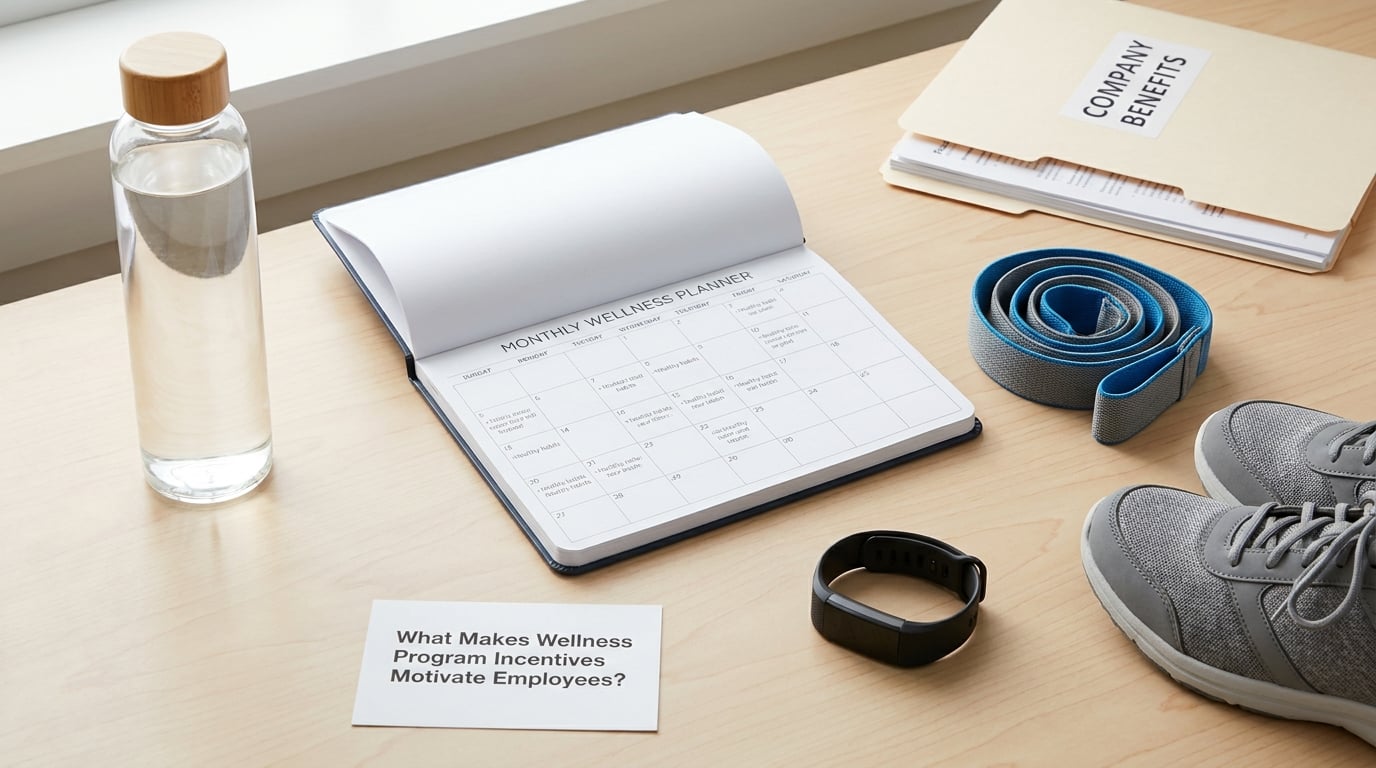
An incentive is a reward offered in exchange for a specific behavior: complete a screening, log steps for a month, finish a stress module. A reward that shows up with no behavior attached is a benefit, not an incentive, and employees tend to treat it differently.
The difference matters because the two things people respond to are not the same. Extrinsic motivation is the pull of an outside reward. Intrinsic motivation is the pull of the activity itself, the sense of progress, or the fact that someone on the team cares. Baicker, Cutler and Song’s 2010 Health Affairs meta-analysis set the optimistic case for health programs generally. The 2019 JAMA trial is the one employers cite most often now, and it is less flattering: participation rose, clinical markers did not.
Read those together and the usable conclusion is simple. An incentive is a catalyst, not an engine. It gets a person through a door they were not going to walk through. What happens on the other side depends on whether the activity itself is worth repeating.
Four design features separate incentives people respond to from the ones they collect and forget:
- Choice. A choice of rewards, or a choice of activities, keeps people in it. Forcing one path produces the highest sign-up rate and the lowest follow-through.
- Relevance. The reward has to match what the person was actually trying to do. A massage voucher for a night-shift nurse who cannot book appointments during the day is a reward with no path to it.
- Progress feedback. People keep doing what they can see. A visible streak or a tier they are close to reaching does more than a lump sum at the end.
- Social support. Team structures supply motivation that survives the reward window, because quitting costs you something other than money.
Self-efficacy is the thread running through all four. Someone who completes one walk becomes someone who walks. That internal shift is what keeps behavior going after the prize is gone, and no budget line can buy it directly.
Wellness Program Incentives That Actually Motivate Employees
This table ranks the incentive types employers actually use. Durability means what is still happening three months after the reward period closes, which is the only honest test of a wellness incentive.
| Incentive type | What it lifts | Durability after the reward ends | Gaming risk | Best workforce fit |
|---|---|---|---|---|
| Prepaid or closed-loop gift card | Sign-up and short-term completion | Low; drops once the card is spent | Low, but shared accounts happen | Broad participation pushes, onboarding |
| Points with tiered prizes | Repeat engagement across a season | Medium to high if the tier is visible | Medium; shared accounts, purchased activity | Desk and hybrid staff with steady routines |
| Extra paid time off | Sign-up and completion of time-consuming tasks | High; the reward is also a health action | Low | Frontline and shift teams short on hours |
| Wellness premium differential | Enrollment in screenings and coaching | Medium; it becomes a recurring cash incentive | Low to medium; people shop the cheapest plan | Benefits-literate employees with dependents |
| Team challenge with a shared pool | Group participation and peer pressure | High while teammates keep participating | Medium; one person carries a team | Co-located teams with an existing culture |
| Charitable donation credit | Sign-up among people not motivated by personal gain | Medium to high; the habit is the donation | Low | Missions-driven and community-focused teams |
| Fitness or class reimbursement | Consistent activity outside work | High; the activity continues without you | Low to medium; receipts get passed around | Employees near a gym, class or studio |
| Choice-based wellness credit | Everything, because the employee picks the activity | Medium to high | Low | Mixed workforces with different constraints |
| Protected break or schedule flexibility | Movement in shifts that have none | High; it changes the workday itself | Low | Manufacturing, logistics, retail |
| Manager and peer recognition | Culture signal rather than participation | High, at near-zero cost | Low | Any workforce, especially remote teams |
Read the durability column as the ranking. Gift cards top the sign-up column and sit at the bottom of the durability column, which is why a card-only program tends to die after one quarter. Time off, schedule flexibility and choice-based credits sit higher because the reward and the healthy behavior are the same thing.
How to Match Wellness Program Incentives to Employee Motivation
Matching means identifying what your people already respond to, then offering the incentive that speaks to it. Here is the practical version.
Immediate reward. These employees finish what gets paid off this week. Short challenges with frequent, small payouts suit them, and a six-week timeline beats a year-long one.
Personal progress. They are motivated by getting measurably better, not by winning against anyone. Points with visible tiers, personal baselines and streak tracking work here, and anything that compares people head to head actively demotivates them.
Belonging. Team challenges, group milestones and shared charity goals. The cost is coordination, and the payoff is that the social pressure does the work once your program stops paying for it.
Flexibility. They respond to control, not to compensation. Choice-based credits, extra paid time off and flexible deadlines outperform any fixed gift in this group, because the reward is the autonomy itself.
Financial value. Premium differentials, HSA or FSA contributions and reimbursement work for employees who think in dollars and cents. This is also the group that notices when an incentive quietly shrinks in a tight budget year.
Charitable giving. Donation credits, matching and volunteer-time rewards. They rarely drive the highest participation on their own, but they often pull in the employees other incentives never reach.
Status and recognition. Public acknowledgment from a manager they respect, or a visible team result, motivates people who are not chasing a prize. It is also the cheapest line in most wellness budgets.
The mistake is running one incentive for all seven. If you survey employees and discover three distinct motivation types, build three tracks rather than one compromise that fits nobody particularly well.
Which Wellness Incentives Work Best for Different Goals?
A step challenge and a stress program need different rewards, because they ask for different amounts of effort and face different barriers. Here is what tends to work for each goal.
Movement. Team-based step and activity challenges with flexible tracking, plus protected break time as the underlying reward. Tracking devices, gym reimbursement and group milestones all fit. Track completion and how much of the team is still active at week eight, not total steps.
Preventive health. Biometric screening and health risk assessments need a concrete payoff and a short session, because completion is the goal. A prepaid card released after a completed screening, or time off to attend the appointment, converts better than a wellness fair.
Stress and mental health. Gartner data shows 87% of employees have access to mental or emotional wellbeing offerings and only about 23% use them, which is an access problem disguised as an interest problem. The fixes are friction removal rather than bigger prizes: sessions during shift time, no cost, no manager notification, and coverage that includes the caregivers and night workers your current program misses.
Nutrition. Short, specific and self-directed. Reimbursement for healthy prepared meals, grocery or produce credits, and cooking sessions with a real person beat a points scheme that rewards logging meals nobody logs.
Sleep. A flexible-earnings or shift-swap allowance and light-touch prompts at the point of scheduling. Sleep cannot be rushed, so time-based incentives beat performance-based ones here.
Social connection. Shared meals, walking clubs, team challenges and volunteering days. These do not need an incentive at all, which makes them the easiest thing to keep when budgets tighten.
Habit formation. Any activity people need to do daily should be supported with progress visibility for long enough to stick. The often-quoted habit research puts the average formation time around 66 days, with a wide range from 18 to 254 days, so an eight-week challenge ends right around the edge of the window where a habit starts to hold.
The 2019 JAMA trial is worth reading carefully here. Despite null clinical results, participants who completed the program reported more regular exercise at 69.8% versus 61.9% in the control group, and more active weight management at 69.2% versus 54.7%. That gap is real but modest, and it is the honest ceiling for what a screening-plus-incentive program usually buys.
How to Design Incentives Employees Can Actually Use
Most failed programs are not badly budgeted. They are designed around people who already have time, gym access and predictable schedules. Here is the design checklist I would work through before anything else.
Make eligibility obvious. If an employee has to email someone to find out whether they qualify, half of them never ask. Put eligibility in the enrollment screen in plain language.
Offer a real choice. Two or three reward types, refreshed periodically, cost almost nothing extra to run and widen access dramatically.
Check accessibility for your actual workforce. Weight-based challenges exclude people for reasons they cannot change, and pregnancy, caregiving, disability and shift schedules all break step-count designs. Offer alternative qualifying activities with equivalent credit, not an opt-out that quietly excludes people.
Price rewards evenly. A voucher worth the same face value across reward types prevents complaints you will spend more time on than the reward itself.
Time the reward well. Mid-challenge recognition beats an end-of-year prize, because the person who is going to fall off has not fallen off yet at week four.
Decide team versus individual deliberately. Individual rewards are fair and lonely; they also create pressure that some people will pay to avoid. Team rewards build belonging and risk free-riding. Many programs run both: a team goal for connection and an individual streak for personal progress.
Say plainly that participation is voluntary. Then make it true. People who suspect a hidden cost will not enroll, and if they enroll under suspicion, you have a grievance instead of a wellness program.
Legal and privacy guardrails every program needs
Employers cannot compel participation, and a premium surcharge for opting out is legally constrained under the ADA in ways that vary by plan design. Programs also touch GINA and state health-data privacy rules.
Four guardrails cover most of the risk:
- Participation is voluntary, with a genuine opt-out path that carries no penalty and no explanation.
- The employer sees aggregate, de-identified cohort data only, never an individual’s readings or results.
- Contract terms state retention and deletion, so biometric data does not sit in a vendor’s warehouse indefinitely.
- No individual biometric or health data is shared with managers or used in employment decisions.
Get counsel involved before launch, not after an employee complaint.
How to Measure Whether an Incentive Motivated Employees
Measurement is where most wellness programs quietly fail, and the failure is usually in the definitions. Only about 32% of total rewards leaders report confidence in their own assessment of whether their wellbeing programs work. Here is the framework I would use.
Separate two ledgers. The ROI ledger holds hard dollars: healthcare claims trend, absenteeism days, turnover and replacement cost. It moves slowly, often taking 12 to 24 months to read anything. The VOI ledger holds leading indicators: enrollment, completion, repeat engagement, self-reported stress and satisfaction. It moves fast and it never settles the financial argument on its own.
Report both, label them honestly, and never present a VOI number as an ROI number.
The metric most worth tracking is the split between enrollment and sustained engagement. Those are different populations, and the gap between them is where wellness budgets leak. Vendor pilots have honestly reported around 29% of enrollees sustaining three or more sessions per week, and the Illinois Workplace Wellness Study found only 56% of employees who were paid to participate completed the screening. Plan against the sustain number, never the sign-up number.
Five things to watch:
- Enrollment rate in the first window, as a marketing measure rather than a success measure.
- Completion rate, and the share of completers active again 30 and 90 days later.
- Behavior signals that are not step counts: reimbursement claims for classes, screening completion, stress score movement in aggregate.
- Equity: participation and completion broken out by shift status, location and employment type. Flat overall numbers often hide a frontline workforce that was never reached.
- Cost per meaningful outcome, meaning per sustained participant, not per enrollee and never per dollar of budget.
Also watch for the selection effect, because it will flatter you. The Illinois Workplace Wellness Study found that employees who chose to join were already spending about 115 dollars a month less on healthcare before the program existed. That rules out most of the flattering return estimates vendors used to advertise. Self-selected participation is not proof that your program caused anything.
Designing Out Gaming and Fraud
Fraud is an expected program cost, not an outlier. One widely reported case saw a Kansas City employer lose more than 300 thousand dollars after employees falsely claimed marathons and triathlons, and trackers have been found attached to dogs and ceiling fans.
Four design moves cut most of it:
- Verify activity through the device or platform rather than self-reported screenshots, and spot-check a sample of high performers.
- Cap individual rewards and pay the majority at team level, so no single fabricated total matters much.
- Run a periodic audit rather than a permanent monitoring regime, which costs trust faster than it catches anyone.
- Publish a short fraud policy with a clawback clause before launch, and enforce it once so it is credible.
How Much Should a Wellness Incentive Budget Look Like?
The most common planning range for a structured program with incentives is roughly 4 to 8 dollars per employee per month, and how that splits between platform, screening and prize pool varies a lot by workforce size. Smaller employers tend to spend more per head because fixed platform costs spread thinner, and they usually do better skipping a dedicated vendor platform entirely in year one.
| Company size | Typical annual incentive budget | Per employee per month | Structure that tends to work |
|---|---|---|---|
| Under 100 employees | 3,000 to 10,000 dollars | 3 to 10 dollars | Two reward options, a seasonal challenge, reimbursement for classes, no dedicated platform fee |
| 100 to 500 employees | 10,000 to 40,000 dollars | 4 to 8 dollars | Points with tiered prizes, one team challenge per quarter, a screening window tied to a prepaid card |
| 500 or more employees | 40,000 to 150,000 dollars | 3 to 7 dollars | Choice-based credits, team and individual tracks, aggregate reporting by shift and location |
These are planning ranges, not quotes, and they shift with benefits costs and headcount. The more useful comparison is against the cost of doing nothing, since burnout, absenteeism and turnover commonly run into the thousands per employee per year in knowledge work, while a well-run program sits in the low single digits per month. Frame the budget conversation that way and the finance conversation gets shorter.
A 90-Day Rollout Sequence
Most incentive programs that stall never had a program design problem. They had a sequencing problem. A workable 90-day sequence looks like this.
- Days 1 to 30: listen and audit. Pull participation and completion data by job type, survey employees on what they would actually use, and get counsel reviewing the voluntariness and privacy design. Do not launch anything in this window.
- Days 31 to 60: build the minimum viable program. Two reward options, plain-language eligibility on the enrollment screen, equivalent-credit alternatives for anyone who cannot do the headline activity, and a written fraud policy. Pilot with one team rather than the whole company.
- Days 61 to 90: open enrollment and measure. Launch with a clear window, time the first recognition early enough to catch people who are drifting, and schedule your first 30-day sustained-engagement read before the initial excitement has faded.
Resist adding incentive types during the first 90 days. You want a clean read on whether the design you chose actually holds engagement, and every new prize launched mid-quarter muddies that read.
Common Incentive Mistakes and How to Fix Them
One reward for everyone. A single gift card option produces a high sign-up rate and low satisfaction among people who could not use it. Fix: run two or three tracks based on what your survey says people value.
Weight and step framing as the default. It excludes employees who cannot change those numbers, and it invites exactly the fraud you are trying to prevent. Fix: offer equivalent credit for strength, mobility, sleep, stress management or nutrition, and publish the alternatives up front.
Overcomplicated rules. If eligibility takes a paragraph to explain, the honest participants who would have benefited never start. Fix: one enrollment screen, plain language, no eligibility email chains.
Short bursts with nothing after them. A four-week challenge followed by silence produces a spike and a trough. Fix: keep a low-cost ongoing element running year round, even if it is just aggregate progress visibility.
Judging success by enrollment. This is the most common reporting mistake and it hides every problem above. Fix: report completion and 90-day sustained engagement beside every enrollment figure.
Designing for people who are already active. Program averages often reflect a small group of employees who would have walked anyway. Fix: report participation by job type, then set goals for the groups sitting at zero.
Cutting incentives first and measuring last. When SHRM’s 2025 survey shows structured wellness programs falling from 53% of employers in 2021 to 39% in 2025, incentives are the first line to go. Fix: measure before you cut, so you know what you are removing.
Frequently Asked Questions
What are the most motivating wellness program incentives?
The most motivating incentives give choice, arrive while the habit is forming, and match how the employee is motivated. Extra paid time off, flexible wellness credits and team challenges that fund something together tend to hold up best because the reward keeps working after the program ends. Gift cards reliably lift sign-up but rarely sustain behavior.
Are wellness program incentives taxable in the US?
Generally yes, the value of an incentive is taxable to the employee as taxable income unless a specific exclusion applies, and it must be reported on payroll. Exclusion rules vary by incentive type and can change, and some arrangements affect how the employer’s own deduction is treated. Treat it as taxable and route exceptions through your payroll provider or tax adviser before launch.
How much should an employer spend on wellness incentives?
Most employers land somewhere around 4 to 8 dollars per employee per month for a structured program, with the incentive portion of that varying widely by workforce size. What matters more is that the per-employee figure covers the whole program, not just prizes. A useful benchmark is against the cost of inaction, since burnout and turnover run into the thousands per employee per year in most industries.
Should wellness incentives be individual or team-based?
Run both, for different reasons. Individual rewards create fair, personal progress tracking and suit people motivated by their own results. Team rewards build belonging and keep participation going once the reward window closes, which is the durability problem individual prizes struggle with. The failure mode for teams is free-riding, which a shared pool with milestone tiers and modest individual caps reduces.
Can a wellness program use gift cards without making employees feel judged?
Yes, as long as the reward is attached to a process rather than an outcome. A gift card released for completing a screening or finishing a challenge carries no body or health judgment. A gift card for losing weight or hitting a step target does, and it screens out people for things they cannot change. Judge participation, never results.
How can employers protect employee privacy when offering wellness incentives?
Limit the employer to aggregate, de-identified cohort data and never share individual readings with managers or use them in employment decisions. Make participation voluntary with a real opt-out that carries no penalty, and make sure anyone in a position of power cannot see who did or did not enroll. Put retention limits and deletion terms in the vendor contract, and get counsel to review the design before launch.
What to Do First
Start by pulling your last two quarters of participation data and splitting enrollment from 90-day sustained engagement. Most programs find that the second number is a fraction of the first, and that the gap concentrates in shift and frontline employees who were never reached by the original design.
Then pick one incentive that rewards a process rather than an outcome, offer a second option for people who cannot use the first, and keep a low-cost version running past the challenge window. Wellness program incentives that actually motivate employees are rarely the biggest line in the budget. They are the ones built around choice, relevance and time.