
Sitting at a desk for eight hours does three things to your body: it holds your neck, hips and hamstrings in a shortened position, it switches off the muscles that hold you upright, and it slows the circulation in your legs. Short, regular movement breaks reverse that in a matter of minutes.
All 12 movements below need no equipment, no change of clothes and no shower afterwards. Ten of them work entirely from a chair, and the remaining two take place standing beside your desk. Most take 30 to 60 seconds once you know them, so a full circuit fits inside a coffee break.
This list was last reviewed in 2026. It is general workplace wellness information, not medical advice. If a movement causes sharp pain, numbness or dizziness, stop and talk to a doctor or physiotherapist.
Table of Contents
- Exercises You Can Do at Your Desk at a Glance
- 1. Seated Neck Reset
- 2. Shoulder Rolls and Shrugs
- 3. Seated Thoracic Rotations
- 4. Wrist Extensor Stretch
- 5. Seated Chest Opener
- 6. Seated Marches
- 7. Chair-Supported Squats
- 8. Standing Calf Raises
- 9. Seated Glute Squeezes
- 10. Seated Hamstring Stretch
- 11. Standing Hip Flexor Stretch
- 12. Seated Figure-Four Stretch
- Frequently Asked Questions
- Where to Start
Exercises You Can Do at Your Desk at a Glance
Every movement in this guide is listed below with the body area it targets, whether you can do it without standing up, and roughly how long it takes. Use the table to build a routine that matches your problem. Someone with neck pain from a low monitor and someone whose ankles feel tight after a long morning need very different picks from the same list.
| Exercise | Body area | Seated or standing | Time needed |
|---|---|---|---|
| Seated neck reset | Upper neck and sides of the neck | Seated | 30 seconds per side |
| Shoulder rolls and shrugs | Shoulders and upper back | Seated | 40 seconds |
| Seated thoracic rotations | Mid and upper back | Seated | 60 seconds |
| Wrist extensor stretch | Forearm and wrist | Seated | 30 seconds per side |
| Seated chest opener | Chest and front of shoulders | Seated | 45 seconds |
| Seated marches | Hip flexors and circulation | Seated | 1 to 2 minutes |
| Chair-supported squats | Thighs, glutes, balance | Standing | 1 minute |
| Standing calf raises | Calves and circulation | Standing | 45 seconds |
| Seated glute squeezes | Glutes | Seated | 40 seconds |
| Seated hamstring stretch | Back of the thigh | Seated | 40 seconds per leg |
| Standing hip flexor stretch | Front of the hips | Standing | 60 seconds per side |
| Seated figure-four stretch | Glutes and outer hip | Seated | 60 seconds per side |
Can these be done while working?
Ten of the twelve yes. Seated neck resets, shoulder rolls, thoracic rotations, wrist stretches, chest openers, marches, glute squeezes, hamstring stretches and figure-fours all read as ordinary fidgeting, which is exactly why they work in an open-plan office. The two standing moves, chair-supported squats and calf raises, work at a sit-stand desk or in a corner away from foot traffic.
Timing matters more than intensity. Two minutes of movement every 30 to 60 minutes beats a single 20-minute session at the end of the day, because the tissues being stiffened are stiffened by how long you hold one position, not by how many hours remain until you get up.
1. Seated Neck Reset
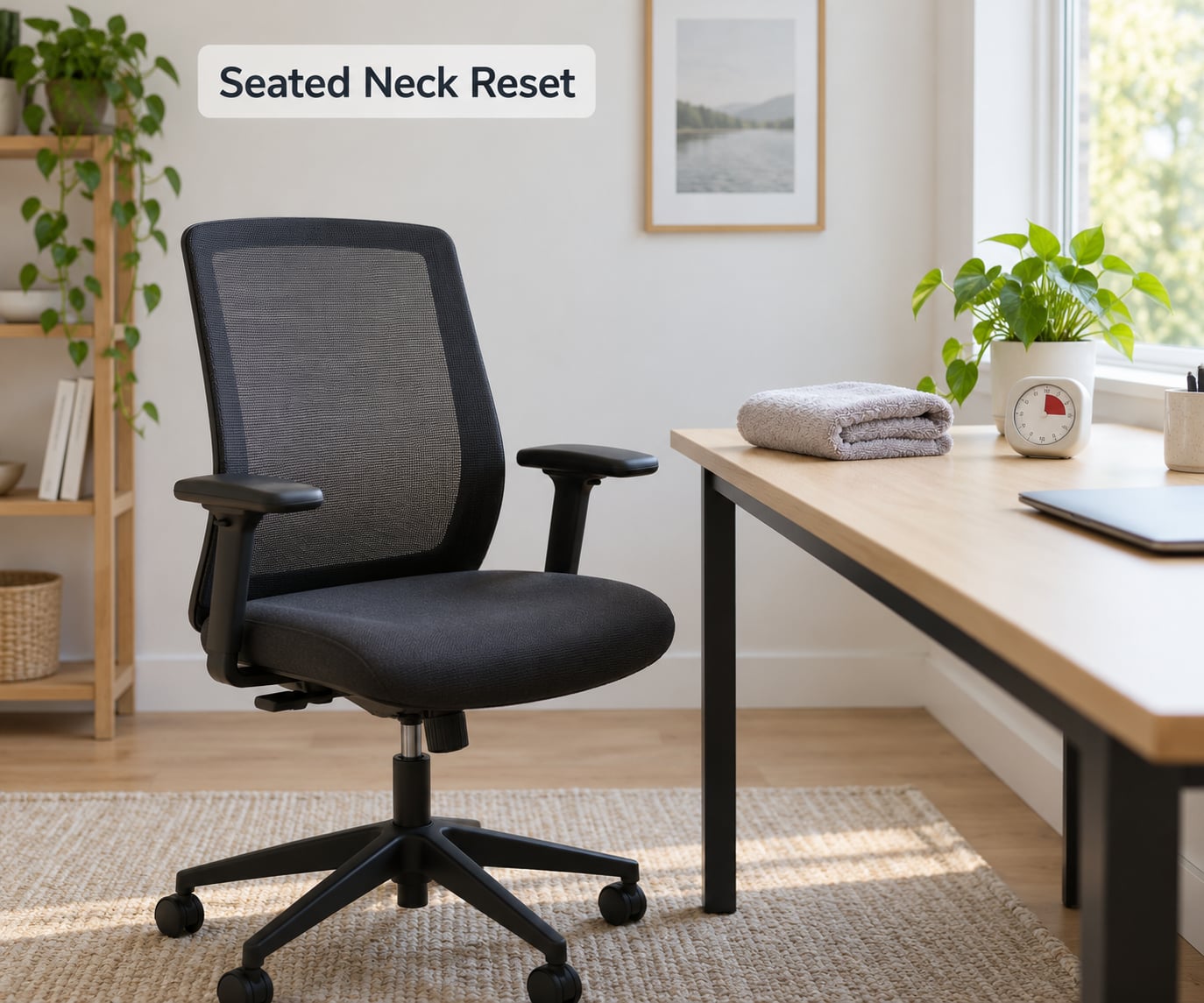
Drop the ear toward one shoulder until you feel a gentle pull along the opposite side of your neck, and hold. That is the whole movement.
Sit tall with both feet flat on the floor and your chin level rather than tilted up. Let your right ear travel down toward your right shoulder. Stop where you feel a stretch, not a pinch, and keep both shoulders heavy and down.
Hold 20 to 30 seconds, breathe slowly, then switch sides. Two or three rounds per side is plenty, and you do not need to repeat it all day for it to count.
Do not pull the head with your hand, do not circle the head, and never force the chin toward the chest. If you feel a sharp pinch at the base of the skull or tingling down the arm, come out of the stretch immediately.
2. Shoulder Rolls and Shrugs
Slow backward shoulder circles, followed by forward circles, restore movement to a joint that spends the whole day held still in front of you.
Sit or stand with arms hanging naturally. Lift both shoulders straight up toward your ears, roll them back and down, and let the shoulder blades slide toward each other at the bottom of the circle. This backward direction is usually where you feel the most benefit, because it opens the front of the shoulder.
Do 8 to 10 slow circles backward, then 8 to 10 forward. Follow up with a shrug, holding the shoulders high for 3 seconds before releasing. The breathing matters: keep exhaling as the shoulders drop, which is when the actual release happens.
If the movement pinches, hurts or feels worse the more you do it, stop and seek advice rather than pushing through it. Rolling shoulders aggressively is a common cause of irritation in an already irritated shoulder.
3. Seated Thoracic Rotations
Twisting through the mid-back while keeping the hips forward is the single most useful thing you can do for a stiff upper back at a keyboard.
Sit at the front third of your chair, feet flat, and place your hands loosely on the opposite side of your thighs, or interlace them in front of your chest. Lengthen your spine, tuck your chin very slightly, then rotate your rib cage to the right as far as your shoulder blades will let you.
Keep both hips facing forward. The mistake almost everyone makes is letting the whole body swivel at the waist, which loads the lumbar spine instead of the mid-back. Breathe in as you pass through the middle and exhale as you reach the end of the turn.
Hold 3 to 5 seconds per side and repeat 5 to 6 times. Use a chair that does not roll or tilt, and never grab a moving chair back to force more range.
4. Wrist Extensor Stretch
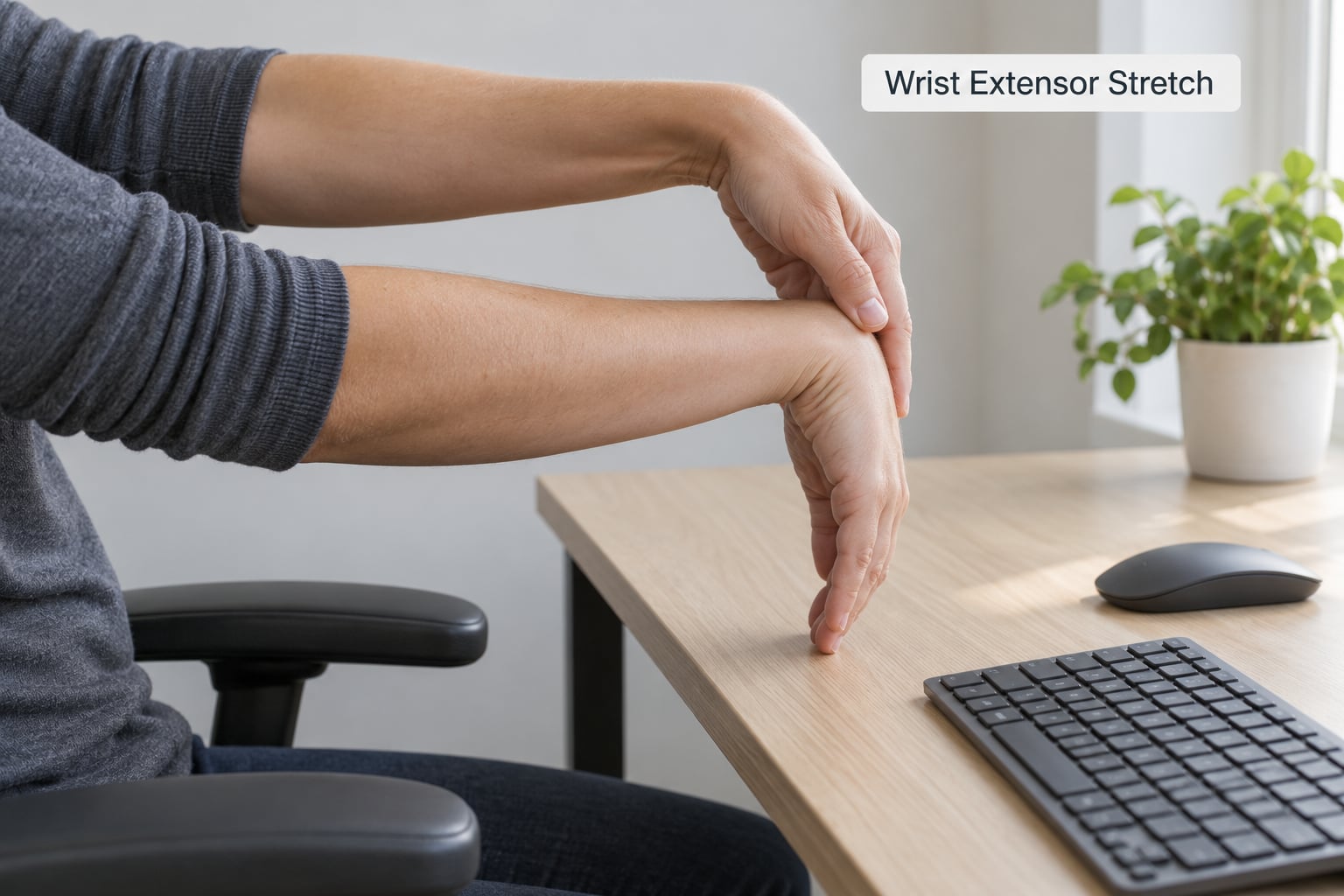
A long day of typing and mouse work shortens the forearm muscles on the top of your wrist, and the stretch below lengthens them in about 30 seconds.
Extend one arm straight out in front of you at shoulder height, elbow locked and palm facing up, as if you are about to signal a stop. With your other hand, gently pull the fingers and hand back and toward you until you feel a stretch across the underside of the forearm.
Hold 20 to 30 seconds, then turn the palm down and repeat for the other side of the same forearm. The two positions stretch different parts of the same muscle group, which is why both are worth doing.
Common mistakes: bending the elbow, which removes most of the stretch, and grabbing the fingers instead of the hand, which pulls the joints around. Stop if you feel numbness or tingling in the thumb or fingers, since that can point to nerve involvement rather than simple tightness.
5. Seated Chest Opener
Opening the front of the chest is what makes it possible to sit up straight, because slouching is mostly a shortened chest pulling the shoulders forward.
Sit with your feet flat and clasp your hands behind your back, or place your palms flat on the chair back behind you with your arms straight. If your hands go behind the chair, check it is stable and not on castors. Take a breath in, then draw the hands down and back as you exhale, allowing the collarbones to spread.
Keep the movement in your chest, not your lower back. If you feel it mostly in your spine, lower your hands, sit taller and try again with less reach.
Hold 15 to 20 seconds and repeat 3 times, or do one round each hour. Wall-assisted is the gentler option: place your forearms on a wall at chest height, step back slightly and let the wall open the chest for you.
6. Seated Marches
Marching in place from a chair is the easiest way to raise your heart rate a little and get blood moving through the legs without leaving your workstation.
Sit tall, away from the chair back if you can manage it. Lift one knee toward hip height, lower it under control, then lift the other. Keep your shoulders relaxed and your hands loose in front of you, and breathe steadily rather than holding your breath.
Run for 1 to 2 minutes, which covers 30 to 40 alternating steps. This is low-intensity movement, not cardio training, but it reliably clears the foggy feeling that arrives mid-afternoon.
Use a stable chair with no wheels. A swivel chair makes marching genuinely dangerous, and this is the movement most often attempted on one by accident.
7. Chair-Supported Squats
A squat to a chair is a real strength exercise rather than a fidget, and it wakes up the thigh and glute muscles that switch off completely during a long sit.
Stand with your feet shoulder-width apart and toes pointing slightly out. Reach back and touch the chair with your hips, then stand straight up by driving through your heels. Think of the chair as a marker to touch, not a seat to collapse into.
Keep your chest up and your weight in the middle of your foot. Do 8 to 12 repetitions, taking about 3 seconds down and 1 to 2 seconds up.
If squatting to a chair is too much, use a desk instead: hold the desk edge, bend the knees and hips together, and stop halfway. If you have knee or back symptoms, a physiotherapist can tell you whether this movement is appropriate for you, and how to modify it.
8. Standing Calf Raises
Calf raises use the lower legs to pump blood back up from your feet, which matters a lot if you sit still all day and your ankles feel swollen by the afternoon.
Stand behind your chair and place your hands on the chair back for balance. Rise onto the balls of your feet so your heels lift off the floor, hold for a second, then lower slowly over 3 seconds until the heels touch down again.
Do 12 to 15 repetitions. The lowering phase is the part that counts, so resist the temptation to drop fast and bounce at the top.
Use a desk, a wall or a chair back as your support rather than a doorframe or a monitor arm. Stop if you get dizzy, and stand somewhere with clear floor space rather than behind a rolling chair you might tip.
9. Seated Glute Squeezes
Squeezing your glutes while sitting is invisible, takes no space and switches on muscles that do almost no work for most of the day.
Sit back in your chair with your spine tall and your hands off the armrests. Squeeze both gluteal muscles firmly as if lifting yourself slightly off the seat, without leaning forward.
Hold for 5 to 10 seconds, release fully, then repeat 8 to 10 times. Breathe throughout instead of holding your breath, since bracing hard and holding your breath is what usually causes the urge to arch the lower back.
If you find you are arching to get more squeeze, the effort is coming from your lower back rather than your glutes. Shorten the hold to 3 seconds and focus on tightening harder rather than longer.
10. Seated Hamstring Stretch
Extending one heel under the desk lengthens the hamstrings, which sit in a shortened position through every hour of sitting.
Sit tall and slide one foot forward so the heel rests on the floor and the leg is nearly straight, toes pointing up. Keep a long spine and hinge forward from the hips until you feel a gentle stretch behind the thigh.
Hold 20 to 30 seconds, return upright, and switch legs. Do two rounds per leg. Flexing the foot by pointing the toes up makes the stretch noticeably stronger without any extra effort.
If your lower back rounds as you reach forward, the hamstrings are tight enough that the range is limited by them. Shorten your reach, lift the chest higher, and accept a smaller angle. A standing version with the heel on a low step works well if a seated version keeps your back rounding.
11. Standing Hip Flexor Stretch
Hip flexors shorten whenever you sit, and shortened hip flexors pull the pelvis forward, which is a common reason people end up with a forward-leaning posture and a sore lower back.
Stand and take a long step forward with your right foot, keeping both feet pointing straight ahead. Tuck your pelvis gently backward as though you are zipping your belt, which deepens the stretch in the front of the rear hip. Keep your torso upright rather than leaning forward.
Hold 30 seconds, then switch sides. If you wobble, keep one hand on the desk edge. You should feel effort in the front of the hip, not a joint pinching inside it.
That difference is the whole safety rule here: a muscular stretch is a pulling sensation you can hold and breathe through, while sharp pain in the front of the hip joint is a stop signal. If you feel the second kind, skip this one and get professional guidance.
12. Seated Figure-Four Stretch
The figure-four position is a practical way to reach the glutes and the outer hip without lying on the floor, which matters in a small office or a shared hot-desking setup.
Sit forward in a stable chair, place your right ankle on top of your left knee, and let the right knee fall open to the side. Keeping a long spine, hinge forward from the hips until you feel a stretch in the right glute.
Hold 20 to 30 seconds, change sides, and repeat twice. If it feels shallow, lift the right foot higher using the seat of the chair, or clasp your hands around the shin and draw the legs closer, never the torso folding over the knee.
Skip this if you have knee replacement surgery, recent hip surgery, a hip injury inside the joint, or a history of dislocation. The knee should fall open freely; if it has to be forced or the movement causes groin pain, that is a reason to see a physiotherapist instead of pushing it.
Frequently Asked Questions
How often should I do exercises during the workday?
Most people do best with a short movement break every 30 to 60 minutes, and any consistent pattern beats one long session at the end of the day. Two to five minutes each time is enough to break up stiffness and restore circulation. Set a repeating calendar or phone reminder, because the reason most routines fail is that the trigger is missing.
How long should a desk exercise break last?
Two to five minutes is the useful range. A single minute can take the edge off a stiff neck or a restless shoulder, and five minutes is enough for a full circuit of the movements in this guide. Longer breaks are useful too, but they are harder to sustain and much less likely to happen. Pick a length you can repeat without negotiating with yourself.
Can I do these exercises in a small office or while sharing a desk?
Yes, if you use the seated movements. Neck resets, shoulder rolls, wrist stretches, glute squeezes, seated marches and hamstring stretches all look like ordinary fidgeting and need no floor space. Avoid anything on a chair with wheels, and check that your chair is not on castors before using the chair back for support. The two standing moves need open floor space and are better done away from foot traffic.
What if a desk exercise causes pain or numbness?
Stop the movement immediately. Stretching should feel like a pulling sensation you can breathe through and hold for 20 to 30 seconds, not a sharp, electric or pinching feeling. Numbness, tingling and pain that radiates down the arm or into the leg are not tightness and deserve a proper assessment. A doctor or physiotherapist can tell you which movements are safe for you and why the symptoms are happening.
Which exercises are best for a stiff neck, shoulders, or back?
For a stiff neck, the seated neck reset and shoulder rolls come first. For shoulders and upper back, backward shoulder circles and seated thoracic rotations are the most useful pair. For a stiff lower back, the chair-supported squat, glute squeezes and standing hip flexor stretch address the usual cause, which is weak hips and tight hip flexors. Persistent stiffness that lasts more than a couple of weeks is a reason to be assessed rather than stretched indefinitely.
Where to Start
Pick two movements today and nothing else. The seated neck reset and the glute squeezes are a good pair because they need no space, no coordination and no standing, which means you will still be doing them in two weeks.
Then do them before a long block of sitting rather than after it. A two-minute circuit at the start of a 60-minute stretch of typing does more than a ten-minute session at the end of the day, because you are interrupting the position rather than cleaning up afterwards.
One honest note: none of this replaces real exercise outside work. Desk movement keeps you mobile and eases stiffness, and on its own it will not build the fitness that protects your heart or bones. Pair it with regular walks, and fix the workstation too. A monitor at the right height removes the need for most of the neck work in this list. If pain lasts more than a couple of weeks or keeps returning, book an assessment rather than stretching through it.