
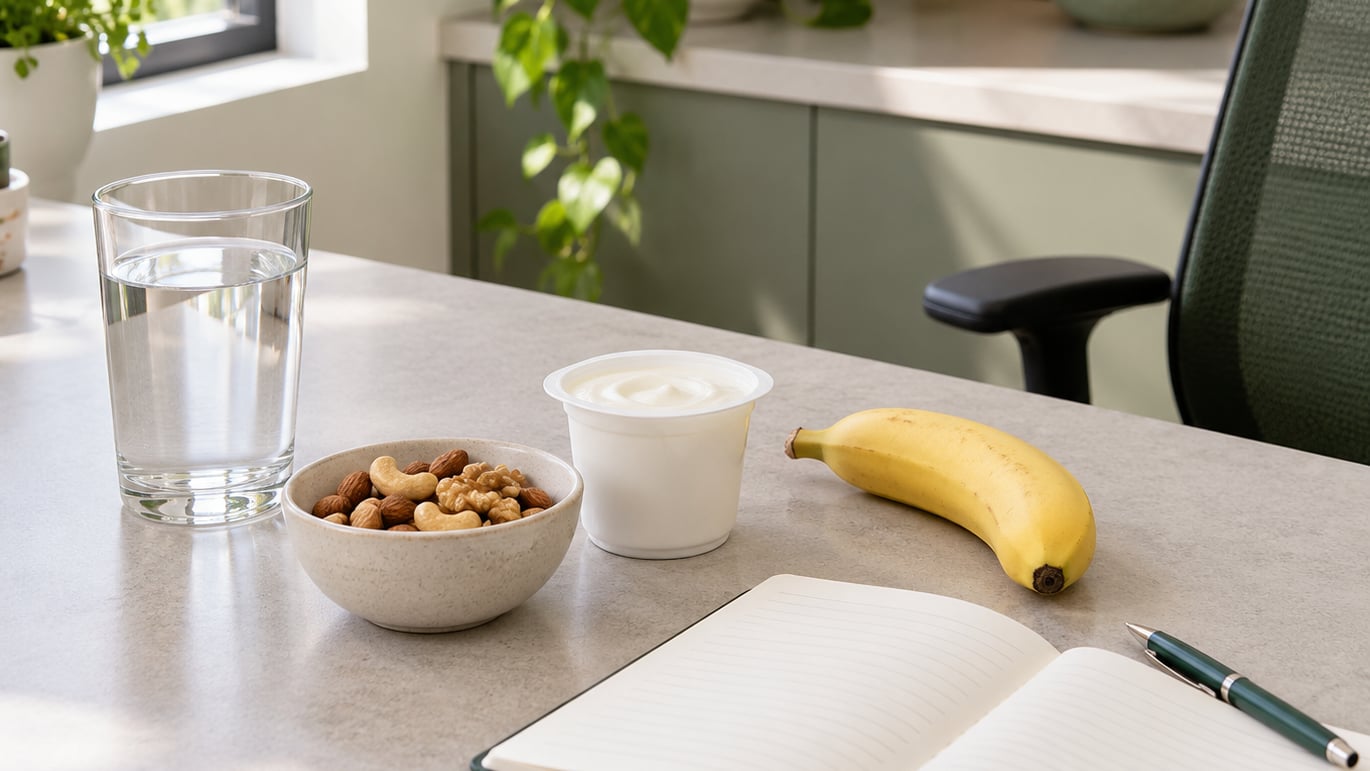
The short answer: most sugar cravings at work are not a willpower problem. They usually start with an unbalanced or skipped meal, a rough patch of sleep, a stressful afternoon, and an environment full of visible cues like a vending machine and a break room pastry rack. Learning how to curb sugar cravings at work means fixing those four inputs, then having a planned response ready for the moment a craving shows up.
Most people can hold off on a cookie at 10 a.m. The trouble starts at 3 p.m., when a light lunch has run out, a meeting ran long, and someone brings back a box of chocolates. The plan below takes about ten minutes to set up on a Sunday and then works on repeat through the workweek. No cleanse, no supplement, no banned-food rules.
Table of Contents
- What You Need
- Step-by-Step: How to Curb Sugar Cravings at Work
- Common Mistakes
- Frequently Asked Questions
- Why do I get sugar cravings in the afternoon at work?
- What should I eat when a sugar craving hits during a meeting?
- Are artificial sweeteners an effective way to control sugar cravings?
- How can employers support workers who struggle with sugar cravings?
- Can a lack of sleep increase cravings during the workday?
- Conclusion: Start With the Next Workday Craving
What You Need
Six things, and none of them require a special diet product. The list is deliberately boring, because the research on cravings consistently points at basic inputs rather than gadgets.
- A water source within reach. A bottle at the desk or a kitchen you can reach in under a minute. Mild dehydration and thirst get mixed up surprisingly often.
- A lunch with protein, fiber, and some fat. Not a salad that leaves you hungry by 2 p.m., and not a sandwich on a white roll with nothing else.
- One or two protein and fiber sources you actually like. Nuts, yogurt, edamame, boiled eggs, cheese, whole fruit with nut butter. Pick two you will genuinely eat on a Wednesday.
- A planned snack in your bag or drawer. Something you can eat without a trip, a line, or a decision.
- Ten minutes you can protect. A short walk, a stretch, or a drink of water away from your screen. Ten is enough. Fifteen is better.
- A notebook or habit-tracking app. You are tracking craving time, trigger, and what you did. Five seconds of logging beats a memory that says Tuesday was terrible.
What you do not need: a detox program, a special sugar-free product, a fasting protocol, or permission to treat every sweet food like a moral failure. Cravings at work are mostly an engineering problem — hunger, stress, sleep, and access. It is fixable with what you already have.
One more prerequisite matters more than people expect: knowing when to stop self-managing. If cravings arrive daily, disrupt your sleep, or come with distressing symptoms, that is worth raising with a doctor or a registered dietitian rather than another week of white-knuckling it. Why water access at work matters covers the hydration side in more depth.
Step-by-Step: How to Curb Sugar Cravings at Work
The routine has six steps, and they work in the order they happen: eat properly, schedule a pause, plan the snack, break the trigger loop, decide before the vending machine, then review the pattern and adjust. The same sequence works for a desk job, a fully remote role, a field or warehouse job, and shift work — only the timing moves.
For a standard 9-to-5, the pressure point is almost always mid-afternoon. For night shifts, it is the small hours when the body is signaling sleep but the schedule demands alertness. For remote workers, the trigger is often proximity — the fridge and the snack cupboard are fifteen steps away. Same plan, different clock.
1. Build a Balanced Meal Before the Cravings Start
A craving at 3 p.m. is often a hunger signal that arrived early and got ignored. A lunch built from protein, a fiber-rich carbohydrate, some unsaturated fat, and water holds much better than one built from refined carbohydrate alone.
What that looks like in practice: a can of tuna or chickpeas over greens with olive oil, a whole-grain wrap with chicken and hummus, a cup of plain yogurt with berries and walnuts, or even a convenience-store version — a hard-boiled egg, a piece of fruit, and a handful of nuts eaten away from your desk. The convenience version works. It is not the “ideal” lunch; it is a lunch that stops you buying a pastry at 3 p.m.
The check that it worked: over the next few days, the afternoon craving should show up less often, feel less intense, or feel less urgent. Not gone. Just less demanding. If the craving arrives at 2:30 instead of 4 and you can sit with it, the meal is doing its job.
2. Plan a 10-Minute Break Before Hunger Peaks
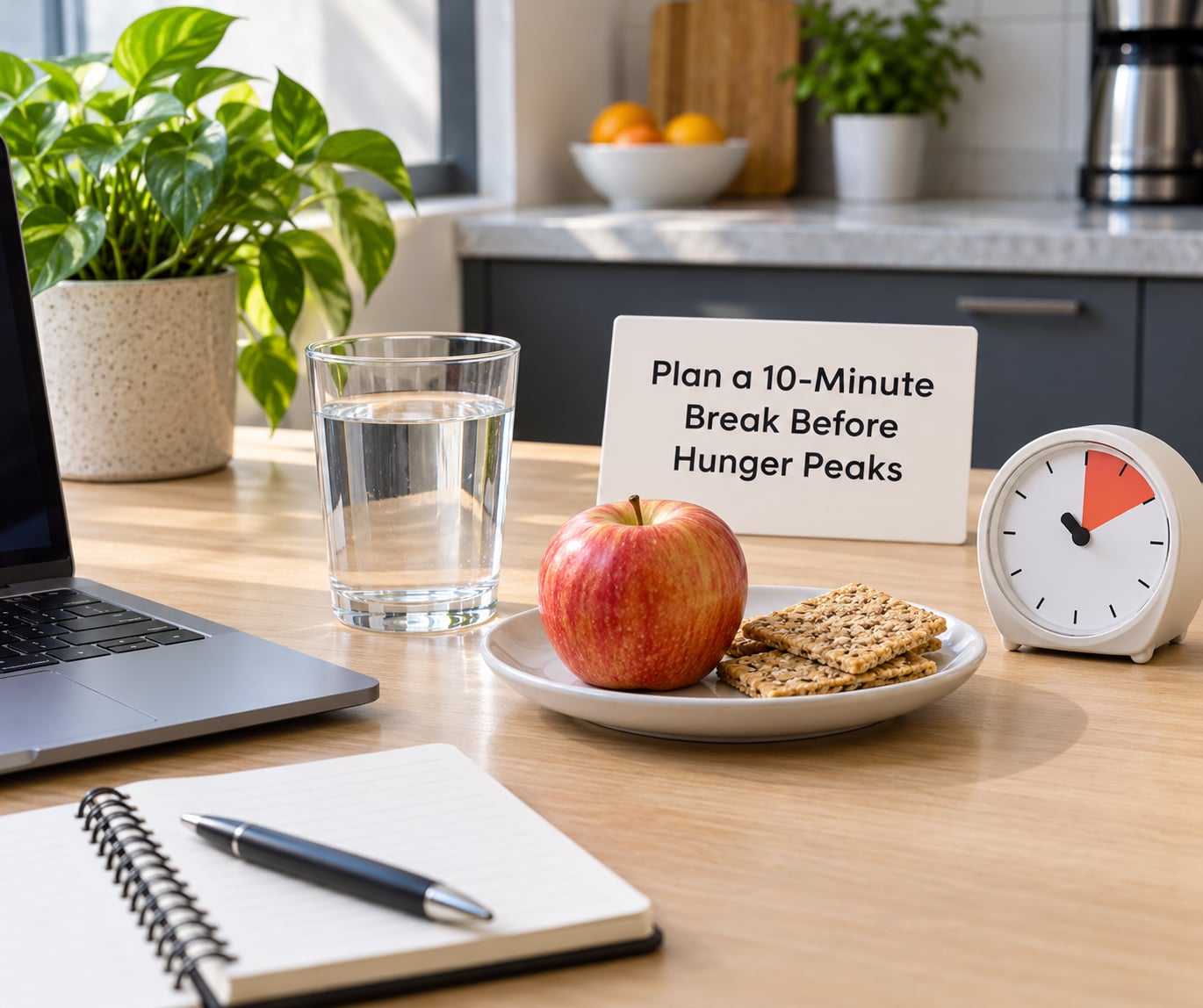
Most people wait for the craving to arrive and then try to out-argue it. That is a losing frame, because by then the urge is at full strength. Put the ten minutes in your calendar before it happens — a repeating 3:00 p.m. block does more than any amount of willpower at 3:20.
The break can be a lap of the building, a stairwell stretch, standing at the window with a large glass of water, or eating your planned snack somewhere that is not your keyboard. Location matters more than most people expect. A craving met at your desk often gets eaten at your desk, where you barely notice what you put down.
The check that it worked: after a few weeks, the pause gives you a choice. You take the snack or you do not, and either way you picked. If you still feel the pull land exactly as hard as before, move the break earlier — ten minutes at 2:45 often beats ten minutes at 3:15.
3. Pair a Smart Snack With Protein and Fiber
The most useful office snack is boring and assemblable in under two minutes. Protein and fiber together slow digestion and take the edge off hunger for longer than a packaged sweet, which tends to spike and then drop.
Combinations worth keeping on rotation:
- A handful of unsalted nuts plus an apple or a pear.
- Plain yogurt with a spoon of nut butter stirred through.
- Boiled eggs with a few raw vegetable sticks.
- Edamame with a small amount of sea salt, eaten warm or cold.
- Whole-grain crackers with cheese or hummus.
- A piece of fruit with peanut or almond butter.
Portion awareness without a spreadsheet: single servings, or pre-portion a day’s nuts into a small container at home. Most people overeat the snack, not because they wanted more, but because the bag made it look like a reasonable amount. A jar of portioned nuts solves that without you counting anything.
Check for success by how long the satisfaction lasts and whether a second craving appears an hour later. If you feel fine for two or three hours, the pairing worked. If you feel hungry again within the hour, add more protein or more fat to the same snack rather than reaching for something sweeter.
4. Break the Trigger-and-Routine Loop
A craving is rarely about sugar. It is about a pattern: a cue, a routine, a reward. A 3 p.m. deadline predicts stress, stress predicts the break room, the break room predicts the pastry. Change any link and the chain weakens.
Start by naming your actual triggers. Common ones in offices: the vending machine glowing at 2:45, a colleague eating at their desk, a long meeting, an inbox that has gone red, boredom on a slow afternoon, and the 4 p.m. caffeine top-up that pulls a snack along behind it. Ways to reduce stress at work goes deeper on the stress side of that list.
Then change the environment rather than the willpower. Keep a snack that meets the craving in your drawer instead of the vending machine downstairs. Sit facing away from the kitchen. Walk to the break room rather than scrolling there. Brush your teeth after lunch — the minty finish of toothpaste is a genuinely effective boundary between lunch and a snack.
Add a delay. Ten minutes, not a promise to never again. Most cravings rise, hold, and fall on their own; plenty of office regulars describe waiting it out as the single tactic that works most often. Moving during the delay — a short walk, ten squats at the stairwell — helps more than staring at the clock.
Check for success with your log. After a week or so, you should have one or two triggers written down with a specific alternative attached. “Craving at 3 p.m. after meetings” plus “walk to the lobby and back” is a working strategy. A trigger you have not named is a trigger you will keep losing to.
5. Use a Structured Decision for Vending-Machine Choices
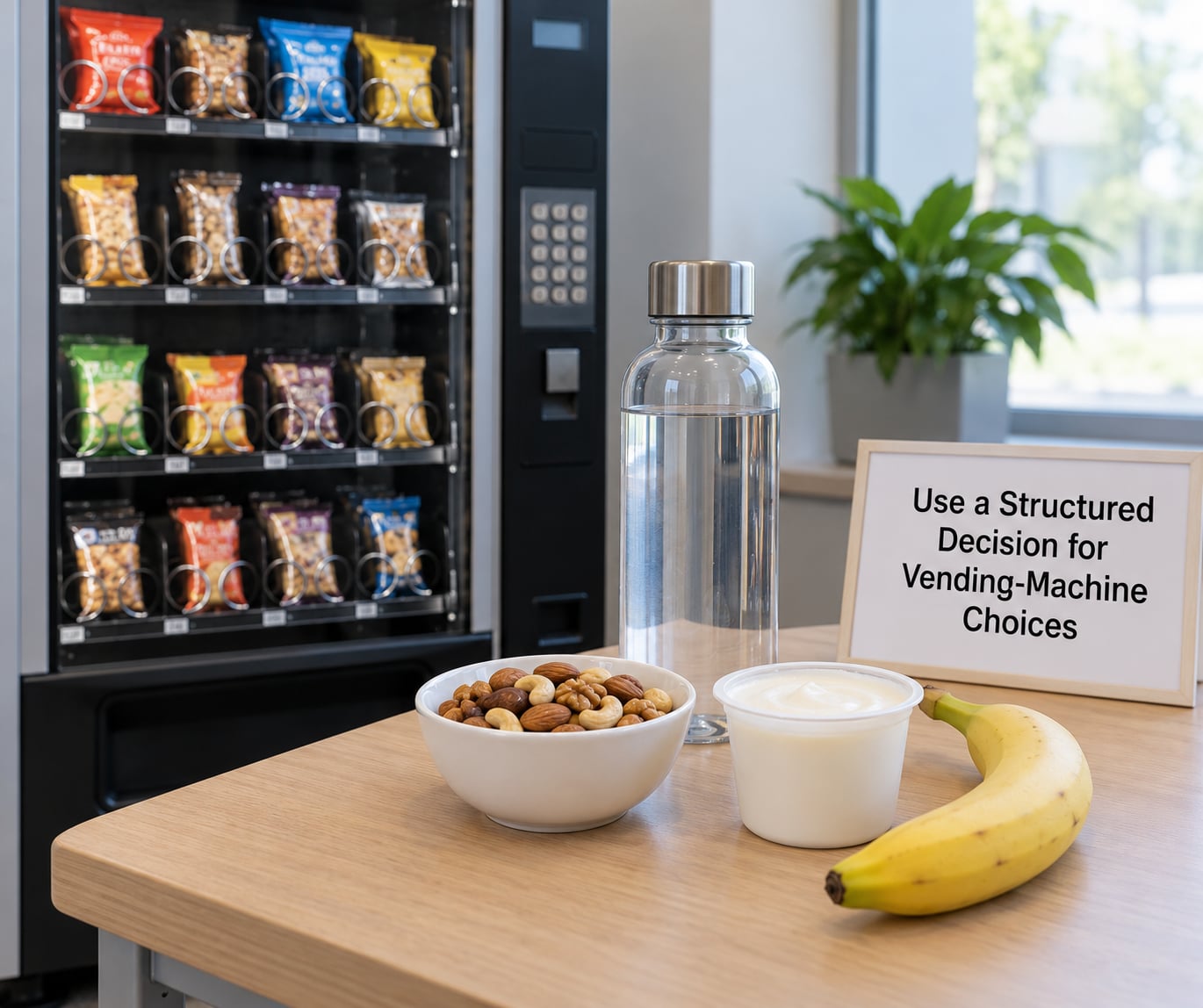
Most vending-machine choices are not decisions at all. They are reflexes, which is why the same bar 20 times can end with the same wrapper in your hand. A three-question routine takes about fifteen seconds and breaks the autopilot.
One: how hungry am I on a scale of one to three? If the answer is one, you are browsing, not hungry. Pick water or nothing and walk away.
Two: what portion did I intend? Decide the portion before you reach the glass. The size in your hand at the start is the portion you get. If the machine only sells large bags, that is a real constraint, and buying one for a craving you scored at a one is how the afternoon goes sideways.
Three: is there something more satisfying available? Water, the nuts in your bag, the yogurt you brought, the fruit in the fridge. If yes, take that instead.
Lower-added-sugar choices that still count as food, not punishment: salted mixed nuts, pretzels, whole-grain crackers, cheese sticks, a banana, plain yogurt, popcorn, or a small chocolate square. Added sugar is one measure of a food, not the whole scorecard. A snack with fiber and protein will hold you longer than a lower-sugar option that is mostly refined starch.
One tactic many people swear by: leave your wallet at home or in a drawer. The friction of getting money out is often enough to end an impulse you would have otherwise justify.
6. Review the Pattern and Improve the Workweek
Run the plan for one to two weeks before deciding whether it worked. Two weeks is enough to see whether cravings cluster around a time, a meeting pattern, or a sleep debt.
Log five things per craving: the time, what you ate for your last meal, what triggered it, how long it lasted, and what you did instead. Five seconds each. Patterns show up fast — the ones I would expect are a skipped breakfast, a heavy meeting block, a bad night’s sleep, or coffee after 2 p.m. arriving in the same line every single day.
Then adjust one variable at a time. Cravings clustered at 3 p.m. after light lunches usually mean the snack moves earlier or gets bigger. Cravings that only show up on deadline days are a stress and sleep problem, not a snack problem. Cravings that arrive at 9:30 p.m. after a night shift usually point at the meal plan, not the vending machine.
When to bring in a professional: cravings that arrive most days, that disrupt sleep, that come with shaking, dizziness or anxiety, or that have followed you since a change in medication or a health diagnosis. A doctor or registered dietitian can look at causes you cannot see from the outside. Workplace support matters too — weight management support at work covers the manager and team side.
Common Mistakes
Restricting everything, then rebelling. A diet that bans all sugar makes the pastry rack the most interesting thing in the building. Keep one planned sweet in your day — a square of dark chocolate, a cookie at lunch — and it stops being a forbidden object you think about at 3 p.m.
Skipping meals to “save” calories. This produces the exact craving you are trying to avoid. A missed lunch guarantees a vending machine run. Fix: eat at your desk on time, even something small.
Buying only low-sugar packaged snacks. Plenty of “sugar free” office treats are refined starch with nothing in them to hold your appetite, so you eat two and feel worse. Fix: choose snacks with protein, fiber or fat on the label rather than sugar on it.
Punishing yourself after a lapse. A missed step does not erase four good ones, and shame reliably triggers the next one. Fix: log it, note the trigger, and continue at the next meal.
Leaning on caffeine to fix the 3 p.m. crash. Coffee plus a sweet snack is a pairing the brain learns quickly. A late-afternoon caffeine top-up can also disturb sleep, and poor sleep makes tomorrow’s cravings stronger. Fix: keep your last cup to early afternoon and find another ten-minute break.
Cutting out every sweet food at once. Total abstinence rarely survives a workplace birthday. Fix: planned portions beat permanent bans.
A few maintenance notes. On travel days, pack two shelf-stable options — nuts, fruit, crackers with cheese — and eat before the airport snack aisle. On meeting-heavy days, eat the snack before the meeting rather than during it. On night shifts, keep the same six-step rhythm but move it to your actual slump hour. At home, the fix is environment, not willpower: the snack sits in a drawer, not on the counter.
Frequently Asked Questions
Why do I get sugar cravings in the afternoon at work?
Most afternoon cravings come from three things stacking up: a lunch that was mostly refined carbohydrate, a few hours of sitting, and a dip in alertness after lunch. Stress and short sleep make it worse. A meal built with protein, fiber and some fat, a scheduled ten-minute break, and water nearby usually take the edge off it within a week or two.
What should I eat when a sugar craving hits during a meeting?
Bring a planned snack and eat it before the meeting starts rather than halfway through, when you cannot pause. Good options are a handful of nuts, plain yogurt, boiled eggs, or fruit with nut butter. If nothing is planned, water plus a ten-minute delay works more often than people expect. Meeting rooms are not ideal places to eat anyway.
Are artificial sweeteners an effective way to control sugar cravings?
Mixed. Some people find a sweetened drink or sugar-free gum bridges an afternoon gap, and the chewing motion helps some people manage an urge. Others report that very sweet products keep the craving alive. Individual response varies widely. Start with water and a planned snack, and treat sweeteners as an optional extra rather than the foundation.
How can employers support workers who struggle with sugar cravings?
Start with access: water that does not require a queue, a fridge for packed lunches, and a break room that is not a pastry display. Small changes matter, like a meeting scheduled past 3 p.m. or a fridge stocked with non-sugar options for shared celebrations. Normalising plain yogurt and fruit at team events helps more people than a policy ever will.
Can a lack of sleep increase cravings during the workday?
Yes. Short sleep raises hunger signals and reduces impulse control, and many people describe cravings for quick energy in the morning after a broken night. The fix is not a harsher diet that day but a smaller one: plan a higher-protein snack, move your break earlier, and protect the following night’s sleep. Persistent sleep problems are worth discussing with a doctor.
Conclusion: Start With the Next Workday Craving
How to curb sugar cravings at work comes down to a repeatable routine, not a test of willpower: eat a balanced meal, keep water within reach, schedule a ten-minute break before your usual craving hour, bring one snack that pairs protein with fiber, name your triggers and change the environment, then review your log and adjust. Six steps, and the first three take about ten minutes to set up.
Do not wait for a Monday. On your next workday, eat a proper lunch, fill a bottle of water, and put a ten-minute break in your calendar at the time the craving usually lands. Then watch the log for two weeks and see what actually moves.