

Hazard communication training for employees is a legal duty for almost any US employer that works with hazardous chemicals, and it is spelled out in OSHA’s Hazard Communication Standard, 29 CFR 1910.1200. The short version: you evaluate the chemicals in your workplace, keep a list and safety data sheets for them, label every container, and train people before they handle anything. Most employers get the first three right and fall down on the fourth, because they hand out a slide deck and call it done.
A compliant program is less work than it sounds. The first time through, give yourself two to four hours to assemble the material and another 30 to 60 minutes to run the session itself. The skill is not in the presentation, it is in proving that the people in the room can find and read the safety information for the chemicals they actually use.
Table of Contents
- What You Need for Hazard Communication Training for Employees
- Step-by-Step: Building a Compliant HazCom Training Program
- Common HazCom Training Mistakes and How to Fix Them
- Frequently Asked Questions
- How often should employees receive hazard communication training?
- Who needs hazard communication training at a US workplace?
- Does hazard communication training need to be in a worker’s primary language?
- What topics must OSHA hazard communication training cover?
- How can an employer verify that employees understood the training?
- Conclusion
What You Need for Hazard Communication Training for Employees
Before you schedule anything, gather the information the session depends on. A practical HazCom training session needs a current chemical inventory, a working way to reach safety data sheets, a person who knows the materials well enough to answer questions, materials built around your own workplace, and a plan for keeping the records afterward.
- A current chemical inventory. Every hazardous chemical known to be present, where it is used, and how it is stored. OSHA expects this list to exist, and it is the raw material for everything else you teach.
- A way for employees to reach safety data sheets. A digital library employees can open from a shared drive, a tablet, or a kiosk, or a physical binder kept where the chemicals are used. Test it: can a new hire find the sheet for a product in under a minute?
- Someone who knows the chemicals. Usually your EHS lead, safety manager, or a consultant. Naming a backup matters more than you might think, because a single trained trainer becomes the bottleneck every time the schedule shifts.
- Materials that match your actual work. A generic vendor course is a reasonable starting point, but the examples should be the solvents, cleaners, coatings, and aerosols your people see on a Tuesday morning.
- Language and literacy resources. Translation of written materials, an interpreter, or a bilingual trainer, depending on your workforce. Plan this before the session, not the day of it.
- Delivery options that fit the shifts. Live sessions, self-paced online modules, short toolbox talks, or a mix. Not everyone can be in the room at 8 a.m.
- A records system. One place where rosters, assessments, and material versions live, and one person responsible for it.
- Emergency procedures. Spill response, eyewash and shower locations, and evacuation routes, in the same document as your written program.
Step-by-Step: Building a Compliant HazCom Training Program
1. Define the training scope
Start by writing down who needs training and why. That is every employee who may be exposed to a hazardous chemical, plus temporary and seasonal workers, plus contractors working on your site, plus new hires before they touch a container. If someone only enters the area but never handles the product, they still need to know what the alarms, the restricted zones, and the spill procedure mean.
Next, list the exposure routes you actually see. Inhalation from vapors and aerosols, skin contact during pouring or cleanup, eye contact, ingestion from contaminated hands, and injection injuries from sharps in clinical or lab settings. Write down your operating languages and any accessibility needs, such as large print, hearing support, or a pace slower than a standard corporate module.
You know the scope is right when you can name every job title in the building and mark it covered or not covered, with a reason attached.
2. Review chemical hazards and safety information
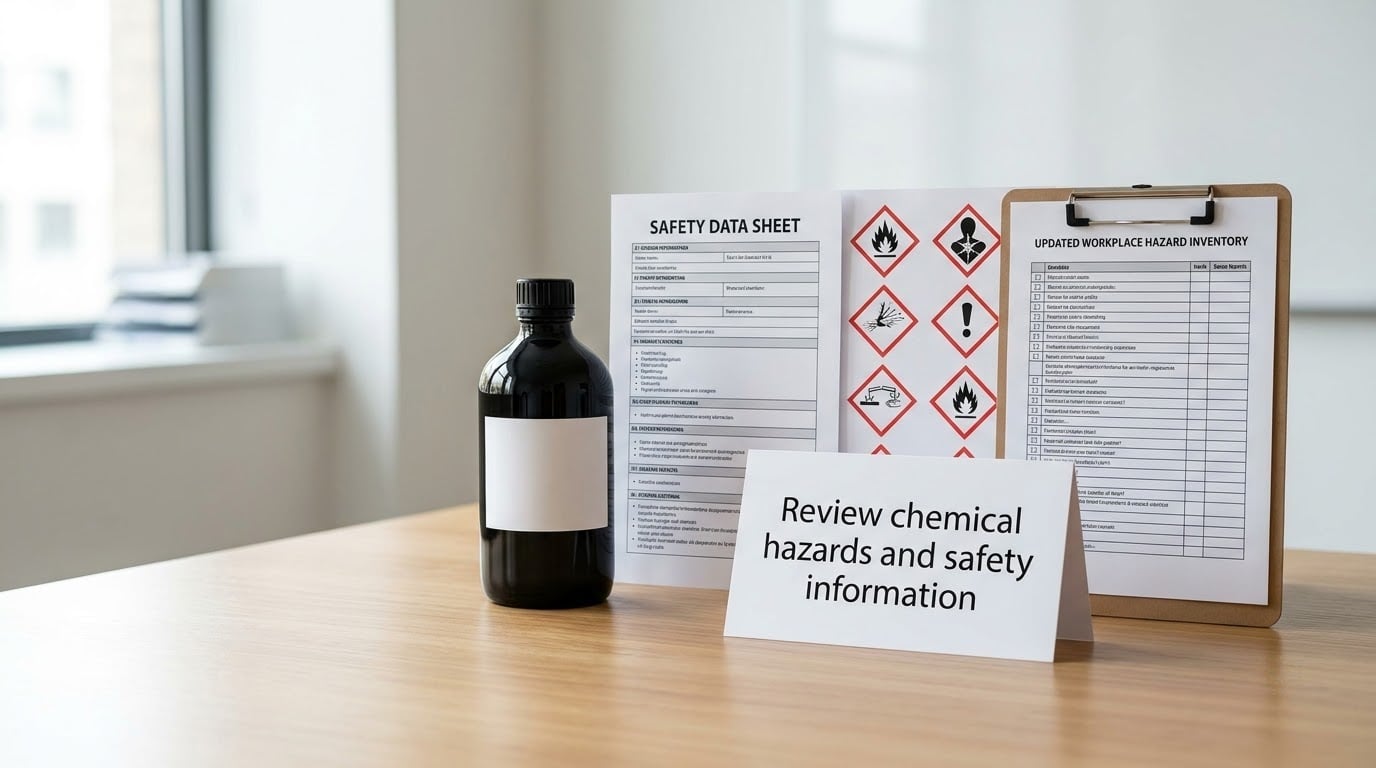
Pull the workplace chemical inventory and the safety data sheets for every product on it, then check them against what is actually on the floor right now. Products get swapped, discontinued, and relabeled without anyone telling the safety office, and training built on a stale list teaches the wrong hazards.
Work through the routes of exposure one at a time. For each chemical, note what happens on skin contact, what the vapors do, what the pictogram means, what the signal word says, and which control the employee should reach for first. Add the exposure scenarios that worry you most, such as a two-person transfer of a solvent indoors with no local exhaust, and the emergency procedures that follow from them.
Include contractor work in that review. When a crew is spraying coatings in your building, their exposure is your air quality problem too, and the session has to cover the coordination between host and contractor.
3. Build practical training content
OSHA expects employees to understand the chemical hazards present, how to read labels and safety data sheets, how to find and use that information, and the measures they can take to protect themselves. Turn those requirements into plain language and a short activity for each one, rather than a bullet list read aloud.
A label-reading exercise works well. Hand out three containers from the floor and ask each person to name the signal word, the pictograms, the hazard statements, and the first control they would use. Then hand out a printed safety data sheet and ask them to find the exposure limits, the handling and storage section, the first-aid measures, and the spill response section. That single exercise covers a surprising share of what the standard asks for, and it produces the mistakes you can correct on the spot.
Add the reporting question, because it is the one people get wrong: employees need to know exactly who to tell and how, and that reporting a concern or an unlabeled container is expected behavior rather than a complaint.
4. Deliver hazard communication training for employees
Keep the classroom portion short and give most of the session over to practice. Twenty minutes of explanation followed by thirty minutes of label, safety data sheet, and scenario work will outperform an hour of slides, and it is easier to document.
Plan the delivery details deliberately. Set up the room and materials in advance, arrange interpretation or translated handouts, offer a session for each shift, and leave ten minutes at the end for questions with no penalty for asking them. Tell people in advance what will be covered so nobody is surprised by a container from their own work area appearing on the table.
Close by stating the responsibilities plainly. Employees handle and store chemicals as directed, use the right protective equipment, read the label before using a product, ask when something is unclear, and report damaged, leaking, or unlabeled containers. Supervisors make sure the work area matches the program and follow up on reports.
5. Test understanding and correct gaps

Attendance alone does not tell you whether anyone learned anything. Add a short check: five to ten scenario questions that ask employees to identify a hazard, locate the right safety data sheet, choose a control, describe how they would report a problem, and state the first step in a spill response.
Read the wrong answers closely, because they point straight at what to reteach. If half the room cannot find the SDS binder, fix access before you retrain. If people can read the label but not identify the required glove material, that is a targeted five-minute follow-up, not a full repeat session.
Document the score, retrain anyone who missed the core items, and note what you changed. A knowledge check that never changes anything is just paperwork with extra steps.
6. Document completion and maintain the program
A defensible training record has more fields than a signature sheet. Capture the employee name, the training date, the trainer, the curriculum version or course identifier, the delivery format and duration, the assessment results, the corrections you made afterward, and the next review date. Keep those records together with the chemical inventory they were based on, so an auditor can see the training matched the chemicals at the time.
Retraining is not on a fixed clock. It happens when new hazards appear, when the process changes, or when a work area changes in a way that introduces a different exposure. Annual refreshers are common practice and worth doing, but they are a best practice rather than a blanket regulatory interval, and the distinction matters when you write your policy.
Also watch the rule itself. OSHA’s hazard communication update has moved compliance dates forward, with obligations for substances landing on November 20, 2026 and for mixtures on May 19, 2028, and earlier revisions already changed what employers must cover. Check your state plan, since state-plan states can set their own dates, and confirm your current obligations with OSHA before assuming the materials you used last year are still accurate.
Retraining triggers and required actions
| Trigger | Required action | Timing |
|---|---|---|
| New chemical introduced to the work area | Train affected employees on the new label, safety data sheet, hazards, and controls | Before the chemical is handled |
| Process, equipment, or control changes | Re-evaluate the hazard, update the inventory, retrain where the exposure changes | Before the change goes live |
| New employee, temporary, or seasonal worker | Full hazard communication training before assignment to chemical-related duties | At initial assignment |
| Contractor or crew arriving on site | Host employer covers site-specific hazards, labels, and emergency procedures | Before site access |
| Evidence of exposure incident or repeated error | Targeted retraining on the specific hazard and control involved | Promptly, before resuming the task |
| Program or rule update | Update materials, then refresh training on the changed content | Within the new compliance date |
Common HazCom Training Mistakes and How to Fix Them
Most compliance problems come from the same handful of habits. The fix is usually small, and it usually shows up the next time someone new starts or a new chemical lands on a shelf.
- A generic slide deck. Fix: replace two slides with the real labels and safety data sheets from your own work area. Relevance is what people remember six months later.
- Safety data sheets nobody can find. Fix: put the library in a place employees already are, and test access with someone who has never seen it. Time the test and write the result down.
- One course for every job. Fix: keep the general hazard communication session for everyone, then add a short site-specific piece for the groups that face different risks, such as dispensing, spraying, or cleanup.
- English-only materials. Fix: get written materials translated and use an interpreter or bilingual trainer. Information nobody understands is not information under the standard.
- Records that only show attendance. Fix: add date, trainer, curriculum version, duration, and assessment results. A signature line alone is the easiest thing to challenge.
- Contractors treated as somebody else’s problem. Fix: give host-employer training to visiting crews before they enter the work area, and put the arrangement in writing in both contracts.
One habit covers most of these: run a short walkthrough of your own area a week before the session and note anything with a faded or missing label, stored where it should not be, or sitting in a second container nobody labeled. You will find more value in that thirty minutes than in another module.
Frequently Asked Questions
How often should employees receive hazard communication training?
OSHA requires training before an employee starts work with a hazardous chemical, and again whenever new hazards or process changes introduce new information. It does not set a fixed repeating interval. Annual refreshers are a widely used best practice, and your own written program can require them, but the legally required trigger is a change in hazards rather than a date on the calendar.
Who needs hazard communication training at a US workplace?
Every employee who may be exposed to a hazardous chemical, including new hires, temporary and seasonal workers, and office staff working in areas where chemicals are used. Contractors need training from their own employer, and the host employer also covers site-specific hazards before they enter the work area. A few categories, such as employees covered by an OSHA laboratory chemical hygiene plan, follow that plan instead.
Does hazard communication training need to be in a worker’s primary language?
The standard requires hazard information to be provided in a manner employees are capable of understanding. In practice that means translated written materials, an interpreter, or a bilingual trainer when English is not the worker’s primary language. Some state-plan states hold this more explicitly than federal OSHA, so check your state plan if your workforce is multilingual.
What topics must OSHA hazard communication training cover?
Employees need to understand the chemical hazards present in their work area, the labels on containers and how to read them, the safety data sheet and how to find it, how to use that information to work safely, and the measures available to protect themselves, including work practices and personal protective equipment. Employer-specific procedures, emergency and spill response, and how to report a hazard belong in the session too.
How can an employer verify that employees understood the training?
Ask. A short scenario check, five to ten questions, is enough to confirm that people can identify a hazard, locate the right safety data sheet, choose a control, and report a problem. Record the score, retrain anyone who missed the core items, and keep the results with the training roster. An attendance sheet alone shows who was in the room, not who learned.
Conclusion
Start with your next session rather than a policy rewrite. Line the agenda up with the chemicals that are actually in the building, hand people a real label and a real safety data sheet to work through, add a short knowledge check, and file the roster, the assessment, and the curriculum version together. Then put a date on the calendar to revisit the materials when the standard or your inventory changes. That sequence is what turns hazard communication training for employees from a compliance formality into something workers can use the day it matters.