
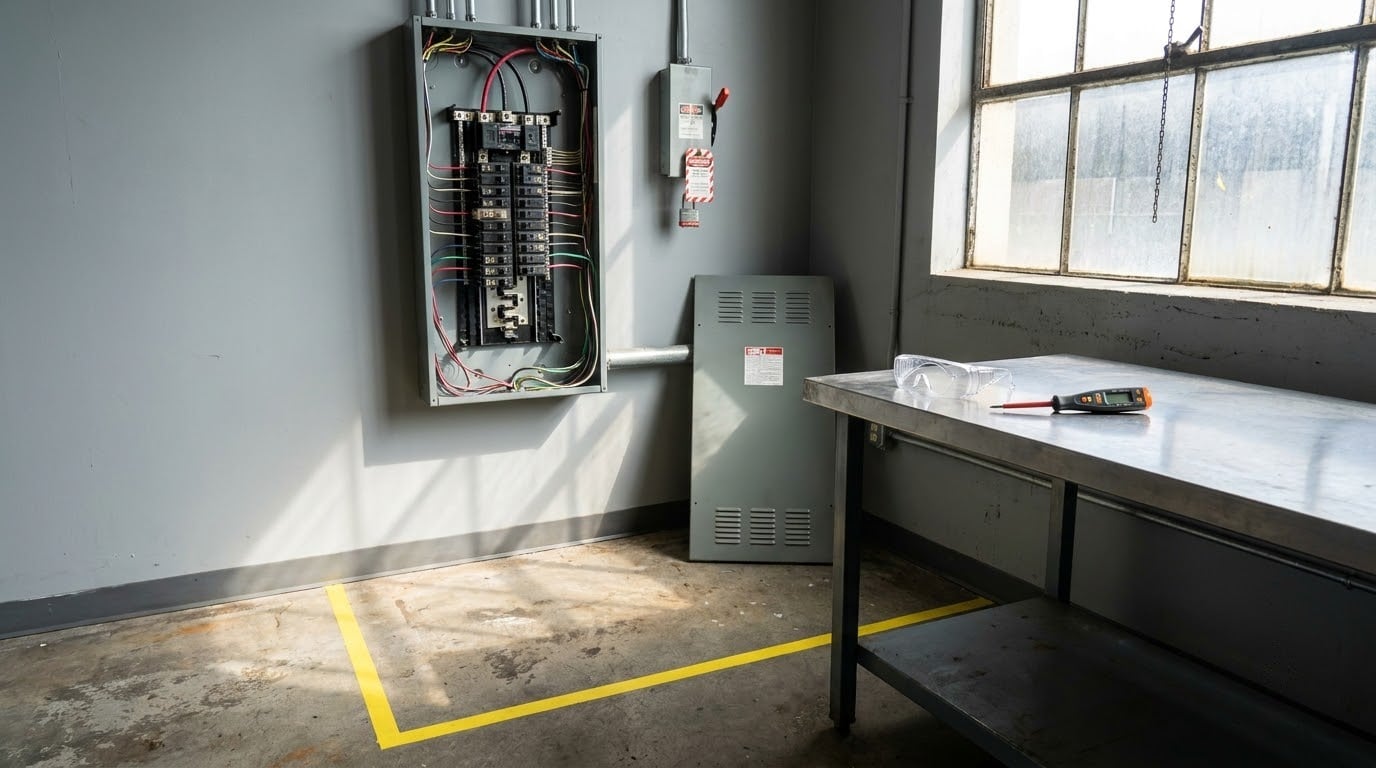
To prevent electrical hazards at work, remove energy from the worker first. Identify every energy source, open the disconnect, lock and tag it, release stored energy, then prove the circuit is dead with a live-dead-live test before anyone touches it. Everything else, from arc-rated clothing to test instruments, sits behind that sequence.
Two different mechanisms are behind nearly every workplace electrical injury, and they need different defences. Electric shock is current moving through the body. Arc flash is a thermal event: molten metal, temperatures far above anything a furnace reaches, a pressure wave, and a flash that blinds before it burns. A worker can suffer either one without the other, which is why a rule that only covers “don’t get shocked” leaves a serious gap.
Here is the compressed version before the detail.
- De-energize before you work, and treat “off” as a claim that still needs proof.
- Lock and tag every disconnect, and release stored energy such as charged capacitors.
- Test for absence of voltage on a known live source, at the equipment, then on the known live source again.
- Never open a panel, junction box or equipment enclosure unless a qualified person is doing it.
- Pull damaged cords, plugs and tools out of service the day you find them.
- Keep cords off the floor, out of walkways and out of water.
- Use GFCI protection where water, damp conditions and grounded bodies meet.
- Wear the PPE the task requires, and remember PPE is the last line of defence, not the first.
- Set approach boundaries and label equipment so other people know where the edges are.
- Report every shock, near miss and damaged item the same day, before the shift moves on.
The rest of this guide breaks that list into a process you can actually run on a floor, with the standards that sit behind it and the first minutes after an incident covered at the end.
Table of Contents
- What You Need
- Step-by-Step: How to Prevent Electrical Hazards at Work
- Common Mistakes
- Treating “off” as safe
- Daisy-chaining cords and stacking adapters
- Using damaged equipment
- Bypassing interlocks and guards
- Improvising a repair instead of making one
- Letting unqualified people do electrical work
- Working near equipment without knowing the boundary
- Letting a long injury-free run set the risk level
- Frequently Asked Questions
- How do you prevent electric shock in the workplace?
- What are the 5 main electrical hazards in the workplace?
- What PPE is required for electrical work?
- When is it allowed to work on live electrical equipment?
- What does an electrical safety checklist include?
- What should you do if someone is electrocuted at work?
- Conclusion
What You Need
Electrical safety is not a toolkit problem. Before anyone starts, five things have to be in place, and the first one is a person rather than a piece of equipment.
Qualified people, and a clear line between them and everyone else
Some electrical work must be done by a qualified person under OSHA 1910 Subpart S, and under NFPA 70E only a qualified person may establish an electrically safe work condition. That means a person who can solve the problem, not just perform the task, and who can be one of the limited number an employer authorises in writing. Most of a warehouse, office or clinic workforce is not, and never will be, one of those people. Write that line down and post it where people work.
The documents that define what is allowed
- OSHA 29 CFR 1910 Subpart S, the enforceable electrical standard, plus 1910.147 for lockout/tagout.
- NFPA 70E, the standard consensus used to build the safe work practice, and NFPA 70, the installation code.
- IEEE 1584 for incident energy analysis.
- Written safe work procedures, job safety analyses and energized electrical work permits for the tasks that need them.
- Arc flash labels and an incident energy study, plus single-line diagrams for the equipment in the area.
This guide follows the 2024 edition of NFPA 70E. Editions and adoption differ by jurisdiction and by site, so check which edition your authority and your plant have adopted before you rely on a number in a table below.
PPE matched to the hazard, not to the job title
That means voltage-rated rubber insulating gloves with leather protectors, arc-rated clothing, a face shield or arc flash hood, safety glasses, a hard hat, hearing protection, and insulated tools where the task calls for them. Clothing rated for arc flash is not shock protection, and gloves rated for voltage are not arc protection. Most serious arc flash injuries happen because the shirt was worn without a face shield, or a category mismatch that nobody checked.
Inspection and test equipment that still works
You need a voltage tester rated for the system being checked, proved on a known source before and after every use, and a non-contact detector as a searching tool rather than a proving instrument. You also need a receptacle tester, an insulation or continuity check, and a camera or a written record so inspections leave a trail. All of it needs a calibration or functional-check schedule; an unverified tester is worse than no tester because it silences the doubt.
Emergency arrangements that were rehearsed
A written emergency response plan, a shut-off location everyone can reach, first aid and CPR capability with trained responders, burn first aid supplies, an emergency contact list, and a way to call for help from a rooftop plant room or a basement electrical room where there is no signal. Arc flash events also blow metal fragments, so eyewash and a clear route for medical help matter.
Step-by-Step: How to Prevent Electrical Hazards at Work
Identify Electrical Hazards Before Work Starts
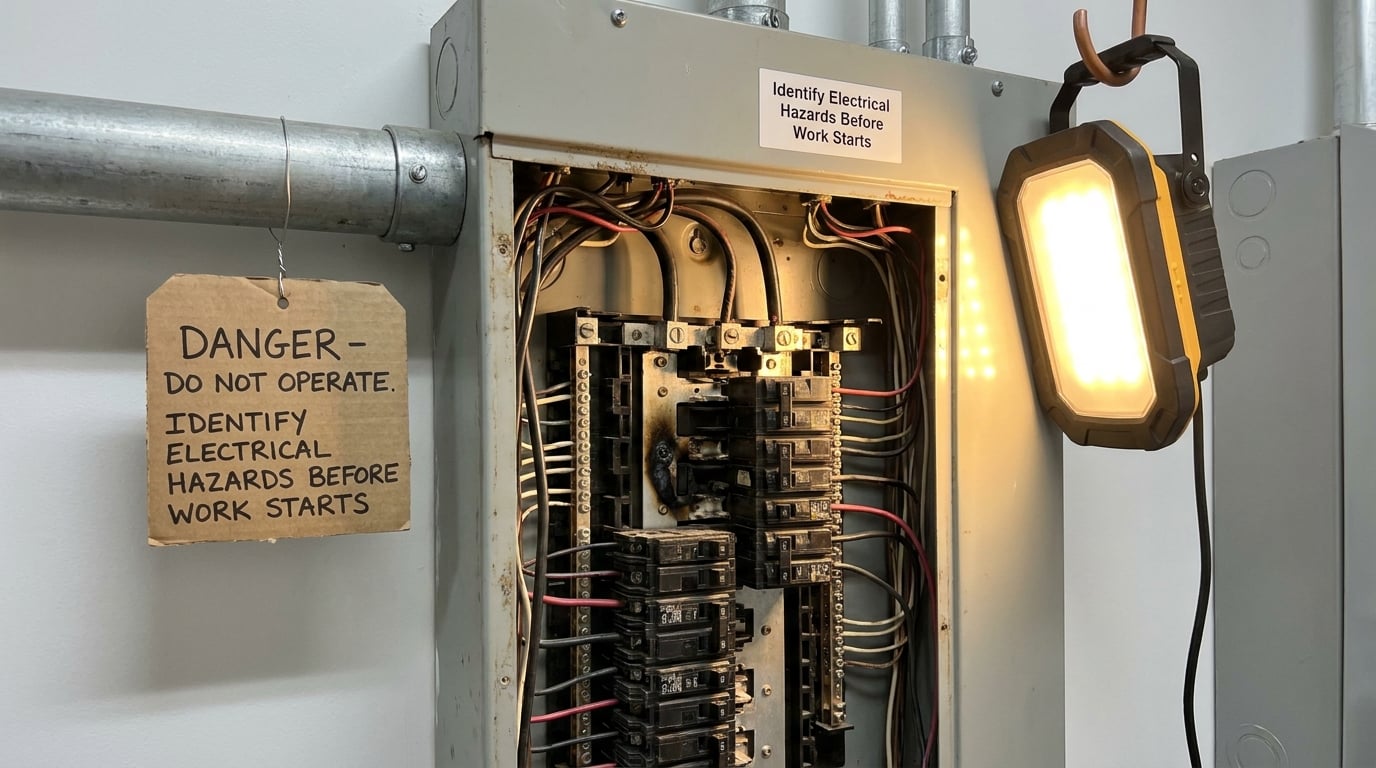
You cannot control a hazard you have not written down. Anyone trying to work out how to prevent electrical hazards at work ends up in the same place: a written plan for the specific task, not a poster on the wall. Start with a walk-through of the task and the area before the first tool comes out, and put it on paper. A job safety analysis that lists the steps, the energy sources, the people who could be exposed and the controls for each is worth more than any generic poster, and it is the document that makes the rest of this process defensible.
On that walk, you are looking for specific things rather than a general sense of risk.
- Exposed wiring, missing dead-front covers, open knockouts and empty panel slots.
- Damaged, cracked, nicked or taped cords and plugs, and tools held together with electrical tape.
- Overloaded circuits, daisy-chained power strips and adapters stacked on adapters.
- Water, damp floors, leaking roofs and wash-down hoses near electrical equipment.
- Missing or unlabelled disconnects, and cabinets that are unlocked or propped open.
- Bonding and grounding that has been jumpered out or “fixed” with something improvised.
- Extension cords used as permanent wiring, and portable heaters plugged into unsuitable circuits.
- Arc flash labels that are missing, faded or no longer match the equipment.
- Conductive dust, combustible dust or flammable storage near a panel.
Shock severity follows current, and current follows the contact condition. These are the standard figures for 60 Hz alternating current, which is what most North American equipment runs on.
| Current through the body (60 Hz AC) | What the body experiences | What it means for the job |
|---|---|---|
| About 1 mA | Perception threshold, a faint tingle | Most people feel nothing and press on |
| 4 to 6 mA | Typical ground fault circuit interrupter trip level | GFCI protection is designed to stop here |
| 10 to 20 mA | Let-go threshold, muscular grip, person cannot release | Call it a mild shock and the hand stays closed |
| 20 to 30 mA | Respiratory muscle paralysis, breathing stops | A medical emergency even when the person looks fine |
| 50 to 100 mA | Ventricular fibrillation, heart rhythm collapses | Frequently fatal, survival depends on response time |
| 1 A and above | Sustained ventricular fibrillation, deep entry and exit burns | Almost always fatal |
Now the part that surprises people. A 120 V shock that gets described as harmless in a break room story is a 120 volt shock that ended a life in a wet location, because wet or abraded skin drops body resistance by orders of magnitude and the current that flowed is the same current that crosses the fibrillation threshold. The voltage did not change. The person did. Electricians on trade forums describe this over and over: the jolt is the easy part, the cardiac effect a few seconds later is the part that matters.
Avoid arc flash and you avoid most of the same failure modes. An arc flash needs a conductive path across an air gap, and the common ways it happens are mundane: a dropped tool bridging bus to bus, a screwdriver that slips, a cover removed under pressure, a breaker that is not on its load centre, a fault developing in equipment that looked fine yesterday. Arc flash temperatures exceed the melting point of steel, and the 1.2 cal/cm2 arc rating on a garment is the point at which it can cause a second-degree burn through the fabric.
Inspect and Maintain Electrical Equipment
Most workplace electrical damage is found by a person who looked properly, which makes the pre-use check the highest-yield control in the whole system. It takes two minutes and it is the control that stops a cord from reaching a machine at all.
Run the same routine every time, and make the findings recordable. A clipboard on a forklift, a tag system on a shared tool crib, or a photo of a defect submitted the day it is found all beat a memory.
- Check the cord from plug to tool for cuts, nicks, crushed sections, exposed conductors and missing strain relief at the handle.
- Check the plug for bent prongs, cracked insulation, a loose grip and any heat discolouration at the blade.
- Check the equipment body for cracks, missing guards, missing screws and damaged insulation around the terminals.
- Check that the three-prong plug, the grounded plug pin and the receptacle ground are all present. Never defeat the ground.
- Check extension cords for nicked insulation at the ends, coil them for storage, and use them only as temporary wiring.
- Check that portable GFCI devices and tested cords are actually being used in wet and outdoor locations rather than left in the van.
- Check temporary power on construction and maintenance sites: GFCI protection, correct cord gauge, protected routing, and no daisy chains.
- Check panels and enclosures for heat marks, buzzing, a warm faceplate, tripped breakers that keep resetting and scorch marks around a bus stabs.
Damaged equipment has one correct response: remove it from service, tag it, and get it to a qualified person. Do not tape a cord and put the tool back on the bench. Do not “just finish the shift” with a nicked cord. Cord repairs, splices and terminations are electrical work, and the repair has to be done with the right connectors, strain relief and insulation, by someone qualified to do it. Keep spares on site so the pressure to use the broken one does not win.
On the maintenance side, put inspections on a schedule rather than a hope. Follow the manufacturer’s service intervals for the equipment and the intervals your insurer and authority expect, and record them. A repeated breaker trip is a symptom, not an annoyance; resetting it until it holds is how an arc flash starts.
Apply Controls and Safe Work Practices
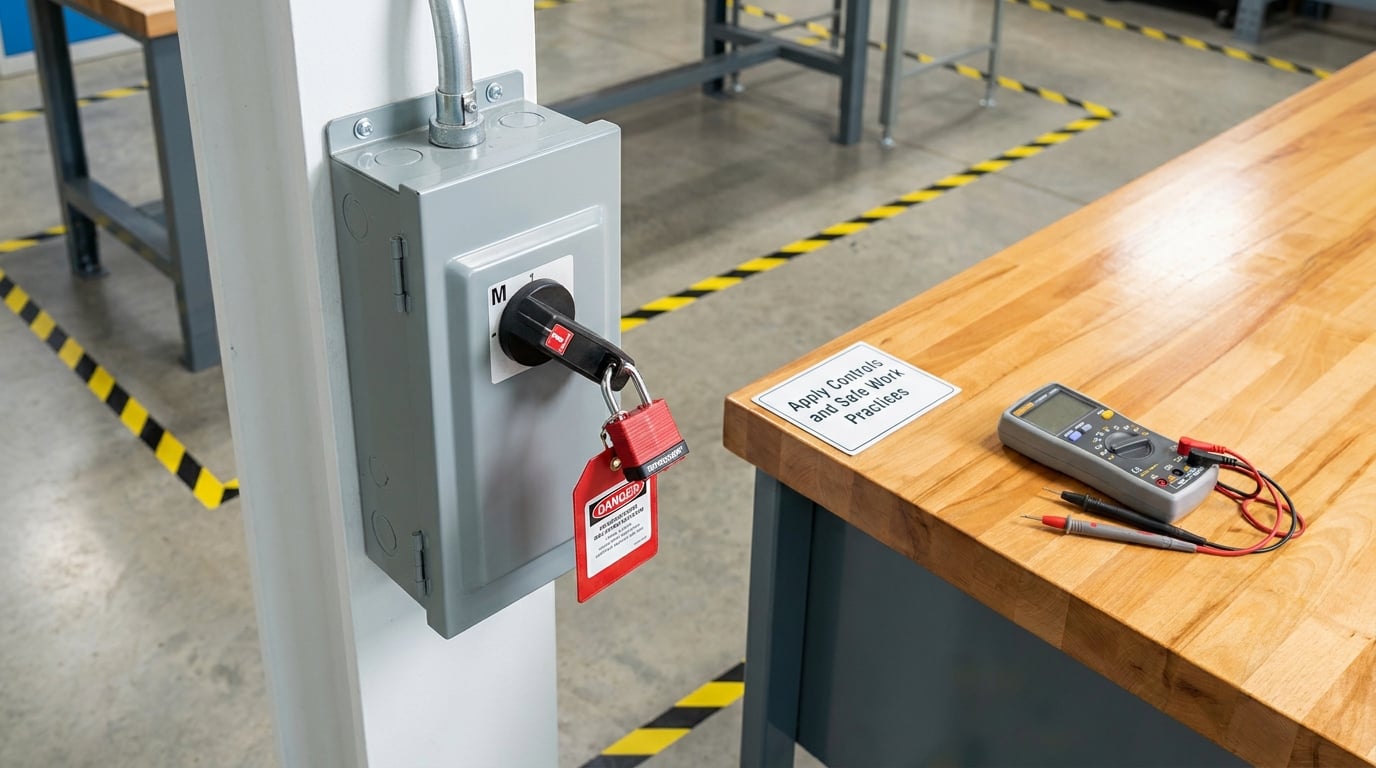
Controls have a rank order, and the reason for the rank is that the higher levels remove the hazard instead of managing it. Elimination means the task is done somewhere and in a way that needs no electrical exposure at all. Engineering controls move the energy away from the person: remote breaker racking, remote switching, current-limiting fuses, arc flash relays, zone-selective interlocking, energy-reducing maintenance switches, arc-resistant switchgear. Administrative controls are procedures, training, permits, labels and two-person rules. PPE is the last line, and a good program treats it that way.
De-energization is the first control you should reach for on every task. It is also the one people rush, and the rush is where incidents live. A switch in the off position is a control device state, not proof that the circuit is dead. Automatic transfer switches, generator back-feeds, photovoltaic back-feeds, control transformers, capacitor banks and adjacent panel back-feed are all live after a disconnect opens.
Establishing an electrically safe work condition follows the 29 CFR 1910.147 sequence:
- Prepare. Identify the equipment and every energy source feeding it, including back-feeds and stored energy.
- Notify. Tell everyone affected that the equipment is being locked out, and tell the affected operators before the work starts.
- Shut down. Stop the equipment in a normal manner, without relying on the control circuit.
- Isolate. Open the disconnect switch, breaker or fuse. This physically breaks the circuit.
- Apply lockout and tagout. Each qualified person working on the equipment applies their own personal lock and tag. One worker, one lock.
- Release or restrain stored energy. Discharge capacitors, block hydraulic or pneumatic pressure, and secure mechanical loads.
- Verify. Test for absence of voltage before any work begins, using the live-dead-live method.
The live-dead-live method exists because testers fail. Check the instrument on a known live source, check the equipment you are about to touch, then check the known live source again. All three steps are required. A tester that fails the last check has told you nothing about the middle one, and a failed final check usually means the tester is bad, the known source died, or both.
Grounding and bonding come next, where required, before conductors are worked on. Then, and only then, does the work start.
Bounding the work is the second half of safe practice. NFPA 70E defines an arc flash boundary by incident energy from a study, plus a limited approach boundary and a restricted approach boundary set by voltage. These distances are the minimum approach limits for unqualified persons, and staying outside them is not optional.
| Nominal AC system voltage | Limited approach boundary | Restricted approach boundary |
|---|---|---|
| 100 to 150 V (typical 120 V branch circuit) | 2 ft 6 in with exposed fixed parts, 3 ft 6 in with exposed movable parts | Avoid contact with exposed fixed circuit parts |
| 151 to 750 V (typical 208, 240, 277, 480 and 600 V) | 3 ft 6 in | 3 ft 6 in, or avoid contact with exposed fixed circuit parts |
| 751 to 1000 V | 5 ft 0 in | 2 ft 6 in, or avoid contact with exposed fixed circuit parts |
Note what the table does not give you: an arc flash boundary. That number comes from the incident energy study for the specific equipment, and it is the distance at which incident energy drops to 1.2 cal/cm2, the point at which a bare skin second-degree burn occurs. Generic numbers found on training slides are not a substitute for a study of your own equipment.
PPE then follows the task and the study, not the other way round. NFPA 70E arc-rated categories give a minimum ensemble for common tasks, and the categories are:
| Category | Minimum arc rating | Required arc-rated ensemble | Rubber insulating glove class | Typical 480 V application |
|---|---|---|---|---|
| 1 | 4 cal/cm2 | Arc-rated shirt and trousers or coverall, arc-rated face shield or arc flash hood, safety glasses, hard hat, ear plugs, arc-rated gloves | Class 00 or 0 with leather protectors | Low fault current switchgear, panel work where the study shows under 4 cal/cm2 |
| 2 | 8 cal/cm2 | Arc-rated shirt and trousers or coverall, arc flash hood, safety glasses, hard hat, ear plugs, arc-rated gloves | Class 0 with leather protectors | Motor control centre work and larger panel exposures after racking out |
| 3 | 25 cal/cm2 | Arc-rated clothing with arc flash hood or balaclava face shield, safety glasses, hard hat, ear plugs, arc-rated gloves | Class 0 with leather protectors | Equipment with higher available fault current, including many 480 V line-ups |
| 4 | 40 cal/cm2 | Arc-rated clothing with arc flash hood or balaclava face shield, safety glasses, hard hat, ear plugs, arc-rated gloves | Class 1 or higher with leather protectors | High fault current gear, large 480 V and 600 V installations, utility and heavy industrial work |
Rubber insulating gloves are classed by voltage. Class 00 is rated for a maximum use voltage of 500 V AC, class 0 for 1,000 V, class 1 for 15 kV, class 2 for 35 kV, class 3 for 60 kV and class 4 for 100 kV. Gloves need an air test before every use, and leather protectors over them, because rubber does not protect from an arc flash.
Sometimes de-energizing is not possible, or the hazards of shutting it down are worse than the hazards of working on it. Live buswork, a device that cannot be de-energized, and diagnostic testing are the usual cases. That is where a written justification, a job briefing, a two-person rule, an energized electrical work permit, a shock protection boundary, a flash boundary, and arc-rated and voltage-rated PPE come together. If the justification cannot be written, the answer is that the work waits.
Where the analysis shows people will be exposed, spend the money on engineering controls instead of another layer of clothing. Remote racking, energy-reducing maintenance switches, current-limiting fuses and arc flash relays have paid for themselves many times over in plants that installed them.
Two housekeeping items that get skipped and should not be. Cords across a walkway are a trip hazard that ends with someone landing on equipment that was not meant to be touched. And the arc flash study and labels go stale: replace a transformer, add generation, change a protective device or modify a bus and the study has to be redone, because the old label is now worse than no label.
Train Workers and Prepare for Emergencies
Training is what turns a procedure into behaviour, and it has to reach everyone, not only the electricians. The audience splits into three groups and each needs different things.
Qualified electrical workers need documented training, an authorization boundary, and competency verification. Competency is demonstrated, not assumed: the retest, the meter check, the live-dead-live sequence, the boundary selection, the PPE category choice, the permit, and the escalation path for a job that goes differently than the JSA said it would. OSHA requires retraining when the standard changes, when the equipment changes, or when a deficiency shows up, and a good program does it on a schedule too.
Non-electrician employees, which is most of any workforce, need recognition and avoidance rules. They should know they must never open a panel, junction box, motor starter or machine wiring, and never remove a lock or a tag that is not theirs. They should know that a warm faceplate, a buzzing panel, a flickering light, a tripped breaker that resets and a cord taped up are all report-it-now items. They should know GFCI protection exists for wet locations and why a kitchen, a wash bay and a rooftop all need it. And they should know who to call and that reporting something will never be punished.
Contractors deserve a written paragraph, because shared equipment on a multi-employer site is where procedures quietly diverge. Agree in advance who holds the keys, who applies locks, which study governs, who isolates a contractor’s temporary power, and what happens when two trades want the same disconnect. A single lock box per isolation point solves more contractor conflicts than any meeting.
Then address complacency directly, because it is the normal condition rather than an exception. Crews describe going years without an injury and then getting a visible false sense of the real base rate. One trade thread has a team counting two non-fatal electrocutions and a concussion over six years. Electricians on forums describe being shown up for safety training after a colleague is killed in their own city. The honest version of this training says that a good run of years tells you nothing about the probability of the next task, because electricity is the one hazard on site you cannot see, hear or smell before it reaches you.
Near-miss reporting is the behaviour that precedes incidents, so protect it. A dropped tool contacting a 277 V bus is reported on trade forums as the near miss that ends in third-degree burns for whoever was standing there without a face shield. That report is worth more than a generic briefing, and it is only offered if the reporter cannot be blamed for the four minutes they spent looking at their phone.
Prepare the response before the incident. Everyone should know the emergency shut-off location, the first aid and CPR arrangements, and the address to give an ambulance. If your people work alone on an electrical fault response, that is a plan with a check-in schedule in it, not a plan.
When a shock or arc flash happens, the first minutes matter. Do not become a second casualty by grabbing a person in contact with energized equipment; cut the power first, and use a non-conductive rescue hook or blanket only if it is genuinely safe to approach.
- De-energize the circuit, or shut down the supply if it is safe to do so.
- Call for emergency medical help immediately. Do not wait to see how the person feels.
- Check breathing and begin CPR or rescue breathing if the person is not breathing normally. Get an AED.
- Do not assume a small jolt is harmless. Cardiac effects can appear minutes later, and the person needs to be assessed and monitored.
- For burns, cool the area with clean running water, cover loosely with a clean dry dressing, and do not apply ointment or ice.
- Secure the scene, keep people back, and preserve the equipment and the labels as they are for the investigation.
- Report the incident the same day, notify the authority if required, and record it for the workers compensation and insurer process.
- Do not hand the equipment back into service until a qualified person has inspected it and the cause is understood.
Get everyone who witnessed it checked, and expect the delayed symptoms. Electrical burns are deep, the skin entry point can look small, and the cardiac risk is the part that does not match how the accident felt.
Common Mistakes
Most electrical incidents at work come from a small set of repeated errors. Each of these has a correction, and the correction is usually about procedure rather than equipment. Reading this section is also the fastest way to see how to prevent electrical hazards at work in a program that is already in place.
Treating “off” as safe
The switch is in the off position, the stop button is pressed, so the work begins. The circuit was never proven dead, the back-feed was never identified, and a stored charge was never released. The correction is the full sequence every time: isolate, lock, release stored energy, then live-dead-live.
Daisy-chaining cords and stacking adapters
An extension cord plugged into an extension cord, or a power strip into a power strip, adds conductors and connections that were never rated for that load and that nobody can inspect once they are behind a desk. This is also the improvised wiring trade electricians keep describing, along with non-electrical materials used on electrical runs. The correction is one cord per receptacle, with the load and cord gauge verified, and temporary power replaced with real wiring.
Using damaged equipment
The cord is nicked, the plug is cracked, the tool is missing a guard, so it is tagged and put back in service with tape over the damage. The correction is removal from service, tagging, and a qualified repair or replacement with spares available on site.
Bypassing interlocks and guards
A safety interlock is jumped so the machine will run faster, a guard is removed to clear a jam, and the bypass becomes permanent. Nobody re-runs the risk assessment that the interlock was part of. The correction is that a guard is never optional, and a change that defeats one is a change to the machine that needs engineering approval.
Improvising a repair instead of making one
Tape, twist and hope, a splice held together with insulation tape, a missing cover filled with putty, an equipment issue that is worked around rather than fixed. The correction is that temporary is not a category that exists in electrical work. Fix it properly or take the equipment out of service.
Letting unqualified people do electrical work
The maintenance tech is handy, the office manager knows how to reset the panel, the operator is confident, so the task gets assigned. On trade forums this is described as the most preventable cause of workplace electrocution. The correction is a written authorization list, enforced the same way every time, with the pressure coming from the employer rather than falling on the worker who said no.
Working near equipment without knowing the boundary
Standing inside the restricted approach boundary to hand a document to someone, watching a troubleshooting session from arm’s length, leaning over a panel to see a label. A study exists somewhere and nobody knows its number. The correction is a label on every piece of serviceable equipment, a boundary the crew discusses before the task, and a rule that a boundary is not negotiable for a five-minute question.
Letting a long injury-free run set the risk level
Nothing has happened in years, the crew is experienced, so the shortcut is a reasonable one. The correction is to keep pre-task briefings short and specific even when nothing has gone wrong, and to treat every near miss as a real event that gets investigated and fed back to the crew.
Frequently Asked Questions
How do you prevent electric shock in the workplace?
De-energize first. Identify every energy source feeding the equipment, open the disconnect, apply your own lock and tag, release stored energy such as charged capacitors, then test for absence of voltage with the live-dead-live method. Keep non-qualified workers out of the approach boundaries, inspect cords and tools before every use, and use GFCI protection in wet locations. Under OSHA 1910 Subpart S, only a qualified person performs the work itself.
What are the 5 main electrical hazards in the workplace?
They are electric shock through the body, arc flash with its heat and molten metal, burns from either, fire and explosion from a fault or overload, and secondary hazards such as falls from ladders, noise and flying debris. Electric shock and arc flash are different mechanisms and need different controls, which is why arc-rated clothing alone will not protect a worker from a voltage. A risk assessment names the ones present in your area.
What PPE is required for electrical work?
It depends on the task and the incident energy study, not on the job title. For shock protection you need rubber insulating gloves of the correct class with leather protectors, plus insulated tools. For arc flash you need the arc-rated clothing, face shield or hood, hard hat, safety glasses and ear protection specified by the NFPA 70E PPE category for that equipment. Note that arc-rated clothing does not protect against shock.
When is it allowed to work on live electrical equipment?
Only when de-energizing is infeasible or creates a greater hazard, such as live buswork or some diagnostic testing. The work then needs a documented justification, a job briefing, a two-person rule, an energized electrical work permit, established shock and flash approach boundaries, and correct arc-rated and voltage-rated PPE. If the justification cannot be written down, the work waits for an outage. Incandescent testing of certain breakers is a limited exception.
What does an electrical safety checklist include?
A useful pre-use and floor-walk checklist covers cords and plugs for cuts, exposed conductors and missing strain relief, plugs and receptacles for damage and heat, equipment for cracks, missing guards and loose parts, extension cords for damage and correct gauge, GFCI protection in wet areas, and panels for missing covers, heat marks, scorch marks and buzzing. Add a de-energization and lockout check before any task, plus a defect reporting route.
What should you do if someone is electrocuted at work?
Do not touch a person still in contact with energized equipment. Cut the power at the disconnect or emergency shut-off first, then call for emergency medical help. Check breathing and start CPR or rescue breathing if the person is not breathing normally, and send someone for an AED. Cool burns under clean running water and cover loosely. Do not assume a small shock is harmless, because cardiac effects can appear minutes later, and preserve the equipment for investigation.
Conclusion
Four actions cover most of it, and none of them need a budget approval. Stop the work when something looks wrong, isolate the energy source and lock it, report the hazard the same day, and bring in a qualified person to inspect and repair it before anyone goes back to work. That sequence is the spine of how to prevent electrical hazards at work, and it holds whether the task takes ten minutes or ten days.
What makes it hold is the part nobody sees: pre-use inspections that get recorded, boundaries and labels that are current, training that reaches the people who are not electricians, and a near miss that gets reported without anyone being blamed. Electrical violations sit among the most cited standards in US workplace inspections, and the reason is simple, because most of them come from a shortcut that felt fine the last ten times.
If your site does one thing this quarter, walk every electrical task and write down which ones cannot be de-energized. That list is where your engineering controls budget should go next.