
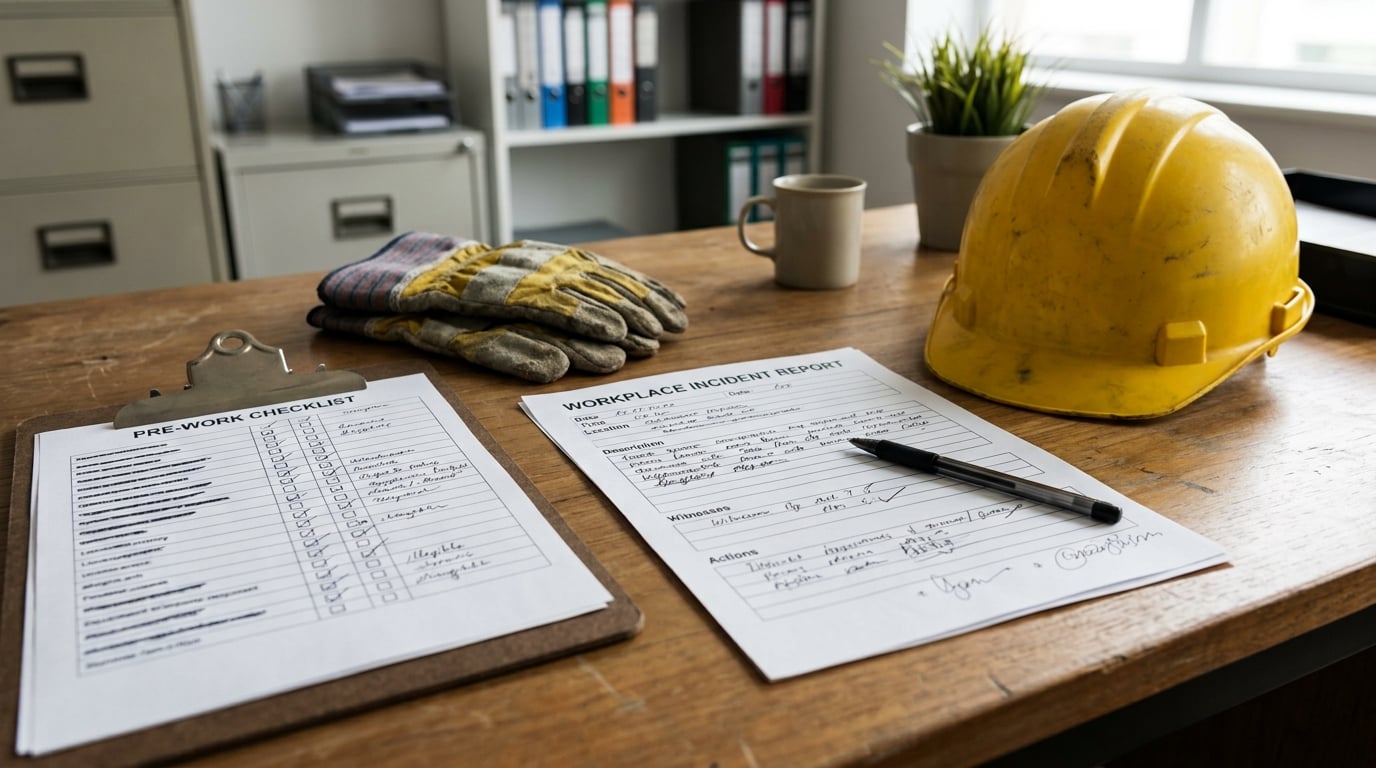
Filling out an incident report at work means writing a plain, dated record of what happened: when and where it occurred, who was there, what you saw, what was damaged or injured, and what was done next. The person who experienced or witnessed the event usually writes it, on their employer’s form, and submits it to a supervisor, HR contact or safety officer. It takes 15 to 30 minutes if the details are still fresh, and almost none if you waited a week.
This is not a legal guide, and deadlines differ by employer, by state and by the kind of event. Your workplace policy is the rule that governs your form. Where a question touches workers’ compensation or a state filing, ask your HR department or your workers’ compensation coordinator.
Table of Contents
- What You Need
- Step-by-Step: How to Fill Out an Incident Report at Work
- Common Mistakes
- Frequently Asked Questions
- How soon should I submit a workplace incident report?
- Should I include medical information in an incident report?
- Can I write down what a witness told me about the incident?
- What if I disagree with my supervisor’s description of what happened?
- Will I receive a copy of the completed incident report?
- What should I do if the workplace form does not ask about a safety concern?
- Conclusion
What You Need
You need four things before you start: the correct form, the correct recipient, a copy of any policy that sets the deadline, and the raw facts. Most rushed reports fail on the last one.
- The form. Ask for the current version, not a saved PDF from a former job. Some employers combine an incident report, a close-call report and a hazard report on one page; others have a separate investigation form that opens later.
- The recipient. Know the name, role and email of whoever reviews reports: your supervisor, an HR generalist, a safety officer, or a site contact for multi-site employers.
- The policy. Your employee handbook or intranet page usually states the deadline and where the form goes. Some forms print it, for example a supervisor form that asks to be completed within 24 hours of the injury.
- The facts and records you already have. Names, job titles, exact location, time, equipment and serial numbers, photos you already took, and the contact details of anyone who saw it.
Write your notes before you open the form, while the sequence is still in your head. Five rough bullet points now save twenty minutes of staring at a blank description box later.
Step-by-Step: How to Fill Out an Incident Report at Work
Work through the seven steps below in order. Each one produces a section that most workplace incident report forms expect, and each one is written as a fact rather than an argument.
1. How to Fill Out an Incident Report Without Delays
Report it the same shift, before you leave the building if you can, and treat an unresolved danger as the reason to act first rather than write. Fill in the heading your employer has designated, notify the supervisor, HR contact or safety officer listed on the form, and confirm the date and time of that notification so the report shows the event was escalated promptly.
If someone is hurt, call your internal emergency number or local emergency services before completing any paperwork. The form can wait ninety seconds. It cannot wait if the person needs help.
Late reports get returned for follow-up, and a follow-up interview weeks later relies on your memory instead of your notes. If you genuinely cannot file today, send a short email to the recipient with the date, time, location and one sentence of description, then complete the form when you can. That timestamp exists for a reason.
2. Record the Basic Incident Details
Complete the identification section exactly as it appears on the form: the date and time of the incident, the specific location, the name and title of every person involved, and the type of incident. Use checkable language, because someone reviewing this in a year has to be able to confirm each item against another record.
Location means the level of detail that would let a stranger walk there. “Dock 3, bay 12, north end, behind the forklift charging station” beats “the warehouse.” If the form asks for environmental conditions, fill them in while you remember: lighting, floor surface, weather, ventilation, whether alarms or guards were active.
These are the field names that show up on most forms, and this is what belongs in each one.
| Common field name | What to write in it |
|---|---|
| Date and time of incident | Both, plus the shift if the site runs around the clock |
| Location | Building, floor, room, bay, or job site address |
| Job title and department | Your title exactly as it appears on the org chart |
| Persons involved | Full name, title, department for each person, including visitors |
| Type of incident | What the form lists: injury, near miss, property damage, hazard, security, other |
| Injury or damage description | Body part and nature of injury, or the item damaged and how |
| Medical or first aid given | Who provided it, what it was, and where the person was taken |
| Witnesses | Name, title, phone or email, and whether they gave a statement |
| Equipment involved | Make, model, serial number, and last inspection date |
| Notifications | Who was told, when, and by what method |
| Attachments | List every photo, statement, or document you are including |
| Preparer signature and date | Your name, signature and the date you are signing |
On equipment, the serial number matters more than the description. It is the thread that connects this report to the maintenance history, the inspection record and any recall notice.
3. Describe What Happened in Chronological Order
Write the description as a sequence a stranger could follow: what you were doing, what changed, what you saw, and what the immediate result was. Keep known facts separate from anything you are inferring, and cut every detail that does not bear on the event.
Three or four sentences usually does the job. What you were doing, the task in progress, the conditions around you, the moment something changed, and what the outcome was. If a form gives you a large box, resist filling it. A dense paragraph of speculation gets a report discounted, because the reviewer cannot separate what you saw from what you concluded.
Use the tense of the event. “The guard was removed” describes the fact; “the guard should never have been removed” is a conclusion that belongs in the corrective action section, if at all.
One useful test: read the description back as if you were the manager who was not there. If you can picture the scene, it works. If you cannot tell what the person was doing or what changed, add a sentence.
4. Add Injuries, Damage, and Witnesses
Document only what you observed. Describe the injury by body part and nature, such as a cut on the left forearm or a swollen right ankle, and record exactly what first aid or medical attention was given, by whom and at what time. If nobody was hurt, write “no injury observed” rather than leaving the field blank, because a blank field reads as an oversight.
Property damage goes in the same section. Name the item, describe the damage, note whether it was taken out of service, and record an estimate of the cost only if your form asks for one.
For witnesses, list each person’s full name, title and best contact number, and note whether they have already given a written statement. Mark clearly what you saw yourself and what someone else described. Something like “secondhand: T. Alvarez stated the ladder was already open” keeps the record honest; a blended paragraph does not.
Ask a witness for their account in their own words and have them sign it. People asked to describe something tend to write shorter, plainer statements than the person writing the report, and that is the point.
5. Identify Causes Without Blaming Anyone
Describe contributing conditions rather than assign fault. Missing guards, unclear labelling, blocked access, absent signage, worn equipment, a procedure that does not match the task, staffing or time pressure you observed, and conditions you could see, are all reportable. “He was careless” is not.
| Write this | Not this |
|---|---|
| The spill guard on the conveyor was hanging open | Maintenance never fixes that guard |
| The step was unmarked and the light above it was out | The building is run badly |
| The cart was overloaded above the marked line | He was being lazy and careless |
| Cause not yet determined; supervisor’s report attached | I know exactly why this happened |
| The procedure does not cover two-person lifts of this load | Nobody ever told us the right way |
If you do not know the cause, say so. “Not yet determined” is a normal and credible entry, and it is more useful to a safety officer than a guess they have to disprove.
One reassurance worth repeating, because it comes up more than any other worry: an incident report is a factual record, not a complaint. Reporting a hazard, a near miss or a coworker’s conduct through this form is not an accusation against them, and a fact-based report is harder to use against the person who wrote it than an emotional one. Advice that surfaces in places like r/AskHR tends to land the same way: build the documentation first, from notes and existing records, rather than starting from memory weeks later.
6. Recommend Immediate Corrective Actions
Suggest controls you can justify from what you saw, and keep them in the present tense. Guarding or locking out the equipment, removing or cordoning the hazard, pausing the task until the area is cleared, replacing or relabelling signage, requesting a follow-up inspection, or retraining on a procedure. Each one should be something a manager can act on this week.

Write a recommendation as an action, not a demand. “Recommend the guard be reattached and the conveyor locked out until maintenance inspects it” reads as useful. “This company needs to be shut down” reads as a grievance, and it will be sorted into a different process.
Flag anything urgent in a way that survives being read out of context. “Recommend immediate lockout pending inspection” tells a supervisor exactly what to do before anyone leaves the site.
7. Review and Submit the Report
Re-read the whole report as a stranger, then check six things: that every name, title, date and number is accurate; that the terminology matches your workplace’s; that injuries, damage and witnesses are not blank; that every attachment is actually attached; that the description contains no blame and no opinion; and that the signature and date are filled in.
Submit it to the contact named on the form, then keep a copy of what you submitted, with the date and time of submission, if your employer’s policy allows it. If your organization is unionized, a grievance procedure under the collective bargaining agreement can run alongside the incident report as a separate route; that is a question for your representative, not for this form.
Some employees get handed a form their supervisor has already written and are asked to sign it. Read it first. If it does not match what you observed, ask for your own account to be added, or attach a separate statement, and do not sign a document you disagree with until that is resolved. Advice in HR forums about responding to a supervisor’s version of events is consistent on one point: answer carefully, stick to facts you can support, and point reviewers to the source records rather than to opinions.
Common Mistakes
The reports that get sent back for rework share the same handful of problems. Each has a straightforward correction.
- Waiting too long. Fix: file the same shift. If you cannot, send a short dated email with the core facts first, then complete the form.
- Vague descriptions. “Injured on the job” tells a reviewer nothing. Fix: give the exact task, location, time and outcome in three or four sentences.
- Guessing at causes. Fix: describe conditions you observed and write “not yet determined” for the rest.
- Blaming a person. Fix: replace characterisations with observable behaviour, and move the suggested control into the corrective action section.
- Leaving injuries and witnesses blank. Fix: enter “none” or “no injury observed” so the form reads as complete rather than unfinished.
- Recording hearsay as fact. Fix: label secondhand accounts and identify who said them.
- Copying someone else’s version without checking it. Fix: compare it against your own notes and ask for corrections in writing.
- Forgetting evidence. Fix: attach photos, list serial numbers, and ask in writing that any camera footage be retained before it is overwritten.
- Not requesting follow-up. Fix: add a line asking for a corrective action decision and a date, then keep the report with your copy.
- Signing without reading. Fix: read every field, correct what is wrong, initial changes, and never sign a blank page.
Reporting Tips
- Replace every adjective with something measurable. “Very slippery floor” becomes “water across approximately 6 feet of walkway.”
- Write timestamps as they happened rather than as you estimate them later.
- Take photos of conditions before anything is moved or cleaned, and note when you took them.
- Keep the report short enough to read in two minutes. Reviewers skip long ones.
- Use your employer’s own process and form, not a template from the internet, even a good one.
- Ask your safety officer or HR contact when a field is unclear, before you submit, not after.
- Report near misses even when nobody was hurt. A close call is a free warning that costs an employer nothing to fix.
Frequently Asked Questions
How soon should I submit a workplace incident report?
Submit it the same shift, and within whatever window your employer’s policy sets. Many workplace forms specify 24 hours, and some shorter for injuries. Employer policy is the deadline that governs your form; federal workplace safety recordkeeping rules and state workers’ compensation timelines are separate and can be stricter. If you are past the window, send a short dated email with the core facts now, then complete the form.
Should I include medical information in an incident report?
Record what you observed and what care was actually given, for example a cut on the forearm treated with first aid from the site first aid kit at 2:15 pm. Leave out diagnoses, prognoses and treatment opinions, which belong to a clinician and to the workers’ compensation file rather than to an incident form. If the form has no medical section, mention the injury and the care given in the description.
Can I write down what a witness told me about the incident?
Yes, but label it. Write what you saw yourself in one section and what the witness told you in another, naming the person who said it. Ask witnesses to write their own statement in their own words and sign it, since a third-party account collected separately carries far more weight than a summary inside your report. Clear the gap between what you observed and what you were told.
What if I disagree with my supervisor’s description of what happened?
Attach your own account rather than editing or crossing out theirs, and ask in writing that both versions be included with the report. Point reviewers to supporting records such as timestamps, photos, equipment logs or contemporaneous notes rather than to your opinion of the event. If the difference is about a person rather than a hazard, raise it with HR or your union representative, because that is a separate process from the incident form.
Will I receive a copy of the completed incident report?
It depends on your employer, so check your policy and ask the person who receives the form. Keep a copy of what you submit, with the submission date and time, as a matter of habit. If you are asked to sign a report written by someone else, read it first and request that your own account be added before signing, and never sign a page left blank.
What should I do if the workplace form does not ask about a safety concern?
Report the unsafe condition in the description and add a recommended corrective action, such as guarding, lockout, clearer signage or a follow-up inspection. Then send a separate note to your safety officer or HR contact so it reaches the person who acts on hazards rather than sitting in a file about injuries. In a unionized workplace, your representative can also raise it through the grievance procedure.
Conclusion
Start with the most accurate objective account you can produce, deal with any remaining danger first, and submit the form through the process your employer requires. When a field or a deadline is unclear, the safety officer or HR contact who reviews these reports is the right person to ask, and asking costs far less than a report that comes back for rework. Reviewed for 2026.