
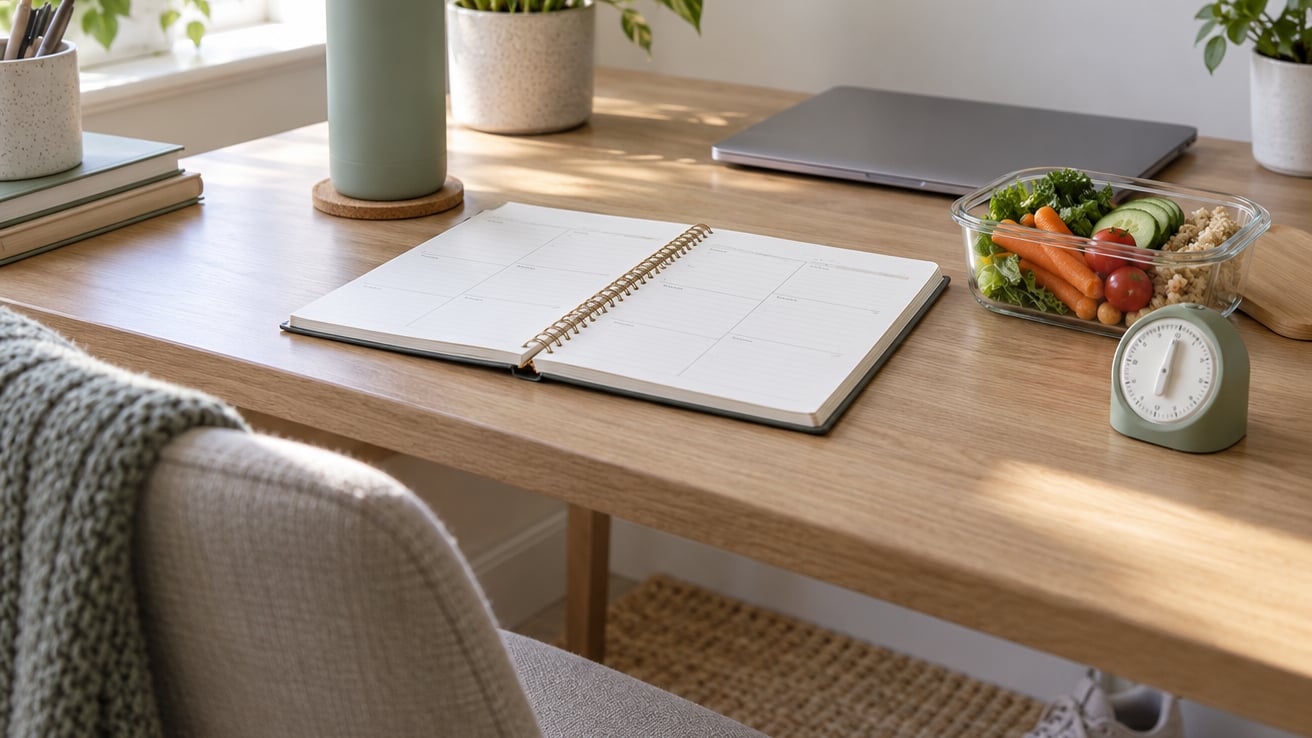
The short answer: eat slightly less than you burn, reclaim a few minutes of movement every hour, and train for strength two to three times a week. You do not need a gym membership, a standing desk, or a wake-up-before-dawn routine to make progress.
Sitting all day works against you in three ways. Your daily calorie burn drops, boredom puts you near snacks you would not otherwise want, and sustained stress keeps hunger hormones elevated. Fixing those three things is the whole job, and most of it happens inside a normal workday.
This guide walks through eight steps you can start on Monday. Most people notice energy and clothing fit changes in four to six weeks, and scale changes a little later.
If weight is affecting your sleep, mood, or joints at your workplace, our weight management support at work guide covers the workplace side of it.
Table of Contents
- What You Need
- Step-by-Step: How to Lose Weight With a Desk Job
- Step 1: Set the Plan for How to Lose Weight With a Desk Job
- Step 2: Build a Balanced Desk-Friendly Eating Routine
- Step 3: Replace Sedentary Work Time With Movement
- Step 4: Control Portions Without Extreme Restriction
- Step 5: Plan Ahead for Meetings, Takeout, and Busy Workdays
- Step 6: Improve Sleep, Stress Management, and Consistency
- Step 7: Strength Train and Support Long-Term Progress
- Step 8: Track Trends, Adjust, and Seek Professional Help
- Common Mistakes
- Frequently Asked Questions
- Can I lose weight with a desk job without going to a gym?
- How much weight should I expect to lose by walking after work?
- Is a standing desk enough to lose weight?
- Should I try intermittent fasting while working from home?
- What can I eat during a busy workday without gaining weight?
- When should I ask a doctor or registered dietitian for help?
- Conclusion
What You Need
Nothing here requires equipment. It does require a plan you can repeat on a bad week, when motivation is nowhere to be found.
- A modest deficit. Eating roughly 200 to 500 calories a day below what your body uses. That typically works out to about 1 to 2 pounds a week, which is a pace you can hold.
- A balanced eating pattern. Protein, fiber-rich carbohydrates, vegetables or fruit, and some healthy fats at most meals. No food group gets banned.
- Comfortable movement. Ten minutes of walking in work clothes counts. It does not have to be a workout.
- A water bottle and a real lunch. Most desk-job snacking starts because nothing was planned and the vending machine was closer than the fridge.
- Workplace routines that fit your office. A plan for the birthday cake, the all-hands pizza, and the colleague who brings pastries every Monday.
- A low-drama tracking method. One weekly number, or a tape measure, or how your jeans feel. Daily weigh-ins are optional at best.
Step-by-Step: How to Lose Weight With a Desk Job
The eight steps below stack on each other, but you do not need all of them working on day one. Pick two, run them for a month, then add more. Rapid plans fail because they cannot survive a Tuesday.
Step 1: Set the Plan for How to Lose Weight With a Desk Job
Decide what success looks like before you change anything. For most people that means energy through the afternoon, better sleep, and clothes fitting differently, with weight loss as a side effect rather than the only scoreboard.
Estimate your baseline honestly rather than aggressively. A calorie counter or a registered dietitian can give you a realistic daily number. Sedentary adults often underestimate intake by a wide margin, which is why a modest deficit that seems small still moves the scale.
Then choose one or two measurable habits. Two is the ceiling. “Walk 15 minutes after lunch” is a habit. “Be healthier” is a wish, and wishes do not survive a deadline week.
How do you know it worked? Check in weekly, not hourly. Track the habit first and the weight second, because habits are what you control.
Step 2: Build a Balanced Desk-Friendly Eating Routine
Three regular meals beat six small random ones for most desk workers. Set times they roughly match your schedule, because an irregular eating pattern usually turns into a 3pm vending machine run.
Build each meal from four parts: a protein source, a fiber-rich carbohydrate, vegetables or fruit, and a small amount of healthy fat. This is not a formula to obey, it is a shopping list shortcut.
- Beans with vegetables and a spoonful of olive oil, plus a piece of fruit.
- Greek yogurt with berries and a small handful of nuts.
- A whole-grain sandwich with lean protein, plenty of vegetables, and mustard instead of mayonnaise.
- Rice or pasta with a palm-sized portion of chicken or fish and a large salad alongside.
Protein deserves particular attention in a sedentary job. Aiming for roughly 20 to 30 g at breakfast tends to reduce mid-morning snacking, because hunger is mostly a protein and volume issue rather than a willpower one.
Fiber matters just as much. Vegetables, legumes, oats, and whole grains fill you up for very few calories, which is why the same meal volume leaves you satisfied.
Step 3: Replace Sedentary Work Time With Movement
Non-exercise activity thermogenesis, usually shortened to NEAT, is the energy you burn through ordinary daily movement: walking, stairs, standing, chores. For desk workers it is the easiest place to add calories burned without adding an hour to the day.
A standing desk helps posture and how you feel, but it does not do much for weight. Standing burns only about 2 more calories per 15 minutes than sitting, which is why people who stand all day without walking elsewhere often see little change. Use a sit-stand desk for comfort and get your real movement from walking.
Where the steps come from matters more than the total:
- A five-minute walk after each meal, which is roughly 15 minutes across a workday.
- Stairs instead of the elevator, at least once a day.
- One-on-one meetings taken as walking calls.
- Getting up during every commercial break or ad pod if you work from home.
- Parking a block or two away, or getting off the train one stop early.
- Walking to speak to a colleague instead of sending a message.
- Two to three desk stretches or squats per hour to break up sitting.
- A standing desk for posture and shoulder comfort, not for calorie burning.
- Under-desk pedal or elliptical use during long reading or coding blocks.
- Eating lunch away from your desk, even if it is just a walk around the block first.
On the step count: 10,000 is a useful baseline, not a law. Many people with desk jobs reach it comfortably by adding a progressive walking block, starting around 5,000 daily and adding roughly 1,000 steps a week until the number feels normal.
Working toward how to lose weight with a desk job also means breaking sitting itself up, not just adding a long evening session. Moving every 30 to 60 minutes helps how your body handles blood sugar, and it beats the same total sitting compressed into fewer breaks.
Desk setup and movement go hand in hand. If your chair and monitor are wrong, movement breaks end in neck pain. Our office ergonomics checklist for desk workers covers the setup side.
Step 4: Control Portions Without Extreme Restriction
Portion control works best when it is boring. Serve meals in smaller dishes, put the serving pot on the counter for a second meal rather than at the table for the first, and stop eating when you are satisfied rather than when the plate is empty.
Speed matters as much as quantity. Most desk lunches last six minutes, which is not long enough for fullness signals to register. Slowing down to twelve or fifteen minutes is often enough to change how much you eat without changing what.
Drink a glass of water before meals, especially before the ones that usually go wrong, such as the late-afternoon meal. Dehydration often disguises itself as hunger in people who sit for hours and forget their bottle.
Aim to fill the plate with vegetables first, then protein, then carbohydrate. Same food, different ratio. Skipping meals to save calories tends to produce the 4pm binge that undoes the day.
For more on the setup side of a long sitting day, see how to set up your desk to prevent back pain.
Step 5: Plan Ahead for Meetings, Takeout, and Busy Workdays
This is the step most desk workers skip, and it is where most plans quietly fail. Decisions made at 3pm in a hungry state are not planning.
A simple system that works: pick two evenings for prep, and spend about 45 minutes. Cook two proteins, one grain, and a tray of vegetables. Portion five lunches into containers, plus two snacks for the drawer at work.
Keep an emergency drawer stocked with food that does not need a microwave or a fork. Nut and seed packets, canned fish with a pull tab, roasted chickpeas, protein powder, and dried fruit all qualify. The goal is to never be more than ten seconds away from something better than the vending machine.
Three realistic workdays look like this:
- Normal office day. Packed lunch, one planned mid-afternoon snack, a walking break after lunch, water refilled twice.
- Back-to-back meeting day. Lunch eaten at your desk, a 15-minute walk between two meetings, and a snack you packed rather than the sandwich someone brought back from a client lunch.
- Takeout day. Order a protein-forward main, a side of vegetables or salad, skip the bread basket, and eat half the portion with a side salad so the rest is dinner.
The social layer matters just as much as the food layer. People on Reddit forums like r/WeightLossAdvice and r/loseit describe the same pressure: constant office treats and the feeling that refusing is rude. The scripts that help are short. “I’m good, but thank you” needs no reason. Mentioning your goals to your team also lowers the number of times someone hands you a pastry.
Step 6: Improve Sleep, Stress Management, and Consistency
Desk work is often high-stress, high-cortisol work. Chronic stress and short sleep both raise hunger and make cravings for quick energy easier to give in to. That is a physical response, not a character flaw.
Keep a steady sleep and wake time, including at weekends, and aim for seven to nine hours if your schedule allows. Naps of 20 minutes or so beat the 3pm crash that ends in the biscuit tin.
Build small stress breaks into the day rather than saving them for the evening. Five minutes of walking after a hard call does more than an hour of doom-scrolling at home. Most people also find that one genuinely hard training session a week is the fastest way to lower baseline stress.
Consistency beats intensity. A plan that holds on 80 percent of days will beat a perfect plan that lasts eleven days. Judge yourself on the month, not the individual Tuesday you skipped.
Step 7: Strength Train and Support Long-Term Progress
Weight loss takes muscle with it unless you tell your body otherwise. Resistance training is what keeps your strength and your metabolism’s biggest tissue engaged while you are eating less. It is the most useful form of exercise for long-term weight maintenance.
For a beginner, bodyweight work is enough. A squat to a chair, a push-up on a desk edge or the floor, a row with a resistance band or a backpack full of books, a glute bridge, and a plank. Two or three sets, stopping a couple of repetitions short of failure.
Progress gradually by adding reps first and load second. Most people add too fast, get sore, skip a week, and decide they do not enjoy training. Three sessions of about 45 minutes a week fits almost any schedule, and split sessions count.
Cardio is useful for the walk half of this guide. Keep the hard sessions short and the easy walking frequent, since the walking is what you will still be doing in three months.
Some readers use a personalized program or a physical therapist, which is a good fit if you have joint issues, are returning after injury, or have been inactive for a long time. The movements above are general information, not an individual training plan.
Step 8: Track Trends, Adjust, and Seek Professional Help
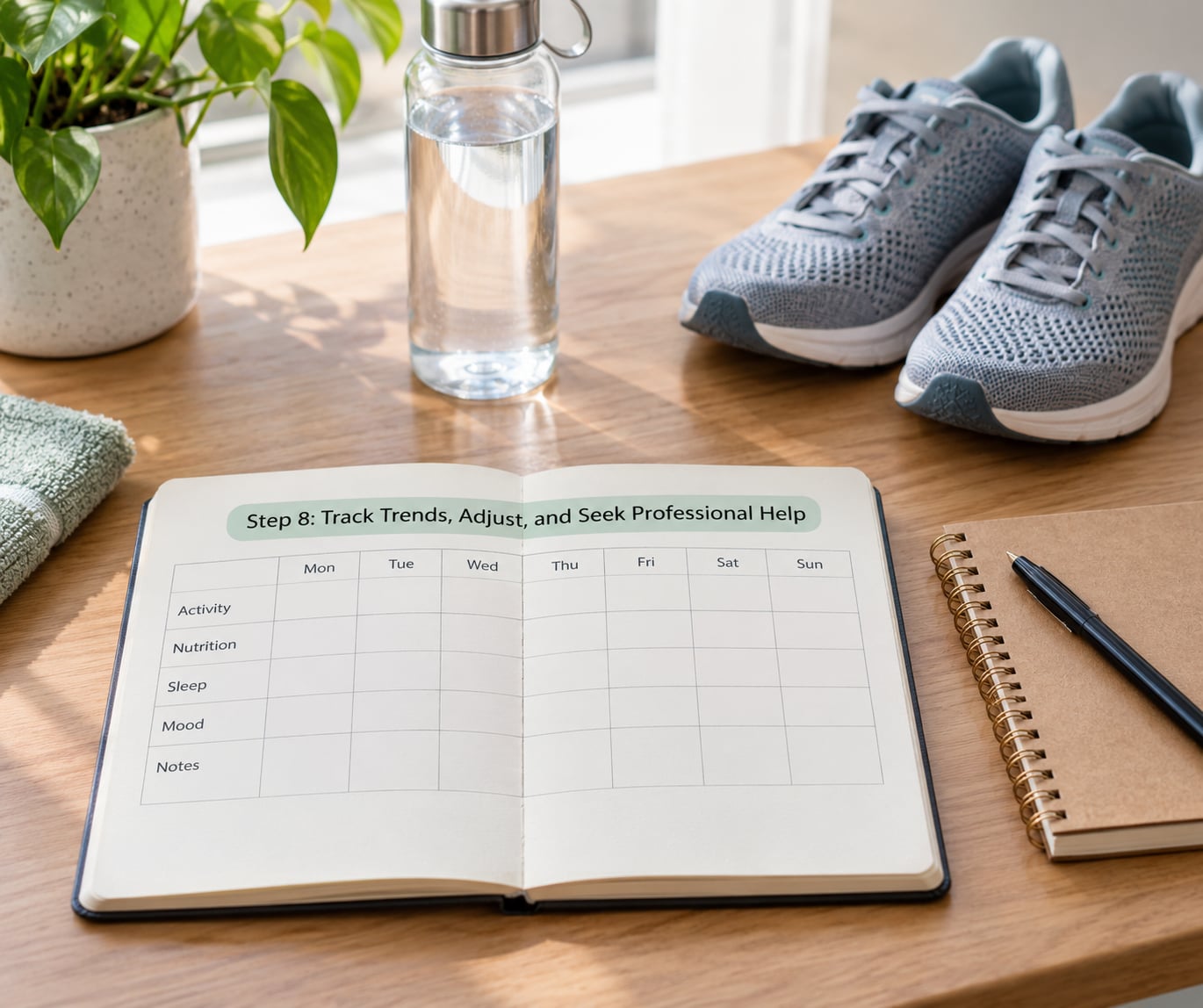
Tracking does not need to be complicated. A weekly average, a note on how your energy was, and one strength number is plenty.
One number a week is enough. Weigh in the same morning each week under the same conditions, or skip the scale entirely and track monthly averages, waist measurement, how your clothes fit, your energy, and your strength numbers.
Then look at what to adjust. If the weight has not moved for two to three weeks, change one variable: meal size, daily step count, or training frequency. Changing everything at once makes it impossible to know what worked.
See a doctor or registered dietitian rather than guessing if you have a medical condition such as diabetes or high blood pressure, take medication that affects appetite or weight, are pregnant or breastfeeding, have a history of disordered eating, or have lost weight unexpectedly without trying.
People who do this well describe the same pattern in forum threads on r/WeightLossAdvice and r/beginnerfitness: the scale stalls, they assume failure, and the plan gets abandoned. Plateaus during a desk job usually mean the deficit or the step count drifted, not that the approach is wrong.
Common Mistakes
Almost every stalled desk-job plan I have seen shares a few of the same problems.
Crash dieting. Very low intakes feel fast at first, then hunger wins, and the rebound usually includes the muscle you were trying to protect. Fix: a modest deficit you can hold for months.
Relying on coffee, energy drinks, or sugary drinks. Liquid calories do not register as satisfying the way food does. Fix: water or an unsweetened drink for most of the day, and keep the one you actually enjoy as a planned treat.
Sitting through the entire workday. One long evening workout cannot fully offset nine hours in a chair, and the health effects of sitting are separate from calories. Fix: a movement break every 30 to 60 minutes.
Making the workout punishing. If your plan assumes an hour and a half, six days a week, it is not a plan for a person with a desk job. Fix: three short sessions you would repeat on a bad day.
Checking the scale every morning. Weight moves with water, salt, and hormones, and daily numbers create stress that leads to reactive eating. Fix: a weekly average or a monthly measure.
Treating one missed day as failure. The all-or-nothing rule is the fastest way to quit. A missed session or an unplanned lunch is one data point, not the end of the month.
A few consistency habits that help: pick exactly two things to track, put a note where you will see it, and plan for your worst day of the week in advance. If you know Thursday is the day that falls apart, decide now what Thursday looks like in a smaller way.
Frequently Asked Questions
Can I lose weight with a desk job without going to a gym?
Yes. Most of the work happens through food choices and movement built into the workday rather than in a gym. A modest calorie deficit, a walking break most days, steps built up gradually, and two or three short strength sessions at home are enough to see steady progress. If you do not like the gym, that is not a barrier you need to solve.
How much weight should I expect to lose by walking after work?
It depends mostly on your total intake, not on the walking alone. A 30-minute brisk walk burns roughly 150 to 250 calories for an average adult, so it works as part of a daily energy deficit rather than as a shortcut on its own. Combine a consistent walk with eating slightly less and expect a gradual rate of about 1 to 2 pounds a week.
Is a standing desk enough to lose weight?
No. Standing burns only about 2 more calories per 15 minutes than sitting, so standing all day adds a small amount at best. Standing desks help with posture, back comfort, and how alert you feel, which has real value. For weight change you need walking that covers real distance, plus control over intake and some resistance training.
Should I try intermittent fasting while working from home?
For some people it works simply because it removes the decision of when to eat. For others it backfires, especially if you are stressed or training in the evening, because hungry office hours turn into a snack attack at night. Start with regular balanced meals and steady protein intake, and only compress eating windows later if you already have the basics in place.
What can I eat during a busy workday without gaining weight?
Keep an emergency drawer: nut and seed packets, canned fish with a pull tab, roasted chickpeas, dried fruit, and protein powder. Pack one planned snack so you are not relying on whatever a colleague brings back from a client lunch. Water throughout the day and a real lunch earlier in the afternoon usually prevent the late hunger that causes most unplanned eating.
When should I ask a doctor or registered dietitian for help?
Ask if you have a medical condition such as diabetes or high blood pressure, take medication that affects weight or appetite, are pregnant or breastfeeding, have a history of disordered eating, or have lost weight without meaning to. A registered dietitian is also useful if tracking food feels confusing, or if progress has stalled for weeks despite consistent effort.
Conclusion
Start with two changes this week, not eight. One balanced eating change, such as a protein-forward breakfast instead of a pastry, plus one movement break you repeat every day, such as a 15-minute walk after lunch.
Run those for a month before adding anything. Gradual habits built around a real schedule are the reason some desk workers keep losing weight while others keep restarting. Check in once a week, adjust one variable at a time, and expect steady progress rather than a dramatic number on the scale.
This is general information for healthy adults and is not personal medical or dietetic advice. If you have a health condition, take medication, are pregnant, or have concerns about your weight or eating, talk with your doctor or a registered dietitian before changing how you eat or exercise.