
Ten minutes of gentle movement is usually enough to loosen the tight band across the tops of your shoulders and the base of your neck. These stretches for neck and shoulder tension from computer work target the upper trapezius, levator scapulae and chest muscles that tighten when you hold a screen-facing posture for hours.
The sequence below needs no equipment beyond a chair and a wall, takes about ten minutes, and works at a desk. Hold each stretch for 20 to 30 seconds, breathe slowly, and stop at the first sign of sharp or radiating pain rather than pushing further.
Table of Contents
- What You Need
- Step-by-Step: A 10-Minute Desk Stretch Routine
- Common Mistakes
- Frequently Asked Questions
- How often should I stretch my neck and shoulders during computer work?
- Can I relieve neck and shoulder tension without leaving my desk?
- How long should I hold each neck and shoulder stretch?
- Do neck stretches help headaches caused by computer work?
- When should neck or shoulder tension see a doctor or physical therapist?
- Conclusion
What You Need
Nothing to buy. You need roughly ten uninterrupted minutes, a stable chair with a back that supports you, and about a metre of clear floor or wall space. If you work in a cubicle or share a desk, most of the routine still works seated, and two of the eight movements need no wall at all.
Pick a time you can repeat. The end of a long work block works well, or the last ten minutes before you log off. Trying to squeeze it into a two-minute gap between calls is how most people end up abandoning it.
Step-by-Step: A 10-Minute Desk Stretch Routine
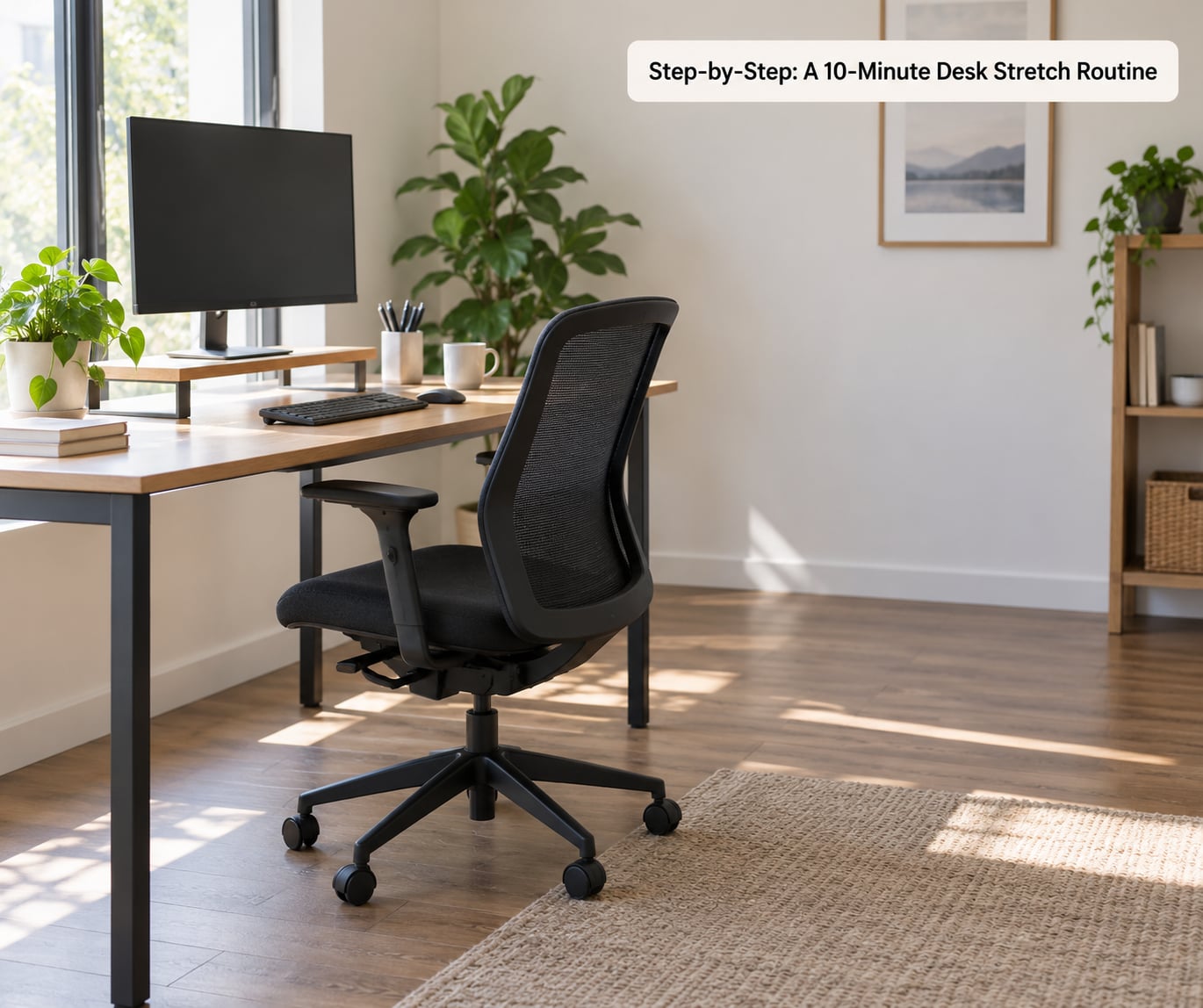
Move through the eight movements in order. The routine starts with posture, works outward to the neck and shoulders, then finishes with controlled shoulder blade work so you end moving rather than relaxed and heavy.
1. Sit Tall and Reset Your Posture
Settle back into your chair with your feet flat on the floor and your lower back supported. Let your head balance over your shoulders rather than jutting forward, and bring your elbows close to your sides with forearms roughly parallel to the floor.
Now check the screen. If the top edge sits below eye level, you will drift into forward head posture within a few minutes and undo the rest of the routine. The fix is usually a stack of books or a monitor riser, and our monitor height and neck pain guide walks through the options. Sitting at the wrong height also drives the eye symptoms covered in how to prevent eye strain from computer screens.
How to tell it worked: your jaw is unclenched and you feel your ribs, not just your stomach, move when you breathe.
2. Perform Seated Neck Retraction
Keeping your chin level, glide your head straight backward as if making a double chin, then stop. You should feel a stretch at the base of your skull and across the back of the neck. Hold for five seconds, release slowly, and repeat ten times.
This is a strengthening and posture drill as much as a stretch, which is why it belongs at the start. It teaches your neck the position you want to return to. Keep the movement in the horizontal plane and do not tip the head down, since that turns it into a different exercise.
3. Stretch the Upper Trapezius
Drop your right ear toward your right shoulder, keeping that shoulder pressed down and away from your ear. Rest your right hand on the armrest or your thigh rather than pulling. Breathe in, then let the tension settle as you exhale, and hold for 20 to 30 seconds.
Switch sides. If the stretch spills into the shoulder itself, tilt your head slightly forward and take your shoulder down further. Many desk workers find one side noticeably tighter, usually the side they hold the phone on.
4. Stretch the Levator Scapulae
Turn your head about 45 degrees to the right, then tilt it back so your chin points toward the space behind your right shoulder. The muscle running from the back of your neck to the top of your shoulder blade is the one you want. Hold for 20 to 30 seconds, breathe throughout, then repeat on the left.
Keep the opposite shoulder heavy and still. This one feels odd the first few times, so start smaller and let the position settle rather than craning to reach the end range. Desk workers who look down at a keyboard all day tend to feel this stretch most strongly at the base of the neck.
5. Roll the Shoulders Down and Back
Lift your shoulders toward your ears, roll them back, then down, then forward. Five times each direction, slowly. The point is the downward half of the circle: it lowers shoulders that have crept up near your ears during hours of typing.
Add a few gentle scapular squeezes here if you like, drawing the shoulder blades toward each other for three seconds before you move on to the chest stretch.
6. Open the Chest With a Doorway-Style Stretch
Stand and place both forearms on a doorframe or wall, elbows at about shoulder height. Step one foot forward through the doorway and lean gently forward until you feel the stretch across the chest and front of the shoulders. Hold for 20 to 30 seconds, then step back and repeat.
Keep your ribs down rather than arching your lower back to go deeper. If there is no wall nearby, the seated version works: sit tall, interlace your hands behind your head with elbows wide, and lean back slightly until you feel a gentle pull across the chest. This is the useful alternative for anyone without a wall.
7. Use a Wall-Supported Shoulder Stretch
Bring one straight arm across your chest at shoulder height and use the other forearm to draw it closer. Your shoulder should stay down, not shrugged toward your ear. Hold for 20 to 30 seconds per side and repeat twice.
Stop immediately if you feel numbness, tingling or sharp pain in the arm, and never force the arm past your chest. That combination is a reason to see a clinician rather than a challenge to work through.
8. Finish With Scapular Squeeze-and-Relax
Draw your shoulder blades together as though pinching a pencil between them. Squeeze for five seconds, then release completely and let the shoulders drop. Repeat ten times, breathing out as you squeeze.
This is the finishing move because it puts the shoulder girdle through a full contraction and a full release. Ending with it means you finish the routine moving rather than sitting in a held position. Full control, no forced range of motion.
Common Mistakes
Bouncing through the stretch. Momentum makes muscles tighten rather than lengthen. Hold still and breathe; the stretch deepens on its own as you exhale.
Forcing range of motion. The right position is about 60 to 70 percent of what you could force. If you are holding your breath or grimacing, you have gone too far.
Holding your breath. Exhale through every hold. Breathing out lets the muscle relax and lengthen, and it is the difference between a useful hold and a wasted one.
Stretching a recently injured or very painful area. Acute pain, recent whiplash, and any arm that is weak or numb are reasons to stop and seek advice. A gentle routine is fine around ordinary stiffness; it is not a treatment for injury.
Rolling the neck in full circles. Aggressive full circular neck rolls force the cervical spine through end-range extension and rotation, and this movement pattern is exactly what people with neck pain should avoid.
Treating the stretch as the fix. Stretching relieves the symptom, usually for an hour or two. If the same tension returns by mid-afternoon, the workstation is the problem.
On frequency, most people get more from a short routine done consistently than from a long one done occasionally. A few minutes every 30 to 45 minutes through a workday addresses the build-up as it happens, and a ten-minute routine in the evening gives deeper release. Our piece on reducing sedentary behavior at work covers how to build movement into the rest of the day.
Expect relief to fade within an hour or two if nothing else changes. That is a useful signal rather than a failure. It means the tension is being rebuilt faster than you are releasing it, which is a workstation problem and sometimes a strengthening problem rather than a flexibility problem.
Frequently Asked Questions
How often should I stretch my neck and shoulders during computer work?
Every 30 to 45 minutes works well for most desk workers, plus a longer ten-minute routine at the end of the day. Short movement breaks keep tension from building in the first place, while the longer routine gives more sustained holds. If you only have time for one, pick the mid-afternoon reset, when stiffness usually peaks.
Can I relieve neck and shoulder tension without leaving my desk?
Yes. Seven of the eight movements in this routine can be done seated in a normal office chair, including neck retraction, upper trapezius and levator scapulae stretches, shoulder rolls and scapular squeezes. The chest stretch is the only one that needs a wall, and a seated hands-behind-head version works in its place. None of them require changing clothes or a space larger than your chair.
How long should I hold each neck and shoulder stretch?
Hold static stretches for 20 to 30 seconds, then repeat twice on each side. The short movements in the routine, like neck retraction and scapular squeeze, work differently: hold them for about five seconds and repeat ten times. Breathe slowly throughout, and stop early if you feel sharp or radiating pain rather than trying to reach a full 30 seconds.
Do neck stretches help headaches caused by computer work?
Often, yes. Tension headaches from screen work frequently involve the suboccipital muscles at the base of the skull and the upper trapezius, which tighten when the head is held forward. Chin tucks, upper trapezius stretches and gentle shoulder rolls all target that area, and releasing it often reduces headache frequency. Persistent or severe headaches still need medical assessment rather than stretching alone.
When should neck or shoulder tension see a doctor or physical therapist?
See a professional if pain lasts more than a week despite regular stretching and workstation changes, if it wakes you at night, or if it spreads into the arm or hand. Numbness, tingling, weakness in an arm or hand, and headaches that do not improve all warrant a prompt appointment. Get urgent care for neck pain following a significant accident or accompanied by loss of balance or weakness in the legs.
Conclusion
Start today with the posture reset and one or two comfortable stretches, not the whole routine at once. Sit with the screen at eye level, draw your head back for five seconds ten times, and then do a 20-second upper trapezius stretch on each side. That takes two minutes and tells you quickly whether this feels right for your body.
If the tension comes back within an hour, the answer is in the setup rather than in more stretching. Adjust the monitor, then book a session with a doctor or physical therapist if pain persists beyond a week, radiates into your arm, or brings numbness or weakness.