
Infection control basics for the workplace are the habits, supplies and written rules that reduce the chance an everyday illness travels from one desk, kitchen or bathroom to the next. Nobody is trying to build a sterile office. The goal is a handful of predictable measures: staying home when you are sick, washing hands properly, cleaning the surfaces everyone touches, and letting fresh air move through rooms people share.
Last reviewed: October 2026
Most of this is unglamorous work, which is exactly why it works. It also has a habit of failing for the same reason: a policy goes up on the wall, the soap dispenser runs dry, nobody restocks it, and three months later the whole thing is decorative. The employers who do this well treat infection control as a supply and scheduling problem as much as a policy problem.
Table of Contents
- What Is Workplace Infection Control?
- How Can Employers Reduce the Spread of Workplace Infections?
- What Hygiene Practices Should Workplace Employees Follow?
- What Should Employers Do When a Worker Becomes Ill?
- How Does Ventilation Reduce Infection Risk?
- How Should Shared Workspaces, Tools, and Surfaces Be Managed?
- How Do Employers Handle a Suspected Workplace Exposure or Outbreak?
- What Workplace Infection Control Measures Are Not Substitutes for Professional Advice?
- Frequently Asked Questions
- What are the 5 basic principles of infection control?
- Are employees required to wash their hands at work?
- How often should we disinfect an office or shared workspace?
- Can an employee be fired for poor hygiene or coming to work sick?
- How do I talk with an employee about a personal hygiene issue?
- When should an employer contact the local health department?
- Your Practical Plan for Infection Control Basics for the Workplace
What Is Workplace Infection Control?
Workplace infection control is the set of shared policies, procedures and habits that an employer puts in place to reduce the spread of infectious disease among staff: hand hygiene, cleaning and disinfection, personal protective equipment, ventilation, and staying home when ill. It is a layer of ordinary precautions, not a response reserved for emergencies.
The value of the layered approach is that no single measure is impressive on its own. Handwashing does very little about a poorly ventilated meeting room. Ventilation does nothing for a shared keyboard. Each measure interrupts a different link, which is why employers who stack them get noticeably better results than employers who pick one and stop.
How germs move through a workplace
Public health guidance usually describes spread as a chain: a reservoir (an infected person), a means of exit (coughing, sneezing or contaminated hands), a means of transmission (touch, droplets, airborne particles), and a point of entry (mouth, nose, eyes or broken skin). Every infection control measure cuts one of those links.
In a real office the links are easy to picture. Someone comes in with a cough and a sore throat on the same morning a team shares a birthday cake in the break room. The chain is short because the room is small, the ventilation is poor and there is a bin nobody wants to be the one to empty.
The five core principles of workplace infection control
These are the principles that show up in guidance from bodies such as the CDC, the WHO and OSHA, translated into plain language for a non-clinical workplace:
- Stay home when you are ill. Sick-leave expectations have to be real and workable, or nobody uses them.
- Keep hands clean. Soap and water for at least 20 seconds, or an alcohol-based sanitizer containing 60% alcohol or more.
- Respiratory etiquette. Cover coughs and sneezes, offer a mask or tissues, and dispose of used tissues straight away.
- Clean high-touch surfaces on a schedule. Door handles, light switches, elevator buttons, handrails, keyboards, phones and shared printers.
- Improve indoor air. More outdoor air and better filtration means fewer particles hanging around between breaths.
Routine prevention is what the list above describes: a set of low-cost habits applied every day, whether or not anyone is sick. Response is the other half. When someone is unwell at work, when a cluster of cases appears, or when public health guidance changes, the employer switches into a more active mode with different rules.
Responsibility is shared, and the split is usually clearer than people expect. The employer provides supplies, ventilation, policy and the consequences for repeated non-compliance. Managers model and enforce the policy. Employees follow it and report problems, including the empty dispenser they walked past for a week. Health professionals handle anything involving diagnosis, individual treatment or reporting requirements.
How Can Employers Reduce the Spread of Workplace Infections?
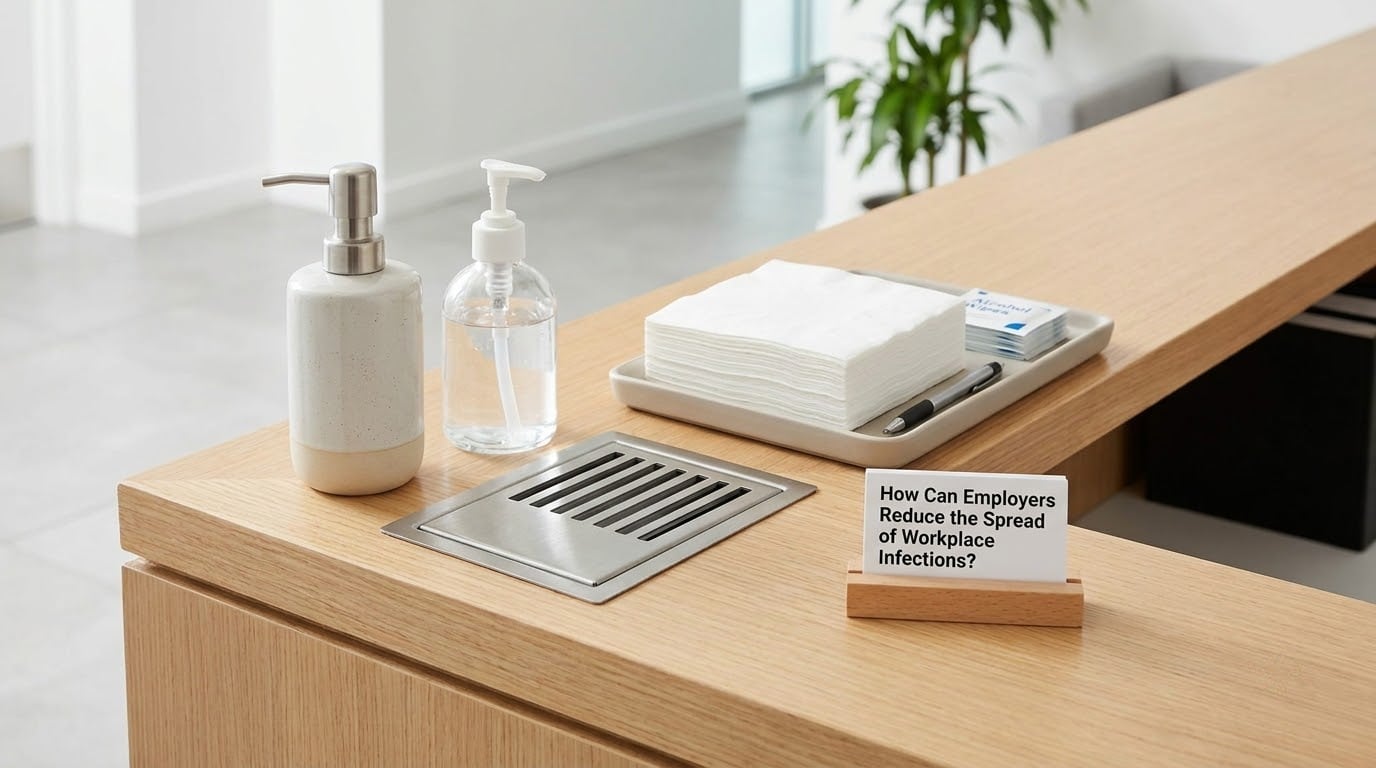
Start with the six levers that do the most work in ordinary workplaces. Everything else is a variation on these.
Make staying home the easy choice. A sick-leave policy nobody can afford to follow does not exist. Look at what your team actually does now: how many people come in with a fever because they would rather hand over a project than lose a day’s pay? Presenteeism is the single biggest reason a workplace infection control program fails in practice, and fixing it is a policy and pay question before it is an education question.
Treat the air in the room. Open windows, run the ventilation system longer, upgrade the filters on the units you already own. In a sealed room with twenty people, the air you breathe has been through a lot of lungs.
Put hygiene supplies where hands actually are. Soap, water, paper towels and sanitizer at building entrances, kitchen doors, copy rooms and anywhere two rooms meet. Then keep them there. A dispenser that ran out on Friday and stayed empty through Monday has quietly cancelled your whole program.
Give cleaning a schedule and a person. Name who does what by area and how often, in writing. “Clean as needed” is not a schedule, and it means the most visible surface in the building is the one nobody owns.
Set rules for shared spaces. Kitchens, break rooms, meeting rooms and restrooms need a stated cleaning standard, and communal items like mugs, cutlery and shared phones need a stated policy too.
Make reporting normal. Tell people what to report, to whom and what happens next. Most employees do not stay home because they want to infect the office; they stay because they do not know if a sore throat counts, or they are afraid of the reaction.
If you want the industry-specific version of this, the depth of the program should track exposure. Healthcare, care settings, food service, childcare, first response, transportation and construction all involve close contact, shared equipment or indoor crowding, and they need the most rigorous version. A general office, a retail floor and a hybrid team need a solid, reliably supplied baseline.
What Hygiene Practices Should Workplace Employees Follow?
Hand hygiene is the single highest-value habit in the whole list, and it is also the one people skip. CDC guidance is simple enough to print on a sign: wet your hands, apply soap, lather all surfaces including the backs of the hands and between the fingers, scrub for at least 20 seconds, rinse, and dry with a clean towel or air dryer. Turn the tap off with the towel if you want to be thorough.
Soap and water is the stronger option when hands are visibly dirty or greasy, after using the restroom, after handling food, and after caring for someone who is unwell. Alcohol-based sanitizer containing 60% alcohol or more is the better choice for the moments when a sink is not close by, and the middle of a shift, or after touching a shared screen.
There is a well-known mnemonic from hand hygiene campaigns, the 5 F’s, that summarises when to clean your hands: after touching fluids or body fluids, after coughing or sneezing or blowing your nose, after using the toilet or after touching waste, after returning from outside, and after handling anything a sick person touched. Different bodies frame it slightly differently, but the list is a handy reminder to carry with you.
The 5 F’s of infection control
- Fluids — after contact with urine, blood, saliva or mucus.
- Faces — after coughing, sneezing, yawning or blowing your nose.
- Food — before eating or preparing food, and after handling raw food or waste.
- Feces — after using the restroom and after handling waste or soiled materials.
- Fingers and phones — after returning from outside and after touching shared equipment.
Beyond hands, the habits worth naming are small. Cough and sneeze into your elbow or a tissue rather than your hands, and bin the tissue immediately. Do not share phones, chargers, headphones, tools, keyboards or cups; give each person their own where the equipment is not expensive to replace. In a shared kitchen, keep cold food out no longer than two hours, refrigerate perishable items promptly, and clean the microwave and fridge handles because everyone touches them.
If your workplace offers masks or respirators, staff should know how to put them on and take them off without touching the front of the mask, and where the used mask goes afterwards. For most general workplaces that means masks stay available in a supply cabinet, not that everyone wears one permanently.
What Should Employers Do When a Worker Becomes Ill?
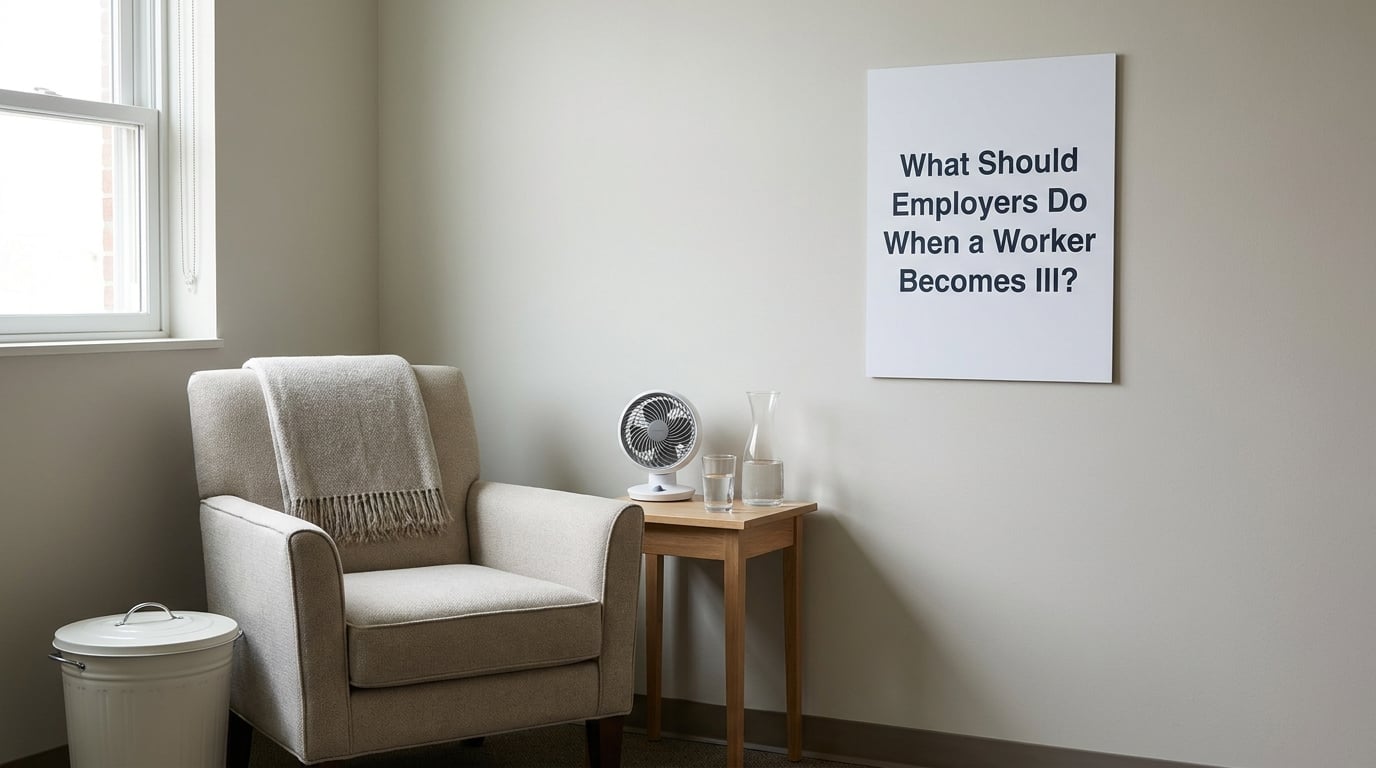
Handle it fast and quietly. A symptomatic coworker in a small room for another hour is a much bigger problem than a short, awkward absence, and the response should be calm rather than dramatic.
Separate them from coworkers immediately. Move them to a well-ventilated space that is away from shared areas, with a chair, water and a bin. Keep the room out of circulation and post a sign so nobody walks in. You do not need a curtain or a drama set; distance and air do the work.
Arrange transport home safely. If the person is well enough to drive themselves, fine. If not, many teams have already agreed a response that does not expose anyone else’s private health information, such as a taxi voucher or a standard arrangement written into policy.
Keep the health details private. Employers routinely need to know that someone is off sick. They generally do not need a diagnosis, and the details that are shared should stay with the people who need them.
Plan the return to work. Agree the expected absence, when the person will check in, and what symptom threshold matters. A written plan prevents the awkward “should I come in tomorrow?” exchange and stops one illness from turning into three.
Communicate without naming anyone. “A teammate is out sick and we are taking extra care of shared surfaces this week” is enough. Public health and medical guidance, not panic, should set any threshold for masks, testing or wider notification.
How to hold a hygiene or sick-attendance conversation with an employee
Managers repeatedly say the same thing: they have no script, so they avoid the conversation until it becomes a disciplinary problem. A workable approach takes five minutes of preparation and about ten minutes of conversation.
- Pick a private moment, not a corridor. Never correct someone in front of the team; it converts a health issue into a humiliation.
- Lead with concern, not accusation. “I have noticed you were coughing hard in the meeting room and I want to check you are okay” lands very differently from “you are being unprofessional”.
- Ask an open question and then stop talking. Employees usually know something is off, or they have a reason you would not guess. Silence gets you further than a second question.
- Name the policy and the support in the same breath. “The policy is that anyone with a fever or contagious illness stays home, and here is how sick time works and what coverage we can arrange.”
- Agree a follow-up point. “Let me know tomorrow whether you are back in or still out.” That single sentence prevents a repeat conversation and a repeat absence.
Frame the same conversation as a health matter and it tends to be received as care rather than surveillance. Managers who speak respectfully get visibly better compliance than managers who police.
How Does Ventilation Reduce Infection Risk?
Ventilation works by lowering the concentration of particles in the air. Germs leave people in respiratory particles that can build up in a room, especially when the room is small, busy and sealed. More outdoor air dilutes those particles, and filters catch a share of what is still floating. Between them, dilution and filtration are two different mechanisms doing the same job.
The practical upgrades an employer can make are unglamorous and mostly affordable. Open windows and exterior doors on breaks. Run the existing HVAC system for longer each day, including before occupancy and at the end of the day. Check whether filters are being replaced on schedule, because a unit running with a clogged filter is only moving air around. Upgrade to higher-efficiency filters where the equipment supports them, and use portable units with HEPA-type filters in meeting rooms and reception areas.
Carbon dioxide readings give you a rough proxy for how much outdoor air a room is actually getting, since a rising reading means occupants are exhaling more than the room takes in. Anything in the region of 1,000 parts per million or below is a reasonable target, and values climbing well past that usually point to an under-ventilated room.
Humidity matters too. Guidance commonly points to keeping indoor relative humidity around 40% to 60%, which is drier than some buildings need for other reasons, so ask a building professional before adjusting humidification. If your site has unusual airflow, an industrial process, or complaints about air quality that nobody has measured, that is a good moment to bring in a ventilation engineer or occupational health professional rather than guessing.
How Should Shared Workspaces, Tools, and Surfaces Be Managed?
Start by separating two words people use interchangeably. Cleaning removes dirt and a good share of germs with soap or detergent and water. Disinfecting means using a product registered with the US EPA and following the label exactly, including the contact time the surface must stay wet to work. Spraying and wiping straight away defeats most products, and that is the most common mistake in this whole subject.
Identify your high-touch surfaces before deciding on a schedule. In most offices that list is short: door handles and push bars, elevator and stair buttons, light switches, handrails, kitchen and coffee machine controls, fridge and microwave handles, reception counters, shared printers, faucets, restroom flush handles and stall latches, and shared desks, keyboards and phones. Counters in customer-facing spaces and touchscreens on shared equipment deserve the same attention.
A working cadence looks like this:
- Daily — restrooms and their touchpoints, kitchens and coffee areas, high-touch surfaces in reception, meeting rooms and copy rooms, plus any shared equipment handled by many people that day.
- Weekly — deeper attention to door handles, light switches, elevator panels, railings, chair arms, shared headsets and anywhere dust builds up.
- Monthly — non-routine or low-traffic spaces, vents and grilles, upholstery and fabric, storage areas, and equipment that rarely gets touched but is handled without washing afterwards.
Shared tools deserve their own rule. Where an item is cheap and single-person use is reasonable, stop sharing it. Where sharing is unavoidable, designate a person to clean it before and after use, and keep wipes at the point of use. Wipe first, then disinfect with the labelled contact time, then leave it to dry.
Shared-space ownership is the part most offices get wrong. The kitchen, bins and restrooms end up as contested territory, employees dodge the chore, and each side assumes the other is doing it. Write down who is responsible, put a rota where the chore happens, and assign the job rather than inviting volunteers. The accountability split between the employer, any cleaning contractor and staff needs stating explicitly, because an unstated split means nobody does it.
Colour-coded cleaning equipment is a cheap way to stop cross-contamination between restrooms, kitchens and desk areas: one set for restroom work, never used anywhere else. Waste bins with lids, emptied on a set schedule and never overfilled, do more than they look like they do.
How Do Employers Handle a Suspected Workplace Exposure or Outbreak?
A suspected exposure is a problem to manage, not a story to tell. The first 24 hours set the tone, and the goal is to be orderly and quiet rather than visible.
Write down what you know. Dates, roles, which areas were involved, and who reported what. Details will be fuzzy for a week and clear on day four, and you will not reconstruct them from memory.
Escalate to the people qualified to advise. Occupational health, your public health authority or the local health department should be your first call when there is a cluster, an unusual organism, or a case involving someone with significant exposure. Follow what they recommend rather than what social media suggests.
Communicate without exposing anyone. Share where and when, what controls are in place, and what employees should watch for. Never name the person or pass along a diagnosis.
Assess the operational impact. If a meaningful share of one team is out, decide before the week gets rough whether work is paused, staggered, or moved to remote for a defined period.
Tighten controls for as long as needed, then step down. Extra ventilation, more frequent cleaning, remote meetings, masking if advised, and clearer sick-leave cover. Then reduce gradually once cases fall, so you are not oscillating between extremes for a month.
Review after. What was missing? A supply that ran out, a role nobody owned, a policy people could not follow from home. The post-incident review is the cheapest improvement available to you.
What Workplace Infection Control Measures Are Not Substitutes for Professional Advice?
General workplace guidance can tell you to wash for 20 seconds, use sanitizer at 60% alcohol, and keep a restroom clean. It cannot diagnose anyone, decide whether a specific illness needs treatment, or tell an individual employee whether they are well enough to work. Those calls belong to a doctor, nurse practitioner or pharmacist, and to public health authorities when there is a wider concern.
Get individual medical advice for any of the following: trouble breathing, chest pain, confusion, signs of dehydration, symptoms that are getting worse rather than better, or any symptom that worries you enough that you are asking the question. People at higher risk of severe illness, including those with underlying conditions, pregnant people, older adults and people with weakened immune systems, should check with a clinician early rather than at the point they feel very unwell.
Do not use a workplace temperature check as a gatekeeper either. Temperature screening misses a great many contagious people who never feel feverish, and it can create a false sense of security. Use it, if your setting needs it, as one layer rather than a verdict.
Employers should be equally careful about legal questions. OSHA, the Americans with Disabilities Act, state and local paid sick-leave rules, and any state healthcare or staffing mandates each have their own requirements, and the boundaries between a conduct problem, a performance problem and a workplace accommodation request are genuinely contested. Talk to a qualified employment lawyer before you discipline someone on health grounds.
This article is general information for workplace health planning, not medical advice.
Frequently Asked Questions
What are the 5 basic principles of infection control?
The five core principles are: stay home when you are ill, keep hands clean with soap and water or 60% alcohol sanitizer, follow respiratory etiquette, clean high-touch surfaces on a published schedule, and improve indoor air with more outdoor airflow and better filtration. Each one interrupts a different link in the chain of infection, which is why employers who layer all five see better results than those who pick one.
Are employees required to wash their hands at work?
In most general workplaces, handwashing is an employer expectation stated in policy rather than a specific written law for every industry, though many sectors and states set their own requirements. Certain settings, including food service, childcare, healthcare and construction, do have binding handwashing rules. Expect a higher bar where blood or bodily fluids may be present, and check your state and local rules before assuming you are free to set your own standard.
How often should we disinfect an office or shared workspace?
Daily for restrooms, kitchens, reception, meeting rooms and copy rooms, plus any shared equipment many people handled that day. Weekly for door handles, light switches, elevator panels, handrails and fabric seating. Monthly for vents, upholstery, storage areas and rarely used equipment. Always follow the product label for contact time, and remember that cleaning and disinfecting are different jobs with different methods.
Can an employee be fired for poor hygiene or coming to work sick?
Coming to work sick is usually a performance or conduct matter, so discipline is possible under an employer’s policy, but firing someone is a high-risk step and the ADA or state law may require an accommodation conversation first. Separately, physical hygiene issues tied to a medical condition or disability should never be handled as a conduct problem. Get advice from a qualified employment lawyer before you take action.
How do I talk with an employee about a personal hygiene issue?
Speak privately, lead with concern rather than accusation, ask an open question and then let the answer land, name the policy and the support available in the same breath, then agree a follow-up point. Never address it in front of the team. Managers who frame hygiene as a health matter get noticeably better compliance than those who treat it as discipline, and an emailed complaint from a colleague is a poor substitute for a conversation.
When should an employer contact the local health department?
Contact your local health department or public health authority when several people in the same area, shift or team develop similar symptoms within a short window, when an unusual or hard-to-treat organism is involved, when someone has a significant exposure, or when guidance on masking, testing or exclusion needs confirmation. For a single isolated case, ordinary sick-leave handling and extra cleaning are usually enough. When in doubt, a quick call costs nothing.
Your Practical Plan for Infection Control Basics for the Workplace
If you do one thing this week, write down your sick-leave and reporting expectations in two sentences and tell your team where that document lives. Everything else can be layered on after that, because without it, none of the cleaning or ventilation work changes the number of people who turn up unwell.
Then, in roughly this order: walk every sink, dispenser and kitchen and fix anything empty, empty-handed or out of soap. Write a daily, weekly and monthly cleaning list with a named owner for each area. Run the ventilation system longer and open windows at breaks, and check whether the filters are actually being changed. Put a plain list of high-touch surfaces on the wall where your cleaning contractor or your staff will see it, and set the contact time for the product you use. Tell managers how to handle a symptomatic employee and what to say, and agree who they call.
None of this is sophisticated, and that is the point. It fails when it is treated as a compliance document and succeeds when it is treated as a set of boring systems somebody owns. If you are unsure about a specific rule in your industry or state, ask your occupational health provider or public health authority before you write it into policy, and send anyone with a personal health question to their own clinician.