

To choose the right safety gloves for a job, match the glove’s certified performance rating to the specific hazard your task creates, using the standard that legally applies where you work. Start with the hazard, not the product: a glove rated too low fails under the hazard, and a glove rated too high is so bulky that workers take it off, which is the more dangerous outcome.
Hand injuries sit near the top of preventable workplace injuries, and most of them trace back to a guess. Someone ordered the thickest leather glove in the catalogue for a job that needed a chemical barrier, or a thin disposable glove for a job that needed a cut rating. Both look like glove decisions at a distance. Up close they are different failure modes: a laceration from a blade, a chemical burn that shows up hours later, a heat burn, or contamination carried from one surface to another on a glove nobody thought to remove.
The method below takes about half an hour for a straightforward job and a full morning for something involving chemicals or electrical work. It is the same method a safety officer would use to defend the choice to an auditor, and it works without naming a single brand.
One thing to clear up first: this process supports a written PPE hazard assessment, it does not replace one. In the US, OSHA’s standard 29 CFR 1910.138 requires the employer to assess the workplace for hazards that require PPE, document the assessment, and certify it in writing. Standards also get revised, so confirm you are working from the current edition of anything cited below.
Table of Contents
- What You Need Before You Choose the Right Safety Gloves for a Job
- Step-by-Step: A Six-Step Glove Selection Method
- Common Mistakes When You Choose the Right Safety Gloves for a Job
- Frequently Asked Questions
- How do I know which safety gloves are suitable for a chemical?
- Are cut-resistant safety gloves puncture-proof?
- Should I choose disposable or reusable gloves for workplace tasks?
- What does the glove size number mean?
- Can safety gloves protect against electrical shock?
- How often should safety gloves be replaced?
- Conclusion
What You Need Before You Choose the Right Safety Gloves for a Job
You cannot compare gloves until you have four things settled. Gather them before opening any catalogue, or you will be comparing packaging.
- The task, written out. What exactly touches the hand, and for how long? A ten-second brush of solvent and an eight-hour shift soaking in the same solvent are entirely different glove problems.
- The conditions. Wet or dry, hot or cold, oily or dusty, indoors or outdoors, and whether the work happens in a conductive environment.
- The dexterity demand. Does the worker need to feel a 6 mm nut, pick up a wafer, or pull a trigger? Protection and touch feel compete directly here.
- The governing standard. The US runs on ANSI and ASTM documents plus OSHA rules. The EU and UK run on EN standards under the PPE Regulation 2016/425. A glove certified to one system is not automatically certified to the other.
Also worth having to hand: access to the chemical safety data sheet (SDS) for every substance in play, a sample box of candidate gloves rather than a catalogue page, and a worker who will actually wear the glove for a real trial. That last one gets skipped more than it should.
Step-by-Step: A Six-Step Glove Selection Method

1. Identify the Job Hazards
Write down every hazard the hand meets, not just the obvious one. Work through the list mechanically: mechanical risks (cuts, punctures, abrasion, impact), chemical risks (splashes, immersion, vapours), thermal risks (contact heat, radiant heat, flame, cold), electrical risk, and biological or contamination risk.
For each hazard, note three variables: the strength of the contact, how long it lasts, and whether the glove takes the hit directly or is only a splash barrier. A stainless steel sheet edge and a sheet-metal screw behave very differently against the same fabric, and glove ratings usually describe laboratory test cuts, not the sharp-and-irregular edges found on a real job site.
2. Check the Required Safety Standard
Now find the standard that binds you, and read what its marking actually claims. In the US, mechanical cut protection is graded on ANSI/ISEA 105-2016, which uses letters A1 through A5 for cut resistance, where A1 is roughly 500 to 1000 grams of force to cut through and A5 is 4400 grams or more. Those are laboratory figures, not field guarantees.
Across the Atlantic, EN 388 covers mechanical risks, EN 511 covers thermal risks, and EN 374 covers chemical protective gloves. EN 388:2016+A1:2018, aligned with ISO 23388, moved to letter-plus-number cut levels (T1 through T5) to match the ANSI scale, and added a puncture test as a separate letter. An older glove marked EN 388:2016 shows plain numbers 1 to 5, and those numbers do not map cleanly onto A1 to A5.
For heat and flame there is EN 511 in Europe, which rates contact heat in bands from T1 up to T4, and NFPA 2112 plus ASTM F1506 in the US, where flame-resistant clothing is tested to an arc rating in calories per square centimetre. For live electrical work, the US uses ASTM D120 classes for rubber insulating gloves, from Class 00 at 500 volts AC to Class 3 at 35,000 volts. For welding gloves, look for ASTM F903 or F1207. Canada adds CSA requirements of its own.
The marking has to be legible and permanent on the glove itself, and the glove has to carry the manufacturer’s identification. If it does not, treat the claim as unsupported.
3. Compare Glove Materials
Material is how the rating gets delivered, and each family has a clear personality.
Leather handles abrasion, heat and impact well and is tough to break in, but it is porous, so it offers no meaningful chemical barrier. Coated fabric (nitrile, PVC or polyurethane coating on a cotton or polyester shell) gives good grip and dexterity, and the coating is the part that resists liquid. HPPE (high-performance polyethylene) and aramid fibres deliver cut resistance at a low weight, which is why they dominate cut-rated gloves.
For chemicals, nitrile is a general workhorse for oils, greases and many solvents, neoprene handles a broad range of oxidising and corrosive chemicals, PVC resists strong acids and alkalies, and latex still performs well against dilute chemicals but triggers allergic reactions in a meaningful share of wearers. None of those covers everything, and the material name alone never tells you compatibility for your specific substance.
Read the chemical breakdown chart on the glove manufacturer’s technical data sheet. If your substance is not listed, the answer is not “probably fine” — it is that nobody has tested it.
4. Choose the Right Protection Level
Set the rating from your hazard list, and take the highest requirement as the floor. Chemical protection has three separate failure modes that get confused constantly: degradation, where the glove physically changes (swells, softens, stiffens, discolours); penetration, where a chemical slips through a hole, seam or defect without touching the material; and permeation, where the chemical passes molecularly through intact material, which on the skin looks like a burn appearing hours after exposure.
EN 374 rates this as breakthrough time, the time until the chemical reaches the inside face. A Type A glove must hold six named chemicals for at least 480 minutes, Type B three chemicals for 480 minutes, Type C one chemical for 480 minutes. Longer is only meaningful for your specific chemical at your specific concentration and temperature, because a hot solution strips a glove far faster than a cold one.
For mechanical work, set abrasion, tear, cut and puncture separately where the standard allows it. A cut level A3 glove is a reasonable answer for sheet metal and block work. Jumping straight to A5 because it exists costs you touch feel, raises fatigue, and gets the glove removed halfway through the shift.
5. Test Fit, Grip, and Dexterity
Have the person who will do the job wear each candidate for a realistic stretch, ideally a full shift. Watch what happens without coaching: does the cuff ride up and let debris fall inside, does sweat start making the palm slippery after two hours, do they take the glove off to wipe their glasses and then forget to put it back on.
Check three specifics. Grip: have them pick up the actual tools, including oily or wet ones, and see whether the coating holds. Fit: the glove should not slide on the finger when the hand points down, and the seam should not sit across the fingertip. Interference: the cuff must work with existing PPE such as a jacket sleeve, and a gauntlet cuff that tucks under a sleeve beats a short cuff in a chemical or particulate environment.
Sizing is not cosmetic. Gloves that are too large snag in rotating equipment and reduce grip; gloves that are too small restrict circulation over a long shift. If the manufacturer’s chart runs small, size up rather than compensating with a tighter cuff.
6. Check Care and Replacement Needs
Decide the replacement rule before you order, not after the first tear. Write down the conditions that end a glove’s service: any hole or tear, a coating that has worn through to fabric, chemical degradation or a colour change, a lost or damaged marking, or a fixed date set by the manufacturer or your facility policy.
Reusable gloves need a care instruction from the manufacturer — laundering temperatures, whether detergent residue affects performance, whether industrial washing is acceptable at all. Disposable gloves are single-use by design; washing and reusing a nitrile glove degrades the barrier and is one of the more common habits worth breaking.
Record the selection itself: the hazard, the standard, the rating, the material and the date. That one page is what makes the decision defensible later.
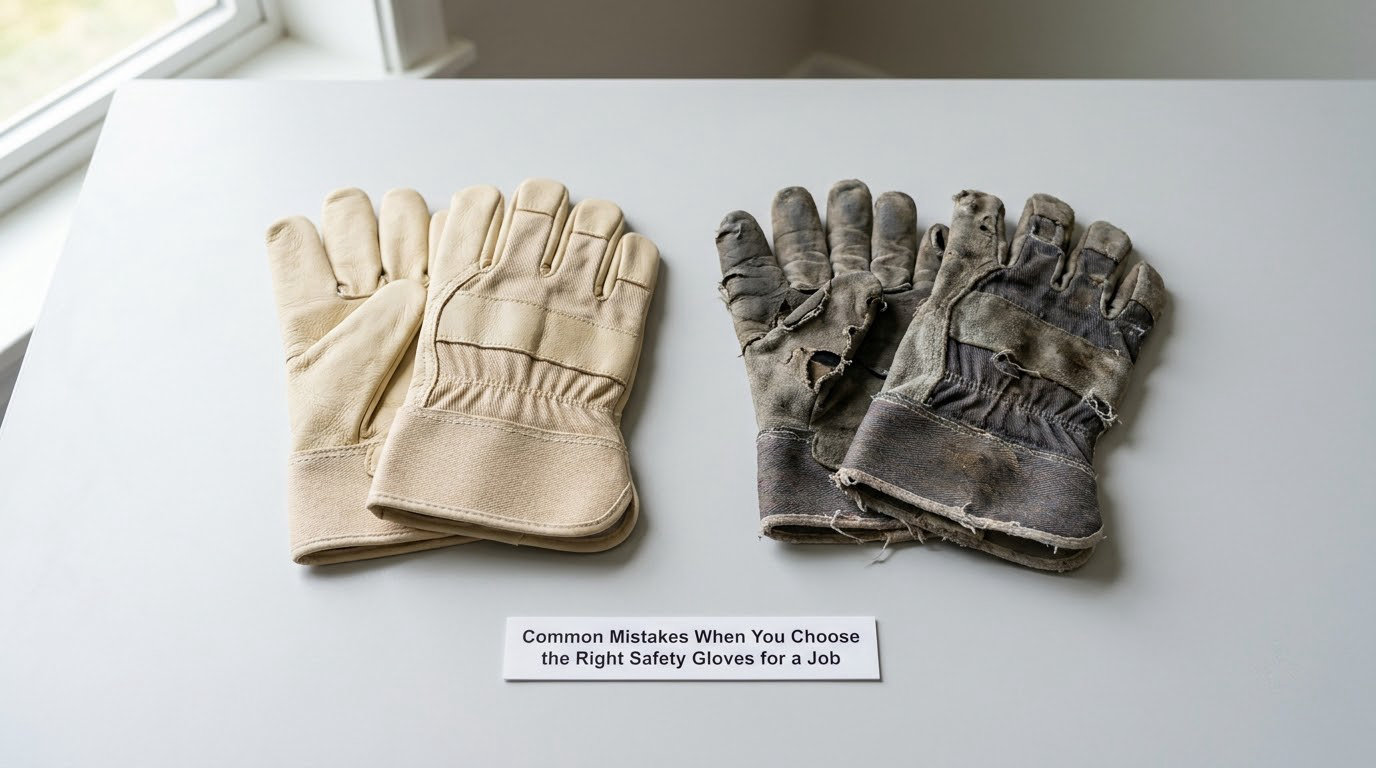
Common Mistakes When You Choose the Right Safety Gloves for a Job
Choosing by colour. Glove colour is a convention, not a rating. Blue meaning chemical resistance, yellow meaning cut resistance, and grey meaning general purpose are industry habits that vary by manufacturer and region. Read the printed rating, not the colour.
Over-specifying the protection level. Maximum protection in every category is the most common specification error. Excessively thick gloves reduce dexterity and comfort, so wear time drops and workers bypass them entirely. Specify the highest rating the hazard demands, no higher.
Ignoring chemical compatibility. “Chemical resistant” without a named chemical attached is a marketing phrase, not a specification. Use the manufacturer chart, and defer to the SDS and the technical data sheet, which are the authoritative and substance-specific sources.
Getting the size wrong. Buying bulk in one size and hoping it fits is how you end up with gloves nobody wants to wear.
Skipping inspection. Cut-resistant yarns look intact long after the fibres have shortened. Protection is lost quietly, so build a pre-use check into the shift: flex the fingers, look for worn-through coating, check for holes, and pull the cuff.
Treating a certification mark as a guarantee. A printed rating says a glove met a test under laboratory conditions. It does not say the glove suits your task, that it is the right size, or that the mark is genuine. Buying gloves with an illegible or absent marking, or from a supplier who cannot name the standard, gives you a claim you cannot check.
Frequently Asked Questions
How do I know which safety gloves are suitable for a chemical?
Look the chemical up by name in the glove manufacturer’s compatibility chart, then confirm the breakthrough time covers your exposure. Check the SDS for concentration and temperature, since heat shortens breakthrough time. EN 374 Type A, B and C mark six, three or one chemical respectively at 480 minutes. If the substance is not listed, contact the manufacturer rather than assuming.
Are cut-resistant safety gloves puncture-proof?
No. A cut rating from ANSI/ISEA 105 or EN 388 measures resistance to a laboratory blade, not to a needle, screw or wire tie. EN 388:2016+A1:2018 added puncture resistance as a separate optional test because a high cut level does not imply puncture resistance. Where both hazards exist, look for gloves carrying a puncture test result as well as a cut level.
Should I choose disposable or reusable gloves for workplace tasks?
Disposable gloves suit short, frequent-contact tasks and any single-use hygiene requirement, and they are made to be discarded after one use. Reusable coated or leather gloves suit abrasion, heat and sustained mechanical work, and cost less per hour once the service life is counted. The deciding factors are exposure duration, whether the glove contacts contamination, and whether your facility can wash and store reusable gloves properly.
What does the glove size number mean?
The number is a length, usually in millimetres, from the tip of the middle finger to the wrist cuff along the palm side. So size 9 means roughly a 230 mm hand length. Measure that same line on the hand that will wear the glove, then check the manufacturer’s chart, because a 9 from one maker can fit differently from a 9 from another. Fingers should not touch the glove tip when the hand is relaxed.
Can safety gloves protect against electrical shock?
Only gloves specifically tested and rated for electrical work, such as rubber insulating gloves meeting ASTM D120 in the US or EN 60903 in Europe, and used under the rules of your electrical safety programme. A leather or coated work glove offers no electrical insulation at all. Voltage class matters: in the US, Class 00 covers 500 volts AC and Class 3 covers 35,000 volts. Never rely on a glove rating alone for live work.
How often should safety gloves be replaced?
Replace on condition, not on the calendar, except where a time limit is set for a specific reason such as chemical reuse. Retire a glove at the first hole, tear, worn-through coating, degraded or discoloured material, or missing marking. Cut-resistant gloves need replacing sooner than they look because the fibres shorten invisibly, and chemical gloves must be changed at the breakthrough time stated for that substance.
Conclusion
Start with the hazard, not the glove. Write down what touches the hand and for how long, find the standard your jurisdiction enforces, set the rating that hazard actually demands, then let the material follow from that rating.
Test the result on a real worker for a real shift before you order in bulk, and write down the choice so the reasoning survives an audit. Standards move, so confirm you are reading the current edition, and let the manufacturer’s SDS and technical data sheet settle any chemical question.