
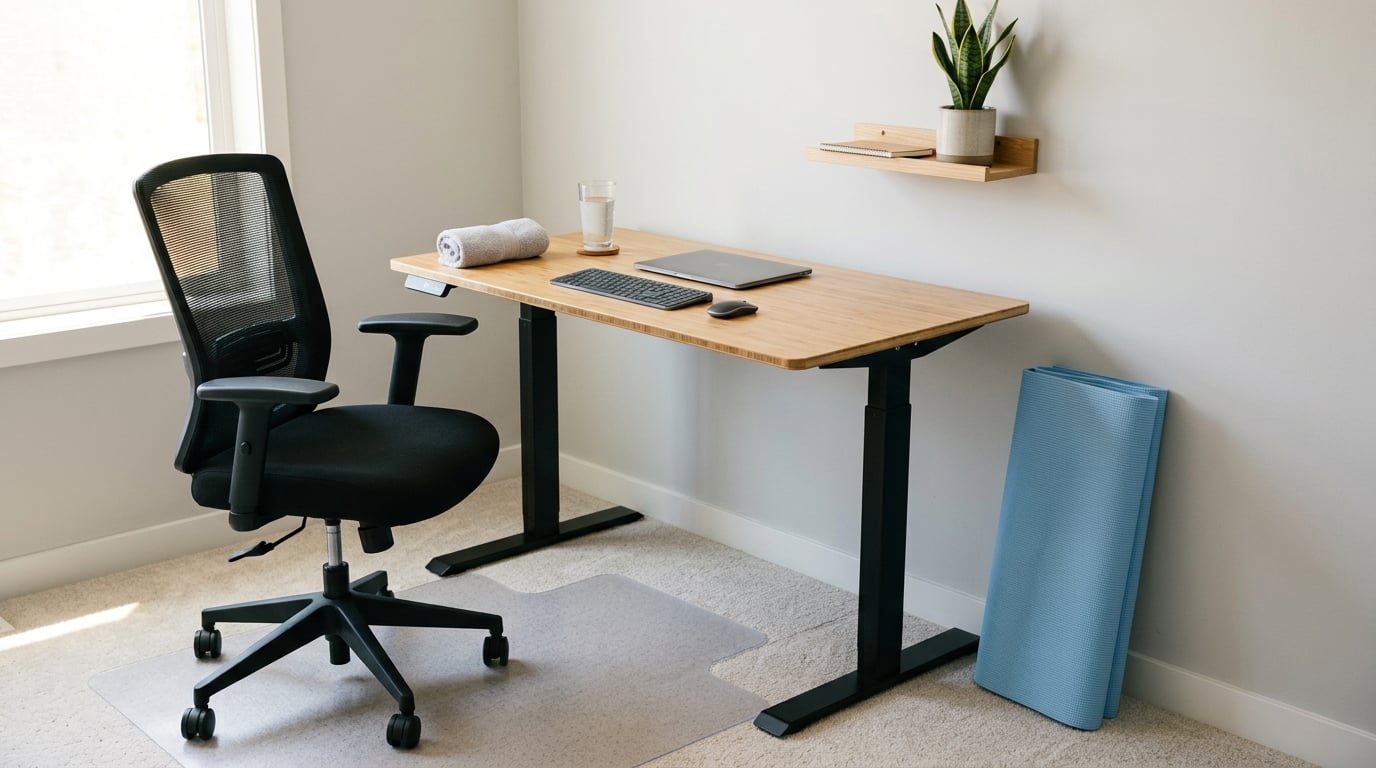
Desk exercises for stiff hips are short, equipment-free movements you can do in your work clothes, in an office chair or standing beside your desk, in five to ten minutes. The sequence below covers the five positions that get tight from prolonged sitting, holds each one for 20 to 30 seconds, and adds a short strength move so the stiffness stops rebuilding itself. Updated for 2026.
You do not need a mat, a change of clothes, or a gym membership. You need a chair that does not roll, about two feet of clear floor, and a willingness to stop before the movement turns into pain. That last part matters more than any single stretch in this guide.
Table of Contents
- What You Need
- Step-by-Step: 5 Gentle Desk Exercises for Stiff Hips
- How to Tell the Routine Is Working
- Common Mistakes
- When to Pause and Ask a Professional
- Frequently Asked Questions
- When should I do desk exercises for stiff hips during the workday?
- How long should I hold each hip stretch at my desk?
- Is mild discomfort normal when stretching tight hips?
- Can these exercises help if I work at a standing desk?
- What if I cannot cross my ankle over my knee?
- When should hip stiffness see a doctor or physical therapist?
- Conclusion: Start With One Comfortable Repetition
What You Need
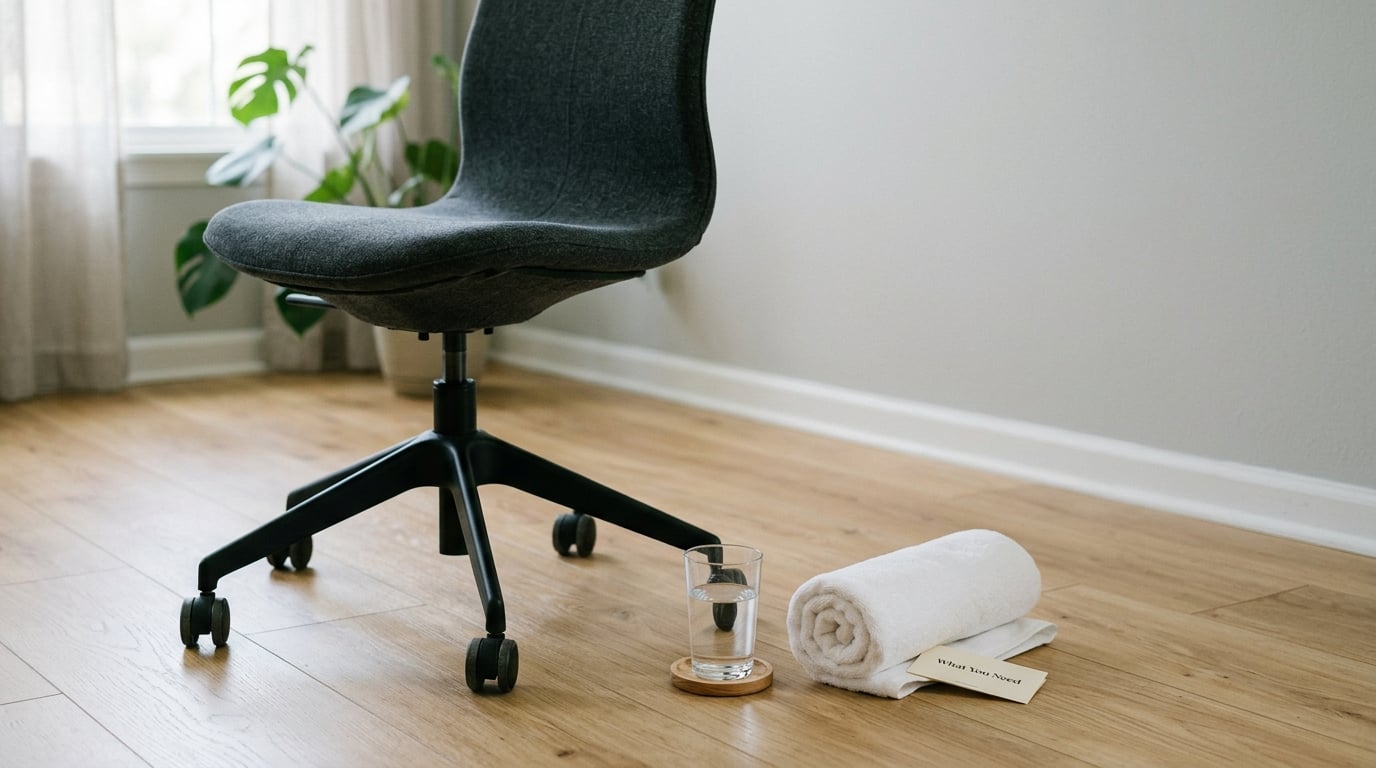
The only real requirement is a chair that stays put. A rolling task chair is the single most common reason a reader gives up on a desk routine: the back wheels slide every time you lean, so you end up bracing harder than the stretch requires. A four-legged chair, a stacking chair, or a stable stool all work. If your chair rolls, park it against a wall and test it with a hard lean before you start.
Next, clear a patch of floor roughly the size of a yoga mat. You do not need to be on the floor for most of this routine, but the standing hinge and the side steps want a little room and a wall nearby to catch you if your balance is off on day one.
Everything else is optional. A rolled towel under the back of one foot makes the split-stance reach easier to hold, and a water glass is worth keeping nearby because you will be holding positions longer than you expect. A stretching strap, a resistance band, and a foam roller all have a place in a mobility program, but none of them is a prerequisite here. If you buy nothing, you can still do all five moves.
Step-by-Step: 5 Gentle Desk Exercises for Stiff Hips
Run the sequence in order. It moves from the front of the hip to the deep external rotators, then to the hips as a whole, then to the low back, so each position builds on the one before it. Aim for comfortable mobility, not a maximum. If you can only reach a third of the available range on the first week, that is a correct rep.
1. Seated Hip Flexor Reach
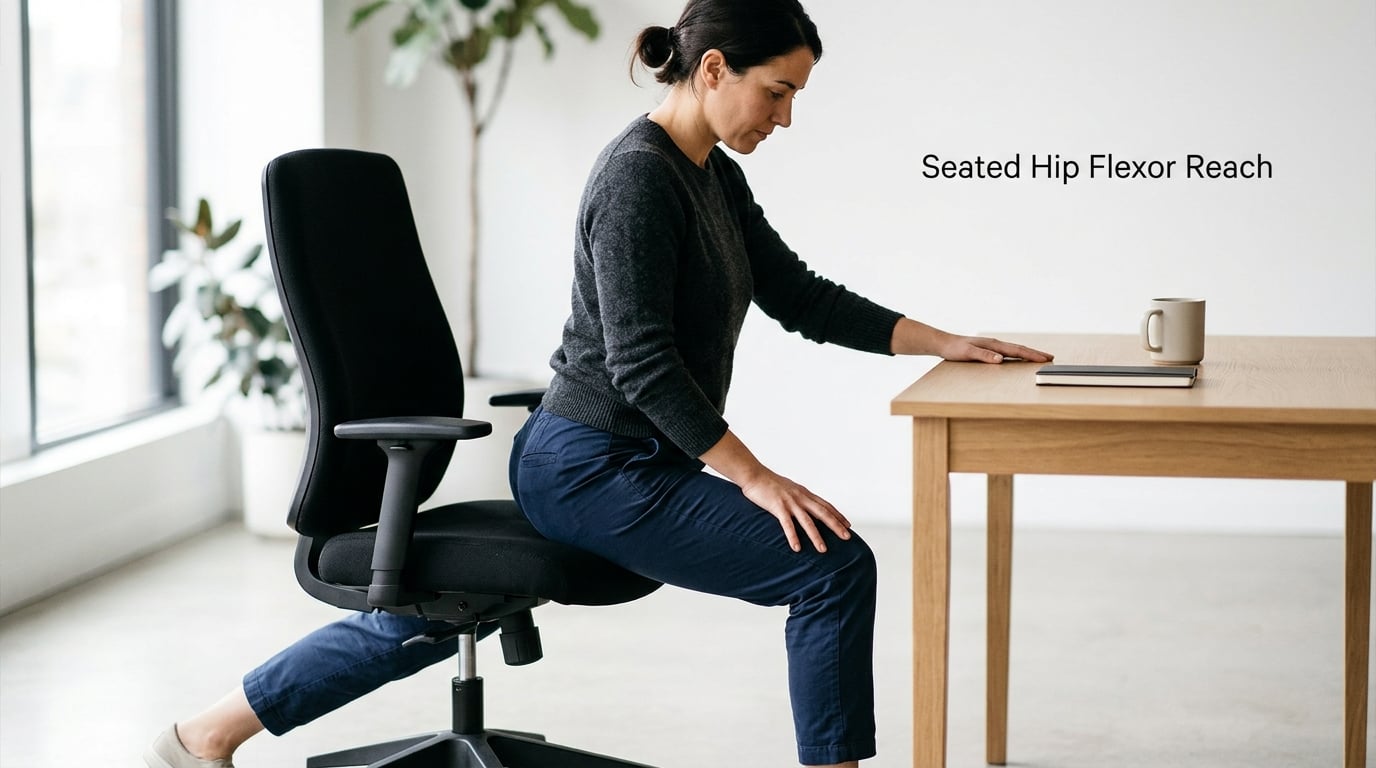
The seated hip flexor reach is the single most useful desk exercise for stiff hips, because it is usually the position your chair puts you in all day. Sit toward the front of the seat, then step one foot forward into a split stance. The back knee stays under the chair or slightly behind it, with a rolled towel under the back foot if the floor is hard.
Put the hand on the same side as the forward foot lightly on the desk. Tuck the tailbone under slightly, keep the torso vertical, and rock your hips forward a few inches. You should feel a stretch along the front of the back hip and in the crease where thigh meets pelvis. Hold for 20 to 30 seconds, breathe normally, then come out of it under control rather than dropping your foot.
Do two rounds per side. The back knee should feel like it is lengthening, not like it is being crushed. If you feel the pinch at the front of the hip joint itself, reduce the forward step until the stretch sits in the muscle, not the joint.
What success feels like: the front of the hip warms up and your hip extension at the end of the range increases, meaning you can stand and step back a little further than you could a minute earlier. Nothing dramatic. That is the point.
2. Seated Figure-Four Hip Opener
The figure-four opener works the other side of the hip: the glutes and the piriformis, the deep rotator that sits under them. Sit tall with both feet on the floor, then place one ankle across the opposite thigh just above the knee. Keep the supporting foot flat on the floor so you are not balancing on your toes.
Keeping your spine long, hinge forward from the hips until you feel a stretch in the glute of the crossed leg. Do not round into it. Hold for 20 to 30 seconds, swap sides, and repeat once more per side for two rounds total.
If the crossed ankle strains your knee, or the hinge grumbles in your lower back, skip the crossing. Sit with both feet flat, place both hands behind you on the seat, and simply sit tall with your knees over your toes for 30 seconds. You lose most of the piriformis work, but you keep the hip extension habit that most desk workers have lost, and a modified rep beats a skipped one.
3. Standing Hip Hinge Drill
Stand with your feet hip-width apart, a desk edge or chair back within arm’s reach, and soften your knees. Push your hips straight back and let your chest come forward as one unit, as though you are closing a car door with your backside. The weight stays in your heels and mid-foot.
The most common error here is doing it in reverse: rounding the lower back and pushing the hips up. If you can see your ribs poking forward at the bottom of the movement, you have lost it. Reset and think about sending the hips back and slightly down instead. Eight to twelve controlled reps is plenty.
This one feels deceptively small. It is also the movement that most directly counteracts the rounded sitting posture, because it teaches your hips to travel behind you while your spine stays long.
4. Standing Side-Step Hip Mobility
Step sideways a few inches at a time, and while each foot is in the air, turn the toes and knee out slightly before setting the foot down. That outward turn is the whole exercise. It takes about three minutes of sideways shuffling to wake up hip abductors and the gluteus medius, which is the muscle that holds your pelvis level when you walk.
Keep the range small and the pace slow. Five steps one way, five steps back, repeat for two or three passes. Your desk edge or the wall is there for balance only; if you are holding on the whole time, shorten the stride.
Watch for the knees. If they collapse inward as you step, the range is too wide for your current control, and smaller steps with a stronger outward turn will do more for you. Light pressure, short steps, high reps.
5. Seated Knee-to-Chest Reset
Sit forward on the chair, away from the backrest, and lift one foot off the floor with the knee bent. Draw that knee toward your chest without yanking it and without pulling the other leg. The opposite leg stays long, heel on the floor, and the spine stays tall rather than curling.
Hold for 15 to 20 seconds, swap sides, and repeat. Two rounds per side finishes the sequence.
This is the low-back and hip-extensor reset, and it is the gentlest option in the guide. If straight-leg work feels like nothing, keep one hand on your shin for support. If getting a foot off the floor is difficult, push through the heel of the hand on the chair seat, or do the movement lying on your back when you get home.
How to Tell the Routine Is Working
Progress here is functional, not dramatic. The clearest sign is that getting out of your chair stops feeling like a task. Others worth watching for: walking to the kitchen at the end of the afternoon without noticing your hips, turning to check your blind spot without a warm-up, and squatting to a low shelf without bracing.
Short, frequent movement tends to beat one long session, and this is the most common thing people report once they have stuck with it for a few weeks. A two-minute routine done three times a day will usually feel better by the end of a shift than a ten-minute routine done at the end of it.
Also expect the same local soreness you get after any unfamiliar movement, mostly in the front of the hip, for a day or two. That is not a warning sign, and it fades. Sharp pain, or pain that is still getting worse two days later, is a different conversation, and it is covered below.
What is not a sign of progress: trying to hit a bigger range each session. Range you cannot control is borrowed, and borrowed range tends to cost you somewhere else, usually the lower back or the front of the hip joint.
Common Mistakes
Bouncing through the stretch. The instinct is good, the tool is wrong. Bouncing makes the muscle fire to protect itself, which defeats the purpose. Settle into a position, breathe, and hold it still.
Forcing the leg into position. A deep range built by force is a range your nervous system is not behind. Use a smaller range and more reps, and let the range grow over weeks rather than minutes.
Twisting through the lower back to reach further. If the movement comes from your ribcage or your lumbar spine rather than your hip, you are not stretching the hip. Keep the torso facing forward and let the hip joint do the work.
Skipping the setup. Skipping the chair check, the foot placement, or the spine position is how a two-minute routine turns into a sore back. Thirty seconds of setup is the difference between mobility work and noise.
Holding far too long. Twenty to thirty seconds per side is plenty for tissue adaptation. A two-minute hold in a loaded position is a stress test, not a stretch, and it is a poor use of a work break.
Rushing it at the end of a bad day. Stiffness is often worst right after sitting through a long afternoon, and that is also when people push hardest. The right response to a stiff hip is smaller, not bigger.
When to Pause and Ask a Professional
Stop the routine and get an individual assessment if any of the following show up. Sharp or sudden pain during a stretch, pain that radiates down the leg, numbness or tingling in the thigh or foot, a hip that feels unstable or catches, or symptoms that are worsening over days rather than easing.
Persistent morning stiffness that lasts more than 30 to 45 minutes, or hip pain that wakes you at night, is worth a clinician’s opinion rather than another stretch routine. The same goes for a hip you have had surgery on, a diagnosed joint condition, or a history of injury in that area. General advice about tight hips does not apply cleanly to those situations, and a physical therapist or doctor can tell you what is safe.
Your workplace may also have an occupational health service or an employee wellness program that can point you to a clinician familiar with desk-work complaints. If the problem is that your setup forces you into a position you cannot work out of, a proper assessment of the workstation is often more useful than a list of stretches.
Everything here is general movement education, not medical advice or a diagnosis. It cannot account for your history, imaging, or exam findings.
Frequently Asked Questions
When should I do desk exercises for stiff hips during the workday?
Most people feel the most benefit in the middle of the morning and again in the early afternoon, before the stiffness has had all day to build. Two or three short sessions spread across the shift work better than one long session at the end. The single most useful habit is simply standing up every 30 to 60 minutes, even if you do nothing else. The stretches matter more when they break up long unbroken sitting than when they are done once at the end of the day.
How long should I hold each hip stretch at my desk?
Hold each stretch for 20 to 30 seconds per side, breathing normally, and do two rounds. The movement reps in the hinge and side-step work are different: aim for 8 to 12 slow reps there rather than a hold. Longer holds are not better here. If you cannot hold 30 seconds comfortably, that is useful information about your current range, not a reason to push past it.
Is mild discomfort normal when stretching tight hips?
Mild tension, warmth or a stretchy feeling on the front of the hip is normal and expected. Sharp pain, a pinch inside the joint, radiating pain down the leg, numbness or tingling are not, and you should stop and change the position. A useful rule: discomfort that eases when you adjust the position is a stretch, and discomfort that gets worse with more movement is a signal to back off or see a professional.
Can these exercises help if I work at a standing desk?
Yes, though the emphasis shifts. A standing desk reduces sustained hip flexion, so hip flexor stretching matters less and hip extension strength matters more. The standing hinge drill and the side-step work become the priority, and the seated figure-four and knee-to-chest moves are worth keeping because most people still sit for a good part of the day. Watch your own setup: a standing desk set too high will trade hip stiffness for lower back strain.
What if I cannot cross my ankle over my knee?
Skip the crossing and use the modified seated version instead: both feet flat on the floor, hands behind you on the seat, spine tall, knees tracking over your toes for 30 seconds. You still get hip extension, which is the part most desk workers have lost. If you cannot get a foot off the floor at all for the knee-to-chest reset, use your hands on the chair seat for leverage, or leave that move for later in the day when you are warmer.
When should hip stiffness see a doctor or physical therapist?
Book an appointment if stiffness persists despite a consistent routine, if you have sharp or radiating pain, numbness, tingling, or a hip that feels unstable, or if morning stiffness lasts more than 30 to 45 minutes or wakes you at night. Stiffness that follows a fall, a previous hip surgery, or a diagnosed joint condition also needs individual advice rather than a general routine. A physical therapist can also assess your workstation, which often matters as much as the exercises do.
Conclusion: Start With One Comfortable Repetition
Start with the seated hip flexor reach, both sides, one round. That single move addresses the position your chair held you in for most of the day, and doing it correctly is worth more than all five moves done badly. Add the figure-four, the hinge, the side steps, and the knee-to-chest reset as the range and the timing feel normal.
Consistency beats intensity, and a small comfortable range repeated two or three times a day is what changes how your hips feel at 5pm. If you hit sharp pain, numbness, or anything that gets worse rather than better, stop the routine and get it looked at individually, because no general exercise list can account for your history.