

Good safety meeting topics for monthly meetings do three things: they match what is actually happening on your site right now, they give workers something to argue about, and they end with an action someone owns. This list gives you fifteen of them, one for each month of a rotation, plus a discussion question for every topic so your meeting is a conversation rather than a slide deck.
Most safety professionals I talk to don’t have a content problem, they have a repetition problem. They ran a talk on forklift awareness in one month, another on housekeeping the next, and by month four the team was signing the sheet without hearing a word.
So these fifteen are ordered as a rotation rather than a ranking. Start with whichever topic matches the season where you are, and swap the order to suit your calendar. Update the list for 2026 and the plan still works next year.
Table of Contents
- Safety Meeting Topics for Monthly Meetings at a Glance
- 1. Emergency Preparedness and Evacuation Planning
- 2. Near-Miss Reporting and Prevention
- 3. Slips, Trips, and Fall Prevention
- 4. Manual Handling and Ergonomics
- 5. Chemical and Hazardous Materials Safety
- 6. Fire Safety and Hot-Work Controls
- 7. Workplace Violence and De-escalation
- 8. Mental Health and Psychological Safety
- 9. Personal Protective Equipment and Clothing
- 10. Vehicle, Driving, and Parking Safety
- 11. Contractor and Temporary-Worker Safety
- 12. Incident Reporting and Investigation
- 13. Equipment and Machinery Safety
- 14. Remote, Hybrid, and Home-Office Safety
- 15. Safety Culture and Employee Participation
- Frequently Asked Questions
- How long should a monthly safety meeting be?
- How do I stop safety meetings turning into a sign-the-sheet exercise?
- What should be documented at a monthly safety meeting?
- What are good safety meeting topics for an office or remote team?
- Who should lead a monthly safety meeting?
- What safety meeting topics are worth adding this year?
- Conclusion
Safety Meeting Topics for Monthly Meetings at a Glance
How to pick the right safety meeting topics for monthly meetings
Read across the middle column before you commit to a schedule. If a topic’s main concern does not describe your site, park it and pull the next one forward rather than forcing a talk nobody can connect to their own work.
| Month | Safety meeting topic | Main concern | Suggested meeting activity |
|---|---|---|---|
| January | Emergency preparedness and evacuation | Nobody knows the route or the assembly point | Tabletop scenario walk-through |
| February | Near-miss reporting | Small hazards stay unreported until someone is hurt | Review three real reports from last year |
| March | Slips, trips and falls | Housekeeping drift, wet floors, bad lighting | Ten-minute area walk with a hazard list |
| April | Manual handling and ergonomics | Strain injuries from lifting and repetitive work | Live lift demonstration with the team |
| May | Chemical and hazardous materials | Wrong label, wrong storage, wrong protection | Find-the-SDS scavenger hunt |
| June | Fire safety and hot-work controls | Blocked exits, hot work without a permit | Extinguisher check by feel and weight |
| July | Workplace violence and de-escalation | Aggressive customers, lone cash handling | Two-minute role-play of a hard call |
| August | Mental health and psychological safety | Stress, burnout, bullying going unreported | Anonymous question box review |
| September | Personal protective equipment | Wrong gear, worn gear, gear that does not fit | Inspect and try on the PPE on site |
| October | Vehicle, driving and parking safety | Distraction, blind corners, reversing incidents | Pedestrian route walk of the yard |
| November | Contractor and temporary-worker safety | New faces with no site induction | Buddy-up sign-up for crews |
| December | Incident reporting and investigation | Reports that vanish into a pile of observations | Sort real reports into four categories |
| Rotation slot 13 | Equipment and machinery safety | Defects, guarding, unauthorized operation | Pre-use inspection on one real machine |
| Rotation slot 14 | Remote and home-office safety | Ergonomics, electrical, screen fatigue | Home setup photo review |
| Rotation slot 15 | Safety culture and participation | People stop speaking up | Review actions closed this cycle |
The table runs a twelve-month spine with three evergreen topics parked at the end. In practice you would not use fifteen months in order, you would run the first twelve and keep the last three for the following year or for a month that needs a lighter session.
1. Emergency Preparedness and Evacuation Planning
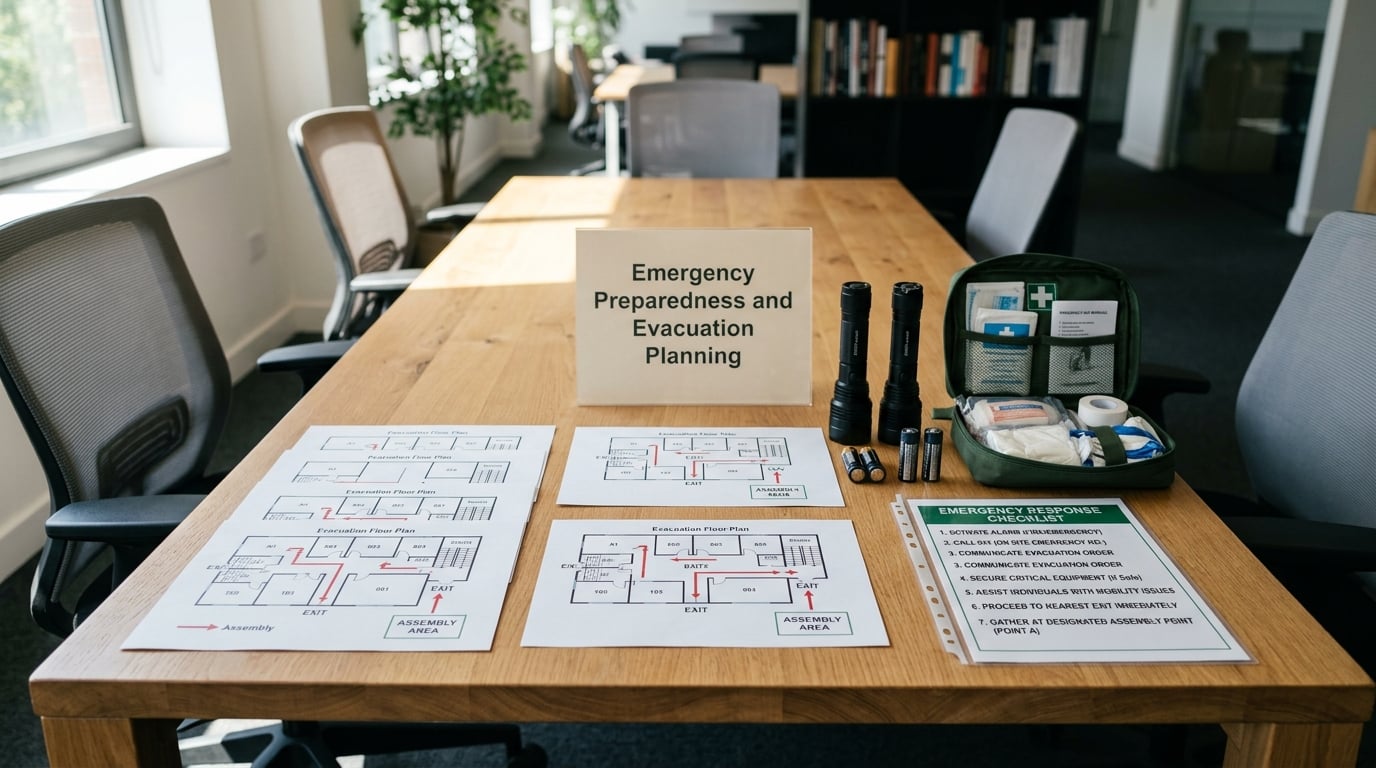
Most sites can recite a fire alarm drill. Far fewer can say who calls emergency services, who sweeps the toilets, or where the assembly point sits relative to the car park. That gap is the whole point of this meeting.
Cover the evacuation routes from your actual floor, the assembly point, the muster board and who keeps it, and how someone who uses a wheelchair or has limited hearing gets out. Ask workers to point to the nearest exit from where they are sitting right now, not from the one they happen to be closest to.
A tabletop scenario works better than a lecture. Give the group a scenario such as a chemical spill in the storage area with one exit blocked, and give them four minutes to decide who does what. Then ask one question: what would we change next month? Write the answer down with a name against it.
Post-incident reviews often turn up that the alarm was not heard over running machinery. That is a topic you can confirm in five minutes of asking workers directly.
2. Near-Miss Reporting and Prevention
A near miss is any event that could have caused harm but did not. It is the cheapest, fastest, most useful piece of data your site collects, and it is the one people report least.
Explain how the reporting process actually works: where the form or app lives, who reads it, and how long it takes. Then show a realistic example. A pallet stacked four high in an aisle that nobody hit is a perfect teaching case because it costs nothing and it was nearly an amputation.
The point people miss is what happens after the report. If near misses go into a box and nothing changes, the message is that reporting is pointless. Bring one closed report to the meeting and describe the corrective action and who did it.
Discussion question for this topic: what is the most recent near miss you saw, and why did nobody report it?
3. Slips, Trips, and Fall Prevention
Slips, trips and falls stay on a monthly rotation because the causes are boring and repeat themselves: a mop left up, a cable run across a walkway, a light out in a stairwell, a pallet in an egress route.
Work through housekeeping, wet floor signage, lighting levels, footwear, stair handrails, ladder condition, and any walkway that gets obstructed during deliveries. Where your floors are polished or wet regularly, ask whether the signage is high-visibility or just a plastic A-frame someone forgot to put out.
The activity that works is a walk. Give the group ten minutes to walk their own area and each person names one hazard they saw. Collect the list, photograph it, and hand the photos back to the responsible person before the next meeting.
Some sites cover their department’s work as roughly twelve broad subjects rather than monthly fragments, with walking and pedestrian routes as one of them. That is the right instinct for a hazard that never goes away, because a topic that comes round once a year gets a fuller run than one that gets a twenty-minute slot every month.
4. Manual Handling and Ergonomics
Manual handling injuries rarely happen on the lift that was done badly. They happen on the twentieth repetition of a lift that was never set up properly, or on a bench that is too high for the person using it.
Cover the load test, a stable stance, keeping the load close, bending at the knees rather than the waist, and the real reason to get help, which is that you cannot see past a heavy box. Then move to workstations: chair height, screen distance, foot support, and where the elbows actually sit.
Demonstrate rather than describe. Have two people lift the same awkward object, one with the technique and one without, and let the room notice the difference. Keep the demonstration age-appropriate to your workforce and never turn it into a fitness test.
Ask for early warning signs: aching shoulders that last overnight, numbness in the hands, a headache that starts mid-shift and clears at the weekend. Those are the reasons to get a workstation assessment before something is diagnosed.
5. Chemical and Hazardous Materials Safety
Most sites use more chemicals than anyone has formally assessed. The ones that cause trouble are the everyday ones in a cupboard nobody owns, the cleaning products, the degreasers, the aerosols, the solvents in the maintenance shop.
Cover what a label means, how to find the safety data sheet for a product, what storage segregation looks like, when ventilation matters, which personal protective equipment matches which task, how to deal with a spill, and how disposal works. The gap is rarely knowledge, it is access to the data sheet at the moment of use.
A scavenger hunt works well. Print a handful of product names from your own inventory and have the team find the matching safety data sheet and correct glove type for each one. Five minutes of this teaches more than fifteen minutes of slides.
Ask whether anyone has ever poured a product into an unlabelled bottle, and get the answer. The fix is usually a labelling station and a rule, not a lecture.
6. Fire Safety and Hot-Work Controls
Fire safety meetings go wrong when they blur two different decisions: when to get out and when to stay and fight. Say both plainly. When the alarm sounds, the alarm sounds, you leave. If a fire is small and you are trained and you have an exit behind you, you may use an extinguisher, and the fire department still comes.
Cover what an extinguisher needs to be useful, which class of fire it handles, and the physical check that costs nothing: the pin, the seal, the gauge, the weight. Hot work is the higher-consequence topic, so walk through permit requirements, fire watch duration, gas cylinder storage, and guarding of nearby combustibles.
Ask the group to name the nearest exit from their current seat and what has blocked exits on this site in the last year. Blocked exits are found constantly and they are always something ordinary, like a delivery pallet or a bike rack.
7. Workplace Violence and De-escalation
This topic sits awkwardly at a construction all-hands and works well in retail, healthcare, transport, offices with a public front desk, and any team that deals with the public. Adapt the framing to your site rather than skipping it.
Cover the warning signs that precede aggression, which are usually small and early: tone changes, refusal to follow a process, crowding, silence after a correction. Explain the reporting route and the difference between reporting a behaviour and escalating a threat.
De-escalation basics are learnable: keep distance, keep your hands visible, lower your own voice, do not argue, and give the person an exit from the conversation. Call emergency services when danger is immediate, and make sure the team knows that is not a failure to handle it themselves.
A two-minute role-play works better than any slide. Two volunteers, one escalating, one de-escalating, and the room says what the second person did well. Keep the scenario workplace-real, not dramatic.
8. Mental Health and Psychological Safety
Psychosocial hazards are real hazards and they belong in the same rotation as the physical ones. So do stress, burnout, bullying, harassment, and the pressure to work while unwell or exhausted.
Keep this one general and direct. Talk about what stress does to attention and decision-making, why it is a safety issue rather than a personality issue, and what the organisation actually provides, whether that is an employee assistance program, a named person, or a confidential route for reporting bullying.
The tone matters more than the content. A meeting that turns into a therapy session puts people on the spot, and a meeting that says mental health does not matter here is worse. Aim for a level, informational tone and point anything personal to the right resource afterwards.
An anonymous question box works here and nowhere else as well. Read the questions out, answer what you can, and take the rest to the people who can answer them privately. Report back next month on what you did with them.
9. Personal Protective Equipment and Clothing
Personal protective equipment is the last line of defence and the most visible, which makes it a good monthly topic. The recurring problems are wrong gear for the task, gear that no longer fits, gear that has been through the wash too many times, and gear stored nowhere near the work.
Cover selection, fit, inspection before use, cleaning, storage, and replacement. Walk through eye, hand, foot, hearing, and respiratory protection in general terms and point to your own written procedure for the specifics.
Have people bring their gear. A pair of boots with a separated sole and a glove with a pinhole are far more persuasive than a photograph of a hazard control on a wall chart, and the owner usually spots it before you do.
One question worth asking: when was the last time you were issued something that did not fit, and did you say so at the time?
10. Vehicle, Driving, and Parking Safety
Any workplace with a yard, a loading area, delivery vehicles, or staff who drive between sites is a workplace where a pedestrian and a reversing truck are a serious combination. Parking lots have some of the highest-consequence near misses in any industry and almost no fatalities.
Cover seat belts, distraction including phone use, following distance, and what a pre-trip vehicle check should cover. Then move to site-specific driving: the company speed limit, who has permission to move a vehicle, reversing cameras and their blind spots, and where pedestrians are supposed to walk.
The activity that shifts behaviour fastest is walking the yard. Physically walk the route a delivery driver takes at 5 a.m. and a worker takes at lunch, and mark where the two paths cross. People are surprised every time by how much of the yard has no marked route at all.
Also cover delivery and loading hazards: securing loads, dock levellers, tail lifts, and why a driver should not be left to guess where to stop.
11. Contractor and Temporary-Worker Safety
Temporary and contracted workers are where your safety system most often fails quietly, because they are not on your payroll, they are not in your toolbox talk, and they are working on your site while carrying somebody else’s procedure in their head.
Cover orientation before the first task, hazard communication, who supervises them, badge and access control, incident reporting, and the expectation that anyone on site can stop work when something looks unsafe. Make the stop-work expectation explicit, because a subcontractor who does not know they can call a stop is not going to call one.
Ask for the gaps rather than the policy. Where does a new temp get their first briefing? Who confirms they had one? What happens when two firms are working in the same space with different rules? The answers are usually more honest in a small group than in an audit.
Discussion question: how would a brand new agency worker find out what they are not allowed to do on this site?
12. Incident Reporting and Investigation
People confuse four different things and it matters: an incident, an injury, a hazard, and a near miss. Each has a different reporting path, and mixing them up is why genuine reports disappear into a pile of observations.
Define them in plain words. An incident is an unplanned event that caused or could have caused harm. An injury needs the medical record and, in the United States, may need to be entered on the OSHA 300 log under 29 CFR 1904. A hazard is a condition with no event attached. A near miss is an event with no harm attached.
Cover what must be reported, how quickly it must be reported, and who is legally responsible for making the entry. In the United States, the employer, not the supervisor, carries the recordkeeping duty, and the 1904 rules set the time limits and the exemptions. Know your state plan, because several states run their own.
Close on how investigations are shared without blame. The point of an investigation is the cause, not the person who caused it. If people believe a report ends their career, reporting rates fall and injuries rise instead.
13. Equipment and Machinery Safety
Machine topics go wrong when they drift into step-by-step operating instructions nobody should be learning in a meeting room. Keep it general and send people to the manufacturer’s manual and your own procedure for the specifics.
Cover pre-use inspections and who is authorised to operate, guarding and interlocks, energy control and the awareness level every worker needs of lockout or tagout even if they never perform it, maintenance scheduling, and how a defective machine is taken out of service.
Pick one machine the team actually uses and do its pre-use inspection together, out loud. The disagreement is always interesting, usually about a frayed cord, a cracked mirror, or a guard that came off for a job years ago and never went back.
Ask what the sign-out procedure is for a broken machine and who has the authority to authorise a repair. Half the risk sits in that handover.
14. Remote, Hybrid, and Home-Office Safety
Office and hybrid staff are usually the group with the least safety contact and the most hours at a desk. A monthly meeting for them should be short, practical, and led by someone they recognise rather than delivered by a contractor.
Cover ergonomic setup, screen breaks, electrical safety with extension leads and daisy chains, cable routing across walkways, kitchen and shared-space hazards, and the ergonomics of the loaner laptop that has sat on a dining table for eight months.
For hybrid and travelling staff, add device and data security handled as a safety-adjacent topic, road travel and fatigue, and the expectation that the incident reporting duty does not switch off when someone is at home. A strain at home is still worth reporting, and it may be the only place the cause is visible.
The checklist worth handing out: chair height, feet supported, screen at arm’s length, one hand on the mouse, lighting not behind the screen, no overloaded power strips, a clear route to the door, and a five-minute stretch every hour. It is a short list and people act on it.
15. Safety Culture and Employee Participation
The last topic in a rotation is the one that decides whether the other fourteen mattered. Safety culture is not a poster on a wall, it is the observable answer to one question: when something goes slightly wrong here, what happens to the person who speaks up?
Measure it rather than assume it. Ask how comfortable people feel raising a concern, ask what happened to the last report they filed, and ask whether anyone has been told to speed up after a stop. You do not need a survey platform, you need three honest questions and someone willing to take the answers.
Review the actions from the previous cycle out loud: what was closed, what is still open, and why. Nothing damages a meeting faster than a list of actions nobody has seen again, because it teaches people that the meeting produces paperwork rather than change.
Then set one measurable improvement for the next month, assign an owner, and set the date. Running the meeting on the same fixed date each month makes it predictable enough that people plan around it rather than hoping it gets cancelled.
Frequently Asked Questions
How long should a monthly safety meeting be?
Thirty to sixty minutes is the useful range for a monthly all-team meeting. Shorter than ten and it becomes a notice, longer than an hour and attendance falls. A workable structure is five minutes opening on last month’s actions and any incidents, fifteen to thirty minutes on the topic, ten minutes of open discussion, and five minutes to agree actions with owners and dates. For site crews who cannot leave their work area, a five-minute safety moment delivered at the workface works better than a long meeting nobody attends.
How do I stop safety meetings turning into a sign-the-sheet exercise?
Move the sign-in sheet to the end and make the meeting about something real. Bring a photograph of a hazard from your own site last week, bring a near miss that was reported, and ask the team what they would change. Let a seasoned worker deliver part of it rather than only the safety officer. Ask people to write one question and answer the ones you can. If the same topic is delivered the same way for a year, people stop listening, so rotate the format as well as the subject.
What should be documented at a monthly safety meeting?
Record the date and time, the topic covered, who attended, who led the session, any hazards or near misses raised, every action item with a named owner and a due date, and what was carried over from the previous meeting. Keep the record for at least the period your jurisdiction requires. In the United States, OSHA recordkeeping under 29 CFR 1904 sets the rules for the injury log and the annual summary, and several states operate their own approved plans with different requirements.
What are good safety meeting topics for an office or remote team?
Office topics that get taken seriously: desk ergonomics and screen setup, electrical safety with extension leads and overloaded power strips, slips and falls in shared walkways and stairwells, fire evacuation routes and assembly points, manual handling of files and equipment, incident and near-miss reporting, lone and hybrid working, emergency contacts, and psychosocial topics such as workload and burnout. The remote variant adds home electrical safety, screen and chair setup, and road travel between sites.
Who should lead a monthly safety meeting?
The leader depends on the topic. Your safety officer sets the standard, sets the structure and handles the legal and recordkeeping side, but a foreman, team lead, or experienced worker usually delivers better than an outsider, because the group trusts them and knows the work. A workable pattern is a safety professional setting the frame for ten minutes and a worker leading the twenty-minute discussion on the task in front of them. Rotate the delivery across the year so the burden does not sit with one person.
What safety meeting topics are worth adding this year?
Four topics have grown quickly: automation and robot safety, including who is authorised to reset a cell and what happens on a safe stop; extreme heat and the heat index thresholds your site triggers on, plus acclimatisation for new starters; lone worker monitoring and check-in systems for remote sites and vehicles; and contractor, agency and gig worker safety across the same site with different employers. Two quieter ones are worth adding too, automated hazard reporting systems and the safety of battery energy storage and charging areas.
Conclusion
Start with whatever is unresolved. Open the last two incident reports, read out the action that never got closed, and make that the topic for the next monthly safety meeting you run.
Give it one owner and one due date, put the discussion question from the relevant section above into the agenda, and record the attendance the same day. Then set the date for the meeting after that, on the calendar, where everyone can see it.