

To build a safety culture at work, leaders show up and model safe work, expectations are written down, reporting a hazard or near miss is easy and never punished, employees help find and fix problems, and progress is tracked with leading indicators. The difference between an organisation that says it values safety and one that actually has a safety culture is repetition, not a launch event.
Most employers do not have a knowledge problem. People already know to wear the harness, isolate the machine, lift with their legs. The problem is that the unwritten rules of a workplace say something different, and the unwritten rules always win.
The steps below take three to six months to put in place, but a genuine shift usually takes two to three years of consistent follow-through. Most of the effort sits with supervisors and managers, not with the safety department. If you only have an hour a week to give this, spend it walking the floor and talking to the people doing the work.
Table of Contents
- What You Need
- Step-by-Step: How to Build a Safety Culture at Work
- 1. Set a clear safety purpose and expectations
- 2. Get visible leadership commitment
- 3. Make it safe and easy to report concerns
- 4. Involve employees in finding and fixing hazards
- 5. Provide practical training and reinforcement
- 6. Learn from incidents, near misses, and unsafe conditions
- 7. Measure culture and improve it over time
- Common Mistakes
- Frequently Asked Questions
- How long does it take to build a safety culture at work?
- What is the difference between safety culture and safety climate?
- How do you measure safety culture at work?
- What is a just culture, and how do you build one?
- How do you build a safety culture when leadership does not support it?
- What are the four C’s of safety culture?
- Conclusion
What You Need
Safety culture fails when it is launched as a campaign and left to run on posters and annual training. Before you start, line up six things. Missing any one of them tends to be the reason the effort stalls in month three.
- Leadership time, not leadership slogans. Named senior leaders who will spend real hours on site, walk areas, and answer reports personally. A few hours a month, protected in a diary, beats a launch speech every year.
- Employee participation. People who work in the area, not just safety staff. You need frontline workers, contractors, and shift leads who can point out what actually goes wrong.
- A reporting process. More than one route in, a named owner, a response time, and a way to tell reporters what happened. Paper, phone, and a mobile or desktop form all help, since people use different ones on different shifts.
- Training resources. Role-specific material, a room or a device, and time for people to attend. Generic modules that everyone watches on their own do very little.
- Records. A way to keep reports, investigations, actions, and closures in one place so patterns are visible rather than lost in a shared inbox.
- Measurement tools. A short set of agreed indicators, a monthly review slot, and a baseline. Without a starting number you cannot tell whether the work moved anything.
You do not need a large budget for any of this. The scarce resource is consistent attention, and attention is something only leaders can give. That is the part most advice on how to build a safety culture at work gets wrong by promising a toolkit instead.
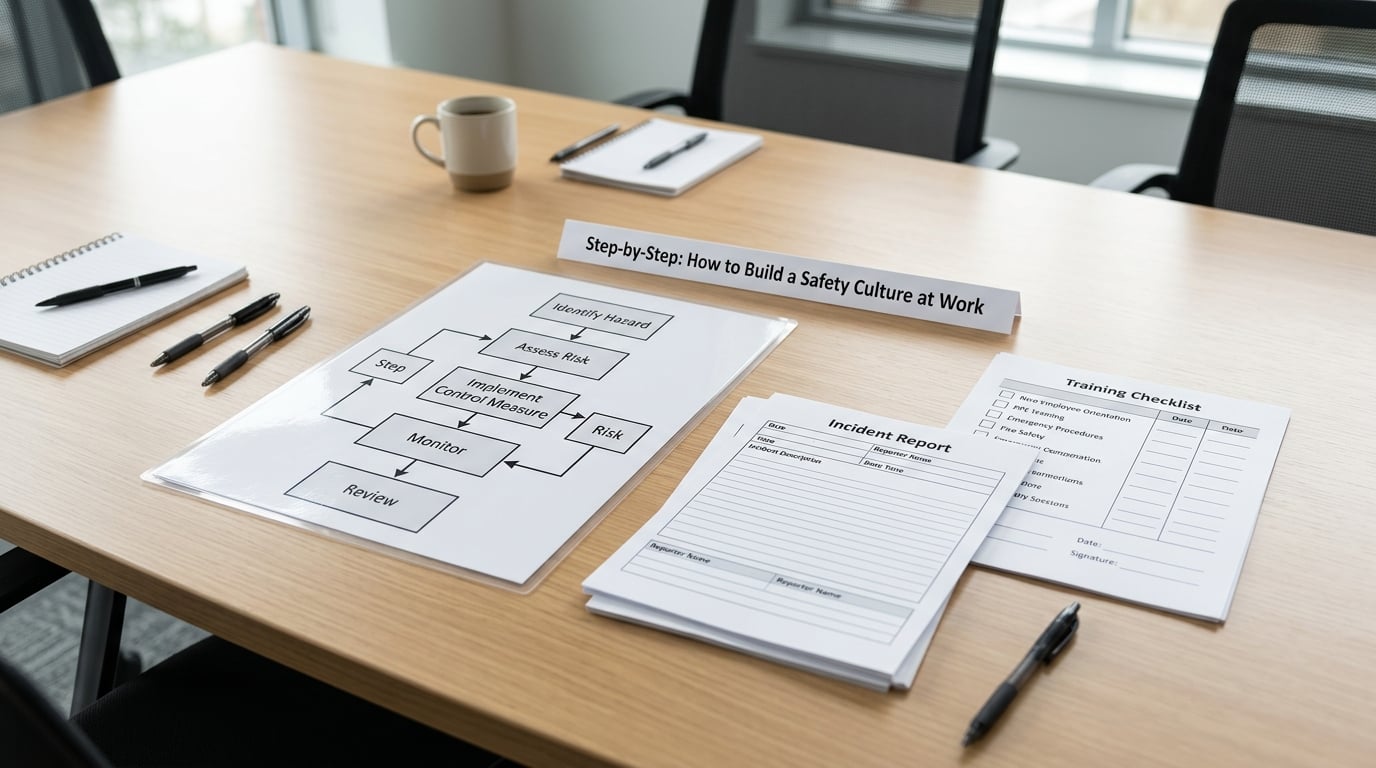
Step-by-Step: How to Build a Safety Culture at Work
Culture is built out of repeated actions, not statements. Work through the seven steps below in order, and give each one enough repetitions that people start to expect it before you move to the next.
1. Set a clear safety purpose and expectations
Start by writing down what you mean by safety, in plain language, in a page that anyone in the company could read in two minutes. “Everyone goes home safe” is a slogan. “Nobody overrides a machine interlock, and anyone can stop a job they believe is unsafe without needing permission” is an expectation.
Then connect it to something people already care about. People tend to protect what matters to them, so link safe work to the crew, the customer, the schedule, and the reputation of the team. Spell out who is responsible for what: leaders walk and respond, supervisors coach on shift, employees report and stop work, and the safety team supports rather than polices.
You will know this step worked when a new starter can say, after their first week, what is expected of them and who to ask. Test it by asking two or three people rather than reading the policy yourself.
2. Get visible leadership commitment
Leaders set the standard everyone else copies. If a manager walks past a blocked fire exit or hurries a forklift past a pedestrian, the written policy quietly stops existing, and no amount of training will fix that.
Make leadership visible in ways that cost time rather than money. Walk the site or the floor three or four times a week, talk to crews without a clipboard in hand, look at housekeeping, and ask what nearly went wrong this week. Practitioners on r/SafetyProfessionals describe exactly this as the difference between a site that improves and one that does not, and they are blunt about the failure mode: supervisors and managers who model unsafe behaviour while demanding compliance from the crew.
Leaders also have to respond well in public to bad news. The first time someone reports a serious near miss, the room is watching how you handle it. Thank the person, name the fix, and follow up where people can see it. If a report disappears into a folder with no response, the reporting system dies quietly, and it takes far longer to restart than it does to keep alive.
You will know this step worked when employees can name a leader who has been on their floor recently, and when a worker who stopped a job was thanked rather than questioned about why the job was unsafe.
3. Make it safe and easy to report concerns
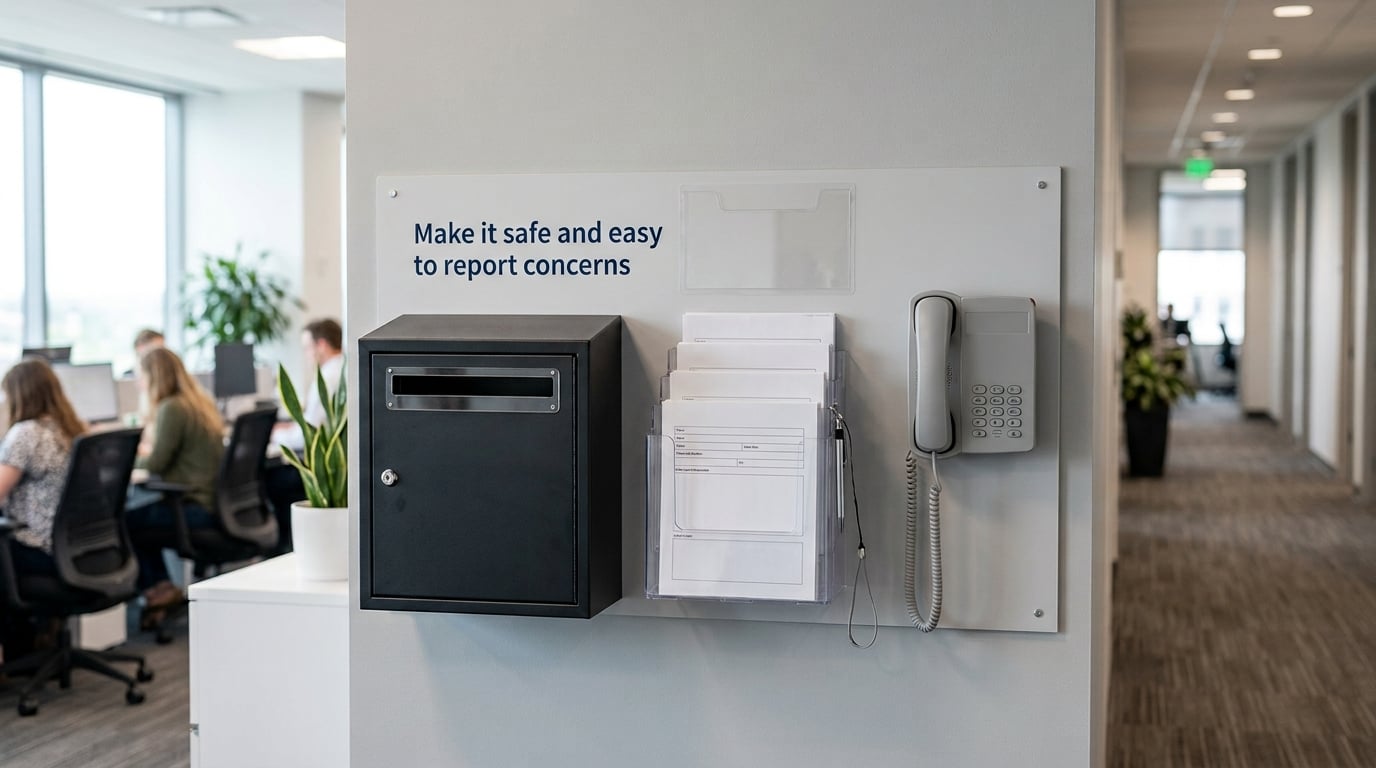
Most organisations have a reporting form. Far fewer have a reporting culture, and the difference shows up in the volume and honesty of what comes in. Offer several routes: an app or web form, a phone number, a physical drop box for sites where people do not carry devices, and a named safety contact. Then tell people, in writing, what happens after they report.
Say how quickly someone will respond, who reads the report, and how the person who reported it will hear back. Closing the loop is the single most useful thing you can do here, because unanswered reports teach people that reporting is pointless. Aim to acknowledge within one working day and give a real update within a fortnight, even when the honest answer is that nothing has changed yet.
Protect anyone who raises a concern in good faith. This is where a just culture earns its keep. Reason’s model is useful and simple: separate human error, which needs a supportive conversation and better tools; at-risk behaviour, where a shortcut looked reasonable in the moment and needs coaching and better design; and reckless behaviour, which is a choice made with full knowledge of the harm and does need accountability. Treating all three the same is how you get silence.
You will know this step worked when the report volume rises in the first two months, which is a good sign rather than a bad one. It means people have started trusting the system. A sudden drop in reports after a bad outcome, by contrast, usually means people have decided not to bother.
4. Involve employees in finding and fixing hazards
Your crew knows where the near misses are. They know which shortcut gets used at 2am, which machine behaves oddly when warm, and which customer site always needs a second conversation. Capture that knowledge with a safety committee that meets monthly, frontline inspections on a set rotation, and short hazard reviews before work starts on a job or a shift.
Give the committee real authority, not a guest seat. Let it stop a task, spend a small budget on a fix, and require a written response when a raised hazard is not actioned. If members can only raise concerns, they will raise them once and then stop.
Psychological safety is the mechanism that makes this work. People take personal risk when they speak up in front of peers, and that risk is low only when being wrong is cheap. A first-time manager on r/SafetyProfessionals described the move that worked best as simple and unglamorous: talk with the crew, teach them, and learn their names. Culture follows those relationships far more reliably than it follows inspection checklists.
You will know this step worked when a fix someone proposed in a committee meeting is visible in the area within a month, and the person who proposed it can see that it happened.
5. Provide practical training and reinforcement
Training works when it matches the task, happens on the equipment, and is repeated after a change. Someone trained on a machine last year, before the guarding was modified, is not trained now. Build your programme around role-specific competence: task demonstrations, refresher sessions after equipment or process changes, and a short toolbox talk on one topic before each shift or each job.
Keep sessions short and practical. A twenty-minute conversation on a specific hazard beats an hour of slides on a generic topic, and people retain far more of what they have done than what they have watched.
Training alone will not change behaviour, which is a recurring frustration on practitioner forums, where the common complaint is that safety roles get pulled into producing numbers and paperwork rather than changing how work is done. The work that changes behaviour happens on shift: supervisors watching a task, correcting gently, and reinforcing the same standard the same way every week. Train the supervisors first, because they set the standard that the training is trying to teach. On a tight budget, that single hour is the highest-return time you will spend figuring out how to build a safety culture at work.
You will know this step worked when an experienced worker can demonstrate a task to a new starter using the same method the supervisor would recognise.
6. Learn from incidents, near misses, and unsafe conditions
Incidents are the most expensive teacher you own. The cheapest lessons come from what nearly happened, which is why near-miss reporting should be treated as valuable information rather than as an admission of failure. Heinrich’s triangle, and Bird’s later refinement of the ratio, are the usual way to frame the idea that many more things go wrong than ever cause harm.
Run investigations that ask why several times, and look at conditions rather than people. When a task fails, the useful questions are about the tool, the layout, the staffing, the procedure, the time allowed, and the training, not about who was careless. A report that ends in a retraining assignment for one person has fixed one person and left the system intact.
Then share what you learned. A short message that says what happened, what changed, and who decided it demonstrates to everyone else that reports lead to action. Recognise the reporting behaviour specifically and by name, not just the outcome, because a specific thank-you feels credible and a generic award does not.
You will know this step worked when a second report of a similar hazard arrives and you can point to the corrective action taken the first time.
7. Measure culture and improve it over time
Measure what happens before someone gets hurt, because injury counts are lagging indicators and they tell you about the past only once the harm is done. Useful leading indicators include the number of reports, the time to acknowledge and close them, the percentage of corrective actions closed on time, participation in inspections and committees, the rate of overdue actions, and short periodic safety climate survey responses on whether people believe reporting is safe.
Keep your lagging indicators too. Recordable incident rates, days lost, and severity are how you compare against industry benchmarks and how regulators and insurers read the file. Just do not let them be the only numbers in the room, and do not celebrate injury-free periods. Tying recognition to a streak of zero injuries quietly rewards underreporting, which is the exact behaviour you spent the last six months trying to stop.
Review the numbers monthly with the leadership team, look for trends rather than single months, and bring a safety climate survey back at six and twelve months so you can show movement. The Hudson and Parker maturity model, and the Bradley Curve built on it, are useful for describing where an organisation sits and what it needs next:
- Pathological. Safety is treated as a paperwork problem and people are blamed after incidents. It needs leadership ownership and a reporting system people trust.
- Reactive. Effort spikes after an incident and fades between events. It needs regular scheduled activity that does not depend on an alarm.
- Calculative. Systems, procedures, and audits are in place and followed. It needs employee involvement, because systems alone miss local reality.
- Proactive. People anticipate hazards and report near misses before harm occurs. It needs recognition and feedback loops that keep the behaviour reinforced.
- Generative. Safety is how the organisation runs, and it is sought out as an advantage. Nothing to fix, apart from watching for drift as the workforce changes.
You will know this step worked when your indicator set shows reports going up, closure time going down, and survey scores on fair treatment improving, while injuries trend down over the following year.
Common Mistakes
Most failed safety culture efforts fail in recognisable ways. Here are the ones practitioners describe most often, and what to do instead.
- Treating culture as messaging. Posters, slogans, and badge campaigns change nothing on their own. Fix: give the same amount of calendar time to visible leader presence, on the floor, as you give to the launch event.
- Blaming the person who reported or made the mistake. One punished report teaches an entire workforce not to report again. Fix: sort each case into error, at-risk behaviour, or recklessness, and respond to the first two with support and system changes.
- Ignoring reports once they are in. A report with no response is worse than no report, because it teaches people the system is theatre. Fix: set an acknowledgement target of one working day and an update target of two weeks, and hold the owner to it.
- Running training once and moving on. A certificate nobody has used does not change a task. Fix: demonstrate the task, observe it, and repeat it after any change to the equipment, the process, or the crew.
- Measuring only injuries. Zero recordables can mean a good year or a year nobody reported. Fix: pair every lagging number with three or four leading indicators, including report volume and closure time.
- Leaders behaving one way and expecting another. This is the complaint that comes up most often in safety forums, and it is the one that cannot be trained away. Fix: a personal commitment from each leader to a handful of visible habits, reviewed by their peers rather than by the safety team.
- Rewarding injury-free days. Streak bonuses create pressure to hide small hurts and to rush minor injury reporting. Fix: recognise reporting, near-miss catching, and improvement work instead, which is also far harder to fake.
- Letting turnover erase everything. A crew that turns over a third of its people each year loses habits faster than training replaces them. Fix: build onboarding that puts a new starter in front of an experienced worker early, and treat that as part of the safety programme rather than as HR onboarding.
One more situation deserves its own note: what to do when senior leaders and the general manager simply will not enforce the standard. This is not a rare edge case, and it is the frustration that shows up most often in practitioner discussions. You cannot fix the culture from the bottom alone, and pretending otherwise burns people out. What you can do is document patterns in writing, keep reporting through the channels that do work, bring your own indicators rather than waiting for leadership to choose them, and lead with the people in your own span of influence, where your authority is real. Change one supervisor’s behaviour in one area, show the result, and let it travel. Professionals who try to force a top-down reversal usually end up labelled as difficult and replaced.
Frequently Asked Questions
How long does it take to build a safety culture at work?
Expect the systems to be in place in three to six months and a genuine shift in two to three years. Culture changes at the speed of repeated behaviour, so the signal to watch is not a launch date but whether leaders still walk the floor, still answer reports, and still coach on shift a year later. Organisations that rush the first stage and then stop tend to see the whole effort lose credibility by month twelve.
What is the difference between safety culture and safety climate?
Safety culture is the deep set of values, beliefs, and assumptions underneath how an organisation thinks about risk. Safety climate is what people perceive and report at a given moment, usually measured by survey. Culture is slow to change and hard to observe; climate is visible, measurable, and changes faster. A rising climate score is often the earliest evidence that a culture effort is working.
How do you measure safety culture at work?
Combine three kinds of evidence: leading indicators such as report volume, time to close reports, overdue corrective actions, inspection participation, and safety climate survey scores; lagging indicators such as recordable rates, days lost, and severity; and observation-based measures of critical behaviours on the job. Run the review monthly, repeat the survey at six and twelve months, and avoid setting targets on report volume, which suppresses honest reporting.
What is a just culture, and how do you build one?
A just culture separates human error, at-risk behaviour, and reckless behaviour, and responds to each differently. Error gets support and better tools, at-risk behaviour gets coaching and removal of the incentive that made the shortcut look sensible, and recklessness gets accountability. You build one by publishing that framework, applying it consistently in public, and protecting good-faith reporters so the volume and honesty of reporting can rise.
How do you build a safety culture when leadership does not support it?
Focus on your own span of control and build proof rather than argument. Document patterns in writing, keep reporting through whichever channels still work, bring your own indicators so results do not depend on leadership choosing them, and coach the supervisors you do control consistently for six months. Leadership change, pressure, or a visible incident often moves faster than persuasion, so keep the evidence trail ready for when it does.
What are the four C’s of safety culture?
The four C’s are commonly used as a quick self-check: competence, that people are trained and capable; commitment, from leaders and the organisation as a whole; communication, so information flows both ways; and compliance, meaning procedures are followed rather than worked around. Weak compliance with strong competence and commitment is usually a sign the procedure is wrong, not the people.
Conclusion
If you do only five things this month, do these. Get a named senior leader to walk the floor on a fixed schedule and respond personally to what they hear. Write down your expectations in plain language, including who owns what. Put an easy reporting route in place and tell people what happens after they use it. Start a safety committee with real authority and a real budget. Then pick three leading indicators and a short safety climate survey, and review them monthly.
That is how to build a safety culture at work in practice: not through a launch, but through a set of behaviours that leaders repeat until the crew copies them without being asked. The crews who get there are rarely the ones with the largest safety budget. They are the ones where people report hazards early, get a response, and see the fix.