

If you are asking what to do after a workplace injury, the short version is this: stop any ongoing danger, get medical help, report the incident to your employer in writing today, write down what happened while you still remember it clearly, and do not resign while you are injured. The first week shapes how the rest of the process goes, and most of the work is done in that week rather than months later.
Most of this article applies to any job, in any state, whether you are an hourly employee, a salaried staff member, a supervisor, or a contractor working on site. Rules differ by employer and by jurisdiction, and medical and legal decisions belong with qualified professionals. What follows is general information and a practical action plan, not medical or legal advice.
If you are injured right now and in pain, skip to the first step below. If you are reading this days later, the same order still works, because reporting and documentation hold up far better than assumptions about what will be believed.
Table of Contents
- What You Need
- Step-by-Step: What to Do After a Workplace Injury
- Step 1: Make the Immediate Area Safe
- Step 2: Get Appropriate Medical Attention
- Step 3: Record the Incident While Details Are Fresh
- Step 4: Complete the Employer’s Reporting Process
- Step 5: Preserve Evidence and Protect Confidentiality
- Step 6: Notify the Right People and Ask About Benefits
- Step 7: Follow a Clinician-Led Recovery Plan
- Step 8: Plan a Safe Return to Work
- Step 9: Review the Incident and Prevent Recurrence
- Common Mistakes
- Frequently Asked Questions
- Should I go to the emergency room after a workplace injury?
- Do I still need to report an injury if I go home and feel okay?
- Can my employer require me to see a doctor for a workplace injury?
- What should I do if I need to miss work after an injury?
- Should I share my medical records with my employer?
- What if workplace symptoms return after I return to work?
- Conclusion: Start with Safety and Documentation
What You Need
You do not need to assemble a perfect file before helping someone. Emergency care never waits for paperwork, and getting to a clinician matters more than having the right form. Having a few things ready simply makes the rest faster.
- Contact names. Your supervisor, the HR or people operations contact, the safety officer, occupational health, and the workers’ compensation administrator or claims line. Save numbers in your phone before you need them.
- The employer’s procedures. Most organizations publish a return-to-work or injury reporting policy, and larger ones often have a workers’ compensation administrator named in it.
- Your employment documents. Offer letter, job description with essential functions, recent pay statements, and any prior work status notes. Job protection questions usually come down to what your role actually requires.
- A way to write things down. A notes app is fine. Include dates, times and who you spoke with.
- Photo capability. Useful for the scene, the equipment involved, and visible injuries. Avoid photographing other people’s bodies or medical details.
- A copy of your medical records. Ask for them at your first appointment. People often assume they are already in the file, and they are not always.
One thing not to gather: a pile of medical information you did not ask to receive. You can read your own claim file, but collecting other people’s records is a privacy problem and rarely helpful.
Step-by-Step: What to Do After a Workplace Injury
Step 1: Make the Immediate Area Safe
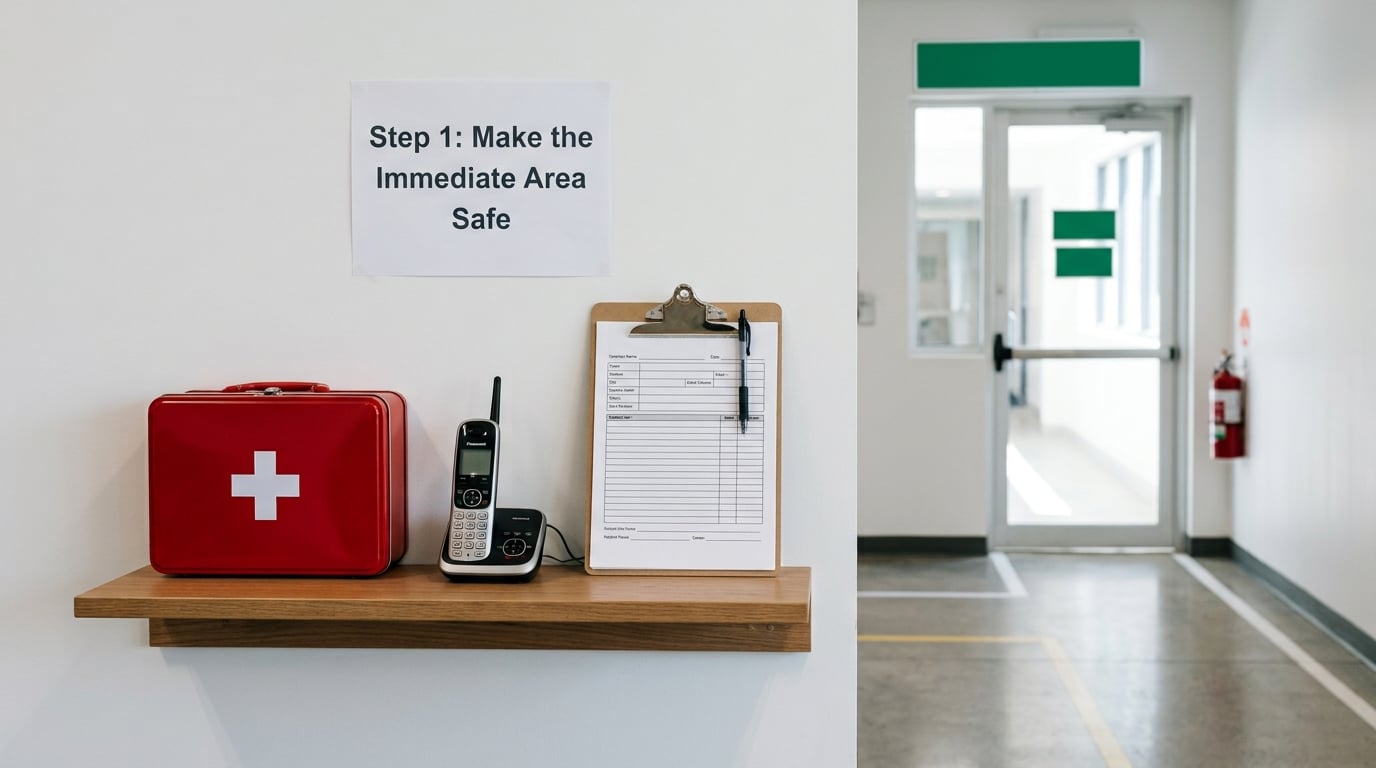
The first job is to stop whatever is still causing harm, for you and for the people around you. Shut down the machine, isolate the spill, cut the power, block the stairwell, or move the load that is about to fall. You do not need to repair anything or diagnose the fault.
Then decide whether to call emergency services. Call for help when there is heavy bleeding that will not stop, chest pain, trouble breathing, loss of consciousness, a suspected head, neck or back injury, a limb that is clearly deformed, signs of a stroke, or a chemical or electrical exposure. When you are unsure, calling is not the wrong move. The dispatcher will tell you what to do while you wait.
Move the person only if staying where they are is more dangerous than moving them, and only if you are not going to make the injury worse. Preserve the scene by leaving equipment in place and taking wide photographs from several angles, but do not touch anything that could be evidence.
Keep the first response about safety, not blame. Who caused what can be worked out later by people qualified to do it. Questions of fault in a workplace injury are usually settled in a no-fault system, where benefits follow the injury rather than a finding of negligence.
Step 2: Get Appropriate Medical Attention
Get evaluated rather than deciding in the moment that something is fine. Stiffness, mild swelling, and soreness that night can look completely different the following morning, and early assessment gives you options that delayed care does not.
Emergency evaluation is for the warning signs listed in Step 1. Prompt evaluation within a day or two suits less urgent musculoskeletal injuries, and a same-day call to a clinic or urgent care is reasonable when symptoms are mild but clearly work-related. Delayed-onset symptoms, including back strain, joint problems, repetitive-motion conditions, and symptoms after a single incident, are common enough that clinicians see them routinely.
If the employer directs you to a specific provider, follow the process and keep a record of the appointment date, the provider, and what you were told. If you cannot reach a provider, document that too, with dates and times. A long gap between the injury and the first appointment is one of the most common sources of frustration later, and a written record of your attempts is worth having.
This article does not diagnose anything or recommend treatment. Any decision about medication, therapy, imaging, or surgery belongs with a qualified healthcare professional who can examine you.
Step 3: Record the Incident While Details Are Fresh
Write your own account the same day, while it is still accurate, and keep it out of the employer’s system so you have your own copy. A simple timeline beats a polished story.
Include the date, time, and location; the task you were doing and the step you were on; the equipment, tool, machine, or substance involved; the names of anyone who saw it; what you felt first and where; who you told and when; what help or first aid you received; and any photos you took.
Separate what you remember from what you are guessing. If you do not know why the guard was off the saw, write that you do not know. Speculating about causes, even in your private notes, is something that can be read back to you later.
Some people keep a symptom diary as their symptoms change: what hurts, when it is worse, what makes it better, and how it affects sleep, stairs, or lifting. It is short, boring work, and it is exactly what helps a clinician or reviewer understand the pattern weeks later.
Step 4: Complete the Employer’s Reporting Process
Verbal notice to a supervisor is rarely enough on its own. Send a short written notice the same day, by email so there is a timestamp, to your supervisor and to HR or the person named in the injury reporting policy.
Something along these lines works:
Subject: Work injury report, [date]
On [date] at about [time], I sustained [injury] while [task you were performing] at [location], using [equipment]. I reported it to [name] at [time] and received [first aid or none]. I have sought medical care at [provider] and I will keep you updated. Please let me know which incident report form and return-to-work process I should use.
Then complete whatever the employer asks for, such as a first report of injury form, and keep a copy. Your employer also has recordkeeping duties of its own, including internal logs and, for injuries that meet certain criteria, an OSHA injury log. If a form asks you to name a cause, describe the task and what happened rather than assigning blame.
Reporting deadlines vary by employer and by state, and some states treat late notice differently from late filing. This is one of the strongest reasons to send the written notice the same day rather than waiting until you are sure how bad the injury is.
Step 5: Preserve Evidence and Protect Confidentiality
Camera footage, photos of the scene, equipment settings, maintenance logs, and witness contact details can all matter later. Note where footage lives and who controls it, and request preservation in writing if video is routinely overwritten.
Ask witnesses for their contact information the same day while the conversation is natural. Do not coach anyone or ask them to write something down for you.
There is a line to hold on privacy. Do not gather medical details about coworkers, do not post about other people’s injuries, and do not collect documents you would not be comfortable handing to a neutral reviewer. Medical information about you is yours, and a request from your employer for your records goes to your clinician rather than to you directly. Occupational health and safety investigators work under specific rules about chain of custody, so if you are being asked to hand something over as evidence, ask what it is for and who will hold it.
Step 6: Notify the Right People and Ask About Benefits
Your supervisor is rarely the only person who needs to know. Depending on the organization, that list includes HR, the safety lead, occupational health, the third-party administrator your employer uses, and the insurer or claims adjuster who will handle the file.
Workers’ compensation is a no-fault system, which means benefits are generally owed for a work-related injury regardless of who was careless. Ask neutral, specific questions rather than asking whether you will win:
- Who is my authorized treating provider, and how do I get an appointment with them?
- What is the deadline for me to file a claim, and what form do I use?
- Who do I submit medical bills and work status notes to?
- How is my average weekly wage calculated, and when do wage replacement benefits start?
- What is the process if I need time off, and what medical certification do you need?
- Who do I contact about return-to-work options or light duty?
Keep every confirmation number and reference. If your employer has self-insured coverage, the employer itself handles the claim internally, which changes who you talk to but not the basic process.
If you are an independent contractor or 1099 worker, standard workers’ compensation may simply not apply, and the routes that remain depend on how you were classified and on the contract. Occupational illness, including repetitive strain and conditions caused by long-term exposure, often follows a different timeline because it develops gradually rather than in a single moment.
Step 7: Follow a Clinician-Led Recovery Plan
Follow the plan you are given. Attend the recommended follow-ups, including physical therapy if it is prescribed, and take part in it as instructed. Consistently following the plan is one of the clearest signals that your account of the injury is genuine.
Keep your own separate record: each appointment, what was discussed, every work restriction you were given, and every change in your work status. Ask in writing what you are capable of doing rather than what you cannot do. People returning to a modified role who reported specific limits, such as pain after extended standing or trouble with overhead work, had a far clearer record than those who simply said they could not work at all.
Two terms you will hear, defined plainly. A work status note is the document from your clinician listing your restrictions or declaring you fit for full duty. Maximum medical improvement means treatment has reached the point where further care is not expected to improve the condition, not that you are well. Ask what your status is at each visit if nobody mentions it.
Your symptoms and recovery are yours to track. This article does not offer diagnosis, dosage, or treatment guidance, and any change in symptoms deserves a call to your clinician rather than a guess.
Step 8: Plan a Safe Return to Work
Return-to-work planning starts with the restrictions your clinician gave you, in writing. Then you and your employer compare those restrictions to your actual job duties.

Options usually include modified duties, a reduced or phased schedule, avoiding specific exposures, remote work where the role allows, a temporary reassignment, or further assessment before any return. In larger organizations there may also be a formal reasonable accommodation process, and a medical leave process that runs alongside workers’ compensation under federal family and medical leave rules when you meet the eligibility requirements.
Job protection is the part people worry about most. Employers generally carry anti-retaliation protections, and a termination that appears connected to reporting an injury or requesting benefits is a serious problem for an employer, not a routine HR decision. If your restrictions are not being accommodated, the right move is documentation and escalation, not resignation. People on workers’ compensation forums repeat this constantly, and the reason is practical as much as legal: leaving a job can weaken your position in ways that are difficult to undo.
If your symptoms return after you go back, treat that as new information rather than failure. Note what activity triggered it, report it to your clinician, and tell your employer in writing that your status has changed.
Step 9: Review the Incident and Prevent Recurrence
The point of a review is fewer of the same injuries, not a name to assign. Supervisors, safety staff, and the people involved can look at root causes: the task as designed, the equipment, the guarding, the training, the staffing level, the pace of work, the reporting culture, and whether earlier near misses were ever closed out.
Controls beat reminders. Engineering controls and equipment changes come before revised procedures, and revised procedures come before retraining that only repeats the same instruction. A useful review names the hazard, the control chosen, the person responsible, and how anyone will confirm the control actually worked, with a date attached.
National research from NIOSH and enforcement standards from OSHA are the usual reference points for hazard identification, and they are free to read. A team that treats near misses as free information usually sees fewer injuries, because the lesson arrives before somebody is hurt.
Common Mistakes
Most damaged claims share the same handful of problems, and every one of them is easy to avoid in the moment.
- Waiting to see if it gets better. Fix: get evaluated the same day or the next. Delayed care weakens the link between the injury and the symptoms, and it is the delay, not the injury, that gets questioned.
- Relying on a verbal report. Fix: send a short email the same day and keep your own copy. Verbal notice is real, but it is hard to prove.
- Deleting messages, texts, or asking for footage to disappear. Fix: keep everything. Note where video lives and request preservation in writing.
- Skipping the employer’s form. Fix: complete it and photograph or scan your copy. Skipping a form can stall the administrative clock without warning you.
- Posting injury details online. Fix: assume anything public can reach a claims file, and keep specifics, photographs, and commentary off public channels for now.
- Working through restrictions. Fix: work within the written restrictions or ask for them to be updated. A single bad flare-up can undo weeks of progress.
- Guessing at causes. Fix: describe the task and the sequence of events. Speculation, whether favourable or not, is easy to contradict later.
- Failing to ask for your own records. Fix: request a copy of the incident report and your claim file. Many people never see the report written about them, and plenty have no idea it exists.
- Resigning before seeking advice. Fix: document the problem, escalate in writing, and get professional input first.
- Missing appointments or stopping early. Fix: attend what is scheduled, or reschedule in advance and in writing. Gaps in the record get read as a lack of effort.
Two habits cover most of the above. Write everything down the same day, and never let a conversation with your employer be the only place a fact exists.
Frequently Asked Questions
Should I go to the emergency room after a workplace injury?
Go to an emergency department for warning signs such as heavy bleeding, chest pain, trouble breathing, loss of consciousness, a suspected head, neck, or back injury, a deformed limb, or a chemical or electrical exposure. For less urgent musculoskeletal injuries, same-day or next-day evaluation at a clinic or urgent care is usually appropriate. Do not delay care to gather paperwork, and let the dispatcher or clinician guide you.
Do I still need to report an injury if I go home and feel okay?
Yes. Report it anyway, in writing, the same day. Many injuries that feel minor on the first evening show up as stiffness or pain the next morning, and a written notice that already exists makes the work connection much easier to establish. Reporting does not mean you are claiming a serious injury, and it gives your employer a chance to arrange help before things get worse.
Can my employer require me to see a doctor for a workplace injury?
Often, yes. Most employers have a designated provider or a network, and treatment generally has to go through that process to be paid. Rules on whether you can request a different provider, or see your own doctor at your own cost, vary by state. Ask in writing who is authorized, keep every appointment record, and contact your state workers’ compensation board or a qualified attorney if you need a second opinion.
What should I do if I need to miss work after an injury?
Get the restriction in writing from your clinician, then notify your supervisor and HR the same day with a copy of the note. Ask what leave process applies, what medical certification is required, and whether wage replacement benefits are available. Keep a log of every day you are off and why. If you are unsure how long to expect, ask for a timeframe at each visit rather than guessing at your own return date.
Should I share my medical records with my employer?
Usually your records go to them through your clinician or occupational health, not from you directly. You have the right to read your own file, and you can request a copy of the incident report written about you and of your claim file. Be cautious about gathering other people’s medical information, and be careful about posting injury details publicly, since adjusters do review public posts.
What if workplace symptoms return after I return to work?
Treat it as new information rather than a setback. Note which activity triggered it, how long it lasted, and what you changed as a result, and report it to your clinician. Tell your employer in writing that your status has changed so a work status note can be updated. Returning does not mean your claim is closed, and a recurrence is a normal part of many recoveries.
Conclusion: Start with Safety and Documentation
When you ask what to do after a workplace injury, the order matters more than the volume. Stop any danger that is still happening, get appropriate medical help, make an accurate written record of what occurred, and use your employer’s reporting channel and the correct benefits process. Everything after that, from claim forms to light duty, runs on the record you built in the first week.
Medical decisions belong with a qualified healthcare professional, and legal deadlines and rights differ by employer, state, and country, so confirm yours with your state workers’ compensation board, a qualified attorney, or the U.S. Department of Labor’s Office of Workers’ Compensation Programs for federal employees. This guide was reviewed in 2026, and it is general information rather than a substitute for advice about your own situation.