
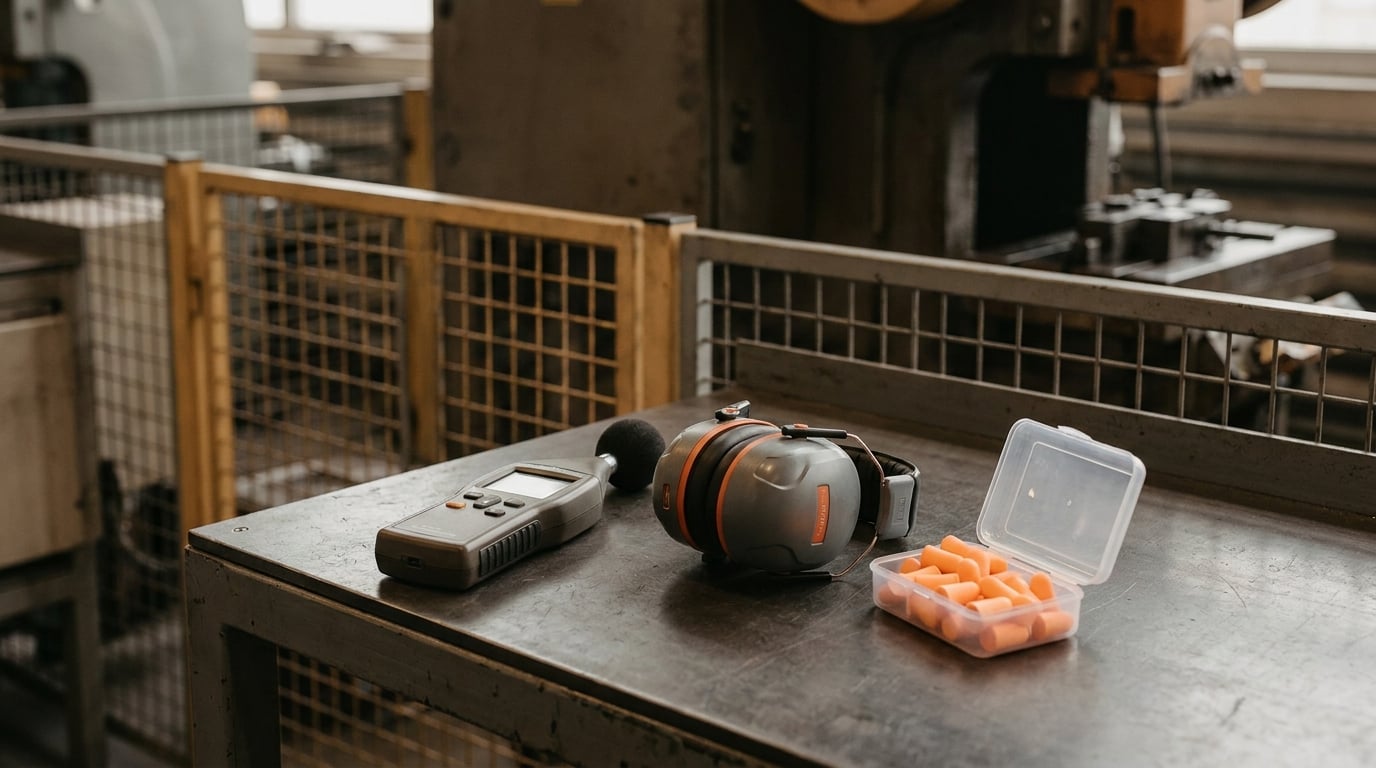
Workplace hearing loss is preventable, and the way you prevent it is not by handing out earplugs and calling it done. The plan that works runs in layers: cut the noise at the source, change how people are exposed to whatever noise remains, then fit and verify hearing protection for the noise you cannot engineer away. Under US rules, that whole sequence kicks in once a worker’s 8-hour time-weighted average reaches 85 decibels A-weighted (dBA), the OSHA action level that triggers a hearing conservation program.
If you are working out how to prevent hearing loss from workplace noise, the difference between a program that protects people and one that does not is usually down to a handful of specific, unglamorous tasks: measuring before guessing, selecting protection that fits the worker rather than the box, training people to use it correctly, and checking whether it is still working six months later. Most sites skip one of those, then blame the workers.
One finding is worth sitting with before you start. Across a study of more than 19,000 workers, hearing protection use without individual selection, training and fit testing showed no statistically significant reduction in noise-induced hearing loss risk, and measured real-world attenuation has ranged from 0 to 35 dB against laboratory ratings. Protection is part of the answer. Protection by default is not.
Table of Contents
- What You Need
- Step-by-Step
- Common Mistakes
- Frequently Asked Questions
- Are earplugs enough to prevent hearing loss from workplace noise?
- How loud does workplace noise have to be to damage hearing?
- What type of hearing protection is best for noisy workplaces?
- How should workers be trained to insert and use earplugs or earmuffs correctly?
- What should employers do if a worker cannot wear hearing protection?
- When should an employer bring in an occupational-safety or hearing-consultation professional?
- Conclusion
What You Need
You cannot select controls or protection in a vacuum. Before you change anything, assemble a short list of what you already have and what is missing.
- Noise measurements. A sound level meter for spot checks, a noise dosimeter for a full shift, or previous survey data. Record results as an 8-hour time-weighted average with an exchange rate, not as a single spot reading.
- A list of tasks, machines and areas with rough exposure times, including short high-noise jobs people forget to mention, such as blade changes, pressure washing or emptying bins.
- Worker names against tasks. Who is exposed, for how long, and on which shift. Exposure patterns differ between day and night crews even in the same building.
- At least three protection options. Behavioural research on hearing protection use points consistently at choice: at least one earmuff and two earplug styles available so people can match their own comfort and communication needs.
- An audiometric testing arrangement, plus a quiet room or procedure for the pre-test noise-free period.
- Records worth reviewing. Previous audiograms, complaints, near-misses, and any list of ototoxic chemicals or materials handled on site.
- Named owners. A supervisor accountable for enforcement, someone who can authorise equipment changes, and a worker representative who hears objections honestly.
OSHA expects employers to provide hearing protection at no cost to the employee. Budget for that, and for the measurement and training time, before you start.
Step-by-Step
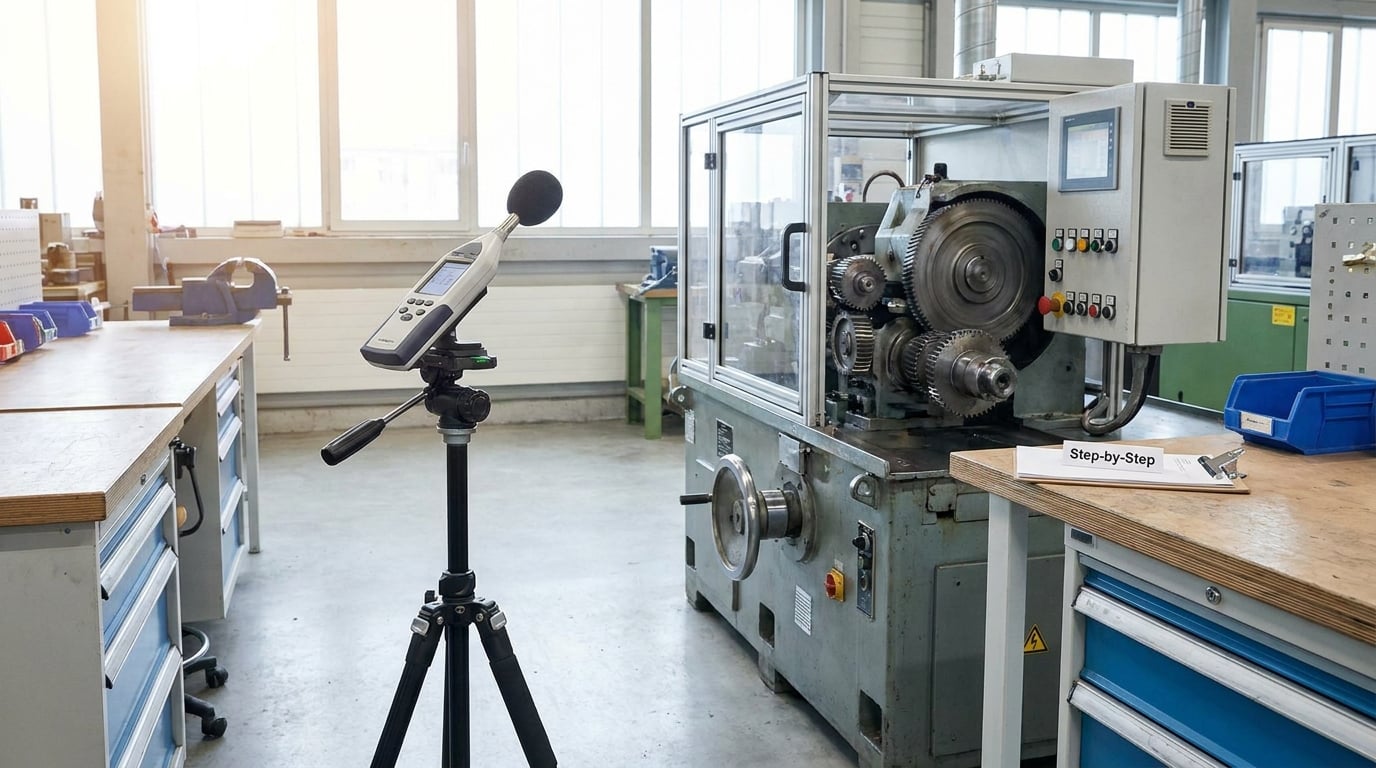
Six steps, in this order. The order matters, because protection bought before the noise has been measured rarely protects the right thing.
Step 1: Identify Where Noise Exposure Is Highest
Walk the site with a notebook and map noise to tasks, not to rooms. A quiet-looking assembly area can be louder than the press shop if it holds twenty people talking over a compressor.
Separate two different problems that get lumped together. Continuous noise is the steady hum of fans, conveyors, blowers and air handling, and it is measured as an 8-hour time-weighted average. Impulse and impact noise is the hammer, the pneumatic ram, the blast, the pressure washer, and it should never exceed 140 dB peak sound pressure level no matter how brief it is.
Ask workers where their ears ring after a shift, then compare notes. They usually point at the task a supervisor forgot to mention.
Step 2: Measure and Review the Noise
Use a calibrated sound level meter for a quick screening pass, and a dosimeter worn by the worker for the real number, since dose reflects where the person stands and what they touch. Bring in a qualified occupational-safety or industrial-hygiene professional when you need exposure limits, dosimetry, or a defensible record; a screening pass does not replace that assessment.
Two numbers decide how much of the problem you have: the level and the exchange rate. The 3 dB exchange rate NIOSH recommends means every extra decibel halves the permitted time. OSHA’s US permissible exposure limit is 90 dBA over 8 hours on a 5 dB exchange, with the 85 dBA action level starting the conservation program. In the EU, Directive 2003/10/EC sets a lower exposure limit value of 87 dBA on a 3 dB exchange, with hearing protection made available above 80 dBA and required above 85 dBA.
| Level (dBA) | OSHA 90 dBA, 5 dB exchange | NIOSH 85 dBA, 3 dB exchange | EU 87 dBA, 3 dB exchange |
|---|---|---|---|
| 80 | 32 hours | 25 hours | 40 hours |
| 85 | 16 hours | 8 hours | 13 hours |
| 87 | 12 hours | 5 hours | 8 hours |
| 90 | 8 hours | 2.5 hours | 4 hours |
| 95 | 4 hours | 48 minutes | 1.3 hours |
| 100 | 2 hours | 15 minutes | 48 minutes |
| 105 | 1 hour | 5 minutes | 8 minutes |
| 110 | 30 minutes | 1.5 minutes | 1 minute |
Approximate figures for an 8-hour day, shown to make the gap between the three systems visible rather than to replace your own monitoring. Read the NIOSH and EU columns as the conservative planning figures, because the OSHA column permits more exposure at the same level.
While you have the data out, review what the site already knows: past surveys, incident reports, maintenance history, and complaints that were closed without a fix.
Step 3: Reduce the Noise at the Source
This is the layer most programs skip, and it is the only one that helps everyone on site at once, including visitors and contractors nobody issued earplugs to. Personal protective equipment is the last line of defence in the hierarchy of controls, not the first move.
- Enclose and isolate. Full or partial acoustic enclosures around compressors, chillers, presses and gearboxes; vibration isolation mounts so a machine stops transmitting through the floor.
- Barriers and layout. Position noisy equipment away from work areas and away from quiet spaces like break rooms and offices. Distance is the cheapest control there is.
- Maintain what you own. Worn bearings, dry lubrication, unbalanced fans, rattling guards and blocked mufflers all add noise. Put noise checks on the same preventive-maintenance schedule as oil changes.
- Buy quiet. Specify lower-noise equipment on purchase orders, and require noise data at specification stage rather than after installation.
- Quiet the process. Slower operating speeds, batch rather than continuous running, remote operation of loud tools, or moving a hot, noisy job to a ventilated booth.
- Give people somewhere to recover. A sound-quiet break or rest area limits accumulated exposure across the day, and helps when the noise source is not going away this year.
Work out the cost against the dose you are removing. A control that cuts 5 dBA at the source usually pays back faster than years of replacement earplugs, because it protects the whole shift at once.
Step 4: Select the Right Hearing Protection
Selection should follow the measured environment, the work the person does, and their own preference, rather than whatever is in the box at the supply room.
| Device | Best for | Drawbacks |
|---|---|---|
| Formable foam earplugs | General use in most industrial noise | Depends entirely on insertion technique; no communication cues |
| Pre-molded earplugs | Workers who cannot get a foam plug to seal | Must match ear size; can pressure the canal |
| Custom-molded earplugs | Long shifts, musicians, workers with existing hearing loss | Needs an earmold impression and periodic replacement |
| Canal caps (semi-insert) | Situational awareness where full occlusion is unwanted | Less attenuation than plugs or muffs |
| Earmuffs | High noise, and workers who cannot wear plugs | Heavier, can interfere with glasses and hearing aids |
| Electronic or pass-through | Tasks needing alarms, radios or machine cues | Higher cost, more parts to maintain |
| Dual protection | Extreme environments above roughly 100 dBA, some mining work | Comfort and communication problems; only if required |
Then handle the label number correctly. The noise reduction rating is a laboratory figure measured with a perfect seal and a trained user, so it overstates what a real worker gets. OSHA advises subtracting 7 dB when using an NRR for an A-weighted estimate, and NIOSH recommends keeping 70 percent of the rating for pre-formed earplugs, 50 percent for formable foam plugs, and 25 percent for earmuffs. A label reading 33 dB is not 33 dB of protection in the field.
Verify what a person actually gets. In January 2025 NIOSH published a science policy update recommending individual quantitative fit testing to measure real-world attenuation. Whatever your size of site, train a person to check a plug seal by listening for leak, or by cupping your hand over the ear with the plug in place, and record the result. Hearing aids are not hearing protection, and workers who wear them need dual-compatible protection fitted separately.
Step 5: Train Workers and Supervisors
Training is the step that converts protection from an object into something used correctly, and supervisors need it as much as the crew. Cover what the noise does to hearing, what your site measured, why controls come before plugs, and which tasks trigger protection.
Teach insertion as a hands-on skill, demonstrated by someone and then checked on each person:
- Roll the foam plug between your fingers until it is a thin, uncompressed cylinder.
- Pull the ear up and back with the opposite hand to open the canal.
- Insert the plug well past the narrowest part of the canal, then hold it there for around a minute until it fully rebounds.
- Check the seal by trying to hear sound clearly, or by cupping a hand over the ear; a proper fit feels slightly occluded and dull.
- For earmuffs, confirm the cushions seal all round with no hair or glasses in the way, and check the headband tension.
Finish with care, replacement and reporting: keep plugs clean and stored in their case, expect to replace single-use plugs every two to four weeks and ear cushions every three to eight months, replace immediately if torn or hardened, and report ringing, ear pain, dizziness or a sudden drop in hearing the same day. Set out clearly who responds and what happens next.
Step 6: Monitor, Review, and Improve
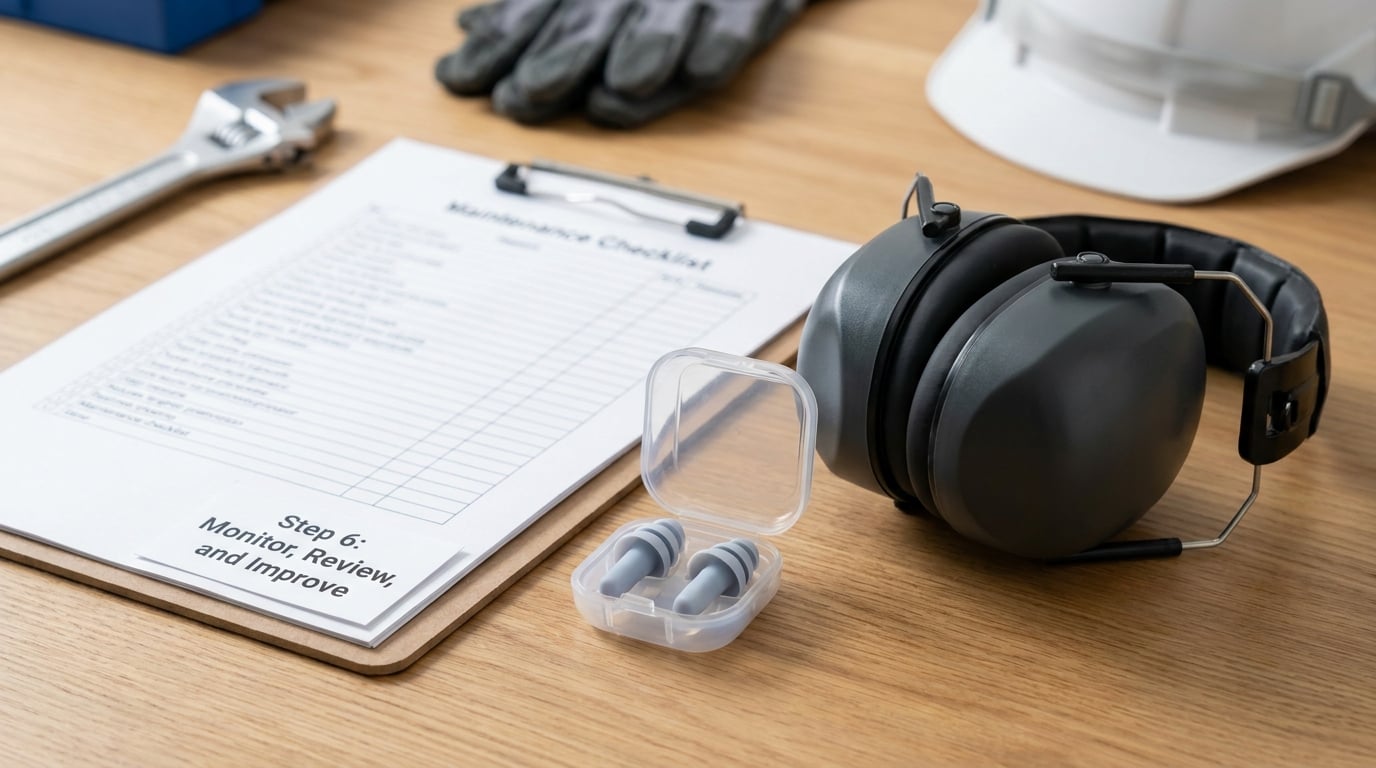
A program that is never measured is a program that quietly stops working. Three things to keep on a schedule.
Equipment upkeep. Inspect muffs and plugs at every issue, log the maintenance work on the same schedule as the noise-producing equipment, and keep an ample supply of the protection people actually choose. Devices that run out get improvised, and improvised protection is not protection.
Hearing tests. OSHA requires a baseline audiogram within six months of first exposure at or above 85 dBA TWA, with 14 hours of noise-free time before the test so results reflect hearing rather than the last shift, and annual testing after that. A standard threshold shift is an average change of 10 dB or more at 2000, 3000 and 4000 Hz in either ear, and the worker must be notified within 21 days. As a program check, NIOSH suggests fewer than 5 percent of exposed employees should show a 15 dB significant shift in the same ear and frequency; higher than that and the program, not the workers, is the problem.
Worker feedback. Ask whether the protection still fits, whether the noise changed, and whether anyone heard something they could not because of it. The people who report that protection gets in the way of the job are telling you where the next control needs to go.
When the noise keeps coming back after a fix, stop treating it as a hearing-protection issue and bring in an occupational-safety or industrial-hygiene professional to re-measure, re-model the controls, and re-check the exposure limits.
Common Mistakes
Most failed programs repeat the same handful of errors. Each one has a straightforward fix.
Measuring one location and assuming it covers the site. A reading taken near the quietest machine understates everyone else’s dose. Fix: dose several workers doing their actual tasks, including short high-noise jobs, across more than one shift.
Providing protection without training or fit support. A plug inserted halfway offers very little, and a worker who cannot get a seal will stop wearing it within weeks. Fix: hands-on insertion practice for every new starter, plus a seal check method people can actually use on their own.
Choosing equipment by comfort or cost alone. The most comfortable item in the drawer is not the one that reduces exposure at the ear. Fix: choose by the measured environment, then offer several options and let the person pick within that set.
Using the NRR on the box as the protection you have. Lab ratings overstate real attenuation, sometimes by a lot. Fix: derate the label, and where the exposure is severe, verify real-world attenuation with fit testing.
Assuming protection removes the risk. Plugs reduce dose; they do not cancel the hazard, and workers still avoid them during the noisiest ten minutes of the shift. Fix: treat protection as layer three and keep working on the source.
Ignoring equipment and process noise entirely. A quiet workplace full of people shouting, slamming doors and running old blowers will still show threshold shifts on the audiogram. Fix: treat building services, compressed air, alarms and communication as noise sources with the same seriousness as the press line.
Failing to revisit the plan. Equipment gets replaced, shifts change, new materials appear. Fix: put the noise review on the calendar with the rest of your safety audits, and keep the audiogram trend as the scorecard.
Frequently Asked Questions
Are earplugs enough to prevent hearing loss from workplace noise?
No, on their own they are the weakest layer. In a study of more than 19,000 workers, hearing protection use without individual selection, training and fit testing produced no statistically significant reduction in noise-induced hearing loss risk, and measured real-world attenuation has ranged from 0 to 35 dB. Plugs work as part of a program that cuts noise at the source, limits exposure time, and verifies fit.
How loud does workplace noise have to be to damage hearing?
Long-term exposure above 85 dBA causes permanent hearing loss, and short exposures up to about 120 dB can occur without harm. Impulse or impact noise should stay below 140 dB peak sound pressure level. NIOSH recommends an 85 dBA 8-hour time-weighted average with a 3 dB exchange rate; OSHA permits 90 dBA on a 5 dB exchange. Lower figures, not higher ones, should drive your planning.
What type of hearing protection is best for noisy workplaces?
Most sites need a choice rather than a single answer. Formable foam plugs suit general industrial noise, pre-molded plugs help people who cannot get a foam seal, custom-molded plugs suit long shifts and workers with existing hearing loss, and earmuffs work where plugs will not go or where noise is higher. Offer at least one earmuff and two plug styles, then derate the label rating to estimate real protection.
How should workers be trained to insert and use earplugs or earmuffs correctly?
Teach it hands-on, not from a poster. Roll the foam plug into a thin cylinder, pull the ear up and back, insert it past the narrowest part of the canal, and hold until it rebounds fully. For earmuffs, check that cushions seal all round with no hair or glasses underneath. Demonstrate, watch each person do it, and re-check at every new starter and after any equipment change.
What should employers do if a worker cannot wear hearing protection?
Treat it as a fitting problem, not a disciplinary one. Offer alternative device types, and in-ear or custom-molded protection for workers with existing hearing loss or a medical condition. Note that hearing aids are not acceptable hearing protection, so those workers need compatible protection fitted separately. Record the reason, involve occupational health, and revisit the underlying controls if the only answer is that person tolerating discomfort.
When should an employer bring in an occupational-safety or hearing-consultation professional?
Bring one in when you need a defensible exposure assessment, dosimetry across multiple tasks or shifts, interpretation of exposure limits, or fit testing of personal protection. It is also worth doing after a failed control, after a new process or material is introduced, and after any report of ringing, sudden hearing change or acoustic trauma. The professional sets the numbers; your team runs the day-to-day program.
Conclusion
Start with the noisiest tasks, not with a box of earplugs. Map where exposure actually happens, measure it as an 8-hour time-weighted average, and treat the 85 dBA action level as the trigger for everything that follows.
Then work down the layers: reduce noise at the source, shorten or schedule exposure, select protection that fits the person and derate the label honestly, train people with your own hands, and check the fit. Protect the workers who already have hearing loss by fitting them separately, since hearing aids do not count as protection.
Over the first month, I would aim for four concrete outcomes: a measured exposure list by task, one control completed and verified at the source, protection choices issued with training and fit checks, and baseline audiograms booked with the 14-hour noise-free period in the diary. Review the trend annually, and treat rising threshold shifts as a signal to fix the plant rather than to remind people to be more careful.
Workplace noise-induced hearing loss is permanent. Dead hair cells in the inner ear are never replaced, which is exactly why the effort is worth spending up front.