

An employee wellness program is a set of habits, policies and small benefits that look after your team’s physical, mental and financial health. The employee wellness program ideas for small business that actually stick are rarely a platform with a dashboard. They are a handful of repeatable things you do every week, most of them free, plus one or two things you pay for. The ideas below are ordered from zero cost to modest cost, and each one comes with the simplest first step.
If you are running a team of eight with no HR function, you do not need a vendor. You need permission to take a walk, a colleague who notices when someone is drowning, and a written plan for what happens if the building’s alarm goes off. That is the whole foundation, and everything else is decoration on top of it.
One thing worth saying early: for small teams, wellness shows up in retention and absenteeism, not in healthcare cost reduction. Burned-out and financially stretched staff resign faster, call in sick more, and produce less. With a small team, one departure costs you far more in lost knowledge and overtime than a small monthly wellness budget ever does.
Table of Contents
- Employee Wellness Program Ideas for Small Business at a Glance
- 1. Create a Simple Wellness Committee
- 2. Offer a Flexible Work and Wellness Policy
- 3. Provide an Employee Assistance Program
- 4. Start a Mental Health Check-In Practice
- 5. Run Regular Walk-and-Talk Meetings
- 6. Build a Movement Breaks Culture
- 7. Provide Ergonomic Workstation Guidance
- 8. Offer Healthy Food and Drink Options
- 9. Support Preventive Health and Screenings
- 10. Provide Financial and Legal Wellness Resources
- 11. Create a Safety and Emergency Preparedness Program
- 12. Measure What Employees Actually Value
- Frequently Asked Questions
- What is the best employee wellness program for a small business?
- How much should a small business spend on employee wellness programs?
- Do employee wellness programs increase productivity or retention?
- How can we protect employee privacy in a workplace wellness program?
- How do we encourage employees to participate in wellness initiatives?
- What wellness benefits can a small business offer without a large HR team?
- Conclusion
Employee Wellness Program Ideas for Small Business at a Glance
The table below is the quick reference. The wellness goal and the first step matter more than the cost column, so read the goal column first and let the cost column confirm that you can afford to start this month.
| Idea | Wellness goal | Typical cost | Best team size | Simplest first step |
|---|---|---|---|---|
| Wellness committee | Ownership and local relevance | None | 8 and up | Ask three people to join a monthly call |
| Flexibility policy | Stress, burnout, work-life balance | None | Any | Write down your current break and start rules |
| Employee assistance program | Mental health and confidential support | Low, per employee per month | 5 and up | Get two quotes and read the confidentiality terms |
| Manager check-ins | Early detection, psychological safety | None | Any | Add a wellbeing question to your one-to-one template |
| Walk-and-talk meetings | Movement and easier conversations | None | Any | Book one one-to-one outside the office this week |
| Movement breaks | Circulation, focus, energy | None | Any | Try one five-minute break after lunch |
| Ergonomic guidance | Pain, posture, remote work comfort | None to low | Any | Run a ten-minute self-assessment at each desk |
| Healthy food and drink | Nutrition, hydration | Low | Any, more useful on site | Put a water filter and a decent coffee option in the kitchen |
| Preventive health and screenings | Early detection, lower absence later | Low, usually employer share | Any | Share your insurer’s screening calendar, not employee details |
| Financial and legal resources | Money stress, benefits understanding | None to low | Any | Book one free neutral budgeting session |
| Safety and emergency plan | Physical and psychological safety | Low to moderate, one-off | 5 and up | Check your fire plan dates and first-aid kit |
| Employee feedback loop | Relevance, participation, trust | None | Any | Run a five-question anonymous pulse |
Read the last column as the real to-do list. If you only do the first three of those this quarter, you are already ahead of most small businesses that announce a program in January and never mention it again.
1. Create a Simple Wellness Committee
A wellness committee is four people who meet for thirty minutes a month and decide what is actually going to happen. That is it. It is not a committee with a budget, a mandate or a chairperson with a title.
For a team of eight, recruit across roles rather than by seniority: the newest person, the person who commutes longest, the shift worker if you have any, and the person who talks most in meetings. You want the quiet ones’ problems represented, not the loud ones’ enthusiasm.
Give the committee three jobs: collect pain points, test one idea, and report back. Testing one idea at a time is what keeps this from turning into a wish list nobody executes.
HR practitioners in the community consistently say the same thing about this: low-friction programs that repeat beat elaborate one-time launches every time. A committee that tries one small thing a month produces more real change than a launch event with a poster and a photo.
How to launch it in an afternoon
Write a one-page note saying what the group does, when it meets, and that participation in the group is voluntary. Name the four people, send the first date, and let that first meeting be nothing more than listing the ten things people would change if they could. Bring the list to your next all-hands and pick one item.
2. Offer a Flexible Work and Wellness Policy
Flexibility is the most-used and least-expensive wellness benefit there is, because it costs you scheduling discipline rather than money. The interesting part is that it needs to be written down. Undocumented flexibility is whatever the most anxious person assumes, and the result is that nobody uses it.
A small-business version typically includes predictable start and end times, some remote days where the role allows it, meeting-free focus blocks that everyone protects, and clear rules for stepping away during a personal or family need.
Those last rules are the ones people actually test. If your policy says flexibility exists but your manager treats a personal afternoon as a favour, the policy is a fiction and the people who need it most are the least likely to ask.
Be consistent about how the rules apply. The classic failure is a generous arrangement for two people that quietly becomes a precedent for the rest, followed by resentment when it is withdrawn.
3. Provide an Employee Assistance Program
An employee assistance program, usually called an EAP, is a confidential service that gives employees and often their families access to counselling, referral and practical support for personal problems. Employers pay a small per-employee-per-month fee, and the employee pays nothing and never has to tell you who they used.
Two things matter more than the vendor. The first is confidentiality: check what the provider reports back to you, because the default in a good EAP is aggregate numbers only, never individual cases. The second is whether anyone tells your team it exists.
That second point comes up constantly in HR discussions. EAPs are widely valued and widely unused, and the usual reason is that nobody mentioned them twice. A mention at onboarding disappears within a year, so plan on reminding people at the start of each benefits period, not once.
Never put a referral in a performance file or make use of the service a condition of your employee assistance policy or any other policy. That destroys the confidentiality the whole service depends on.
4. Start a Mental Health Check-In Practice
Most small-business managers are not therapists and should not try to be. What they can do reliably is notice change and route it to help. The practice that works is boring: ask, listen without diagnosing, and know where to send someone.
Add one question to your existing one-to-one routine rather than building a new meeting. Something like how the week actually felt, and what would make it lighter, is enough. Twenty focused minutes is a realistic commitment for a small team.
When someone opens up, resist the urge to fix it or match their energy. The useful responses are short: thank them for saying it, ask what would help, and offer the EAP, the company’s flexible time policy and the employee assistance contact details. If someone mentions anything urgent, stop and help them get to proper care rather than handling it yourself.
Leaders set the tone far more than policy does. If the person who signs the paycheques visibly takes a walk or uses the EAP, participation goes up. If the owner treats wellbeing as a joke, no poster in the break room will fix it.
5. Run Regular Walk-and-Talk Meetings
A walk-and-talk is a one-to-one or small-group conversation that happens while walking, outdoors or around the block. It works for two reasons at once: it removes people from a desk, and it makes a serious conversation feel less like a performance review.
Most managers find that they themselves say more during a walking conversation than they would in a meeting room, which is usually a sign that the room was the problem rather than the subject.
Ten to twenty minutes is plenty, and a weekly or fortnightly rhythm is easier to keep than a monthly one. For remote teams, the same idea works on a phone call taken outdoors, or as a standing video call instead of sitting.
One caution: do not use the walk to deliver bad news or to run performance conversations. The informality that makes it useful is exactly what makes it wrong for those conversations.
6. Build a Movement Breaks Culture
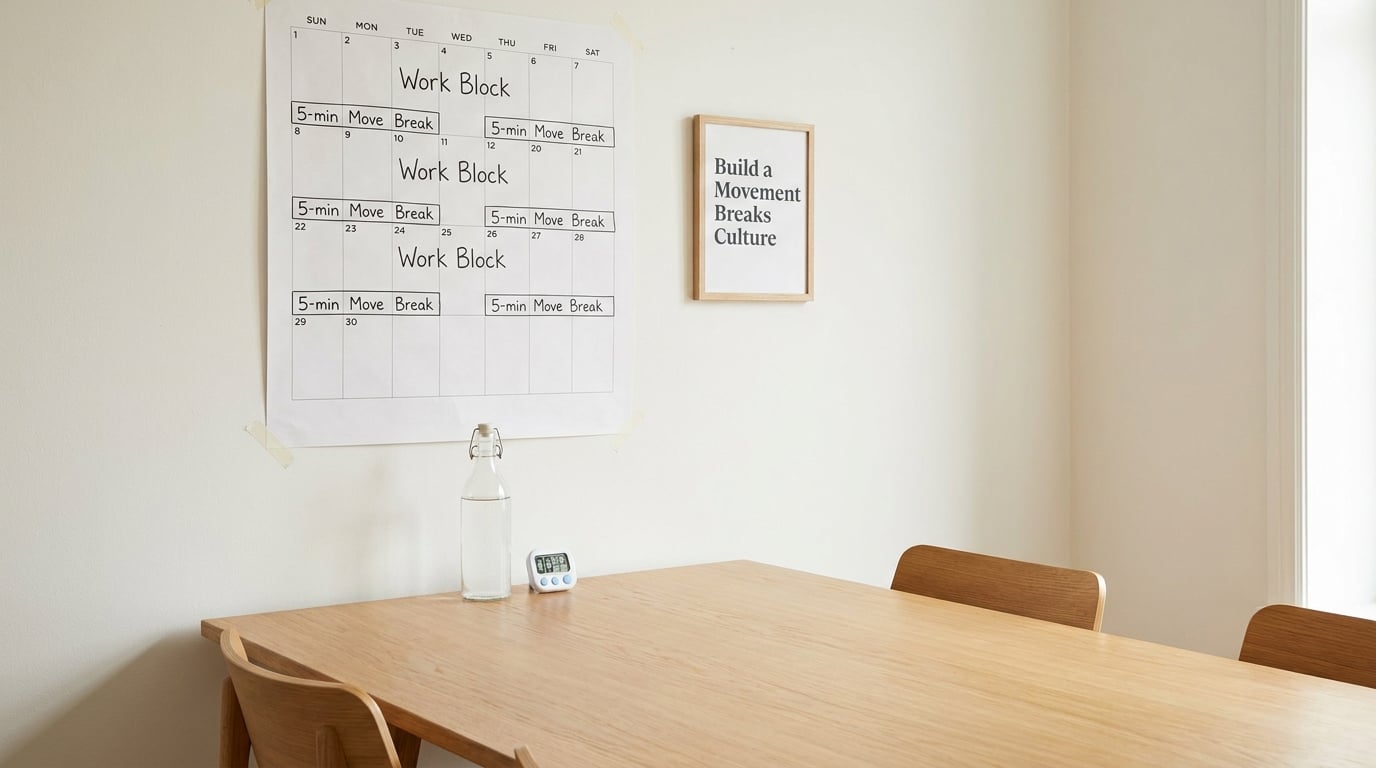
Movement breaks are three to five minutes away from the desk, taken when the person chooses. Stairs, a lap of the car park, a stretch at the wall, anything. The point is to break up sitting, not to burn calories, and framing it that way is what keeps it voluntary and low-pressure.
The cultural part matters more than the timer. If a manager keeps working through the break and says nothing, employees assume it is a productivity test and the idea dies quietly within a month.
What works is a stated permission: breaks are encouraged, they do not need permission, and nobody tracks them. Five minutes twice an afternoon is a reasonable starting target for a desk-based role, and a phone reminder is usually enough to make it stick.
For shift work, the same principle applies differently: build movement into the handover, and make sure the break is genuinely taken rather than nominally available. A break that is never taken is not a wellness benefit.
7. Provide Ergonomic Workstation Guidance
Ergonomics is the least glamorous idea on this list and one of the few that produces a measurable complaint reduction. The basics are a chair that supports the lower back, a monitor at roughly arm’s length with the top of the screen near eye level, a keyboard and mouse close enough that the elbows stay near the body, and lighting that does not come from behind the screen.
You do not need an assessment vendor to start. A ten-minute self-check that employees run at their own desk, with a printed or shared checklist, catches the majority of problems. Chair height, screen height and wrist position are the three that matter most.
Where budget allows, the highest-return purchase is usually the chair, followed by a monitor riser or a second monitor for people working from a kitchen table. For remote staff, a small one-time home office budget or an equipment allowance solves more discomfort than any amount of advice.
Keep the guidance accessible. Staff with a disability, a chronic pain condition or a pregnancy need individual adjustments, and the right route is an occupational health referral or an accommodations conversation, not a general wellness email.
8. Offer Healthy Food and Drink Options
This idea is about what is available in the building, not about telling anyone what to eat. Water within reach, a functioning coffee option, and meeting snacks that are not all vending-machine wrappers will do more than a nutrition newsletter, and they take about one small purchase to improve.
Start with the cheapest fix. A refillable water filter, a second kettle so the queue is shorter, and a rule that the good snacks live somewhere people can reach without asking a manager are nearly free and immediately noticeable.
For on-site teams, catering choices for meetings and events are the lever. Ask for vegetarian and vegan options, a gluten-free option, and something with no pork or beef for teams that need it, and for halal or kosher items when that matches your workforce. That is not a perk, it is basic inclusion.
Skip anything that asks employees to disclose weight, calories, body measurements or health conditions. You do not need that information, and collecting it is exactly how a wellness initiative turns into a source of discomfort.
9. Support Preventive Health and Screenings
The most useful thing a small employer can do here is make screening easy to access without turning into a data collector. Share your insurer’s or your local health service’s screening calendar, host a voluntary health event on site if you can get a provider, and pay the employer share of routine screening where your plan allows it.
Voluntary has to mean voluntary, in practice and not just in writing. No sign-up sheets that circulate, no attendance lists, no follow-up emails that reveal who went and who did not.
Privacy is the part small businesses get wrong. Do not ask for medical details, do not receive individual results, and do not let a provider hand you anything identifiable. If you host an event, the organiser keeps the individual records and gives you attendance totals only.
Flu vaccination days and seasonal safety reminders are the low-effort version of this that works year round, and they suit teams without a wellness budget or a meeting room to spare.
10. Provide Financial and Legal Wellness Resources
Money stress shows up at work in ways managers recognise immediately: late arrivals, concentration problems, short tempers, resignations that surprise everyone. Financial wellness is also the benefit employees are most willing to use, because asking for help with a budget carries none of the stigma attached to asking for help with mental health.
You do not have to build this. A local credit union, a community college or an adult education service will often send a neutral advisor to run a free budgeting session for your team, and your insurer or benefits administrator may offer free financial coaching as part of the plan you already pay for.
There is usually free content you are not using: your benefits guide explained properly, a session on what the health plan does and does not cover, an introduction to your retirement options, and a plain-language summary of employment-related rights and where free legal help exists locally.
Keep it informational and keep it neutral. Presenters should not sell financial products to your employees, and it should be clear that the session is general information rather than individual financial or legal advice. Anything specific to someone’s circumstances goes to their own adviser, and for legal questions, a free legal aid clinic in your area.
11. Create a Safety and Emergency Preparedness Program
Preparedness is wellbeing. People who know what to do in an emergency, and who have been told where the exits are and who is trained, work with noticeably less background tension than people who have never thought about it.
The minimum version is unglamorous and mostly one-off work: a current emergency plan that names who does what, first-aid kits checked and stocked, first-aid and fire training for the named people, an evacuation route that includes anyone who would need assistance, and a system for reporting incidents and near misses.
Make it a document with dates on it. Plan reviews lapse silently, and the version in the drawer is usually the one from before the office moved.
The psychological half of this matters too. A respectful debrief after an incident, and a real anti-harassment process that people believe, do more for how safe staff feel at work than any wellness activity in this guide. Both are also simply the right thing to run a workplace by.
12. Measure What Employees Actually Value
The last idea keeps the other eleven alive. Without feedback, a wellness program becomes whatever the owner decided eighteen months ago, and participation drops to the two people who enjoy it. Of all the employee wellness program ideas for small business, this is the one that decides whether the rest are still worth running next year.
A five-question anonymous pulse is enough. Keep it under three minutes, do not run it more than twice a year, and cover: which of the current activities do you use, which one thing would help most, what is a barrier, and what should we stop doing. That last question is the useful one. People will tell you, in writing and anonymously, what is annoying about your program.
With a team under about twenty, do not chase percentages. One person’s answer is five percent of your data, and a participation rate on eight people is noise. Read the comments, count how many people named the same thing twice, and act on that instead.
Then report back. Tell the team what you heard, what you are changing and what you are deliberately not changing this quarter. That short message does more for trust than any new benefit, and it is the cheapest item in this entire list.
Frequently Asked Questions
What is the best employee wellness program for a small business?
The best one for a small business is the smallest one that people actually use. For most teams under twenty, that is a written flexibility policy, a confidential employee assistance program, a manager check-in habit and one movement habit, run consistently by someone the owner can name. Programs that need an app, a champion team and a monthly budget to survive tend to lose momentum within two quarters, especially without HR support.
How much should a small business spend on employee wellness programs?
Most small teams spend nothing more than a modest monthly amount, and often the largest single line is an employee assistance program priced per employee per month. If you are unsure, start with the free ideas, add one paid item you know your team will use, and revisit after a quarter. A useful discipline is to express the budget as cost per employee per month so you can compare vendors fairly.
Do employee wellness programs increase productivity or retention?
They can, and the effect is usually modest and gradual rather than dramatic. Small businesses see the clearest wins in retention and absenteeism, because stressed staff leave and take sick days before productivity numbers move. Owners should expect the biggest single factor to be manager behaviour rather than the program itself, and should judge success on feedback and uptake rather than on a return-on-investment figure nobody can verify.
How can we protect employee privacy in a workplace wellness program?
Keep every element voluntary and never collect health information you do not need. Do not record who takes a screening, who meets a counsellor or who uses a mental health day, and do not let a provider share identifiable records with you. Anonymous surveys help, and keeping the total number of people small means you should resist the temptation to publish percentages that trace back to one individual.
How do we encourage employees to participate in wellness initiatives?
Make participation easy, repeated and clearly optional, and remind people more than once. Most underused benefits are unused because nobody mentioned them again after onboarding, so put reminders at the start of each benefits period. Choose activities with low friction, such as walking meetings or a flexible break, and make sure leaders visibly take part, because owner and manager behaviour drives adoption more than any policy or poster.
What wellness benefits can a small business offer without a large HR team?
Most of them. The benefits that need the least administration are a written flexibility policy, confidential access to an employee assistance program, ergonomic guidance and equipment, healthier meeting snacks, a clear safety and emergency plan, and access to neutral financial or legal information sessions. A small business can also run a short anonymous survey and a monthly volunteer wellness group, which together cover the feedback and ownership that larger programmes get from software.
Conclusion
Pick one idea from this list this month, choose it because your team mentioned it rather than because it looked good in a list, and name the one person responsible for it. Give it a trial period of ninety days, ask two questions at the end, then keep it, change it or drop it honestly.
That is the difference between employee wellness program ideas for a small business that quietly work and the ones that end up as a poster in a break room nobody enters. The programs that survive are the boring, repeated ones your own team helped choose, and they are updated as of October 2026.