
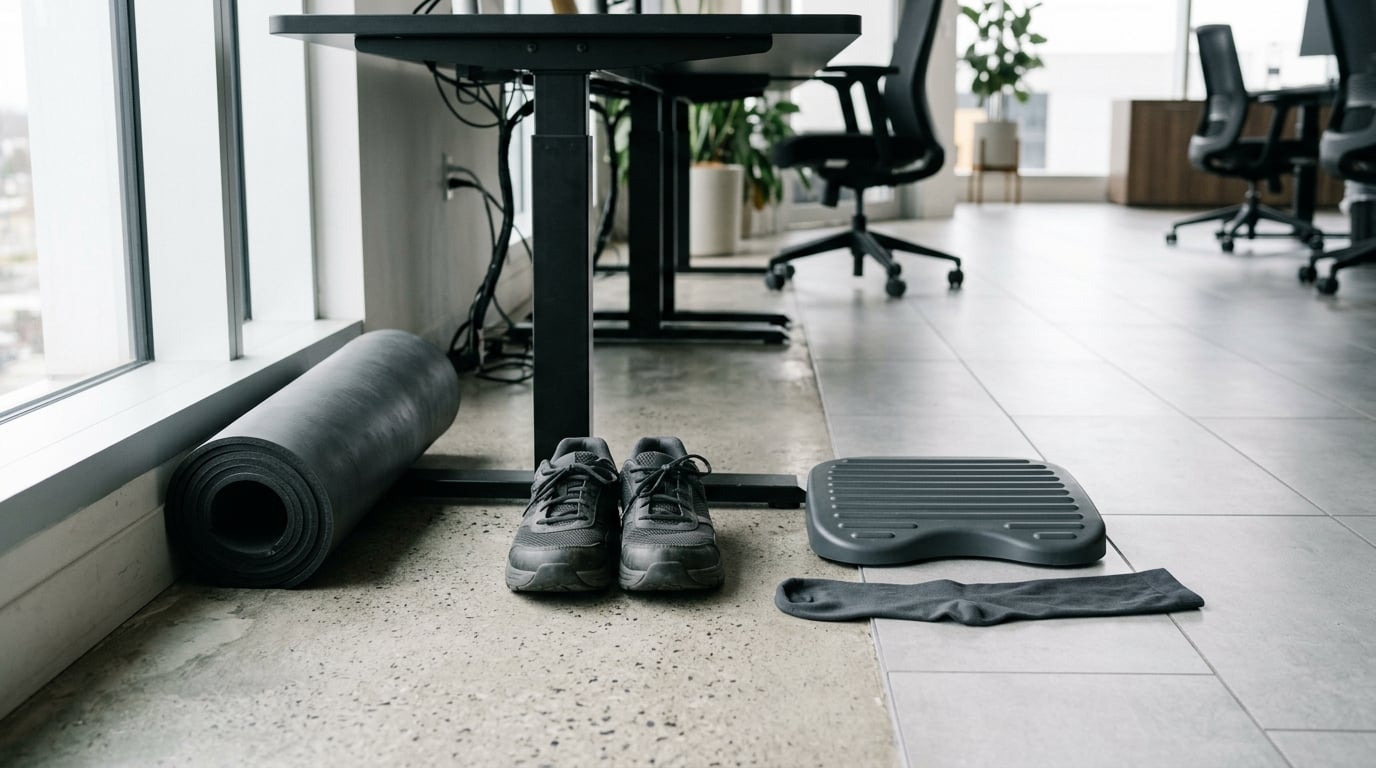
If your workday puts you on your feet, the fix is rarely one product. It is a set of small changes: the shoes you wear, how you distribute your weight, how often you move, and what you do in the ten minutes after your shift. Most people who work on their feet can reduce discomfort within one to three weeks by changing those four things.
This guide is for retail staff, nurses, servers, teachers, warehouse and factory workers, security guards, hair stylists, and anyone else who spends hours on hard floors. Everything here is general information about comfort and work habits, not medical advice. If your pain is severe, worsening, or lasting longer than a couple of weeks, a doctor or podiatrist can tell you what is actually going on.
Start with the step that costs nothing. Most shifts include a few minutes where you could sit, walk, or change your stance but do not, because the work never quite stops.
Table of Contents
- What You Need to Reduce Foot Pain From Standing Jobs
- Step-by-Step
- Common Mistakes
- Frequently Asked Questions
- Do anti-fatigue mats actually work?
- Why do my feet hurt when I use a standing desk all day?
- How often should I take breaks when standing all day?
- Can barely walk after standing all day – is that something to worry about?
- How long before foot pain from standing jobs improves?
- What should I tell my employer about foot pain at work?
- Conclusion
What You Need to Reduce Foot Pain From Standing Jobs
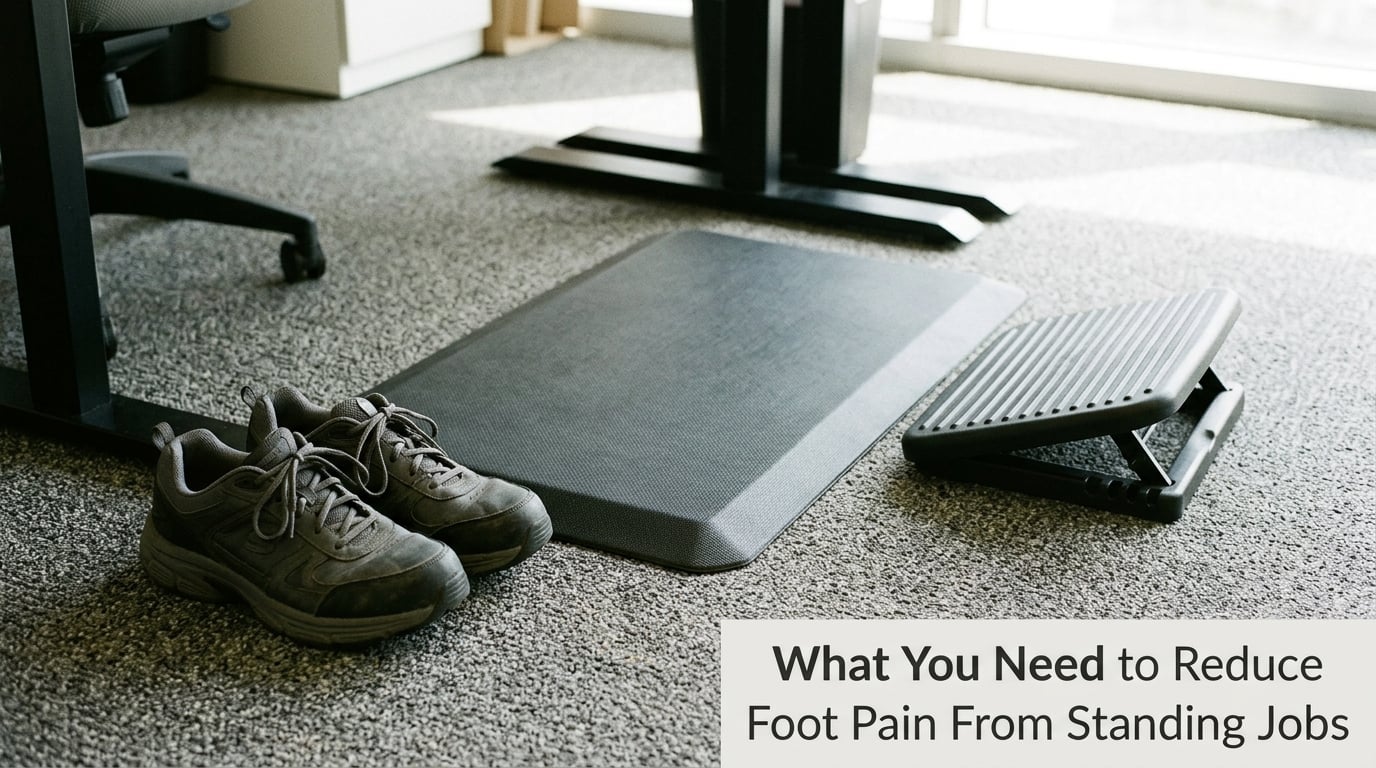
You do not need a lot to start. These are the practical items that support the changes in the steps below.
- Supportive, closed-toe work shoes or boots with a cushioned midsole, a wide toe box, and a slip-resistant outsole that suits your workplace floor. If your employer issues safety footwear, take the model that fits rather than the one that only comes in one size.
- Insoles you can remove and swap. Over-the-counter arch support or orthotic inserts are a reasonable first try; custom orthotics can come later if simpler changes have not helped.
- An anti-fatigue mat for the spot where you stand longest, especially on tile, concrete, or a shop floor. A rolled mat is easier to store than a full one.
- A footrest or low platform so you can change leg position without leaving your task.
- A small firm ball for rolling the arch of your foot. Tennis balls and dryer balls are the ones people already report using.
- Compression socks, if your feet and lower legs swell noticeably by the end of a shift.
- Permission to vary tasks and take movement breaks. This is the item most people never ask for, and it often matters more than anything on the list.
Keep a second pair of shoes at work if you can. Switching between two pairs across the week gives each midsole time to recover its shape, which is a change people report working better than any single upgrade.
Step-by-Step
1. Start with supportive footwear
Pick shoes you can comfortably stand in for a full shift, and give them a fair trial before you decide. Look for a cushioned midsole that absorbs impact, a roomy toe box that does not pinch the front of your foot, and a firm heel that keeps your foot from sliding around.
Fit matters more than brand. Leave roughly a thumb’s width between your longest toe and the front of the shoe, check both feet because they are rarely identical, and make sure nothing rubs the ball of your foot when you stand still.
Break new shoes in gradually, wearing them for shorter stretches at first. Shoes cushion the load; they do not treat pain, and no pair erases an underlying problem.
How to tell it worked: the pain at the end of the shift arrives later, feels less sharp, or takes less recovery time. If nothing changes after two weeks of full wear, the fit is the problem, not the features.
2. Change how you stand at work
Standing still for hours is harder on your feet than walking, because walking uses the calf muscles to pump blood back up the leg. So the goal is not to stand better, it is to stand differently.
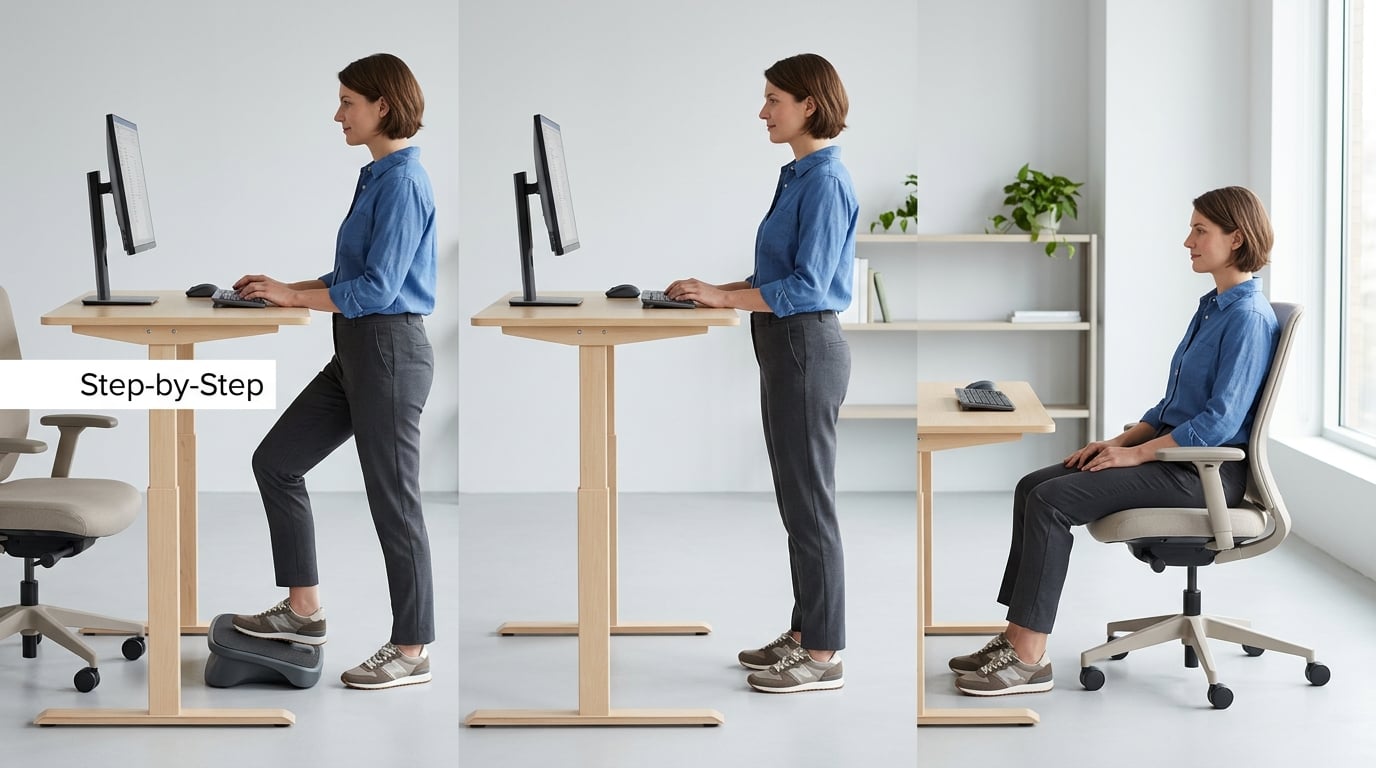
Shift your weight from one leg to the other every few minutes rather than parking on one hip. Keep a soft bend in your knees instead of locking them straight, and vary your stance: one foot slightly forward, then both feet even, then one foot on a footrest or low step.
Where the floor is genuinely hard, an anti-fatigue mat changes how a static hour feels. It encourages the small ankle and hip adjustments that keep circulation moving, which a rigid floor discourages.
How to tell it worked: your ankles and knees feel less sore at the end of the shift, and the tight band across your lower back eases up.
3. Add short movement and rest breaks
This is the core of the problem. Reducing foot pain from a standing job is mostly about frequency, not duration. A two to five minute break every 30 to 60 minutes does far more than one long sit at the end of the shift.
Make the break count. Walk a lap, take the stairs, do ten slow calf raises at a counter, or roll each foot over a ball for sixty seconds. Then do a short stretch routine, holding each position for about 30 seconds and repeating three times:
- Calf stretch against a wall. One foot back, heel pressed down, front knee bent, body leaning forward. Hold 30 seconds, switch, and repeat three times per leg.
- Straight-knee hamstring and Achilles stretch. Heel on the floor, toes pulled toward you, hinge forward from the hips. Hold 30 seconds, three times each side.
- Ankle circles and alphabet. Ten slow circles each direction, then trace the alphabet in the air with each foot.
- Toe raises and toe walks. Twenty heel raises holding a counter, then twenty steps on your toes across the room.
- Arch roll. Sit down, place a ball under the arch, and roll slowly from heel to toe for sixty seconds per foot.
- Short foot exercise. Sit with heels down and flatten and lift the front of the foot without lifting the heel, ten repetitions per foot. It targets the small muscles under the arch that support the rest of the foot.
How to tell it worked: you stop feeling stiff when you start your next shift. Track it for two weeks, even just a note in your phone, so you can tell a real change from a good day.
4. Reduce pressure on one spot
Ball-of-foot pain, heel pain, or pain in one exact spot usually means pressure is concentrated somewhere it should not be. Anti-fatigue mats, heel wedges, and footrests all spread or unload that pressure, and they work best when you keep moving on top of them.
Put the mat where you stand longest rather than everywhere, since a mat that covers a whole work area gets walked on and stops helping. If you spend part of the day on one foot, a heel wedge or rocker platform under that foot changes the angle of the ankle and the load through the arch.
Compression socks are worth a try when the swelling and visible veins in your lower legs are the main complaint, and they are easiest to tolerate if you put them on before your shift rather than after it. Stop using any of these if they make numbness, tingling, or worse pain.
How to tell it worked: the end-of-shift pain is more diffuse instead of concentrated in one place. Equipment that lets you stand longer without moving is working against you.
5. Adjust tasks and schedules when possible
Where you have any control, the biggest change is rotating between standing, sitting, and walking tasks. Ask for a rotation that puts a cashier task after a stocking task rather than eight uninterrupted hours at the register, and ask for a stool, a perch at the counter, or a sit-stand station for tasks that can be done either way.
Being specific makes requests easier to approve. “I would like to rotate between the register and stocking” is workable; “my feet hurt” tends to get a generic answer. A short written record of when pain shows up during the shift also helps, especially if the problem is becoming a workplace health and safety issue.
How to tell it worked: your manager agrees to a trial for a couple of weeks. If it is declined, ask what the process is for requesting an assessment or accommodation, and keep a copy of what you asked for.
6. Use after-work recovery habits
A ten-minute routine at the end of a shift prevents the “can barely walk home” feeling more reliably than anything you do during it. Elevate your legs above hip level for five to ten minutes while you watch something, and do it before you sit down for the evening rather than after three hours of sitting.
Roll each foot over a ball for a minute, massage the arch with your thumbs, and foam roll or massage the calves if they feel tight. Then change out of your work shoes into supportive slippers or shoes, and keep that rule on the stairs and first thing in the morning, since those are the surfaces most likely to set off morning heel pain.
Use a cold pack for fifteen minutes on a hot, swollen, sore foot after a hard shift, and gentle movement rather than long inactivity. Heat feels good for stiff muscles, but skip heat on a swollen or hot foot, and stop if the pain increases. None of this replaces medical care, and nothing here involves medication.
How to tell it worked: you can walk to the car comfortably. If your feet are so sore you can barely walk, or the pain lingers past the next morning, that is a sign to see a clinician rather than adjust your routine again.
Common Mistakes
Standing in one position for the whole shift. The fix is small and frequent: change stance every few minutes and sit or walk for two to five minutes every 30 to 60 minutes. Ten short breaks beat one long one.
Wearing the wrong shoes for the surface. A soft cushioned sole is wrong on a wet kitchen floor, and a flat rigid sole with no grip is wrong on a warehouse aisle. Match the outsole to the floor and the toe room to long shifts, and treat any loss of grip as a reason to change shoes.
Buying a mat and then standing still on it. A mat is a tool for variation, not a substitute for it. If your mat is the only change you make and the pain is the same a month later, add breaks and stance changes.
Buying custom orthotics first. Insoles are often the expensive answer given before anyone has tried better shoes, breaks, or stretching, and the simplest fixes come first. Give the low-cost changes a genuine two to three weeks before spending more.
Assuming the pain is normal and saying nothing. Mild end-of-shift soreness is common in standing work, and pain that builds every week, arrives first thing in the morning, or spreads up the calf or into the lower back is not something to normalize. Report it early, in writing, before it becomes a bigger problem.
Expecting results in two days. Most people who improve report it over two to three weeks, with the first sign usually being better recovery after a shift rather than a pain-free shift. If you have made consistent changes and see nothing at all by week three, that is information for a doctor or podiatrist, not a reason to try harder.
One safety note for everyone: if you have diabetes, poor circulation, reduced feeling in your feet, or a history of foot problems, do not manage foot discomfort with self-care alone. Get it checked, because reduced sensation hides damage that would otherwise warn you.
Frequently Asked Questions
Do anti-fatigue mats actually work?
They do help, mostly by making it easier to make small stance and weight shifts, which keeps the calf muscles moving and blood circulating through the leg. A mat works best where you stand longest, on a floor you cannot change, such as tile, polished concrete, or a retail sales floor. It is not a substitute for movement, and a rigid mat that is simply stood on for eight hours changes very little. Try one for a couple of weeks and judge it by how your feet feel after a shift, not by whether the mat feels cushiony underfoot.
Why do my feet hurt when I use a standing desk all day?
A standing desk is only better if you use it as a tool for varying position, not as a new way to stand still for eight hours. Swapping sitting for standing keeps the load through your feet, so the discomfort can be identical. What tends to help is alternating: standing for a stretch, then sitting or perching, then standing again, with a clear change every 30 to 60 minutes. If the desk cannot be adjusted or you cannot move freely, that is worth raising with your employer as a work design issue.
How often should I take breaks when standing all day?
Every 30 to 60 minutes, and two to five minutes is enough. The useful part is the movement: a short walk, ten slow calf raises, a stretch with a 30 second hold repeated three times, or a minute rolling the arch of your foot over a ball. A single long break at the end of the shift does far less, because the discomfort has already built up. Track how you feel over two weeks and adjust the frequency until the end-of-shift pain starts easing.
Can barely walk after standing all day – is that something to worry about?
Occasional soreness that clears by the next morning is common in standing work and usually responds to better footwear, more frequent movement, and after-shift recovery. Trouble walking, pain that lasts more than a couple of days, swelling that does not settle, numbness or burning, or pain in your heel first thing in the morning are different. Those deserve an appointment with a doctor or podiatrist, and a podiatrist can also look at your footwear, arch shape, and whether an orthotic insert would help.
How long before foot pain from standing jobs improves?
Most people who see improvement notice it in the first or second week, usually as better recovery after a shift or less stiffness on the next morning, rather than pain-free shifts. A fair trial of consistent footwear changes, movement breaks, and stretching is two to three weeks. If nothing has shifted by week three, or if symptoms are worsening, book an assessment rather than continuing to self-manage. Fast fixes for a structural problem rarely hold, and that is a good thing to learn early.
What should I tell my employer about foot pain at work?
Be specific about the job, not the diagnosis. Say that standing for long stretches is causing foot and lower-leg pain, name two or three concrete changes that would help, such as task rotation, a sit-stand station, a perch at the counter, an anti-fatigue mat, or a different safety footwear model, and ask whether a trial is possible. Keep a short written record of when the pain appears during the shift, and ask what the process is if it continues. That record is useful if the issue ever needs a workplace health and safety assessment.
Conclusion
Change four things, in this order: get footwear that fits your shift and your floor, vary your stance, take two to five minutes of movement every 30 to 60 minutes, and do a ten-minute recovery routine once you are home. Expect the first signs in one to three weeks, usually as easier recovery after a shift rather than a pain-free one.
Go up the list: swap insoles, add a mat or footrest, rotate two pairs of shoes, and ask for task rotation where you can. And see a doctor or podiatrist rather than pushing through foot pain that lasts past a couple of weeks, arrives with your first steps in the morning, or comes with swelling, numbness, or pain you cannot walk off. This guide is general information about work habits and comfort, not a diagnosis or a treatment plan.
Last reviewed in October 2026.