
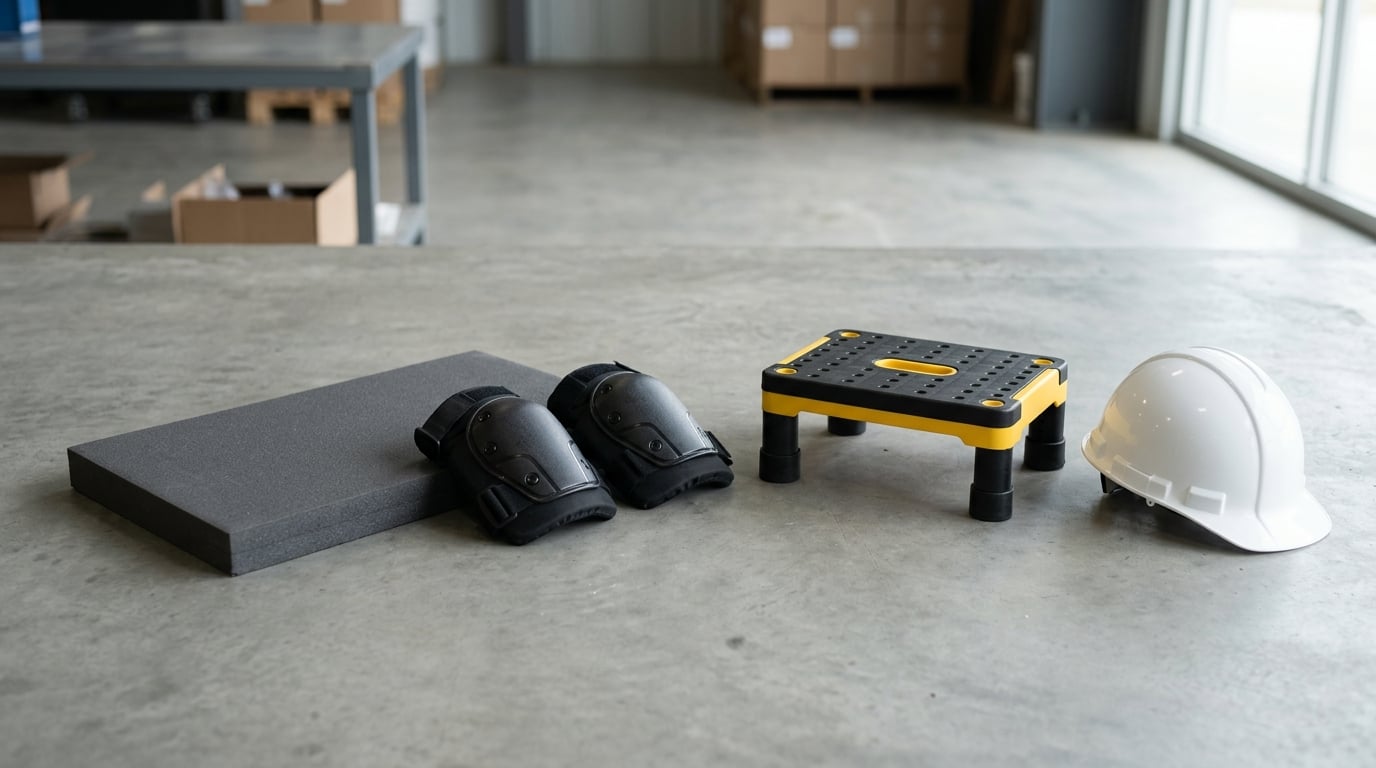
Knee pain from kneeling at work usually comes from one of two things: steady pressure on the front of the kneecap, or the load the joint carries when you bend it deeply. Hours on hard surfaces inflames the tissue in front of the knee, while repeated deep bending, twisting, and getting up and down wears on the structures inside the joint. Neither has to be dramatic to be worth changing.
Educational note: this is general workplace health information, not medical advice. It cannot tell you what is happening in your knee. A qualified clinician or occupational health professional has to do that.
Most people who land on this page are not looking for a diagnosis. They want to know whether the ache they get after a shift is normal, whether they should say something at work, and what they can actually change on a job where kneeling is not optional. Those are reasonable questions, and most of them have practical answers.
Table of Contents
- Why Kneeling at Work Can Hurt Your Knees
- Common Causes of Knee Pain at Work
- Jobs and Tasks That Put the Most Pressure on Knees
- How Risk Depends on Time, Posture, and Load
- How to Reduce Knee Pain from Kneeling at Work
- Choosing a Knee Pad or Alternative Work Position
- A Practical Prevention Checklist for Employers and Workers
- When Knee Pain from Kneeling at Work Needs Attention
- Frequently Asked Questions
- What to Do First
Why Kneeling at Work Can Hurt Your Knees
Kneeling hurts in two separate places, and confusing them leads to the wrong fix. Pressure on the front of the joint and load inside the joint feel similar but behave very differently.
Pressure. A small cushion of tissue sits between your kneecap and whatever is underneath you. Put your body weight on it for hours at a time and it becomes irritated and swollen. The result tends to be a sore, puffy spot centred on the kneecap itself, sometimes with a visible lump and a dull ache that builds through the shift.
Load. Bending the knee far past a right angle pushes force into the cartilage, the meniscus, and the tendons around the kneecap. The pain from this kind shows up deeper, behind or around the joint, and it tends to be sharper. It is also the kind that lingers for days rather than hours.
Temporary discomfort settles with rest and disappears by the next morning. Pain that keeps returning, keeps swelling, or starts showing up at home after work is a different category and deserves attention.
Common Causes of Knee Pain at Work
Risk builds from a handful of ordinary workplace conditions rather than one dramatic injury.
- Kneeling for long stretches without a break. A cleaner’s knees and a tiler’s knees are both low to the ground for hours, and neither gets a real pause.
- Hard, uneven surfaces. Concrete, screed, gravel, bare subfloor, and workshop floors transmit pressure straight through a thin pad or nothing at all.
- Twisting while kneeling. Pivoting on a planted knee to reach behind you or sideways puts a rotational force through a joint that is not built to take it. This is the shape that most often leads to a meniscus-type problem.
- Getting up and down repeatedly. Each transition loads the knee far more than sitting or standing does. A hundred kneeling transitions in a shift is a hundred times the peak load.
- Carrying or supporting weight while kneeling. Holding a box, steadying a patient, or kneeling on a ladder with tools in your belt turns body weight into a much larger number.
- Restricted movement. Tight aisles, low crawl spaces, and vehicle interiors stop you finding a comfortable position, so you hold one shape for too long.
- No usable equipment. Padding exists but sits in a van, the wrong size is issued, or the work simply has no sensible kneeling position.
- An existing condition. Previous injury, arthritis, or a recent operation changes what the same job demands of the joint.
Jobs where these overlap are where work-related knee pain shows up most often. A worker dealing with all six at once has a very different risk profile from one dealing with two.
Jobs and Tasks That Put the Most Pressure on Knees
Trades get the attention, but they are not the only group affected. The pattern repeats wherever the work happens below waist height.
Flooring and carpet installation, tiling, and concrete finishing mean hours of kneeling on hard subfloors with frequent rises for every few metres laid. Plumbing, HVAC ductwork, and electrical rough-in put the worker in crawl spaces and under equipment where there is no choice of position at all. Roofing, shingling, and solar installation add slope, weather, and material handling to the same load.
Automotive repair and maintenance work underneath vehicles on hard floors, often with a creeper that concentrates the load in one spot. Mining and heavy equipment maintenance involve kneeling on rock and steel with limited rest and long distances to walk.
Then there is the work that rarely appears in trades lists. Commercial cleaners kneel to reach low areas and stair edges, sometimes for an entire shift. Childcare and early-years staff kneel on floors with children all day, on mats that are softer but never soft enough. Healthcare and nursing staff kneel or squat for dressings, wound care, and fall assist, and often do it while holding something heavy. Warehouse picking, gardening, landscaping, event setup, and vehicle detailing all involve repeated kneeling transitions rather than long static holds, which is a different stress pattern.
Risk in each case depends on how long the position is held, how awkward it is, what is being carried, and whether the worker can change position freely.
How Risk Depends on Time, Posture, and Load
The same eight hours of kneeling is not the same exposure for everyone. These are the variables that move the risk up or down.
| Factor | What increases risk | What lowers risk |
|---|---|---|
| Time kneeling | Long unbroken holds, more than an hour without changing position | Short bouts with a genuine posture change between them |
| Body position | Deep bend, weight fully on the kneecap, twisting on a planted knee | Shallower angle, weight distributed onto hands and shins, no pivoting |
| External load | Holding a patient, a box, a tool belt, or balancing on a ladder while kneeling | Hands free, materials placed within reach before kneeling |
| Transitions | Frequent kneeling-to-standing with nothing to push off | A stable handhold or platform to rise from, and fewer transitions |
| Surface | Bare concrete, screed, gravel, thin board | A proper pad or mat rated for the surface, plus a surface that is level and clear |
| Rest and rotation | Same kneeling task for the whole shift, no breaks | Rotation to standing or seated tasks, planned posture breaks |
None of these works identically for every person. Age, previous injury, body weight, and general conditioning all shift how much a given posture costs, which is why two people on the same task can have very different experiences. It is also why workplace redesign usually beats asking people to tolerate discomfort longer.
How to Reduce Knee Pain from Kneeling at Work
Reducing kneeling minutes does more than any pad. Padding handles surface pressure; only changing the job handles the load inside the joint.
What actually reduces knee pain from kneeling at work
Start by finding out how much of the shift is kneeling that does not need to be. A surprising share of it is often habit, layout, or a tool that is stored in the wrong place. Materials and tools moved to waist height before the task starts remove more knee minutes than anything else you can change.
Use mobile or elevated work platforms so the work happens at standing height. A lift, a stair, a rolling scaffold, or a low platform with steps turns a two-hour kneel into a two-hour stand. For low work that genuinely requires kneeling, put a stable platform beside the task and work from it part of the time.
Rotate kneeling tasks with standing or seated ones rather than alternating within a single task. Change position before you are stiff, not after. And avoid twisting under load: move your feet to turn instead of pivoting on a planted knee.
What improvement looks like: the pain no longer builds through the shift, the next morning is uneventful, and the ache stops following you home. That is a workable outcome, and it usually arrives before any change feels dramatic. Workplace adjustments also have limits. If the task genuinely requires long kneeling and the surface is fixed, adjustment means managing exposure and protecting the joint rather than eliminating the position.
Choosing a Knee Pad or Alternative Work Position
Padded protection is worth having when kneeling cannot be avoided. It is worth choosing carefully, and it is not a substitute for changing the task.
Look at five things. Support matters most on hard surfaces: a soft foam pad suits a smooth indoor floor, while a harder cap or articulated design suits rubble, gravel, and rebar. Fit matters more than most buyers expect, since a pad that slides or rotates puts the load somewhere you did not plan for. Mobility decides whether you can actually get up and down with it on; a stiff pad on a frequent-transition job is worse than a thinner one. Surface conditions decide the material, since grit and swarf will destroy a soft pad in a day. Cleaning decides whether you will actually keep using it, and dirty equipment gets abandoned quickly.
Alternative positions are often the better answer: a rolling stool where the work is at a bench, a creeper seat for under-vehicle work, a kneeling board with raised supports for gardening, a stable step platform for painting or wiring. Each removes pressure from the kneecap rather than cushioning it.
Where a pad does not solve the problem: pain that is deep rather than on the kneecap, pain that arrives with swelling inside the joint, symptoms that show up even on days you are not kneeling, or pain that keeps returning no matter what you wear. Those need an assessment, not a different piece of gear.
A Practical Prevention Checklist for Employers and Workers
Useful prevention happens at two levels, and both need to be in place.
- Assess the task. Look at what genuinely requires kneeling, for how long, on what surface, and with what load. Note the tasks that look kneeling but could be done differently.
- Provide the right equipment. Pads or mats suited to the surface, plus platforms, creepers, stools, or lifts for tasks that can be raised. Equipment that is stored out of reach does not exist.
- Ask the people doing the work. Workers know which tasks hurt and which positions are impossible. That information is faster and more accurate than an inspection.
- Train on technique and task change. How to distribute weight, how to reposition feet instead of twisting, and when to stop. Training supports the controls; it does not replace them.
- Maintain the work area. Clear routes, stable footing, no stray debris, and equipment that still works. A platform with a missing step is a hazard, not a control.
- Rotate tasks and schedule posture changes. Short, frequent position changes beat a long stretch followed by collapse.
- Report early. Workers should report knee pain as soon as it appears rather than at the point they cannot work. Early reporting is what makes a reasonable adjustment possible.
- Have a route to occupational health support. A known contact, a referral process, and a documented return-to-work or modified-duty discussion matter more than a policy nobody can name.
Reading that list from the other side is useful too. If you are the worker, the practical move is to raise the specific task, not a general complaint. “This stretch of flooring means three hours of kneeling without a break” is a conversation. “My knees hurt” often gets a sympathetic nod and no change.
When Knee Pain from Kneeling at Work Needs Attention
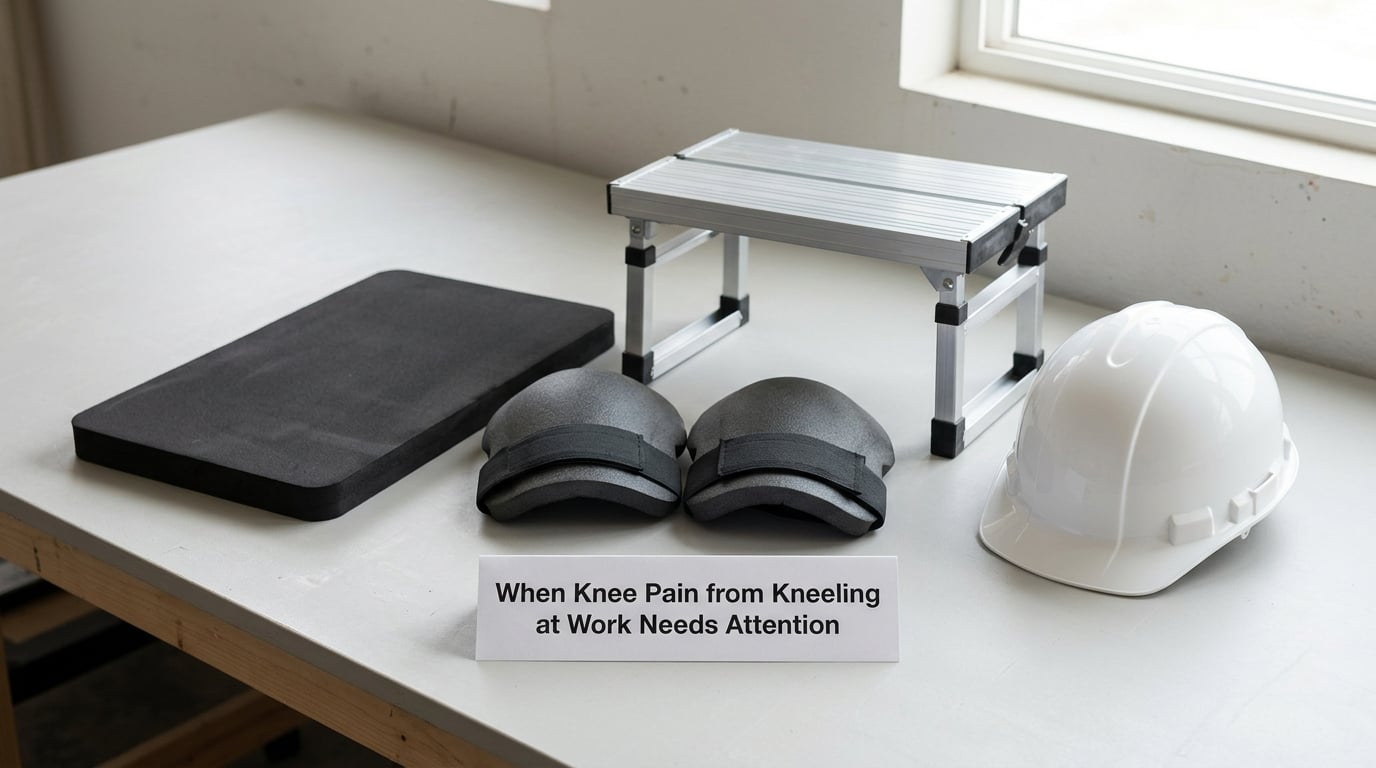
Stop the task and get assessed by a qualified healthcare or occupational health professional if any of the following show up. This article cannot tell you the cause, and it cannot tell you whether a symptom is serious.
- Severe pain following a specific incident, such as a knee giving way while kneeling or a fall onto a hard surface.
- Rapid swelling within hours of the injury, or a knee that is visibly larger than the other one.
- Inability to bear weight, or a knee that will not straighten fully.
- Locking, catching, or giving way during movement, which can indicate a problem inside the joint.
- Visible deformity following an injury.
- Numbness, tingling, or a foot that feels cold, which needs prompt attention.
- A hot, red, very tender area with fever or feeling unwell, which can indicate an infection and needs same-day medical attention.
None of those need a threshold. Some warning signs appear within minutes of an injury and some build over a week, so the timeline matters less than the symptom itself.
For everything below that severity, the sensible step is still a professional assessment rather than a longer tolerance test. Work-related knee pain that keeps recurring, that wakes you at night, or that is limiting what you can do on the job deserves to be looked at while it is still treatable by simple changes.
Frequently Asked Questions
Is knee pain from kneeling at work normal?
Some discomfort after a long shift on hard surfaces is common, especially if you are new to the job. Pain that builds during the shift, keeps swelling, or is still there the next morning is not something to put up with. Recurring pain means the exposure is too high for you, and it is worth changing the task or getting an assessment.
How long should workers be allowed to kneel during a shift?
There is no single safe number of minutes that applies to everyone. What matters is whether the kneeling is broken up, whether the surface is padded, and whether the worker can change position freely. In practice, frequent short kneeling bouts with posture changes are far better than one long block, and rotation to standing tasks is the control that works best.
Do knee pads prevent long-term knee problems?
A well-fitted pad reduces pressure on the front of the kneecap and helps with the soreness most workers describe. It does not reduce the load inside the joint from deep bending, twisting, and getting up and down. Pads are one layer of protection, and they work best alongside fewer kneeling minutes and safer working positions.
Can I kneel at work if I already have knee pain?
Working through existing knee pain can make an underlying problem worse, and pushing through recurring pain usually prolongs it rather than shortening it. Ask for an assessment of the task and an ergonomic review, and get a clinician’s view on what you can safely do. Some tasks can be modified or avoided; a restriction on kneeling is a medical question, not a judgement call.
What should an employer do when an employee reports knee pain?
The response should start with the task, not the person. Document the report, look at how much kneeling the role actually requires, and check that suitable pads, mats, and platforms are available and used. Early reporting is what allows a task change or modified duty to work. Where pain persists, a referral to occupational health or a clinician is the appropriate next step.
What to Do First
Stop or modify the task that is causing the pain, rather than trying to work through it. Raise the specific task with your supervisor or an occupational health professional and ask for it to be looked at, since a request naming the task usually gets a real answer.
Then take stock of what is available to you: surfaces, pads, platforms, and a way to rotate out of kneeling. If the pain is recurring, still there the next morning, or accompanied by any of the warning signs above, book an appointment with a qualified healthcare professional. 2026 is a good year to get the task changed rather than another one to get through.